Sun in Cancer: the architecture of belonging
Water · Cancer
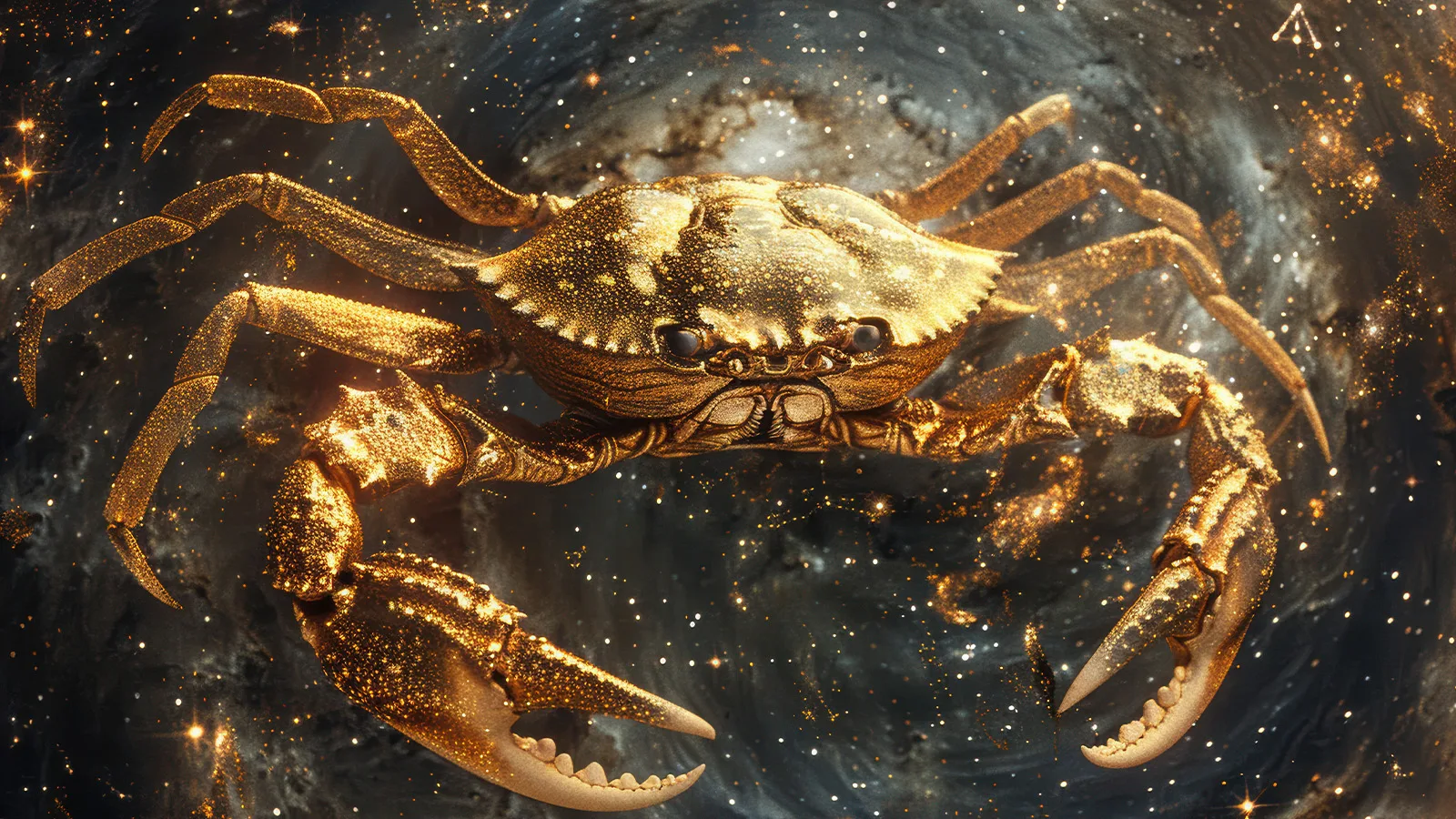
The Sun enters the tropical sign of Cancer each year at the June solstice — the longest day in the northern hemisphere, the moment when the Sun reaches its maximum declination north of the celestial equator and, for one still point, appears to stop before turning back. The word "solstice" comes from the Latin sol stitium: the Sun stands still. In astronomy, this is a measurable event — a function of the Earth's axial tilt. In the astrological tradition, it became the threshold of the zodiac's most interior sign: the point where the light is fullest and the inward turn begins.
That astronomical fact matters more than it might seem. Cancer begins at the moment of maximum external brightness, and yet the tradition has consistently associated it with interiority — with home, with memory, with the private architecture of emotional life. The paradox is not accidental. It is the symbolic insight at the core of the sign: that what is most deeply internal often emerges precisely when the external world is at its most expansive.
As with all tropical zodiac signs, the Sun is not within the astronomical constellation of Cancer during these weeks. Due to the precession of the equinoxes — the slow gyration of the Earth's axis over roughly 25,800 years — the tropical signs have drifted approximately twenty-four degrees from the constellations whose names they share. The constellation of Cancer is among the faintest in the zodiacal belt, containing no first-magnitude stars — a quiet patch of sky for so emotionally resonant a sign. Western astrology since Ptolemy has worked with the tropical zodiac, anchored to the solstices and equinoxes rather than to fixed stars, and that is the system Astrian uses by default. Those working in the sidereal frame should expect the corresponding shift.
What follows is a reading of Sun in Cancer within tropical astrology: what the symbol has carried through the tradition, what modern psychological astrology has made of it, and what someone with this placement might usefully ask themselves.
What the Sun represents
Before the sign comes the planet. The Sun in a natal chart is not "who you are" in any fixed sense. It is — across the major schools of modern astrology, from Dane Rudhyar's humanistic framework to Liz Greene's Jungian synthesis to the contemporary Hellenistic revival — the principle of conscious orientation, the central axis of selfhood around which the rest of the psyche organizes. It signifies vitality, purpose, the inner drive toward becoming what one is meant to become.
Robert Hand described it as the symbol of "the self one is growing into." Howard Sasportas called it the fuel of the personality — not the personality itself, but the energy that sustains its development. These formulations resist the popular habit of collapsing the Sun into a static trait. The Sun is a process: the ongoing work of making oneself coherent, visible, present in one's own life.
This matters for Cancer because the popular reduction of this placement — nurturing, emotional, clingy — obscures the real question. The Sun in Cancer is not "you are sensitive." It is closer to: what are you building inward, and who do you allow inside the structure?
The symbolism of Cancer
Cancer is the fourth of the twelve zodiacal signs. In the system of elements and modalities, it is cardinal water: the initiating expression of the water principle, before water becomes sustained emotional intensity (Scorpio) or dissolving empathy (Pisces).
Cardinality, in this system, refers to initiation. The four cardinal signs — Aries, Cancer, Libra, Capricorn — mark the equinoxes and solstices, the turning points of the solar year. Each one begins something. What Cancer begins is interior: a season of feeling, of memory, of the construction of emotional foundations. If Aries initiates action and Libra initiates relationship, Cancer initiates belonging — the act of creating a space where one is known.
Water, as an astrological element, does not signify emotion in any simplistic sense. It is the principle of receptivity — the capacity to be affected, to absorb, to feel the contours of experience from within rather than observing them from without. Cardinal water is therefore the most active form of emotional life: not the passive receipt of feeling, but the deliberate creation of emotional structures. Cancer does not simply feel; it builds with feeling. It constructs homes, families, bonds, traditions — the architecture that holds human life together.
The ruling body of Cancer is the Moon — the only sign in the zodiac ruled by a luminary rather than a planet. The Moon in astrological tradition governs the emotional body, the instinctual responses, memory, the rhythms of the inner life. It is associated with the mother, with nourishment, with the cyclical nature of feeling — the way emotions wax and wane like the lunar phases themselves. In Cancer, the Moon is in its domicile: the sign where its nature is most fully and directly expressed.
This makes Cancer unique in the zodiacal system. Most signs are ruled by planets that also rule another sign — Mars rules both Aries and Scorpio (in the traditional system), Venus rules both Taurus and Libra. The Moon rules only Cancer, and Cancer is ruled only by the Moon. The correspondence is singular, intimate, undivided.
The opposite sign, Capricorn, is the necessary complement. Where Cancer builds inward — toward home, family, emotional security — Capricorn builds outward: toward public structure, achievement, legacy in the world. Where Cancer asks "do I belong?", Capricorn asks "what have I built that will endure?" Every Sun in Cancer placement is in structural dialogue with the Capricorn principle of external achievement and responsibility — even when the Cancerian instinct would prefer to remain in the shelter of what is already known.
Sun in Cancer: the symbolism in practice
To have the Sun in Cancer — to be born during the four weeks following the June solstice — is to have one's principle of conscious orientation expressed through the symbolism of cardinal water ruled by the Moon. This is a placement of singular correspondence: the Sun's drive toward selfhood finds in Cancer an environment that routes everything through feeling, through the body's memory, through the question of what constitutes home.
The historical reading is ancient. Vettius Valens, in the second century, associated Cancer with domesticity, changeability of mood, and a capacity for nurture. He noted the sign's connection to water and to travel — a detail often forgotten in modern readings, but consistent with the cardinal impulse: Cancer does not merely stay home; it makes home, sometimes in new places, sometimes repeatedly. William Lilly, in Christian Astrology (1647), described the Cancer type as "a changeable creature, loving peace, yet quick to take offence if domestic matters are disturbed" — a reading that captures the sign's sensitivity to violation of its inner space.
Modern psychological astrology has deepened this considerably. Liz Greene, whose Jungian approach reshaped the field, framed Cancer as the symbol of the personal unconscious — the layer of the psyche where early experience, family conditioning, and emotional memory are stored. The Cancerian question, in her reading, is not about domesticity in any conventional sense. It is about the relationship between present identity and the past that shaped it — about what we carry from childhood, what we inherit from family, and what we must eventually differentiate from in order to become ourselves.
Howard Sasportas, in The Inner Planets, wrote of Cancer as "the sign that builds the container" — the psychological structure that makes it possible to have an inner life at all. Without the Cancerian function, there is no safe space in which to feel, to remember, to be vulnerable. The shadow side — and there is one — is that the container can become a prison, the refuge a refusal.
Stephen Arroyo, working with the elements, placed the water signs in the domain of Jung's "feeling function" — the mode of consciousness that evaluates experience through emotional resonance rather than logic. Cancer, as the cardinal expression of water, carries this function in its most active, constructive form: the feeling that does not merely react but builds.
The shadow side
Every placement has a shadow, and Cancer's shadow is particularly worth naming because it is so often sentimentalized.
The first is protection that becomes control. The cardinal-water instinct to create safe space can become the insistence that others remain within that space on the creator's terms. Greene wrote perceptively of the Cancerian shadow as "the mother who cannot let go" — not necessarily a literal mother, but the psychic pattern of defining one's identity through being needed. When the instinct to nurture becomes the need to be indispensable, the gift curdles.
The second is the past as refuge from the present. Cancer's connection to memory and to the emotional body of childhood can become a retreat — the person who lives more fully in what was than in what is. Nostalgia, in its shadow form, is not love of the past but fear of the present. The Capricorn opposite, with its insistence on current structure and future achievement, carries the corrective: that memory is raw material, not destination.
The third, more subtle, is vulnerability performed rather than felt. Because Cancer is associated with sensitivity, there exists a version of the placement that has learned to display emotion as a way of managing social situations — the tears that serve as negotiation, the wounded retreat that is actually a power move. This is not unique to Cancer, but the sign's facility with emotional language makes it a particular temptation. The deeper Cancer work involves distinguishing between feeling as instrument and feeling as truth.
None of this is destiny. It is the shadow vocabulary of the symbol — the territory that comes with the gift, not its inevitable expression.
The ruling body: the Moon
Because the Moon rules Cancer, the position and condition of the Moon in the natal chart shapes the Sun in Cancer more intimately than perhaps any other ruler-sign relationship. Two people born in the same week of July with Sun in Cancer can have wildly different Moons — one in detached Aquarius, the other in intense Scorpio — and the resulting emotional landscapes will be profoundly different.
The Moon moves faster than any other body used in natal astrology — roughly twelve to thirteen degrees per day, passing through a sign in approximately two and a half days. This means that even among people born on the same day with Sun in Cancer, the Moon may be in different signs, producing sharply different emotional textures beneath the same solar placement.
Reading Sun in Cancer without examining the natal Moon is particularly incomplete. The Sun tells you what the person is building toward; the Moon tells you how they feel while building it — what comforts them, what frightens them, what their instinctual response to stress looks like beneath the surface of conscious intention.
The three decans
The thirty degrees of Cancer are divided into three decans following the Chaldean order:
The first decan (0°–10° Cancer), ruled by Venus, brings a gentler, more aesthetically oriented quality to the cardinal-water sign. People born here, roughly between June 20 and July 1, often combine Cancer's emotional depth with a Venusian sensitivity to beauty, comfort, and relational harmony. The nurturing instinct is expressed through creating environments that are not only safe but beautiful.
The second decan (10°–20° Cancer), ruled by Mercury, introduces a more communicative, intellectually curious quality. The pure emotional receptivity of Cancer gains a narrative dimension — the person who not only feels deeply but needs to articulate what they feel, to find language for the inner life. There is a Virgoan attentiveness to detail here that can make this decan particularly skilled at understanding the emotional mechanics of others.
The third decan (20°–30° Cancer), ruled by the Moon itself, is the most concentrated expression of the sign — the double lunar emphasis producing a heightened sensitivity, a deep connection to the rhythms of the inner life, and a powerful memory that retains emotional experience with unusual fidelity. This subdivision sits at the threshold of Leo, and there is often an emerging quality of self-expression — the private emotional world beginning to seek a form in which it can be shown.
These decanic distinctions are ancient and not universally used in modern practice, but they offer a useful refinement when a chart places the Sun clearly within one decan.
What the placement asks
If astrology in the modern psychological tradition is a tool for self-examination rather than prediction, then Sun in Cancer can be approached as a set of open questions:
- What are you protecting — and is the thing you are protecting still alive, or has it become a memory you are guarding out of loyalty rather than love?
- Where does your sense of home live — in a place, in a person, in a pattern of feeling — and what would happen if that anchor shifted?
- What did you inherit emotionally from your family of origin, and how much of that inheritance serves who you are now versus who you were expected to be?
- Where, in the structure of your relationships, have you confused being needed with being loved?
- And — drawing on the Capricorn opposite — where are you avoiding the public, structured, external work because the private, interior world feels safer?
These questions are not answered by the placement. They are opened by it. That distinction is, as always, the point.
The Sun in Cancer through life
The Sun in Cancer at fifteen is not the Sun in Cancer at fifty. Modern astrology, particularly in the developmental work of Liz Greene and Howard Sasportas, has attended to the way placements unfold through the stages of life.
In youth, the symbol tends to express through intense attachment — to family, to home, to the emotional atmosphere of early life. The young Cancer Sun often has a heightened awareness of mood, an instinctive capacity to read the emotional state of a room, and a need for security that may express as shyness, as fierce protectiveness over a small circle, or as a rich and elaborate inner world that remains largely private.
By midlife, if the work of integration has progressed, the Cancer Sun tends to develop into something more like emotional intelligence in action: the capacity not only to feel deeply but to use that feeling constructively — to build families, communities, organizations, or creative works that provide the sense of belonging the person once needed to receive. The container-building impulse matures from self-protection into generosity.
In later life, Sun in Cancer can take on the quality of the elder who remembers — the keeper of family history, the one who holds the emotional continuity of a lineage or a community. The sensitivity of youth, which may have felt like a burden, becomes a gift: the ability to hold space for others' feeling because one has spent a lifetime navigating one's own.
This is an idealized arc. In practice, some Cancer Suns remain at fifty in the same defensive posture they held at fifteen — guarding a wound rather than building from it. The placement is potential, not destiny.
The relationship with the rest of the chart
The note Astrian insists on: your Sun sign is one factor among many. The Moon — which is not only the ruler of Cancer but the most emotionally significant body in any chart — may be in detached Aquarius or fiery Aries, producing an emotional texture that complicates the Cancerian sensitivity in ways no Sun-sign description can capture. The Ascendant shapes how you meet the world; a Cancer Sun with a Capricorn Ascendant — the axis of home and career running directly through the personality — operates very differently from a Cancer Sun with a Gemini Ascendant.
The houses occupied by the Sun and the Moon matter enormously. The Sun in Cancer in the first house, centered on personal identity, is a different expression from the Sun in Cancer in the seventh house, where the nurturing instinct orients itself toward partnership.
Astrian's calculator exists to make this larger picture accessible. If this article has opened a question about what your Cancer Sun means, the next step is to look at the rest of the chart — and to notice how the cardinal-water impulse meets, and is shaped by, everything else you carry.
Frequently asked
Is Sun in Cancer the same as "being a Cancer"? In everyday speech, yes. In astrological practice, the term refers to a person whose Sun is in Cancer at birth. But many traditions consider the Ascendant a more personally defining marker. A Cancer Sun with a Sagittarius Ascendant will present quite differently from a Cancer Sun with a Cancer Ascendant — the first outwardly expansive and philosophical, the second more visibly sensitive and private.
Does Sun in Cancer make someone overly emotional? This is the most common reduction of the sign, and it deserves careful resistance. Cancer is a water sign ruled by the Moon, which means it carries the symbolism of emotional receptivity and cyclical feeling. Whether that receptivity becomes "overly emotional" depends on how it is integrated with the rest of the chart and on the person's own psychological work. Many Cancer Suns are not visibly emotional at all — the cardinal quality gives them a shell, a protective structure that may make them appear composed or even reserved. The depth of feeling runs beneath, not always on the surface.
Are Cancer and Capricorn incompatible? The opposite-sign pairs represent complementarity. Cancer and Capricorn share an axis concerned with security and structure — how to build a foundation (Cancer from the inside, through belonging; Capricorn from the outside, through achievement). In relationships, this axis can produce a remarkably productive dynamic when each partner values what the other builds. The difficulty arises when one side dismisses the other's domain — when the emotional is dismissed as soft, or the structural as cold.
Why is Cancer associated with the mother? Because the Moon, Cancer's ruler, has been associated in nearly every astrological tradition with the maternal principle — nourishment, protection, the body's earliest experience of being held. This does not mean every Cancer Sun has a close relationship with their mother, nor that they are maternal in a conventional sense. It means the theme of early nurture, of what was received or not received in the first years of life, tends to be a central preoccupation for this placement — a question to be worked with, not a fate to be accepted.
Is Sun in Cancer good or bad? Astrian's editorial position: no placement is inherently good or bad. Every position in the chart carries qualities — patterns of emotional intelligence, recurring questions about belonging and protection, areas of strength and vulnerability. What matters is what the person does with those qualities, and how the rest of the chart modifies them.
Continue reading
- Sun in Gemini: the problem of one mind — the sign that precedes Cancer in the zodiacal sequence
- Sun in Leo: the question of visibility — the sign that follows Cancer
- The Moon in the natal chart: a guide — the ruling body of Cancer and how to read it
- Reading the ascendant: a primer — on the rising sign and why it matters
This article belongs to Astrian's library on planets in signs. It draws on tropical astrological tradition from Hellenistic sources (Vettius Valens, Claudius Ptolemy) through the medieval period (William Lilly, Bonatti) into modern psychological astrology (Dane Rudhyar, Liz Greene, Stephen Arroyo, Howard Sasportas, Robert Hand). Astrological positions are calculated from public ephemerides published by NASA's Jet Propulsion Laboratory.
Last updated: 4 May 2026.
Continue reading
Newsletter
A short reading once a month, in your inbox.
A note on the symbolism of the season, recent editorial pieces, and what to look for in next month's sky. No predictions.
Support this project
Independent, no venture funding, no ads. A contribution keeps Astrian precise and free.
Support on Ko-fi (opens in new tab)