Sun in Leo: the question of visibility
Fire · Leo
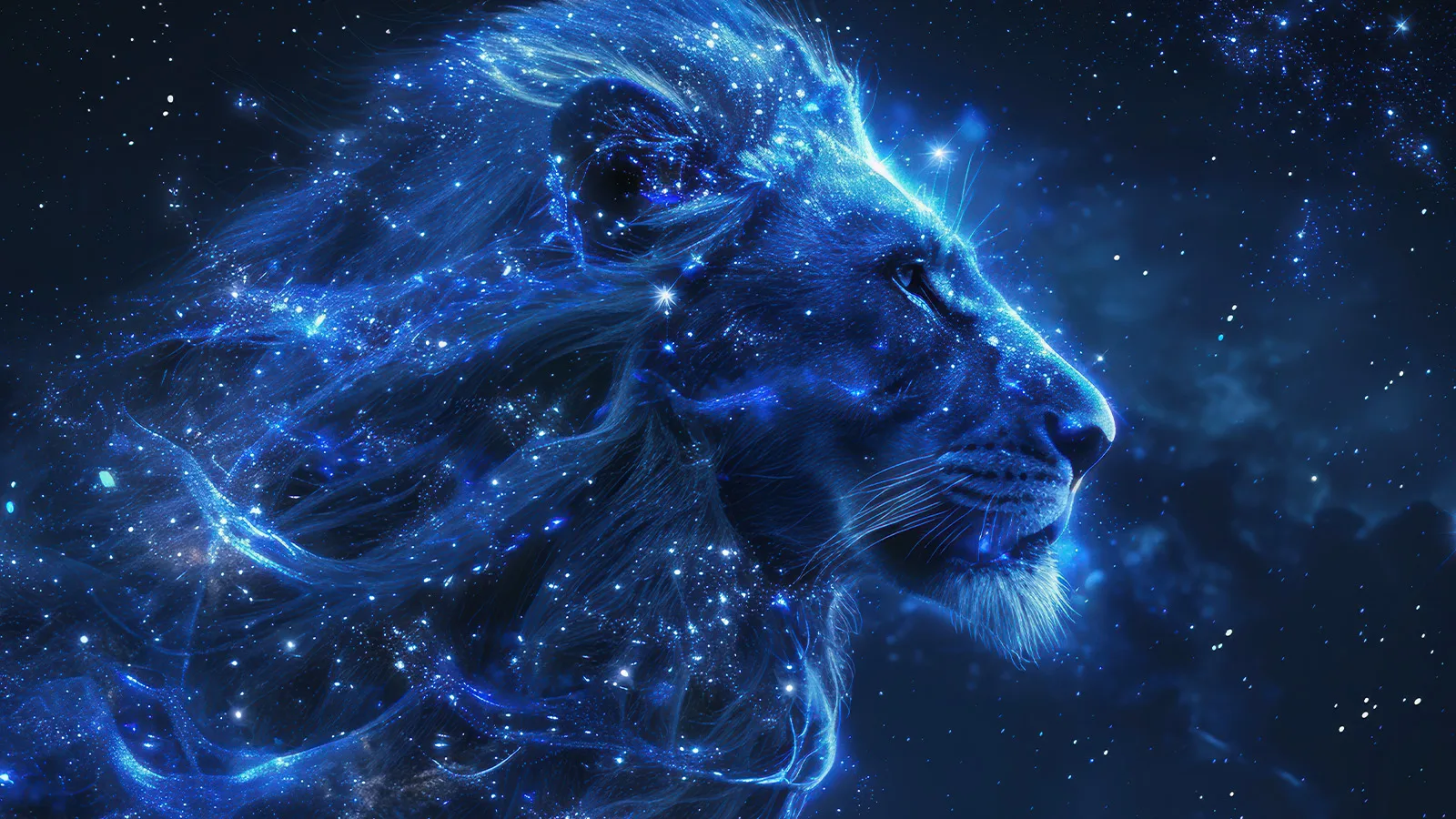
What does it cost to be seen?
Not noticed — noticed is easy, and often accidental. Seen: recognized in the particular, specific sense of what one is, not merely that one exists. The fifth sign of the zodiac is built around this question, and the popular reading — dramatic, confident, attention-seeking — barely scratches its surface. Leo is not about wanting applause. It is about the problem of making the interior visible — of taking something that lives inside and giving it a form that others can witness.
This is harder than it sounds, and riskier. To be visible is to be available for judgment. To express oneself fully is to discover that expression never quite matches the thing being expressed. The gap between the inner fire and the outer performance is Leo's central territory, and the sign's entire symbolic life unfolds within it.
What follows is a reading of Sun in Leo within tropical astrology: what the tradition has made of the symbol, what modern psychological approaches have contributed, and what someone with this placement might find worth holding as an open question.
The tradition responds: the symbolism of Leo
Leo is fixed fire: the sustained, concentrated expression of the fire principle. Where Aries (cardinal fire) initiates the spark and Sagittarius (mutable fire) carries it toward meaning, Leo maintains the flame. It holds the fire steady. It is the hearth, the stage, the sustained creative act that requires not just ignition but commitment.
The fixed modality refers to concentration and sustenance. The four fixed signs — Taurus, Leo, Scorpio, Aquarius — fall at the midpoint of each season, the weeks when the season is most fully itself. In the northern hemisphere, Leo season is the height of summer — the period when the heat is no longer arriving but present, established, inescapable. The fixed quality gives Leo its reputation for steadiness and, in shadow, for stubbornness: the fire that will not go out, even when going out might be the wiser choice.
Fire, as an astrological element, signifies the principle of spirit — visibility, will, the impulse to express. Fixed fire is therefore the most sustained form of creative self-expression: not the flash of inspiration (Aries) or the quest for meaning (Sagittarius), but the ongoing act of making oneself manifest in the world.
The ruling body of Leo is the Sun — making Leo the only sign in the zodiac ruled by the same body whose natal position is being described. This creates a unique recursive quality: to read Sun in Leo is to read the Sun in its own domicile, the place where its nature is least modified by any external influence. The Sun's fundamental signification — conscious identity, vitality, the drive toward selfhood — operates in Leo without the mediation or coloring that other signs impose.
This is both the placement's gift and its complication. When the Sun is at home, the question of identity is not filtered through anything else. It is direct. What you see is what the person is trying to become — and the distance between the trying and the becoming is where the work lives.
The opposite sign, Aquarius, is the structural counterpoint. Where Leo is concerned with individual expression — my creativity, my identity, my visibility — Aquarius is concerned with the collective: the group, the system, the idea that transcends any single person. Where Leo asks "who am I?", Aquarius asks "what are we?" Every Sun in Leo placement exists in dialogue with this Aquarian principle — the recognition that individual brilliance only finds its full meaning in relation to something larger than itself.
Astronomy and position in the zodiac
The Sun moves into the tropical sign of Leo each year around July 22–23, one month after the summer solstice. In the northern hemisphere, these are the hottest weeks — the accumulated heat of summer reaching its peak. The days are still long, though they have begun to shorten imperceptibly. The season is not building; it has arrived. Leo occupies the symbolic center of summer: the moment of maximum presence.
As with all tropical signs, the Sun is not within the astronomical constellation of Leo during this period. The precession of the equinoxes has shifted the tropical zodiac roughly twenty-four degrees from the constellations. The astronomical constellation of Leo, however, does contain one of the zodiac's most prominent stars: Regulus, "the little king," a blue-white star at the heart of the Lion, one of the four ancient Royal Stars of Persia. In traditional astrology, Regulus was associated with kingship, glory, and the possibility of a fall from greatness — a symbolism that maps suggestively onto Leo's themes of visibility and its dangers.
Western astrology from Ptolemy onward works with the tropical zodiac anchored to the seasons. Astrian follows this convention. Those working in the sidereal tradition should expect the corresponding shift of approximately twenty-four degrees.
Sun in Leo
To have the Sun in Leo is to have one's principle of conscious orientation expressed through the symbolism of fixed fire — and to have that principle ruled by itself. There is no intermediary. The Sun's drive toward coherent selfhood finds in Leo an environment that says, essentially: be what you are, fully, and let it be witnessed.
This sounds like permission, and in some sense it is. But it is also a demand. The Sun in Leo does not allow the person to hide — or rather, when a Leo Sun hides, the hiding itself becomes a central problem, a source of frustration or depression that is often difficult for the person to name. The Sun wants to shine. In Leo, the wanting is unmediated. The question is not whether to express but how — and whether the expression serves the self or merely performs it.
The historical reading is characteristically generous. Vettius Valens, in the second century, associated Leo with magnificence, authority, and a noble bearing. William Lilly described the Leo type as "of a great spirit, desirous of rule, magnanimous" — and added, with his usual candor, "scorning to do a base thing." The traditional literature consistently reads Leo as the sign of kings and creators, with the caveat that kingship without humility becomes tyranny.
Modern psychological astrology has deepened this. Liz Greene, in The Astrology of Fate, framed Leo as the sign that carries the hero myth — the journey of the individual who must discover their unique gift, offer it to the world, and face the consequences of that offering. The Leonine question, in her Jungian reading, is not "am I special?" (the narcissistic reduction) but rather: "what is mine to give, and do I have the courage to give it even if it is rejected?"
Howard Sasportas wrote of Leo as "the sign that creates itself" — the part of the psyche that does not merely inherit an identity but constructs one through acts of self-expression, whether artistic, personal, or vocational. The fire of Leo is creative in the deepest sense: it brings into existence something that was not there before.
Stephen Arroyo, attentive as always to the elements, described the fire signs as expressions of the "intuitive function" in Jung's typology — the mode of consciousness that perceives through vision and possibility rather than through fact or feeling. Leo, as the fixed expression of fire, carries this function in its most sustained form: the creative vision that persists, that demands realization, that will not be satisfied with mere potential.
The question the placement opens is not "why do you need attention?" It is closer to: what in you is asking to be made visible, and what are you afraid will happen if it is?
The shadow side
Leo's shadow is culturally well-known — so much so that naming it risks redundancy. But the deeper layers are less often discussed and more worth exploring.
The first, and most visible, is performance substituting for presence. The fixed-fire drive toward self-expression can become a habit of performing an identity rather than inhabiting one. The Leo Sun who has learned to be charming, commanding, or entertaining may discover, in a quiet moment, that the performance has become so practiced that they are no longer sure what lies beneath it. Greene wrote of the Leonine shadow as "the king who has forgotten that the crown is not the head" — the confusion of the symbol of identity with identity itself.
The second is the dependency on external validation. Because Leo's nature involves making the self visible, there is a structural temptation to measure the self's worth by the response it receives. When applause becomes the evidence that one exists, its absence feels like annihilation. The Aquarian opposite, with its capacity to value the idea over the individual, carries the correction: that some things worth creating will not be applauded, and the worth does not change.
The third, more subtle, is generosity as control. Leo is famously generous — the sign associated with warmth, largesse, the impulse to give. But the shadow form of generosity is the gift that creates obligation, the magnanimity that positions the giver at the center. The deeper Leo work involves learning to give without needing the giving to be witnessed, to be generous without requiring gratitude as proof of significance.
None of this is destiny. It is the shadow vocabulary of a sign that carries, alongside these temptations, a genuine and powerful capacity for creative self-realization.
The opposite sign: Aquarius
The Leo-Aquarius axis deserves particular attention because it defines the central developmental tension for the Leo Sun. Leo creates from the individual outward; Aquarius thinks from the collective inward. Leo asks what is uniquely mine; Aquarius asks what belongs to everyone.
For the Sun in Leo, the Aquarian challenge is the challenge of relevance beyond the personal. The creative impulse, the drive toward self-expression, the need to be seen — all of these find their deepest fulfillment not in isolation but in service to something larger. The Leo Sun who paints only for personal glory and the Leo Sun who paints to give others a way of seeing — both are expressing the same fire, but the second has integrated the Aquarian insight that individual expression gains meaning through its connection to the collective.
The integration does not require abandoning the personal. It requires holding the Aquarian question — what is this for, beyond me? — alongside the Leonine drive — this is mine to give — and allowing the tension between them to produce something neither could produce alone.
The Sun as its own ruler
This is the distinctive structural feature of Sun in Leo, and it deserves direct attention. In every other sign, the Sun's expression is shaped by a ruling planet that occupies its own position in the chart. Sun in Aries is colored by Mars; Sun in Taurus is colored by Venus; and so on. The ruling planet acts as a mediator, a lens through which the Sun's raw drive is focused and differentiated.
In Leo, there is no such mediator. The Sun rules itself. This produces a quality of directness — a sense that the person is, for better or worse, simply what they are. There is less complexity in the route from inner impulse to outer expression, which can read as confidence, as authenticity, or as a certain bluntness that other signs, with their planetary intermediaries, do not share.
The practical implication for chart reading is significant. Because there is no separate ruling planet to consult, the condition of the Sun itself — its house, its aspects, its relationship to other planets — carries more weight than usual. A Sun in Leo in the twelfth house, hidden from public view, is a very different creature from a Sun in Leo in the tenth house, oriented toward public achievement. The Sun's aspects to Saturn (which limits and structures), to Neptune (which dissolves and idealizes), to Pluto (which transforms and intensifies) become the primary modifiers of the placement, in the absence of an external ruler.
The three decans
The thirty degrees of Leo are divided into three decans following the Chaldean order:
The first decan (0°–10° Leo), ruled by Saturn, carries a more disciplined, austere quality than the Leo stereotype suggests. People born here, roughly between July 22 and August 1, often combine Leo's creative drive with a Saturnine seriousness about craft, structure, and legacy. The fire is no less intense, but it burns with more control — the artist who works slowly, the leader who earns authority through endurance.
The second decan (10°–20° Leo), ruled by Jupiter, introduces an expansive, generous, philosophical quality. The pure Leonine self-expression gains warmth and breadth — the person who is not only creative but magnanimous, who sees their own gifts as part of a larger pattern of meaning. There is a Sagittarian optimism here that can make this decan the most outwardly warm and socially generous expression of the sign.
The third decan (20°–30° Leo), ruled by Mars, carries a more combative, driven quality. The sustained creative fire meets the Martian impulse toward action and assertion — the Leo who does not merely create but insists on the creation, who fights for the vision. This subdivision sits at the threshold of Virgo, and there is often an emerging quality of precision and self-criticism — the creator who begins to subject their own work to rigorous analysis.
These decanic distinctions are ancient and not universally employed in modern practice, but they offer valuable texture when a chart places the Sun clearly within one decan.
The Sun in Leo through life
The Sun in Leo at eighteen is not the Sun in Leo at sixty. Modern astrology, particularly in the work of Liz Greene and Howard Sasportas, has attended to the developmental arc of placements across the lifespan.
In youth, the symbol often expresses through the need to be noticed — the young Leo Sun is frequently the performer, the class leader, the child who lights up when given an audience. This is not vanity; it is the fire testing its environment, discovering whether the world will allow it to burn. Some young Leo Suns are the opposite — withdrawn, shy, apparently un-Leonine — and in these cases the fire has often been suppressed by early environments that punished visibility. The developmental task is the same in both cases: learning that the fire is real and that it has a right to exist.
By midlife, if the work of integration has progressed, the Leo Sun tends to develop into something more like creative authority: the capacity not only to express oneself but to do so with the maturity that comes from having been tested, rejected, refined. The performer becomes the artist. The person who needed an audience discovers something worth showing that audience.
In later life, Sun in Leo can take on the quality of the mentor — the figure who, having found their own creative voice, helps others find theirs. The fire that once demanded center stage learns to illuminate from the side, to warm rather than to dazzle.
This is an idealized arc. In practice, some Leo Suns remain at sixty in the same hunger for validation they had at eighteen, having never discovered that the fire exists independently of the audience. The placement is potential, not destiny.
The relationship with the rest of the chart
The note Astrian insists on: your Sun sign is one factor in a chart that contains many. For Sun in Leo, this note carries particular weight because of the Sun's dual role as planet and ruler. The Sun's condition in the chart — its house, its aspects, its relationship to the Moon and to the other planets — is not supplementary information. It is the primary information.
The Moon, governing the emotional interior, may be in cool Capricorn or analytical Virgo, providing an emotional groundedness that the Leo Sun's fire alone does not suggest. The Ascendant shapes the first impression; a Leo Sun with a Scorpio Ascendant presents very differently from a Leo Sun with a Libra Ascendant — the first intense and private, the second socially graceful.
Because there is no external ruler to consult, the aspects the Sun makes to other planets become the main interpretive keys. A Leo Sun conjunct Saturn will express its creativity through discipline and may struggle with permission to shine. A Leo Sun trine Jupiter will express its fire with ease and generosity, sometimes without the friction needed to deepen the work. A Leo Sun square Pluto will experience the drive toward visibility as intertwined with power, transformation, and the risk of destruction.
Astrian's calculator exists to make this larger picture accessible. If this article has opened a question about what your Leo Sun means, the next step is to look at the rest — and to notice how the fixed-fire impulse meets, and is shaped by, everything else in the chart.
Frequently asked
Is Sun in Leo the same as "being a Leo"? In everyday speech, yes. In astrological practice, the term typically refers to a person whose Sun is in Leo at birth. But many traditions consider the Ascendant a more personally defining marker. A Leo Sun with a Pisces Ascendant will come across very differently from a Leo Sun with a Leo Ascendant — the first dreamy and receptive, the second immediately radiant.
Does Sun in Leo mean someone is narcissistic? This is a damaging reduction that confuses a symbol with a pathology. Leo carries the symbolism of self-expression and the need for visibility — qualities that exist on a spectrum, like all psychological traits. At one end, the Leo Sun drives genuine creative courage and generosity. At the other, it can express as self-centeredness. Whether it tends toward one pole or the other depends on the rest of the chart, the person's psychological development, and their life circumstances. Equating Leo with narcissism is like equating Cancer with codependency or Scorpio with manipulation — a flattening that helps no one.
Are Leo and Aquarius incompatible? The opposite-sign pairs represent complementarity. Leo and Aquarius share an axis concerned with individual expression and collective belonging — how to be oneself and how to be part of something larger. In relationships, this axis can produce a dynamic of remarkable creative and intellectual energy when both partners value what the other carries. The difficulty arises when the Leo partner dismisses the Aquarian's need for collective meaning, or when the Aquarian partner dismisses the Leo's need for personal recognition.
Why is Leo associated with creativity? Because the Sun, its ruler, is the traditional significator of the creative principle — the capacity to bring something new into existence from the center of one's being. In the system of houses, Leo is associated with the fifth house, the domain of creation, play, children, and artistic expression. This does not mean every Leo Sun is an artist in the professional sense; it means the impulse toward creation — the desire to make something that did not exist before — tends to be a central preoccupation.
Is Sun in Leo good or bad? Astrian's editorial position: no placement is inherently good or bad. Every position carries qualities — patterns of creative drive, recurring questions about visibility and authenticity, areas of strength and vulnerability. What matters is how the person engages with those qualities, and how the rest of the chart shapes them.
Continue reading
- Sun in Cancer: the architecture of belonging — the sign that precedes Leo in the zodiacal sequence
- Sun in Virgo: the discipline of attention — the sign that follows Leo
- The Sun in the natal chart: a guide — the ruling body of Leo and the center of every chart
- Reading the ascendant: a primer — on the rising sign and why it matters
This article belongs to Astrian's library on planets in signs. It draws on tropical astrological tradition from Hellenistic sources (Vettius Valens, Claudius Ptolemy) through the medieval period (William Lilly, Bonatti) into modern psychological astrology (Dane Rudhyar, Liz Greene, Stephen Arroyo, Howard Sasportas, Robert Hand). Astrological positions are calculated from public ephemerides published by NASA's Jet Propulsion Laboratory.
Last updated: 4 May 2026.
Continue reading
Newsletter
A short reading once a month, in your inbox.
A note on the symbolism of the season, recent editorial pieces, and what to look for in next month's sky. No predictions.
Support this project
Independent, no venture funding, no ads. A contribution keeps Astrian precise and free.
Support on Ko-fi (opens in new tab)