Sun in Libra: the weight of balance
Air · Libra
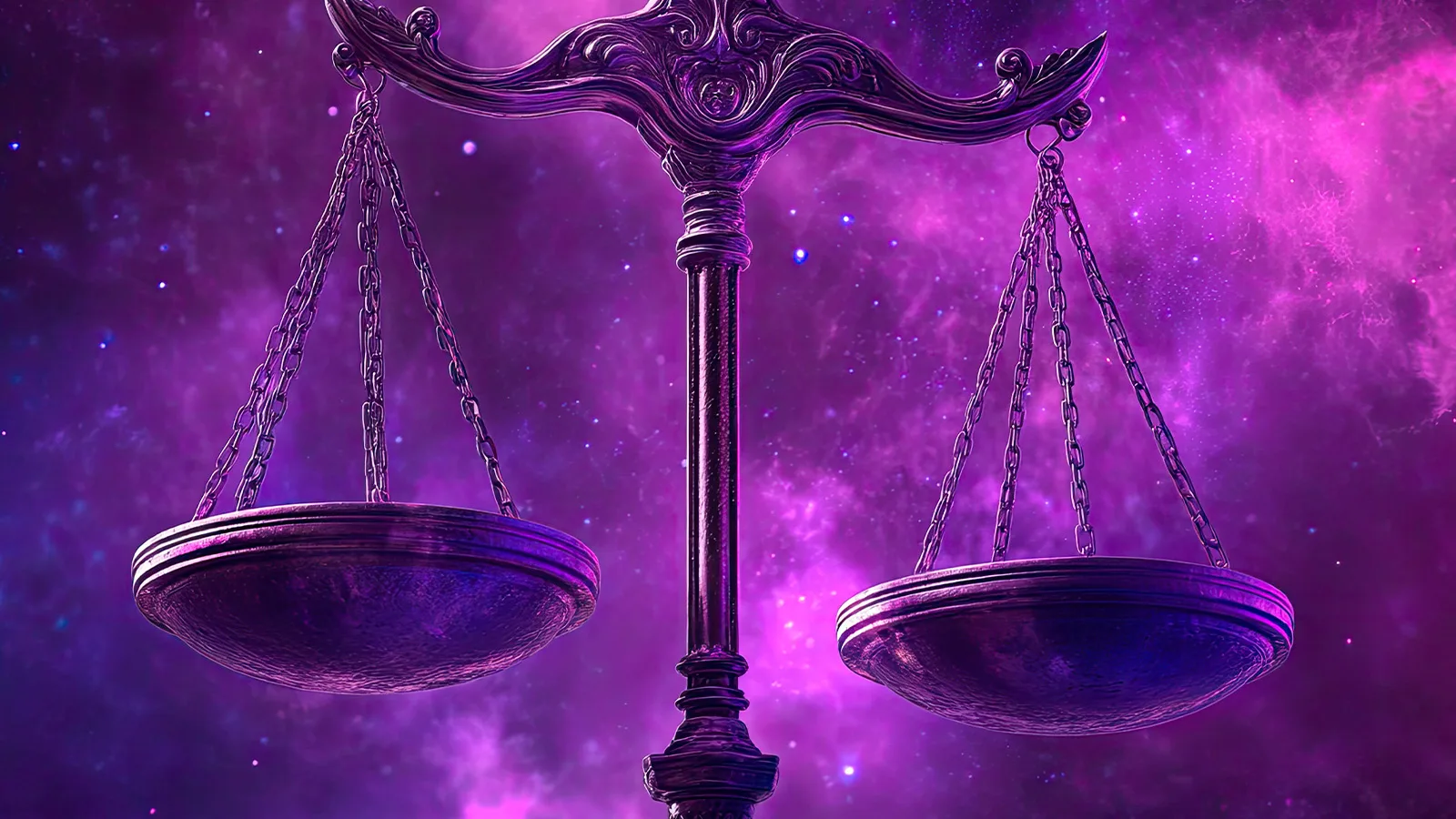
The Sun enters the tropical sign of Libra each year at the September equinox — the second of the two moments in the solar year when day and night stand equal in duration across the globe. In the northern hemisphere, this is the equinox of descent: the light that has been dominant since March now yields to darkness, and the six months ahead will be, on average, dimmer than the six behind. In the southern hemisphere the opposite occurs. The astronomical event is symmetrical, indifferent to geography. The astrological tradition made of this symmetry a symbol.
Where the March equinox and the opening of Aries marks the zodiac's great assertion — "I begin" — the September equinox and the opening of Libra poses a different question. Not "what do I want?" but "what does justice look like between us?" The balance point of the year became the zodiac's emblem of the balance point between self and other.
That symbolic logic has weight. Libra is the only sign of the zodiac represented not by a living creature but by an instrument: the scales. In a tradition populated by rams, bulls, fish, and archers, Libra stands alone as a tool — a device designed to measure the relationship between two quantities and to determine whether they are equal. The symbol is not accidental. Libra is the sign that asks, perpetually: is this fair?
As with all tropical zodiac signs, the Sun is not within the astronomical constellation of Libra during these weeks. The precession of the equinoxes — the slow gyration of the Earth's axis over approximately 25,800 years — has shifted the tropical signs roughly twenty-four degrees from the constellations whose names they carry. The constellation of Libra was, in fact, not originally a separate constellation at all; in early Greek astronomy, its stars were considered the claws of Scorpius, and the Romans later separated them to create a distinct figure. This history of emergence — of Libra being carved out of another sign's body — resonates with the sign's deeper symbolism: the recognition of relationship as something that requires its own space, distinct from the intensity that surrounds it.
Astrian works with the tropical zodiac, following Western astrological convention since Ptolemy. Those using the sidereal system should expect the corresponding offset.
What follows is a reading of Sun in Libra within tropical astrology: what the symbol has carried through the tradition, what modern psychological astrology has drawn from it, and what someone with this placement might usefully hold as an open question.
What the Sun represents
Before the sign comes the planet. The Sun in a natal chart is not a personality type. It is, across the major schools of modern astrology, the principle of conscious orientation — the central axis of selfhood, the drive toward becoming what one is. Dane Rudhyar framed it as the seed of individual purpose. Liz Greene described it as the symbol of the self one is growing toward, not the self one already possesses. Robert Hand, more cautiously, called it the integrated self toward which the psyche moves.
These formulations share a crucial feature: they treat the Sun as dynamic, not static. The Sun is not who you are. It is what you are in the process of becoming — the direction of the personality's development.
This matters for Libra because it complicates the popular reduction. The Sun in Libra is not "you are diplomatic." It is closer to: what does it mean to become yourself through the act of relating to others — and how do you remain yourself in the process?
The symbolism of Libra
Libra is cardinal air: the initiating expression of the air principle, before air becomes sustained ideology (Aquarius) or adaptive communication (Gemini).
Cardinality refers to initiation. The four cardinal signs mark the solstices and equinoxes — the turning points of the solar year. Aries initiates action, Cancer initiates emotional bonding, Capricorn initiates structural achievement. What Libra initiates is relationship — not relationship as passive happenstance but as a deliberate act of engagement with another person, another perspective, another set of values.
Air, as an astrological element, signifies connection — the medium through which things relate. Cardinal air is therefore the most active form of relational intelligence: the impulse not merely to notice the other but to engage with the other, to build a bridge, to negotiate terms. Libra does not simply observe the relationship; it enters it — and in entering it, discovers both the other and itself.
The ruling planet is Venus — the same Venus that rules Taurus, but expressed through a profoundly different mode. In Taurus, Venus is embodied: sensory, material, concerned with substance and tangible value. In Libra, Venus is relational: aesthetic, proportional, concerned with the harmony between things rather than the weight of any single thing. The Taurus-Venus touches; the Libra-Venus compares. Both are authentic expressions of the Venusian principle — the capacity to recognize beauty and value — but the questions they ask are distinct. Taurus-Venus asks "is this real?" Libra-Venus asks "is this fair?"
Traditional astrology adds an important nuance: Saturn is exalted in Libra. This means that the planet of structure, limitation, and responsibility finds its position of greatest dignity in the sign of relationship and balance. The implication is significant. Libra is not merely the sign of pleasant sociability. It is the sign where justice becomes structural — where the impulse toward fairness acquires the weight and discipline of Saturn's demand for accountability. The prettiest reading of Libra ignores Saturn's presence; the truest reading does not.
The opposite sign, Aries, is the necessary counterweight. Where Libra considers the other, Aries asserts the self. Where Libra weighs and deliberates, Aries acts. Every Sun in Libra placement exists in structural dialogue with the Arian principle of individual will — the recognition that relationship, however valued, cannot be purchased at the price of self-erasure.
Sun in Libra: the symbolism in practice
To have the Sun in Libra — to be born during the four weeks following the September equinox — is to have one's principle of conscious orientation expressed through cardinal air ruled by Venus with Saturn exalted. The drive toward selfhood passes through the other. Identity, for this placement, is not something constructed in isolation; it is something that emerges in the space between.
The historical reading is notable for its consistency. Vettius Valens, in the second century, associated Libra with justice, partnership, and public life. William Lilly described the Libra type as "just, upright, loving mirth, a fair-dealing person" — and noted, as always, the shadow: "if Mercury or Moon afflict, then wavering and unsettled." The traditional literature reads Libra as the sign of the judge, the diplomat, the one who holds the center between opposing forces.
Modern psychological astrology has complicated this portrait in productive ways. Liz Greene framed Libra as the sign that carries the anima/animus projection — the Jungian recognition that we encounter parts of ourselves through others. The Libran impulse toward relationship is not, in her reading, merely social. It is psychological: the need to discover, through engagement with another, the parts of oneself that are inaccessible in solitude.
Howard Sasportas wrote of Libra as "the sign that discovers the self through the mirror of the other" — a formulation that captures both the gift and the danger. The gift is genuine relational intelligence: the capacity to understand another person's perspective, to negotiate, to create harmony. The danger is the mirror dependency: the person who cannot know what they think until someone else has offered a position to think in relation to.
Stephen Arroyo, attentive to the elements, placed the air signs in the domain of the "thinking function" — but noted that Libra, as the cardinal expression of air, directs the thinking function specifically toward evaluation. Libra does not merely think; it weighs. It compares. It asks, of every experience: what is this worth, and how does it stand in relation to what came before?
The shadow side
Libra's shadow is less frequently caricatured than some signs, but it runs deep.
The first is indecision as identity. The cardinal-air impulse to weigh all sides before acting can become a permanent state of suspension — the person who sees every perspective so clearly that choosing any one of them feels like an act of violence against the others. Greene wrote of this as "the paralysis of the just" — the recognition that in a complex world, every decision creates an imbalance, and the Libran horror of imbalance can prevent decision altogether. The Aries opposite, with its willingness to act before all the evidence is in, carries the medicine.
The second is peace-keeping that avoids truth. Libra values harmony, and the shadow form of that value is the suppression of conflict — not its resolution but its denial. The Libra Sun who agrees with everyone, who smooths over every friction, who cannot say "no" without framing it as "not yet" — this is the shadow of the diplomat: a surface of calm that conceals an interior increasingly disconnected from its own needs. Authentic relationship, the very thing Libra seeks, requires the capacity for honest disagreement, which the shadow form of the sign cannot tolerate.
The third is the aestheticization of experience. Because Venus rules through the lens of proportion and beauty, there is a Libran temptation to treat life as a composition — to arrange experience so that it looks right, feels balanced, presents well. The shadow here is the distance between appearance and reality: the relationship that looks harmonious from outside but is hollow within, the life that is beautifully arranged but not deeply felt. The Aries opposite, with its indifference to how things look, insists that authenticity matters more than elegance.
None of this is destiny. It is the range of the placement — its vocabulary, not its sentence.
What the placement asks
If astrology in the modern psychological tradition is a tool for self-examination, then Sun in Libra can be approached as open questions:
- What in your life are you balancing because balance genuinely serves the situation — and what are you balancing because the act of choosing feels like a loss you cannot bear?
- Where does your sense of self depend on the presence, approval, or response of another — and what would remain if that mirror were removed?
- What conflict are you avoiding that, if faced honestly, might produce a relationship more real than the peace you are maintaining?
- Where, in the structure of your partnerships, have you given away more of your own position than the situation required?
- And — drawing on the Aries opposite — where are you waiting for consensus when what the moment actually requires is a decision?
These questions are not answered by the placement. They are opened by it.
Venus as ruling planet, and the three decans
Because Venus rules Libra, the position of Venus in the natal chart determines how the Sun in Libra actually expresses itself. Venus can be in any sign, and its placement colors the relational intelligence of the Libra Sun profoundly. A Libra Sun with Venus in Scorpio relates with intensity and depth that the airy surface does not immediately reveal. A Libra Sun with Venus in Sagittarius seeks relationships that expand horizons, that feel like adventures rather than negotiations.
The practical rule is that the ruler indicates the manner of expression. Venus tells you how the Libra Sun pursues harmony — whether through intellectual discourse (Venus in Gemini), through sensory beauty (Venus in Taurus), through emotional depth (Venus in Scorpio), or through principled idealism (Venus in Aquarius). Reading Sun in Libra without consulting Venus is reading the question without the style of the answer.
The thirty degrees of Libra divide into three decans following the Chaldean order:
The first decan (0°–10° Libra), ruled by the Moon, brings an emotional, nurturing quality to the cardinal-air sign. People born here, roughly between September 22 and October 2, often combine Libra's relational intelligence with a Cancerian sensitivity to emotional atmosphere — the person who reads the mood of a room as instinctively as they read the logic of an argument.
The second decan (10°–20° Libra), ruled by Saturn, carries a more serious, structural quality. The pure Venusian charm meets Saturnine discipline — the judge rather than the diplomat, the person whose concern for fairness has weight and consequence. This decan, reinforcing Saturn's exaltation in the sign, often produces individuals with a deep sense of social responsibility and an intolerance for superficial harmony.
The third decan (20°–30° Libra), ruled by Jupiter, introduces an expansive, philosophical quality. The relational impulse broadens beyond the personal into the social, the political, the ethical — the person who is concerned not only with whether this relationship is fair but whether the system is just. This subdivision sits at the threshold of Scorpio, and there is often an emerging intensity — a willingness to look beneath the surface that the earlier decans may resist.
These decanic distinctions are ancient and not universally employed in modern practice, but they offer valuable texture when a chart places the Sun clearly within one decan.
The Sun in Libra through life
The Sun in Libra at fourteen is not the Sun in Libra at fifty-five. The developmental arc unfolds through stages.
In youth, the symbol often expresses through acute social awareness — the young Libra Sun is frequently the one who notices who is being excluded, who senses when a conversation has become unfair, who mediates between friends with a diplomacy that can seem advanced for their age. There can also be a dependency on others' opinions that makes adolescence, with its shifting social currents, particularly turbulent.
By midlife, if the work of integration has progressed, the Libra Sun tends to develop into something more like principled engagement: the capacity not only to see all sides but to choose a side — and to do so without losing the ability to understand those who chose differently. The diplomat matures into the negotiator, or the judge. The relational intelligence sharpens into something that can hold complexity without being paralyzed by it.
In later life, Sun in Libra can take on the quality of the mediator whose authority comes not from impartiality but from experience — the person who has chosen enough, lost enough, and remained fair enough to be trusted by both sides. The social grace of youth deepens into something closer to wisdom about human exchange.
This is an idealized arc. In practice, some Libra Suns remain at fifty in the same suspended indecision they inhabited at twenty, still waiting for a perspective that reconciles all contradictions. The placement is potential, not destiny.
The relationship with the rest of the chart
The note Astrian insists on: your Sun sign is one factor among many. The Moon may be in solitary Capricorn or passionate Scorpio, providing an emotional register that the Libra Sun's airy sociability does not prepare you for. The Ascendant shapes the first encounter; a Libra Sun with a Virgo Ascendant — precise, reserved, initially critical — presents very differently from a Libra Sun with a Leo Ascendant — warm, immediate, commanding attention.
Venus, as the ruling planet, deserves particular scrutiny. Its sign, house, and aspects will tell you more about how the Libra Sun operates in relationships than the Sun sign alone can. And Saturn's condition matters too — because Saturn is exalted in Libra, the natal Saturn's placement (its sign, house, and aspects) shapes the seriousness with which the Libra Sun takes its relational work. A strong, well-placed Saturn deepens the Libran impulse into genuine justice; a difficult Saturn can make the demand for fairness rigid or punitive.
The houses matter. Sun in Libra in the seventh house — the house of partnership — operates with a particular intensity around one-to-one relationships. Sun in Libra in the first house directs the relational impulse inward, producing a person whose identity is built around the capacity for engagement. Sun in Libra in the tenth house orients the Venusian sense of proportion toward public life and career.
Astrian's calculator exists to make this larger picture accessible. If this article has opened a question about what your Libra Sun means, the next step is to look at the rest — and to notice how the cardinal-air impulse meets, and is shaped by, everything else in the chart.
Frequently asked
Is Sun in Libra the same as "being a Libra"? In common speech, yes. In astrological practice, the Ascendant is often considered a more personally defining marker. A Libra Sun with an Aries Ascendant — direct, impatient, immediately assertive — presents very differently from a Libra Sun with a Pisces Ascendant — gentle, permeable, emotionally absorptive.
Does Sun in Libra mean someone is indecisive? This is the most common reduction of the sign, and it captures only a fragment. Libra's cardinal modality gives it a genuine impulse toward action — it is an initiating sign, not a passive one. The apparent indecision comes from the sign's commitment to considering all relevant perspectives before choosing. In many Libra Suns, this manifests not as paralysis but as a thoughtful, deliberative style that produces better decisions for having taken the time. Whether it becomes genuine indecision depends on the rest of the chart and on how the person has engaged with the Aries opposite's lesson: that action, even imperfect action, is sometimes the fairest thing available.
What is the difference between Libra-Venus and Taurus-Venus? Both signs share Venus as ruler, but they express the Venusian principle differently. Taurus-Venus is embodied and sensory — beauty experienced through touch, taste, material presence. Libra-Venus is relational and proportional — beauty experienced through arrangement, comparison, the harmony between elements. Neither is more truly Venusian; they are two expressions of the same planetary principle, one grounded in substance and the other in relation.
Are Libra and Aries incompatible? The opposite-sign pairs represent complementarity. Libra and Aries share an axis concerned with self and other — how to assert individual will (Aries) and how to engage with others fairly (Libra). In relationships, this axis can produce a dynamic of remarkable energy when both partners value what the other brings. The difficulty arises when the Libra partner cannot assert their own needs, or when the Aries partner cannot pause to consider the other's perspective.
Is Sun in Libra good or bad? Astrian's editorial position: no placement is inherently good or bad. Every position carries qualities — patterns of relational intelligence, recurring questions about fairness and identity, areas of grace and vulnerability. What matters is how the person engages with those qualities, and how the rest of the chart modifies them.
Continue reading
- Sun in Virgo: the discipline of attention — the sign that precedes Libra in the zodiacal sequence
- Sun in Scorpio: what survives — the sign that follows Libra
- Venus in the natal chart: a guide — the ruling planet of Libra and how to read it
- Reading the ascendant: a primer — on the rising sign and why it matters
This article belongs to Astrian's library on planets in signs. It draws on tropical astrological tradition from Hellenistic sources (Vettius Valens, Claudius Ptolemy) through the medieval period (William Lilly, Bonatti) into modern psychological astrology (Dane Rudhyar, Liz Greene, Stephen Arroyo, Howard Sasportas, Robert Hand). Astrological positions are calculated from public ephemerides published by NASA's Jet Propulsion Laboratory.
Last updated: 4 May 2026.
Continue reading


Newsletter
A short reading once a month, in your inbox.
A note on the symbolism of the season, recent editorial pieces, and what to look for in next month's sky. No predictions.
Support this project
Independent, no venture funding, no ads. A contribution keeps Astrian precise and free.
Support on Ko-fi (opens in new tab)