Understanding Twilight: Civil, Nautical, and Astronomical
The three stages of twilight explained for photographers. When each one starts, what light it produces, and what you can shoot during it.
Twilight isn't one thing. It's three — and each one matters for different kinds of photography.
When the sun drops below the horizon, it doesn't get dark immediately. Light lingers. The atmosphere continues to scatter sunlight upward, illuminating the sky from below even though the sun itself is hidden. The process takes time — anywhere from forty minutes near the equator to several hours at high latitudes — and astronomers divide it into three distinct phases based on how far below the horizon the sun has fallen.
These aren't abstract categories. Each phase produces a specific quality of light, a specific brightness level, and a specific set of photographic opportunities. A cityscape photographer needs to know when civil twilight ends. An astrophotographer needs to know when astronomical twilight begins. A landscape photographer working with long exposures needs to understand the full arc of transition from daylight through all three phases and into night.
This guide breaks down the three twilights, explains what each looks like and how bright it is, and maps each one to the photography it enables.
The Three Twilights at a Glance
The boundaries between twilight phases are defined by the sun's altitude below the horizon, measured in degrees.
Civil twilight occurs when the sun is between 0° and -6° below the horizon. This is the brightest phase — enough light to see clearly, read a newspaper outdoors, and drive without headlights in most places (though legally, headlights are often required). The sky transitions from warm sunset tones through golden-to-blue gradients. Golden hour and blue hour both fall within civil twilight.
Nautical twilight occurs when the sun is between -6° and -12° below the horizon. The sky darkens significantly but the horizon is still clearly defined — the reason it's called "nautical" is that sailors could use this light to navigate by stars while still seeing the horizon line as a reference. The brightest stars and planets become visible. The sky deepens from blue to a dark navy.
Astronomical twilight occurs when the sun is between -12° and -18° below the horizon. The sky appears dark to the unaided eye, though sensitive instruments can still detect scattered sunlight near the horizon. Faint stars become visible, and the Milky Way starts to appear in areas with low light pollution. When the sun drops below -18°, astronomical twilight ends and true night begins — no scattered sunlight remains.
Civil Twilight: The Last Light for Landscape and City Photography
Civil twilight is the golden zone for most photographers. It encompasses both golden hour (sun between -4° and 6°) and blue hour (sun between -6° and -4°), making it the single most photographically productive period of the day.
What It Looks Like
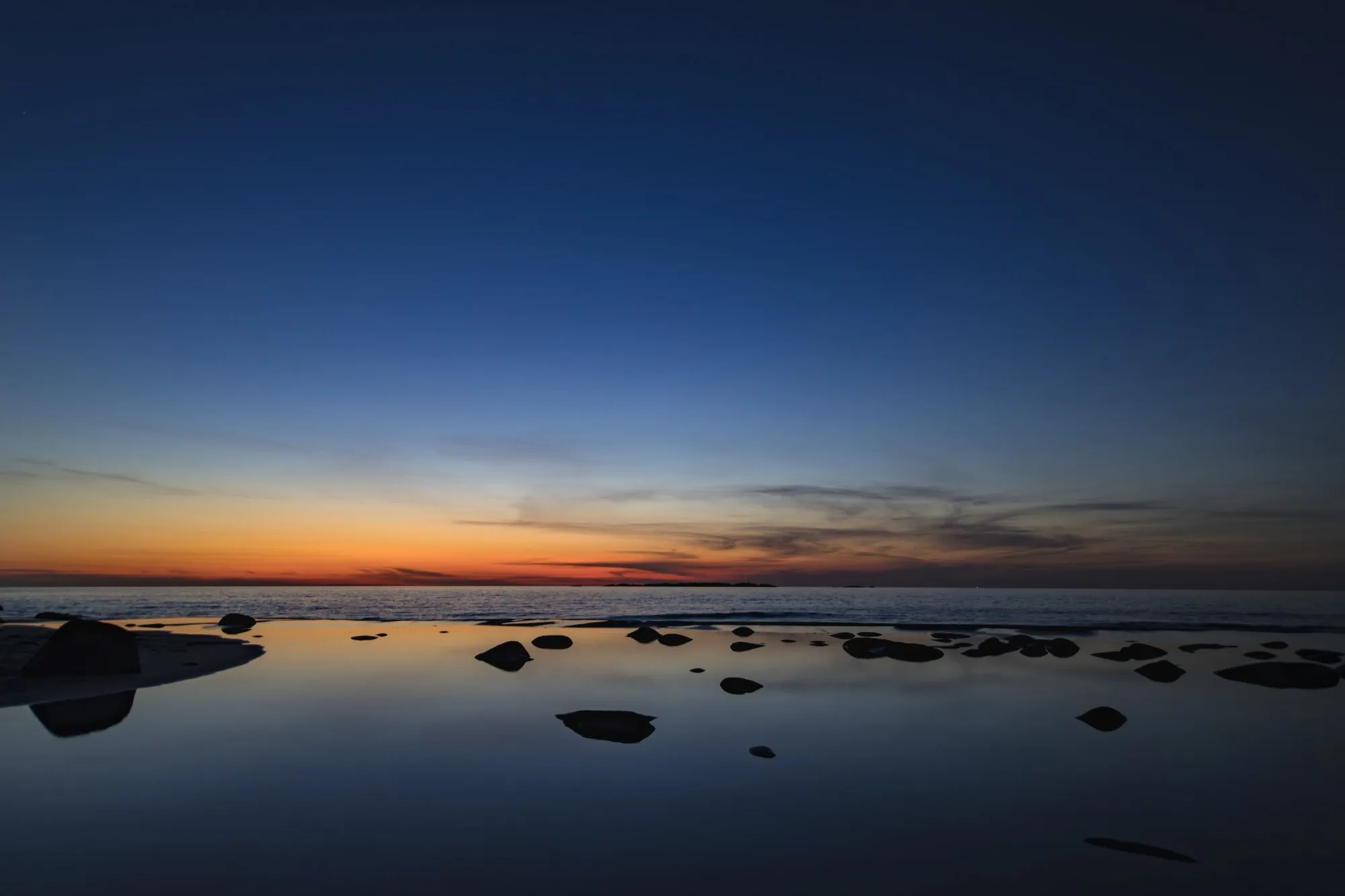
Early civil twilight (sun between 0° and -2°): the sky near the horizon still glows warm from the recent sunset. Higher up, the sky is transitioning from blue to deeper blue. The color gradient — warm at the horizon, cool above — is at its most dramatic. Artificial lights are starting to turn on but are not yet dominant.
Mid civil twilight (sun between -2° and -4°): the warm glow fades. The sky becomes predominantly blue with remnants of color near the western horizon (evening) or eastern horizon (morning). The brightness level drops noticeably. Street lights and building lights are clearly visible and starting to compete with ambient sky light.
Late civil twilight (sun between -4° and -6°): this is blue hour. The sky is a deep, saturated blue. Artificial lights are now brighter than the ambient sky. The brightness balance between sky and lit structures is at its most favorable — this is the sweet spot for cityscapes.
Photographic Opportunities
Cityscapes and skylines: the sky-to-building brightness balance is best during late civil twilight. Plan your arrival to be set up by mid civil twilight so you can shoot through the transition.
Landscapes with sky color: early civil twilight preserves color gradients in the sky that give landscapes drama without the harshness of direct sunlight.
Portraits with ambient light: during early to mid civil twilight, there's enough ambient light for handheld portraits with a fast lens (f/1.8 to f/2.8) at ISO 800-1600. The light is cool and even — flattering for skin tones in a way that differs from golden hour's warmth.
Light trails: by mid civil twilight, car headlights are on and the ambient light is low enough that 10-15 second exposures capture visible light trails while retaining sky color.
Practical Notes
Civil twilight is when light changes fastest. The difference in brightness between early and late civil twilight is roughly three to four stops. If you're shooting in manual mode, check and adjust exposure every two to three minutes. Aperture priority with manual white balance is often the most practical approach.
Duration varies dramatically by latitude. At 40°N, civil twilight lasts about 30-35 minutes. At the equator, about 20-25 minutes. At 60°N in summer, it can exceed an hour. Check your twilight calculator for exact times.
Nautical Twilight: The Transition Zone
Nautical twilight is the middle ground — too dark for conventional daylight photography, too bright for deep-sky astrophotography. But it has its own uses.
What It Looks Like
Early nautical twilight (sun between -6° and -9°): the sky is dark blue to navy. A faint glow persists on the horizon where the sun set (or will rise). The brightest stars — Sirius, Vega, Arcturus — and the bright planets — Venus, Jupiter — are clearly visible. The horizon line is still discernible as a boundary between sky and land or sea.
Late nautical twilight (sun between -9° and -12°): the sky is dark enough that second-magnitude stars are visible. The horizon is barely visible. The faint glow on the sunset/sunrise horizon is almost gone. In areas with light pollution, the sky brightens noticeably toward cities on the horizon.
Photographic Opportunities
Star + landscape composites: during nautical twilight, the foreground is still dimly illuminated by ambient twilight while bright stars and planets are visible overhead. Long exposures (30-120 seconds) can capture both a recognizable landscape and a starry sky in a single frame — no compositing needed.
Planet photography: Venus, Jupiter, and Saturn are often most photogenic during nautical twilight. They're bright enough to be prominent points in the frame but the sky still has some blue tone — more interesting than a pitch-black background.
Moonrise/moonset with context: when the Moon rises during nautical twilight, you can capture it against a sky that's dark enough to show the moon clearly but bright enough to retain landscape detail. This avoids the extreme contrast challenge of photographing the Moon against a fully dark sky.
Aurora photography: at high latitudes, aurora displays can be visible and photographable during nautical twilight. The twilight provides some fill light on the landscape below while the sky is dark enough for the aurora to register.
Silhouettes: the last glow on the horizon during early nautical twilight creates a natural background for silhouettes of trees, buildings, and landforms. The contrast between the dark foreground and the residual horizon glow can be striking.
Practical Notes
Exposures during nautical twilight are long. Expect 10-60 seconds at f/2.8, ISO 3200 for starry skies with landscape. For silhouettes against the horizon glow, shorter exposures work — 1/4 second to a few seconds.
Star trails become a factor at nautical twilight exposure times. At 30 seconds with a wide-angle lens (14-24mm), stars will show as tiny streaks on high-resolution sensors. This is where the 500 Rule or NPF Rule calculations become relevant.
Astronomical Twilight: The Beginning of Darkness
Astronomical twilight is the astrophotographer's starting gun. When the sun drops below -12°, the sky is dark enough for serious deep-sky work.
What It Looks Like
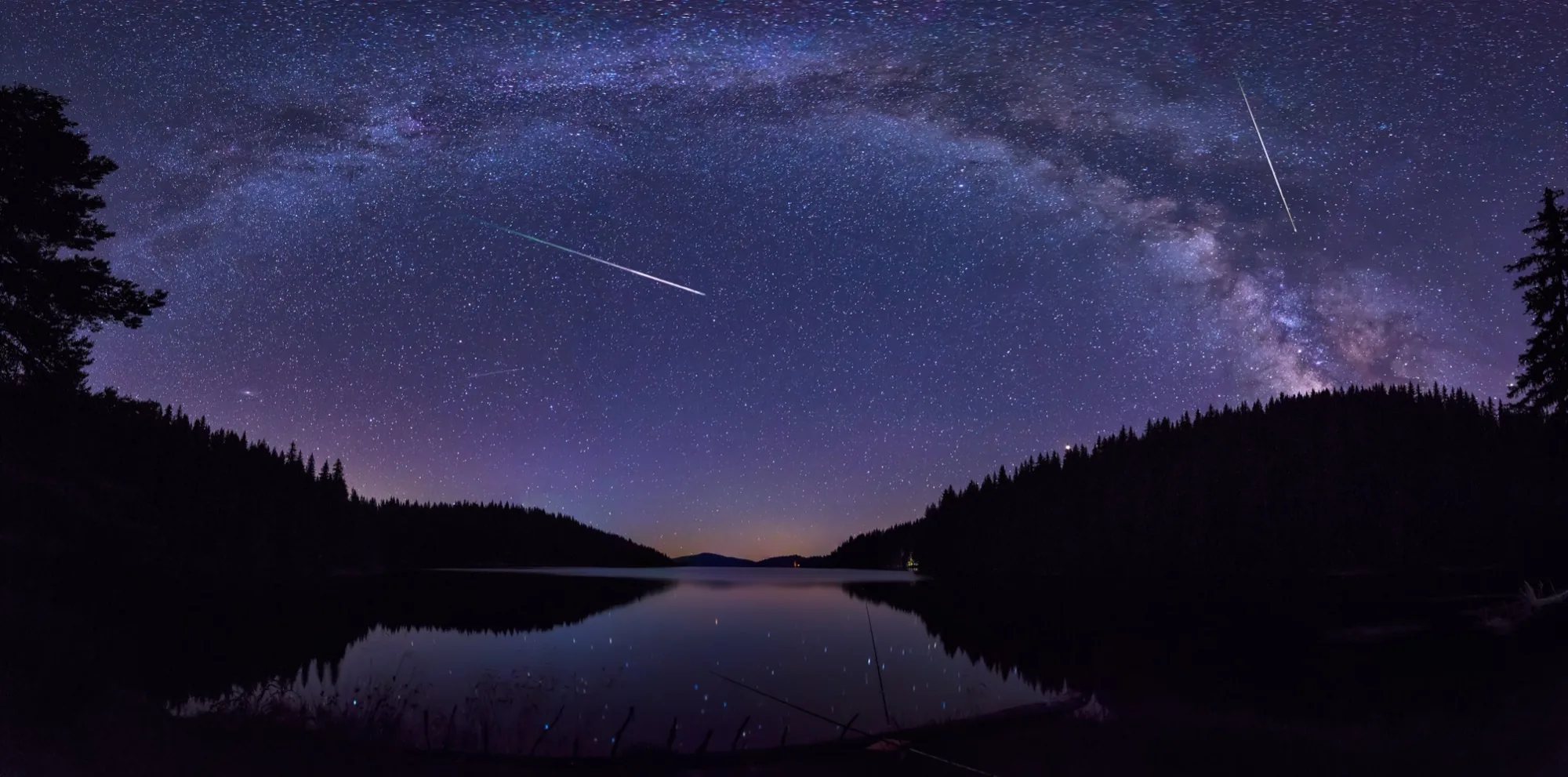
The sky appears fully dark to the unaided eye. In areas with minimal light pollution (Bortle 3 or darker), the Milky Way becomes visible as a faint band arching across the sky. Third- and fourth-magnitude stars are visible. The faintest remnant of scattered sunlight lingers near the horizon where the sun set, but it's detectable only to sensitive cameras with long exposures.
When the sun reaches -18° below the horizon, astronomical twilight ends and true astronomical night begins. At this point, no residual solar illumination remains. The sky is as dark as it will get (barring the Moon, planets, and light pollution).
Photographic Opportunities
Milky Way photography: the galactic center becomes visible during astronomical twilight, though optimal Milky Way photography benefits from waiting until the sun is at -18° or deeper for the darkest possible sky. In practice, many astrophotographers begin shooting during astronomical twilight and simply accept a marginally brighter sky background in their first frames.
Deep-sky objects: nebulae, galaxies, and star clusters require the darkest skies. While dedicated deep-sky astrophotographers with tracking mounts prefer true astronomical night, wide-field captures of objects like the Orion Nebula or the Pleiades are feasible during late astronomical twilight.
Star trails: astronomical twilight is prime time for beginning star trail sequences. Starting your intervalometer when astronomical twilight begins and running it for two to three hours captures a dramatic arc of star rotation with the darkest possible sky background.
Practical Notes
The gap between the end of civil twilight (when most photographers pack up) and the start of useful astronomical twilight is roughly thirty to fifty minutes. During this dead zone, there's often little to photograph unless you're specifically targeting nautical twilight subjects. Many astrophotographers use this time to set up equipment, focus on a bright star, take test exposures, and fine-tune composition.
At mid-latitudes, the total time from sunset to the end of astronomical twilight is roughly 90-110 minutes. At high latitudes near the summer solstice, the sun may never drop below -18° — meaning astronomical night never occurs. This is why the best astrophotography at high latitudes happens during winter months or around the equinoxes.
Seasonal Variation: Why Twilight Duration Changes
The duration of each twilight phase is tied to the angle at which the sun crosses the horizon. This angle changes with latitude and season.
Near the Equator
The sun rises and sets nearly vertically at equatorial latitudes. It passes through each twilight band quickly. Total twilight duration (from sunset to the end of astronomical twilight) is roughly 75-80 minutes year-round. There's minimal seasonal variation — equatorial twilight is short and predictable regardless of the month.
This means less time to work with for golden hour and blue hour photography, but it also means the transition into astrophotography conditions is fast. If you're shooting the Milky Way from near the equator, you can be shooting under dark skies within about 80 minutes of sunset.
At Mid-Latitudes
Between 30° and 50° latitude, the sun crosses the horizon at an angle that varies significantly with the season. Near the equinoxes (March and September), the crossing angle is steeper and twilight is shorter. Near the solstices, the angle is more oblique and twilight stretches out.
At 45°N in June, total twilight can last over two hours, with civil twilight alone stretching past 40 minutes. In December, total twilight at the same latitude is about 90 minutes, with civil twilight lasting roughly 30 minutes.
For photographers, this means summer offers longer golden and blue hour windows, while winter offers faster transitions into dark-sky conditions.
At High Latitudes
Above 55°N (or 55°S), twilight behavior becomes extreme.
During summer, the sun may never drop below -18° — there is no astronomical night. In Reykjavik (64°N), true astronomical darkness doesn't occur from late April through mid-August. The sky never gets fully dark. For astrophotography, this is a dead season. For golden hour photography, it's paradise — the warm light can last for hours.
During winter, the opposite occurs. The sun barely rises above the horizon and the day itself becomes a prolonged twilight. December in Tromsø (69°N) brings continuous nautical or astronomical twilight during the polar night period, with the sun never rising at all but producing hours of deep blue twilight around solar noon.
The equinoxes provide the most "normal" twilight behavior at high latitudes, with proportional durations for each phase.
How Twilight Duration Affects Photography Planning
Understanding twilight isn't academic — it directly affects how you plan shoots.
If You're Shooting Cityscapes
You need civil twilight, specifically late civil twilight (blue hour). Check the exact time civil twilight ends for your location. Be set up and shooting at least fifteen minutes before that time, and plan to shoot until ten minutes after civil twilight ends. That's your window.
If You're Shooting Astrophotography
You need astronomical twilight to end. Check when the sun reaches -18° below the horizon. That's when you begin shooting. In summer at high latitudes, check whether -18° is even reached — if not, plan your astrophotography trip for a different time of year.
If You're Shooting Star-Landscape Composites
Nautical twilight is your window. The sky is dark enough for bright stars while the foreground retains some ambient illumination. Check when the sun is between -9° and -12° below the horizon — that's your best window for single-exposure composites without light painting.
If You're Shooting Meteor Showers
Start during astronomical twilight. Meteors are visible during nautical twilight too, but the brighter sky washes out fainter meteors. The darkest possible sky gives you the best chance of capturing faint trails.
Checking Twilight Times
All three twilight phases shift by several minutes daily, and by much more across seasons and latitudes. Checking an almanac once per month isn't precise enough for serious planning.
The Astrian Light Golden Hour Calculator shows all three twilight phases for any location and date, displayed as a color-coded timeline. You can see at a glance how long each phase lasts, when the transitions occur, and how the pattern changes across the days and weeks of a month.
For astrophotography planning specifically, the key number is when astronomical twilight ends. For cityscape photography, the key number is when civil twilight ends. For anything in between, you need the full timeline.
Twilight and the Polar Regions
A brief note for those planning photography trips to Iceland, northern Scandinavia, Patagonia, or Antarctica.
At these latitudes, "normal" twilight rules break down. The sun can spend the entire day in twilight, or the entire night. The white nights of the northern summer are an extended civil twilight that never deepens past -6°. The polar winter produces extended nautical or astronomical twilight without the sun ever rising.
These conditions create unique photographic opportunities — the hour-long golden and blue tones of midsummer, the deep-blue daytime light of midwinter — but they require planning around a completely different light calendar than mid-latitude photographers are accustomed to.
If you're planning a trip to polar regions for photography, check twilight times for your specific dates well in advance. The difference between early June and late June at 65°N can mean the difference between brief dark skies and no dark skies at all.
Frequently Asked Questions
What's the difference between sunset and the end of twilight?
Sunset is the moment the upper edge of the sun's disk touches the horizon. Twilight is the entire period after sunset (or before sunrise) when residual sunlight still illuminates the sky. Depending on your latitude and the time of year, twilight continues for 70 to 120+ minutes after sunset.
Which type of twilight is best for photography?
It depends on what you're photographing. Civil twilight is best for cityscapes, portraits, and landscapes with sky color. Nautical twilight is best for star-landscape composites and bright planet shots. Astronomical twilight is best for Milky Way, deep-sky, and star trail photography. The "best" twilight is the one that matches your subject.
Does twilight last the same amount of time at sunrise and sunset?
Yes, the durations are symmetrical. Morning astronomical twilight starts at the same angular distance from sunrise as evening astronomical twilight ends from sunset. Conditions may differ (morning air is typically cleaner, water calmer), but the timing is effectively identical.
Why is twilight longer in summer than winter at my location?
The sun's path crosses the horizon at a more oblique angle in summer, taking longer to reach each angular threshold (-6°, -12°, -18°). In winter, the path is steeper relative to the horizon, so the sun passes through each phase more quickly. Near the equinoxes, the path is at an intermediate angle.
Is there twilight on cloudy days?
Yes. Twilight is determined by the sun's position below the horizon, not by cloud cover. However, clouds affect how the twilight looks. Overcast skies during civil twilight can produce dramatic color (clouds catch the sunset light from below). During nautical and astronomical twilight, overcast completely blocks stars and the Milky Way, making those phases useless for astrophotography.
How do I know when it's truly dark enough for astrophotography?
When astronomical twilight ends — the sun reaches -18° below the horizon. At this point, no scattered sunlight remains and the sky is as dark as it gets (ignoring the Moon and light pollution). In practice, many astrophotographers begin shooting ten to fifteen minutes before this threshold, accepting a marginally brighter sky near the horizon.
Check all three twilight phases for any location and date with the Astrian Light Golden Hour Calculator.
Recommended Reading
Continue reading
Newsletter
A short reading once a month, in your inbox.
A note on the symbolism of the season, recent editorial pieces, and what to look for in next month's sky. No predictions.
Support this project
Independent, no venture funding, no ads. A contribution keeps Astrian precise and free.
Support on Ko-fi (opens in new tab)