PROFILE · LITERATURE

Gabriel García Márquez
Gabriel José de la Concordia García Márquez
novelist and journalist
Born 6 March 1927 · Aracataca, Magdalena, Colombia · 10.59° N, 74.19° WX
Source: Birth time not documented in publicly accessible records
About this chart
No birth time is documented for this person. The chart therefore shows planetary positions in their signs, the slow aspects between them, and the generational context — but not house placements, the Ascendant, or the Midheaven, which require an accurate birth time. The Moon's sign carries a ±6° margin: if it falls near a sign boundary, the sign could vary. Positions for all other planets are reliable.
Do you have a verified source for this birth time? Share it →
The sky at birth
No birth time is documented for Gabriel García Márquez. The Ascendant, Midheaven, and house positions cannot be determined. The planetary positions below are calculated for noon local time and are accurate to within a fraction of a degree for the slow-moving planets. The Moon's position carries a margin of approximately ±7°.
The Sun is at 15°07' Pisces. The Moon is at 26°13' Aries (noon position, ±7° margin). Mercury is at 27°04' Pisces R. Venus is at 10°04' Aries. Mars is at 6°40' Gemini. Jupiter is at 11°07' Pisces. Saturn is at 7°33' Sagittarius. Uranus is at 28°34' Pisces. Neptune is at 25°04' Leo R. Pluto is at 13°52' Cancer R.
Mars at 6°40' Gemini opposes Saturn at 7°33' Sagittarius (0°53') — functionally exact and the tightest major aspect in the chart. The Moon at 26°13' Aries trines Neptune at 25°04' Leo retrograde (1°09'), though this aspect carries the Moon's ±7° uncertainty. The Sun at 15°07' Pisces trines Pluto at 13°52' Cancer retrograde (1°15'). Mercury at 27°04' Pisces retrograde conjoins Uranus at 28°34' Pisces (1°30'). Venus at 10°04' Aries trines Saturn at 7°33' Sagittarius (2°31'). Jupiter at 11°07' Pisces trines Pluto (2°45'). Venus sextiles Mars (3°24'). Jupiter squares Saturn (3°34'). Venus squares Pluto (3°48'). The Sun conjoins Jupiter (4°00'). Mars squares Jupiter (4°27').
The engine also identifies the following tight minor aspects involving asteroids and calculated points: venus sesquiquadrate neptune (0.00° sep); moon semi-square jupiter (0.10° sep); ceres semi-sextile vesta (0.12° sep); moon quincunx pallas (0.14° sep).
The tightest major aspects between planets: Mars opposition Saturn (0°53'), Moon trine Neptune (1°09'), Sun trine Pluto (1°15'), Mercury conjunct Uranus (1°30'), Venus trine Saturn (2°31'), Jupiter trine Pluto (2°45'), Venus sextile Mars (3°24'), Jupiter square Saturn (3°34'), Venus square Pluto (3°48'), Sun conjunct Jupiter (4°00'), Mars square Jupiter (4°27').
Note on the Moon's sign: The Moon at 26°13' Aries at noon is near the Aries-Taurus boundary. If born late in the day, the Moon could have moved into early Taurus. The Moon's sign placement in Aries is probable but not certain for the entire day.
The chart was calculated by Astrian's engine using NASA JPL DE441 ephemerides, sub-arcsecond precision. Timezone: America/Bogota (Colombia Standard Time, UTC −5).
| Planet | Sign | Position |
|---|---|---|
| Sun | Pisces | 15°07' |
| Moon | Aries | 26°13'±6° |
| Mercury | Pisces | 27°04'retrograde |
| Venus | Aries | 10°04' |
| Mars | Gemini | 06°40' |
| Jupiter | Pisces | 11°07' |
| Saturn | Sagittarius | 07°33' |
| Uranus | Pisces | 28°34' |
| Neptune | Leo | 25°04'retrograde |
| Pluto | Cancer | 13°52'retrograde |
| Chiron | Aries | 29°00' |
 Sun
Sun Moon
Moon Mercury
 Venus
Venus Mars
Mars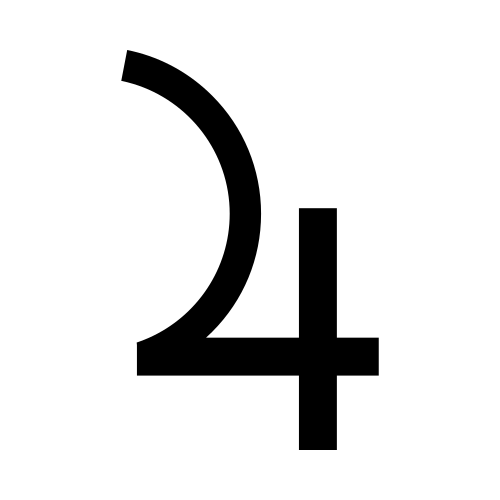 Jupiter
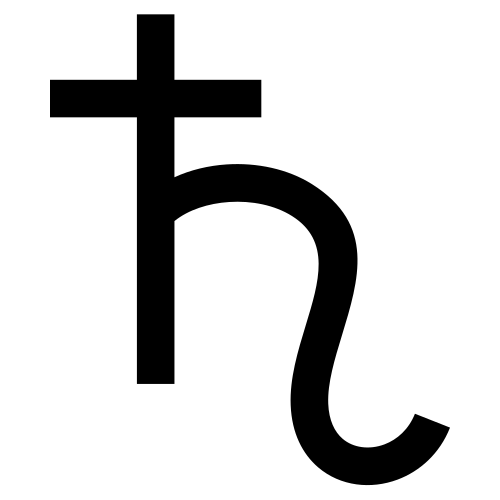 Saturn
 Uranus
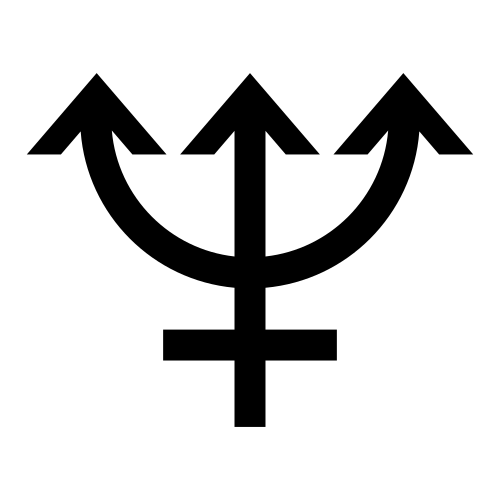 Neptune
 Pluto
Pluto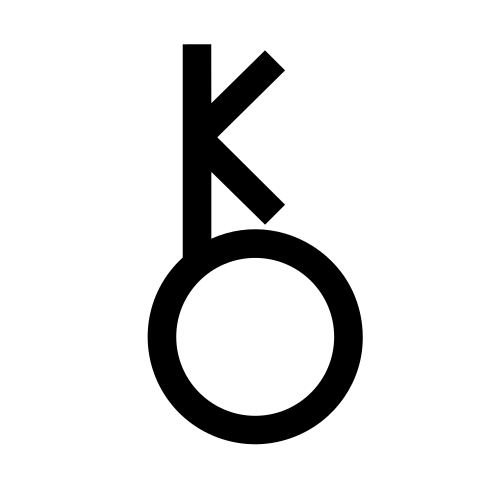 Chiron
Birth time unknown — house positions and Ascendant/MC are not available.
Astronomical context
Those born between approximately 1914 and 1939 carried Pluto in Cancer. This generation lived through the Great Depression, the Spanish Civil War, the Second World War, and the dismantling and remaking of nation-states across four continents. They came of age in a world where the meaning of home — the nation, the family, the ancestral house — had been shattered and had to be rebuilt from memory and from need.
In astrological tradition, Pluto in Cancer is associated with collective transformation of the domains that sign governs: the home, the family, the motherland, the roots, the emotional bonds that hold communities together. Cancer is the sign of origin, of belonging, of the place one returns to. Pluto's transit through Cancer coincided with mass displacement, the refugee crisis of the 1930s-1940s, and the forced reimagining of what homeland meant for millions. The symbolic reading is correlative, not causal.
No other profiles currently in the Astrian collection share this generational configuration. Gabriel García Márquez, born in 1927, belongs to the middle years of this generational wave.
Other profiles from this Pluto in Cancer generation
Symbolic reading
The following describes what classical astrological tradition associates with these configurations. Astrian does not apply these descriptions to the person's biography.
The Sun at 15°07' Pisces is the most prominent structural feature of this chart. Without a documented birth time, there is no Ascendant or Midheaven — the reading is confined to planetary positions by sign and the aspects between planets.
The Moon at 26°13' Aries represents the noon position; the actual placement falls within approximately 7° on either side. If born late in the day, the Moon could have moved into early Taurus. Mercury at 27°04' Pisces retrograde, Venus at 10°04' Aries, and Mars at 6°40' Gemini complete the personal planet picture.
The chart's most striking structural feature is the concentration in Pisces: four planets — Sun, Mercury retrograde, Jupiter, and Uranus — all occupy Pisces, the sign of the imagined, the dissolved, the boundaryless. It is a chart saturated with the register of what lies beneath the visible, of what cannot be said directly but only told slant. And running through its centre is a T-square of considerable force.
### Mars opposition Saturn: discipline against restlessness
Mars at 6°40' Gemini opposes Saturn at 7°33' Sagittarius, orb 0°53' — functionally exact and the tightest major aspect in the chart. Mars governs action, the capacity for effort, and the instinct to move, assert, and fight. Saturn governs structure, endurance, limitation, and the framework within which effort either produces lasting work or breaks against its own constraints. The opposition places them in direct confrontation across the Gemini-Sagittarius axis — the axis of information, language, communication on one side (Gemini), and meaning, belief, the grand narrative on the other (Sagittarius).
Mars in Gemini acts through words, through the multiplication of ideas, through restless movement between subjects and places. Saturn in Sagittarius demands coherence — the discipline to turn the scatter of experience into a structure that holds, a narrative that endures. The opposition reads as a tension between the impulse to tell everything and the demand to tell it in a form that lasts. Neither side can be discarded.
Both square Jupiter at 11°07' Pisces (Jupiter square Saturn: 3°34'; Mars square Jupiter: 4°27'), forming a T-square with Jupiter as the focal planet. Jupiter in Pisces — expansive, generous, operating through the register of imagination and compassion — receives the pressure of the Mars-Saturn opposition and channels it into the vast, the visionary, the stories that contain more than they say.
### Mercury conjunct Uranus in Pisces: the mind that breaks form
Mercury at 27°04' Pisces retrograde conjoins Uranus at 28°34' Pisces, orb 1°30'. Mercury governs communication, the organization of thought, the naming of things. Uranus governs disruption, sudden insight, the capacity to see what convention renders invisible. Their conjunction in Pisces — the sign of dissolution, of the imagined, of boundaries erased — places both the naming faculty and the disrupting faculty in the register of the fluid, the dreamed, the not-quite-real.
Mercury retrograde intensifies the inward turn: the mind processes by revisiting, by circling back, by rethinking what was assumed to be settled. In conjunction with Uranus, this retrograde quality acquires an electric unpredictability — the kind of thought that breaks the expected form of a sentence, a chapter, a genre.
### Sun trine Pluto: identity and depth
The Sun at 15°07' Pisces trines Pluto at 13°52' Cancer retrograde, orb 1°15' — a tight, cooperative aspect connecting two water signs. The Sun governs identity and the central organizing principle of the personality. Pluto governs transformation, what is hidden, and the capacity to reach the subconscious and the ancestral. In Cancer, Pluto operates through the register of family, homeland, origin, and collective memory. The trine connects them without friction: the identity has natural access to the buried, the familial, the generational.
Jupiter at 11°07' Pisces also trines Pluto (2°45'), extending this water-sign circuit. The Sun, Jupiter, and Pluto form a grand trine in water — Pisces to Cancer and back — a configuration the tradition reads as a deep, instinctive connection between identity (Sun), expansive vision (Jupiter), and transformative depth (Pluto), all operating through the register of feeling, memory, and the imagined.
### Venus square Pluto, trine Saturn: beauty under pressure
Venus at 10°04' Aries squares Pluto at 13°52' Cancer retrograde, orb 3°48'. Venus governs value, desire, and the aesthetic sense. The square to Pluto introduces intensity — the aesthetic faculty is pressured by the need to go deeper, to strip away the decorative and reach something essential. Venus also trines Saturn at 7°33' Sagittarius (2°31'), connecting the aesthetic sense to the structuring faculty. The combination reads as an aesthetic that is both intense and disciplined — beauty that has passed through pressure and emerged with form.
Venus also sextiles Mars (3°24'), easing the Mars-Saturn opposition: the aesthetic faculty mediates between the restless and the structured, between the impulse to scatter and the demand to endure.
The planetary pattern here is read as a symbolic portrait, not a causal explanation. No planet caused, predicted, or determined any event or characteristic.
Astrology is a symbolic language with 2,500 years of literature. The reading above is interpretive, not explanatory.
Astrian does not claim that the natal chart of Gabriel García Márquez caused or determined any of the above. Astrology is a symbolic system with 2,500 years of literature. Its capacity for retrospective description does not imply explanatory capacity.
A parallel life
The following are verified biographical facts. No connection to the natal chart is implied.
Gabriel José de la Concordia García Márquez was born on 6 March 1927 in Aracataca, a small town in the department of Magdalena on Colombia's Caribbean coast. His father, Gabriel Eligio García, was a telegraph operator and itinerant pharmacist. His mother, Luisa Santiaga Márquez Iguarán, came from a family of higher local standing — her father, Colonel Nicolás Ricardo Márquez Mejía, was a Liberal veteran of the Thousand Days' War and the dominant figure of Gabriel's childhood. The parents left Aracataca shortly after his birth, and the boy was raised by his maternal grandparents until the colonel's death in 1936.
The grandfather told him stories of the civil wars, of massacres, of the banana plantations and the United Fruit Company. The grandmother told him stories of the dead who walked through the house, of omens, of saints and ghosts and remedies, all delivered with the absolute conviction of the factual. Both registers — the political and the supernatural, the historical and the domestic — entered the child's ear at the same time and with the same authority. He never separated them.
At thirteen he was sent on scholarship to the Liceo Nacional de Zipaquirá, near Bogotá, in the cold Andean highlands — a world that could not have been more distant from the Caribbean lowlands. He studied law at the Universidad Nacional de Colombia in Bogotá beginning in 1947. On 9 April 1948, the assassination of the Liberal leader Jorge Eliécer Gaitán triggered the Bogotazo — days of riots that destroyed much of the city. His boarding house burned. His university closed. He transferred to the Universidad de Cartagena but never finished the degree, having already begun to write for newspapers.
He worked as a journalist in Cartagena, then Barranquilla, then Bogotá — for El Universal, El Heraldo, and El Espectador. In Barranquilla he joined a circle of young writers and readers — Álvaro Cepeda Samudio, Germán Vargas, Alfonso Fuenmayor — who introduced him to Faulkner, Hemingway, Woolf, and Kafka. The encounter with Faulkner was decisive: the idea that a single invented county could contain an entire civilization, that the provincial and the universal were the same thing if written with sufficient force.
His first novel, Leaf Storm (La hojarasca), appeared in 1955 and introduced Macondo — the fictional village modelled on Aracataca that would become the gravitational centre of his work. That same year, a series of investigative articles in El Espectador about a Colombian Navy sailor shipwrecked in the Caribbean angered the military government of Gustavo Rojas Pinilla. The newspaper sent him to Europe as a correspondent. He lived in Geneva, Rome, and Paris, often in poverty. When El Espectador was shut down by the regime, his income stopped. He survived in Paris collecting bottles and old newspapers.
He moved to Caracas in 1957, then to Bogotá, then covered the Cuban Revolution in 1959 for the newly founded Prensa Latina news agency. He became a friend of Fidel Castro — a friendship he maintained for decades and that drew persistent criticism from writers and intellectuals who saw it as complicity with authoritarianism.
He settled in Mexico City in 1961 with his wife, Mercedes Barcha Pardo, whom he had courted since she was thirteen. He wrote screenplays and worked in advertising. In January 1965, driving from Mexico City to Acapulco, the first sentence of a novel came to him whole. He turned the car around, went home, and spent the next eighteen months writing. Mercedes managed the household, pawned their possessions, and ran up debts with the butcher and the landlord. The result was Cien años de soledad — One Hundred Years of Solitude — published in June 1967 by Editorial Sudamericana in Buenos Aires. The first edition of 8,000 copies sold out in two weeks. The novel has since sold more than fifty million copies and been translated into more than forty languages.
The book did something unprecedented: it made Latin American literature a global literary force. The fictional village of Macondo — founded, built, cursed, and destroyed across seven generations of the Buendía family — became one of the most recognized settings in world fiction. What was called "magical realism" was, for García Márquez, simply the way his grandmother told stories: the dead and the living occupied the same sentence, and neither was more real than the other.
Other novels followed: The Autumn of the Patriarch (El otoño del patriarca, 1975), a baroque, almost airless portrait of absolute power; Chronicle of a Death Foretold (Crónica de una muerte anunciada, 1981), a novella of crystalline precision about a murder that everyone knows will happen; Love in the Time of Cholera (El amor en los tiempos del cólera, 1985), a love story that begins at the end of life.
He won the Nobel Prize in Literature in 1982. He accepted the prize in Stockholm wearing a white liqui liqui — the traditional suit of the Colombian Caribbean — instead of the expected tuxedo, and read a speech called "The Solitude of Latin America."
In 1994 he founded the Fundación para el Nuevo Periodismo Iberoamericano (now the Fundación Gabo) in Cartagena, dedicated to training journalists across Latin America. He was diagnosed with lymphatic cancer in 1999. His last novel, Memories of My Melancholy Whores (Memoria de mis putas tristes), appeared in 2004. His health declined through the following decade. He died on 17 April 2014 in Mexico City of pneumonia, at the age of eighty-seven. Three days of national mourning were declared in Colombia.
Biographical sources
- Martin, Gerald. Gabriel García Márque*.
This profile presents the sky at the birth of Gabriel García Márquez and verified facts of their biography. Astrian does not claim that astrology has predictive capacity or that the natal chart determines the trajectory of a life. Astrology is a symbolic system with 2,500 years of literature. Its capacity for retrospective description does not imply explanatory capacity.
Calculate your own birth chart with the same NASA JPL DE441 precision.
Calculate my birth chartLast updated: June 12, 2026
Newsletter
A short reading once a month, in your inbox.
A note on the symbolism of the season, recent editorial pieces, and what to look for in next month's sky. No predictions.
Support this project
Independent, no venture funding, no ads. A contribution keeps Astrian precise and free.
Support on Ko-fi (opens in new tab)