PROFILE · SPORTS
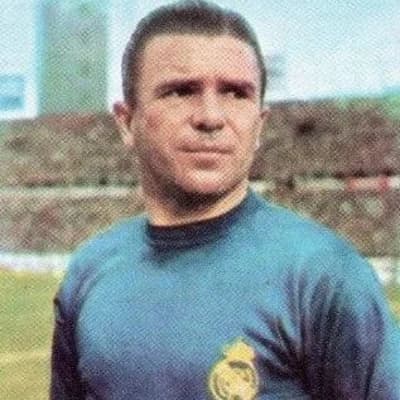
Ferenc Puskás
Ferenc Purczeld Puskás
footballer
Born 1 April 1927 · Budapest, Hungary · 47.50° N, 19.04° EX
Source: Not documented
About this chart
No birth time is documented for this person. The chart therefore shows planetary positions in their signs, the slow aspects between them, and the generational context — but not house placements, the Ascendant, or the Midheaven, which require an accurate birth time. The Moon's sign carries a ±6° margin: if it falls near a sign boundary, the sign could vary. Positions for all other planets are reliable.
Do you have a verified source for this birth time? Share it →
The sky at birth
Without a documented birth time, house positions, the Ascendant, and the Midheaven are not calculated. Planetary positions in signs are derived from noon on the birth date.
Ferenc Puskás was born on 1 April 1927 in Budapest. The Sun at approximately 11° Aries falls in the early middle degrees of the sign — the phase where Aries's qualities of initiative, decisive action, and competitive drive have moved past the sign's initial impulsive assertion toward a more developed directness: the Aries that acts not from reflex but from the conviction that has already calculated the outcome before the action begins. Aries at 11° describes the player whose shot is already decided before the ball arrives: who does not hesitate at the crucial moment because the decision was made during the approach, not at its conclusion.
For a left-footed striker with one of the most powerful and precise shots in football history — a player known for the quality of finishing that allowed him to score with either a drive or a placement with almost identical effectiveness — Aries at 11° describes the decisive forward: the one who creates the goal in the moment of initiative, before the defence can fully organise.
Saturn was in Sagittarius (~1°) at his birth. Pluto was at approximately 15° Cancer, placing him firmly in the Pluto in Cancer generation (1914–1939). Neptune was in Leo (~24°). Jupiter was in Pisces (~9°) at birth.
No birth time is documented for Ferenc Puskás. Planetary sign positions use a noon ephemeris and are approximate.
| Planet | Sign | Position |
|---|---|---|
| Sun | Aries | 10°43' |
| Moon | Aries | 00°19'±6° |
| Mercury | Pisces | 15°11' |
| Venus | Taurus | 11°32' |
| Mars | Gemini | 21°00' |
| Jupiter | Pisces | 17°14' |
| Saturn | Sagittarius | 07°29'retrograde |
| Uranus | Aries | 00°02' |
| Neptune | Leo | 24°30'retrograde |
| Pluto | Cancer | 13°46' |
| Chiron | Taurus | 00°24' |
 Sun
Sun Moon
Moon Mercury
 Venus
Venus Mars
Mars Jupiter
 Saturn
 Uranus
 Neptune
 Pluto
Pluto Chiron
Birth time unknown — house positions and Ascendant/MC are not available.
Astronomical context
Ferenc Puskás belongs to the Pluto in Cancer generation (1914–1939), born in 1927 in Budapest — the Hungarian capital in its interwar period, still the second city of a diminished empire adapting to the post-Trianon geography. His family name was originally Purczeld, from a Swabian German background; his father was also a footballer who shaped his early development at Kispest.
The Pluto in Cancer generation's connection to the collective project, the family unit, and the defensive protection of the group found expression in Puskás through the context of Hungarian football's golden age: the Aranycsapat (Golden Team) of 1950–1956, which won Olympic gold in 1952 and went undefeated for 32 matches before the 1954 World Cup final. The team's defeat in that final against a West Germany they had beaten 8–3 in the group stage remains one of football's most analysed results.
The 1956 Hungarian Uprising forced the question of collective loyalty into biographical reality. Puskás, on tour with Honvéd when the uprising occurred, chose not to return. He joined Real Madrid in 1958 at the age of thirty-one, as a Spanish citizen named Federico Puskás, and won three more European Cups.
Other profiles from this Pluto in Cancer generation
Symbolic reading
The following describes what classical astrological tradition associates with these configurations. Astrian does not apply these descriptions to the person's biography.
The Sun at 11° Aries describes the striker as decisive initiator: the player whose goal is created in the moment of movement, whose left foot carried the generation's quality of transformative force at the personal scale. Puskás was not a complex footballer — the descriptions of him emphasise the directness, the clinical quality of the finish, the absence of hesitation at the moment of the shot. This is Aries at 11°: the decision made before the situation demands it, the shot taken in the gap between the goalkeeper's preparation and the ball's arrival.
The quality of Aries at this degree also describes the competitive nature that sustained Puskás's effectiveness into his mid-thirties at Real Madrid. He adapted his movement and physical approach as his pace diminished but retained the finishing quality that had defined him in Budapest.
Jupiter in Pisces provides the intuitive dimension that modulated the Aries directness: the sense of the space that identified, before the movement began, exactly where the shot would go.
The readings above are symbolic and archetypal. They do not constitute psychological diagnoses or predictions.
Astrian does not claim that the natal chart of Ferenc Puskás caused or determined any of the above. Astrology is a symbolic system with 2,500 years of literature. Its capacity for retrospective description does not imply explanatory capacity.
A parallel life
The following are verified biographical facts. No connection to the natal chart is implied.
Ferenc Puskás was born on 1 April 1927 in Budapest. His father was a footballer who played for and later managed Kispest FC. Puskás made his debut for Kispest at sixteen. When the Hungarian state nationalised the club and it was renamed Budapest Honvéd, he became the centrepiece of the army team and then of the Hungarian national squad.
Hungary's unbeaten run of 1950–1956 included victories over England at Wembley (6–3 in 1953, the first time England had lost at home to a non-British team) and in Budapest (7–1 in 1954). The 1954 World Cup final loss to West Germany, 3–2 despite being heavy favourites, remains the defining result of the era. After the 1956 Hungarian Uprising, he joined Real Madrid in 1958 and won three European Cups (1959, 1960, 1966) and four La Liga titles. He scored a hat-trick in the 1960 European Cup final, which Real Madrid won 7–3 against Eintracht Frankfurt — widely considered the greatest club match in history. He finished as the top scorer in the competition four times.
This profile presents the sky at the birth of Ferenc Puskás and verified facts of their biography. Astrian does not claim that astrology has predictive capacity or that the natal chart determines the trajectory of a life. Astrology is a symbolic system with 2,500 years of literature. Its capacity for retrospective description does not imply explanatory capacity.
Calculate your own birth chart with the same NASA JPL DE441 precision.
Calculate my birth chartLast updated: June 12, 2026
Newsletter
A short reading once a month, in your inbox.
A note on the symbolism of the season, recent editorial pieces, and what to look for in next month's sky. No predictions.
Support this project
Independent, no venture funding, no ads. A contribution keeps Astrian precise and free.
Support on Ko-fi (opens in new tab)