PROFILE · FILM & STAGE

Audrey Hepburn
Audrey Kathleen Ruston
actress
Born 4 May 1929 · 03:00 · 15:14 UTC · Ixelles, Belgium · 50.85° N, 4.35° EAA
Source: Birth certificate
The sky at birth
The Ascendant falls at 28°34' Aquarius. The first house holds three planets: Moon at 6°27' Pisces, Venus at 22°46' Aries (retrograde), and Uranus at 9°20' Aries. The Ascendant cusp is in the final degrees of Aquarius, while all three planets in the first house have crossed into Pisces and Aries. No other house concentrates as many bodies.
The Sun at 13°06' Taurus and Jupiter at 20°45' Taurus are both in the second house. They share a sign and a house, separated by 7°39'. The Midheaven falls at 16°57' Sagittarius. Saturn at 0°02' Capricorn — essentially at the exact beginning of Capricorn — is in the tenth house, close to the cusp of the eleventh.
Mars at 25°09' Cancer is in the sixth house. Pluto at 16°26' Cancer is in the fifth house. Neptune at 28°35' Leo is in the seventh house, retrograde. Mercury at 0°19' Gemini is in the third house.
The tightest aspect in the chart is Mercury quincunx Saturn at 0°17': Mercury at Gemini 0°19' and Saturn at Capricorn 0°02', both at virtually the same degree in their respective signs. The quincunx — a 150° angle — is a pattern of adjustment between modes that do not share element or quality.
Venus trine Neptune carries an orb of 5°49': Venus retrograde at Aries 22°46' and Neptune retrograde at Leo 28°35', both in fire signs, a trine between the first and seventh houses. Moon sextile Saturn at 6°25': Moon at Pisces 6°27' and Saturn at Capricorn 0°02'. Sun conjunct Jupiter in Taurus, orb 7°39', in the second house.
Moon at 6°27' Pisces is in the applying opposition to Neptune at 28°35' Leo across the first-to-seventh axis, with an orb of 7°52'. The first house holds the Moon; Neptune occupies the seventh. This opposition, along with Venus retrograde and Uranus — also in the first house — places considerable weight on the first-seventh axis.
Saturn is placed at the very first minute of Capricorn, the sign of its rulership in the traditional system. A planet at 0°02' of a sign is at the extreme edge of ingress; it has just crossed the boundary.
The chart was calculated by Astrian's engine using NASA JPL DE441 ephemerides, sub-arcsecond precision (RMS error below 0.06 arcseconds). Timezone: Central European Time, UTC +1:00, observed in Brussels in May 1929. ---
| Planet | Sign | Position | House |
|---|---|---|---|
| Ascendant | Aquarius | 28°34' | — |
| Midheaven | Sagittarius | 16°57' | — |
| Sun | Taurus | 13°06' | H2 |
| Moon | Pisces | 06°27' | H1 |
| Mercury | Gemini | 00°19' | H3 |
| Venus | Aries | 22°46'retrograde | H1 |
| Mars | Cancer | 25°09' | H6 |
| Jupiter | Taurus | 20°45' | H2 |
| Saturn | Capricorn | 00°02'retrograde | H10 |
| Uranus | Aries | 09°20' | H1 |
| Neptune | Leo | 28°35'retrograde | H7 |
| Pluto | Cancer | 16°26' | H5 |
| Chiron | Taurus | 10°02' | H2 |
 Sun
Sun Moon
Moon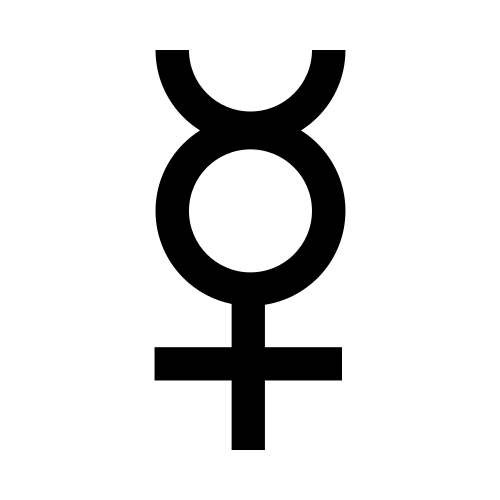 Mercury
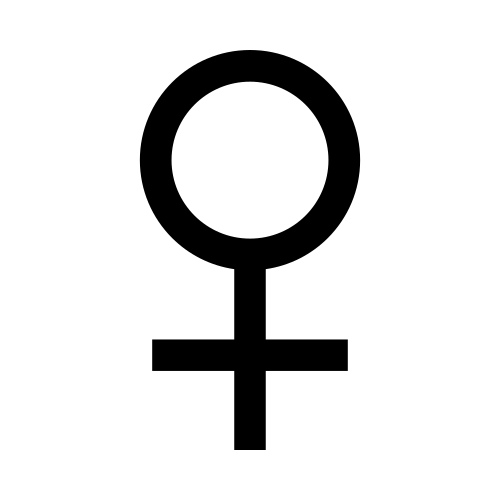 Venus
Venus Mars
Mars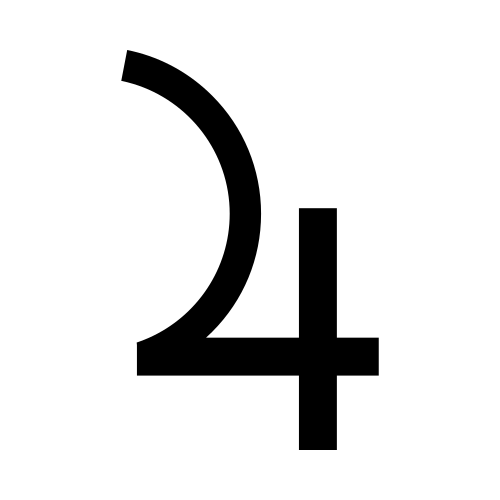 Jupiter
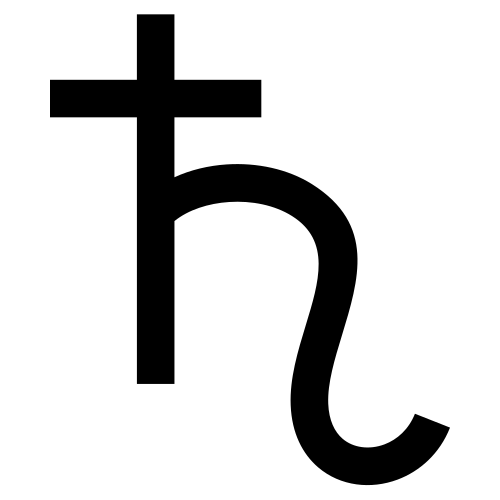 Saturn
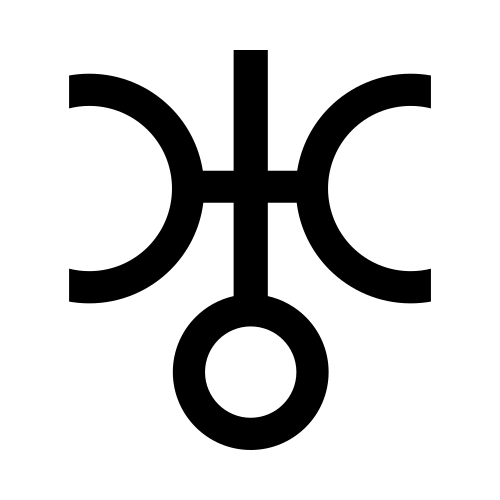 Uranus
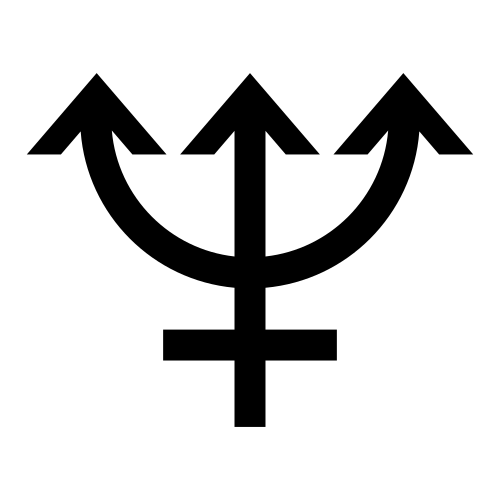 Neptune
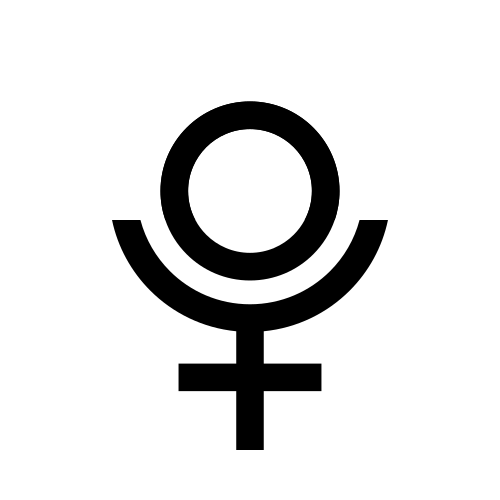 Pluto
Pluto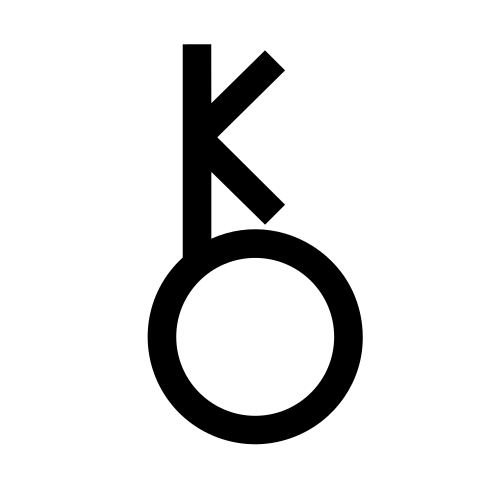 Chiron
Astronomical context
Those born between approximately 1913 and 1939 carried Pluto in Cancer. Hepburn was born in 1929, in the middle third of this transit. The generation includes, among others, Marilyn Monroe (born 1926, Pluto in Cancer) and Marlon Brando (born 1924, Pluto in Cancer).
In astrological tradition, Pluto in Cancer is associated with transformative pressure applied to the domains Cancer governs: home, family, nation, security, private life, maternal lineage, and the psychic substrate of belonging. The historical period of this transit delivered precisely this kind of pressure in concentrated form. The First World War (1914–1918) dissolved the territorial order of the 19th century. The Spanish influenza (1918–1919) killed between 50 and 100 million people in under two years. The Great Depression (1929–1939) dismantled the economic certainties of industrial capitalism for a generation. The Second World War began in 1939, the year Pluto was leaving Cancer.
The generation that carried Pluto in Cancer grew up inside this dissolution. Many of them later contributed to reconstructing exactly the domain Pluto had pressurized: the mid-century emphasis on domesticity, national identity, and family security was in part a cultural response to the instability of the previous decades. The symbolic reading is correlative, not causal.
Neptune was in Leo from 1916 to 1928, overlapping with part of the Pluto-in-Cancer period. Hepburn was born in 1929, at the close of the Neptune-in-Leo period, carrying both Pluto in Cancer and Neptune nearly leaving Leo. ---
Other profiles from this Pluto in Cancer generation
Symbolic reading
The following describes what classical astrological tradition associates with these configurations. Astrian does not apply these descriptions to the person's biography.
An Ascendant at the final degrees of Aquarius, with three planets in the first house spanning Pisces and Aries: the first house is dense. Moon in Pisces, Venus retrograde in Aries, Uranus in Aries — three bodies in two different signs occupy the house of self-presentation and immediate identity. In traditional vocabulary, the Moon governs emotional response and instinct, Venus retrograde introduces a quality of internal orientation rather than outward expression, and Uranus carries associations with disruption and divergence from pattern. That all three occupy the same house, along with the late Aquarius Ascendant, is a structural observation.
Neptune retrograde at 28°35' Leo in the seventh house stands in wide opposition to the first-house cluster: opposition to Moon (7°52'), trine to Venus (5°49'). In traditional astrological vocabulary, the seventh house governs the encounter with others — partners, the public, those who mirror and respond. Neptune in that position, in wide aspect to the first house, sets the relationship between self-presentation and the encounter with others under its symbolic weight. Retrograde Neptune in Leo amplifies the register toward idealized image and the gap between persona and interior.
The tightest aspect in the chart — Mercury quincunx Saturn at 0°17' — links two planets traditionally associated with mind and structure across an angle that combines adjustment and friction. Mercury at Gemini 0°, Saturn at Capricorn 0°: both at the exact degree of ingress into their signs, the aspect is precise. The quincunx is read in traditional astrology as a pattern requiring ongoing accommodation between incompatible modes.
Saturn at 0°02' Capricorn in the tenth house is in the sign of its traditional rulership, placed in the house governing public standing and professional trajectory. In the traditional system, a planet in its own sign is in a position of strength; Saturn at the exact degree of ingress into Capricorn, in the tenth house, is a specific structural placement.
Sun conjunct Jupiter in Taurus, both in the second house: the second house governs material resources and the relationship to physical form and stability. Sun and Jupiter in the same sign and house, in the sign traditionally ruled by Venus, is a pairing the tradition reads as amplifying — both bodies in a house associated with what sustains and consolidates.
Astrology is a symbolic language with 2,500 years of literature. The reading above is interpretive, not explanatory.
Astrian does not claim that the natal chart of Audrey Hepburn caused or determined any of the above. Astrology is a symbolic system with 2,500 years of literature. Its capacity for retrospective description does not imply explanatory capacity.
A parallel life
The following are verified biographical facts. No connection to the natal chart is implied.
Audrey Kathleen Ruston was born on May 4, 1929, in Ixelles, a municipality of Brussels. Her mother was Ella van Heemstra, a Dutch baroness; her father, Joseph Victor Anthony Ruston, a British-born banker. The family moved to the Netherlands — to Arnhem — where her parents separated in 1935. Her father left and did not maintain contact. She was educated at a girls' school in England for a period before the war.
In May 1940, Germany invaded the Netherlands. Hepburn was ten years old. The occupation lasted five years. In the Dutch Hunger Winter of 1944–45, as the German administration restricted food supplies to the occupied western Netherlands in response to a Dutch railway strike, severe famine conditions set in. Hepburn later described symptoms consistent with malnutrition from this period: edema, anemia, respiratory problems. She was fifteen years old when the Netherlands was liberated by Allied forces in May 1945.
After the war, she moved to London with her mother. She studied ballet under Marie Rambert at the Ballet Rambert school. Her height — she grew to five feet seven — was not ideal for classical ballet, and she redirected toward musical theatre. She worked in small stage and film roles in London and appeared as an extra in several British productions in the early 1950s.
In 1951, while filming in Monte Carlo, she met the French novelist Colette, who selected her on the spot to play the title role in the Broadway adaptation of Gigi. The play opened in New York in November 1951. It ran for 219 performances. The production brought her to significant attention in the American entertainment industry.
In 1953, William Wyler cast her as Princess Ann opposite Gregory Peck in Roman Holiday, filmed on location in Rome. The film was released in August 1953. She won the Academy Award for Best Actress for the role, as well as a Tony Award in the same year for Ondine, becoming the first person in a single calendar year to win both. Sabrina (1954), directed by Billy Wilder opposite Humphrey Bogart and William Holden, followed. In 1954 she married actor-director Mel Ferrer.
War and Peace (1956), directed by King Vidor; Funny Face (1957) opposite Fred Astaire; The Nun's Story (1959), for which she received another Academy Award nomination. Breakfast at Tiffany's (1961), directed by Blake Edwards, cast her as Holly Golightly. The film's title sequence, featuring Henry Mancini's "Moon River," became among the most reproduced cultural images of the decade. The Children's Hour (1961), Charade (1963), Paris When It Sizzles (1964). My Fair Lady (1964), directed by George Cukor opposite Rex Harrison: she was not permitted to record her own songs; the singing parts were dubbed by Marni Nixon, a fact that generated controversy at the time. How to Steal a Million (1966), Two for the Road (1967), Wait Until Dark (1967) — the last earned her a fifth Academy Award nomination.
Her marriage to Ferrer ended in divorce in 1968. In 1969 she married Italian psychiatrist Andrea Dotti; they had a son, Luca. That marriage also ended in divorce, in 1982. She largely withdrew from acting through the 1970s and early 1980s, living primarily in Tolochenaz, Switzerland. She returned to film with Robin and Marian (1976) opposite Sean Connery, and appeared in several further productions through the decade.
In 1988, she became a Goodwill Ambassador for UNICEF. Over the following four years, she traveled extensively — to Ethiopia, Sudan, El Salvador, Guatemala, Honduras, Venezuela, Ecuador, Bangladesh, Vietnam, Somalia — documenting conditions and advocating for international food and medical assistance. The work occupied the final years of her life more fully than any professional engagement.
In late 1992, she was diagnosed with appendiceal cancer during filming in Mexico. She returned to Tolochenaz. Audrey Hepburn died on January 20, 1993, at her home in Switzerland. She was sixty-three years old.
Biographical sources
- Walker, Alexander. Audrey: Her Real Story. St. Martin's Press 1995
- Spoto, Donald. Enchantment: The Life of Audrey Hepburn. Harmony Books 2006
- Mat.
This profile presents the sky at the birth of Audrey Hepburn and verified facts of their biography. Astrian does not claim that astrology has predictive capacity or that the natal chart determines the trajectory of a life. Astrology is a symbolic system with 2,500 years of literature. Its capacity for retrospective description does not imply explanatory capacity.
Related profiles
Calculate your own birth chart with the same NASA JPL DE441 precision.
Calculate my birth chartLast updated: June 12, 2026
Newsletter
A short reading once a month, in your inbox.
A note on the symbolism of the season, recent editorial pieces, and what to look for in next month's sky. No predictions.
Support this project
Independent, no venture funding, no ads. A contribution keeps Astrian precise and free.
Support on Ko-fi (opens in new tab)