PROFILE · SCIENCE & TECHNOLOGY
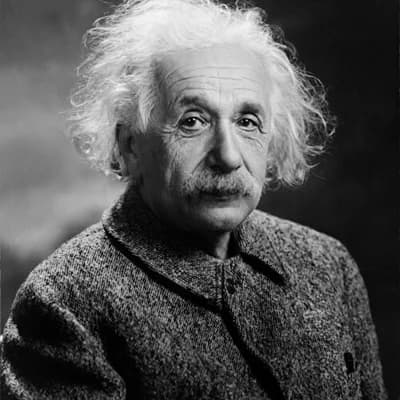
Albert Einstein
Physicist. Author of the special and general theories of relativity. Nobel Prize in Physics, 1921, for the discovery of the law of the photoelectric effect. German citizen by birth; Swiss citizen from 1901; naturalized American citizen, 1940. Died April 18, 1955, Princeton, New Jersey.
Born 14 March 1879 · 11:30 LMT · 10:37 UTC · Ulm, Germany · 48.40° N, 9.99° EAA
Source: Birth certificate, Stadtarchiv Ulm, Germany
The sky at birth
The chart places four bodies in the tenth house: the Sun at 23°30' Pisces, Mercury at 3°08' Aries, Saturn at 4°11' Aries, and Venus at 16°59' Aries. The Midheaven falls at 12°50' Pisces. The Sun is 10°41' past the upper meridian, close to the MC and moving toward the eleventh cusp. Mercury and Saturn are in near-exact alignment at 1°03', positioned at the first degrees of Aries. Saturn occupies Aries in fall; Venus occupies Aries in detriment.
The Moon is at 14°31' Sagittarius, in the sixth house, waning at 58% illumination. The full moon of March 9, 1879 had elapsed five days prior; at this phase the Moon rises well after midnight and is visible in the pre-dawn sky, a morning star configuration.
Mars is at 26°54' Capricorn, in the seventh house, in exaltation. Jupiter is at 27°29' Aquarius, in the ninth house. Uranus is at 1°17' Virgo, in the third house, retrograde. Neptune is at 7°52' Taurus, in the eleventh house. Pluto is at 24°43' Taurus, also in the eleventh house; Neptune and Pluto share this house at 7°52' and 24°43' respectively. The Ascendant falls at 11°38' Cancer.
Eight aspects appear in the chart. Mercury conjunct Saturn: 1°03'. Sun sextile Mars: 3°25'. Sun sextile Pluto: 1°13'. Moon trine Venus: 2°27'. Mars trine Pluto: 2°19', separating. Jupiter opposite Uranus: 3°48', applying. Jupiter square Pluto: 2°46', separating. Uranus trine Neptune: 6°35', generational, separating.
One additional structural detail: Pluto at 24°43' Taurus falls within 0°18' of the fixed star Algol (beta Persei, 24°25' Taurus in this epoch). This is among the closest registered conjunctions between a chart body and Algol in this dataset.
The chart was calculated by Astrian's engine using NASA JPL DE441 ephemerides, sub-arcsecond precision (RMS error below 0.06 arcseconds). Timezone: Local Mean Time, UTC +0h 39m 58s, corresponding to Ulm's longitude of 9°59'E. Germany did not adopt Central European Time until April 1, 1893.
| Planet | Sign | Position | House |
|---|---|---|---|
| Ascendant | Cancer | 11°39' | — |
| Midheaven | Pisces | 12°50' | — |
| Sun | Pisces | 23°30' | H10 |
| Moon | Sagittarius | 14°31' | H6 |
| Mercury | Aries | 03°08' | H10 |
| Venus | Aries | 16°59' | H10 |
| Mars | Capricorn | 26°54' | H7 |
| Jupiter | Aquarius | 27°29' | H9 |
| Saturn | Aries | 04°11' | H10 |
| Uranus | Virgo | 01°17'retrograde | H3 |
| Neptune | Taurus | 07°52' | H11 |
| Pluto | Taurus | 24°43' | H11 |
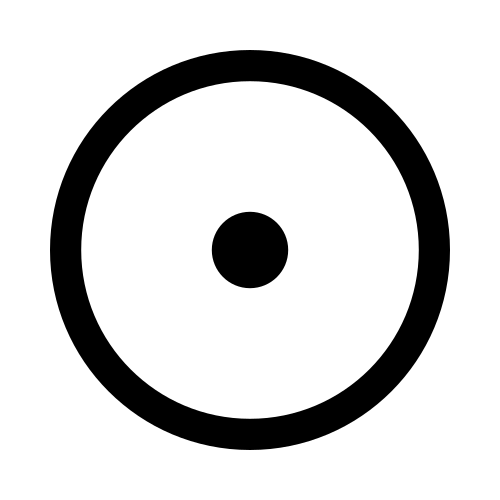 Sun
Sun Moon
Moon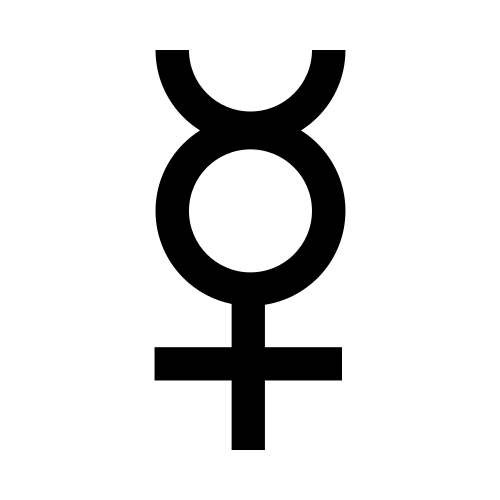 Mercury
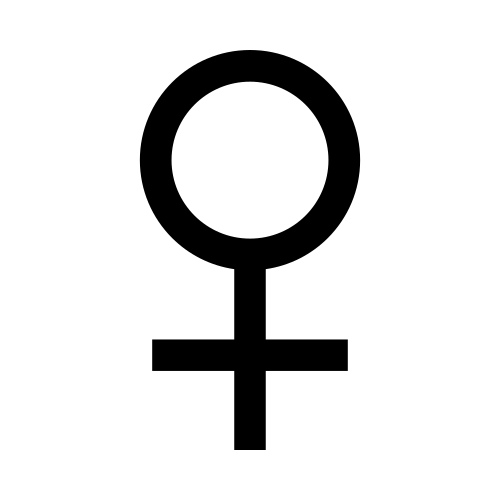 Venus
Venus Mars
Mars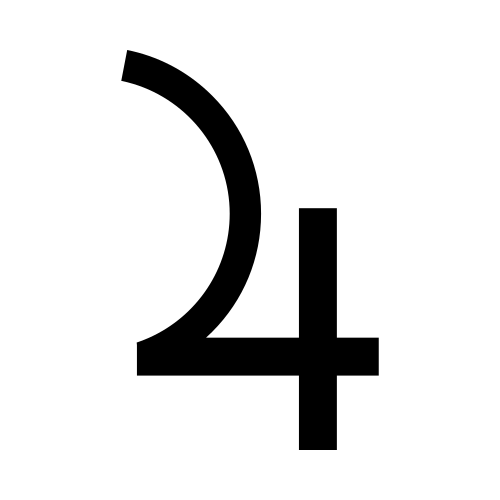 Jupiter
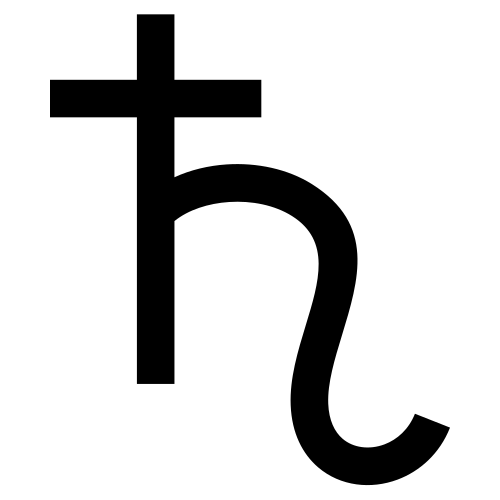 Saturn
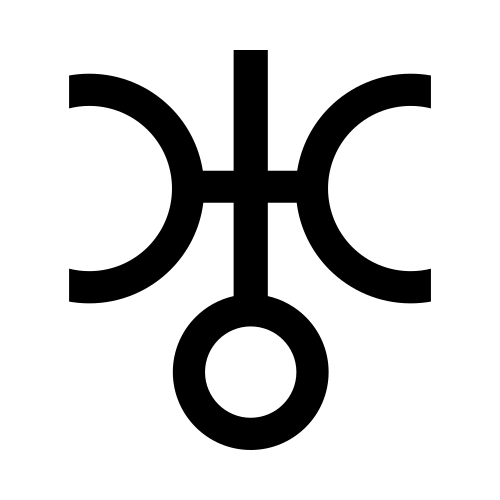 Uranus
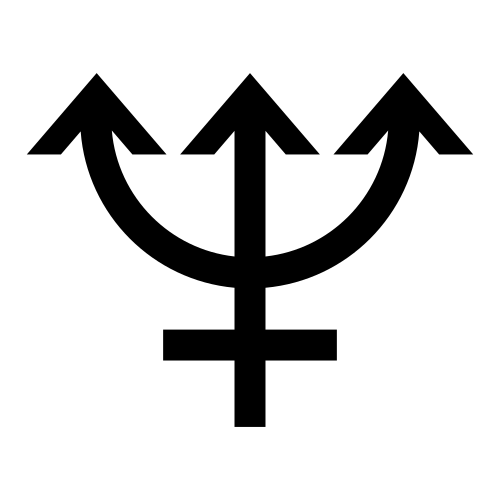 Neptune
 Pluto
PlutoAstronomical context
Those born between approximately 1851 and 1882 carried Pluto in Taurus. Neptune entered Taurus in 1874 and remained there until 1889. Einstein's chart belongs to the final years of the full overlap: the cohort that came of age during the late-industrial transformation of the Western world.
In astrological tradition, Pluto in Taurus is associated with pressure applied to material structures: land, wealth, industrial capacity, the physical substrate of civilization. The second half of the nineteenth century delivered precisely this configuration in historical terms. The consolidation of railroads, the industrialization of steel and coal, the first electrification of cities, the enclosure of agrarian economies into wage labor: Pluto's passage through Taurus coincided with the period when the material world became the primary field of transformation. The symbolic reading is correlative, not causal.
Neptune in Taurus layers a different quality onto the same terrain. Neptune's symbolic register involves dissolution, idealization, the permeation of fixed forms. In Taurus, a sign associated with solidity, endurance, and the tangible, Neptune introduces instability into the very structures that Pluto is pressing. The generation that carried this configuration grew up in a world whose physical certainties were quietly dissolving: the classical mechanics of Newton, the fixed categories of species and matter, the geopolitical arrangements of the old empires.
Others born into this generation include Marie Curie (born 1867, Pluto in Taurus, Neptune in Aries approaching Taurus), Sigmund Freud (born 1856, Pluto in Taurus, Neptune in Pisces), Pablo Picasso (born 1881, Pluto in Taurus, Neptune in Taurus), and Virginia Woolf (born 1882, the final year of Pluto in Taurus). Carl Jung, born 1875, shares the full Pluto and Neptune in Taurus overlap.
Across this cohort, the symbolic resonance observed in astrological tradition is consistent: the dismantling of fixed categories, whether in matter, mind, form, or narration.
Other profiles from this Pluto in Taurus generation
Symbolic reading
The following describes what classical astrological tradition associates with these configurations. Astrian does not apply these descriptions to the person's biography.
A stellium of four bodies in a single house is structurally unusual. In traditional astrology, a concentration of this kind — Sun, Mercury, Saturn, and Venus spanning Pisces and Aries across the tenth house — is read as an intensification of energy directed toward the domain of that house: public life, vocation, professional standing, and long-term reputation.
The placement close to the Midheaven carries additional symbolic weight. In the vocabulary of astrology, the MC-to-tenth-house region represents the meridian through which a chart's energy is most directly expressed into the world. Sun within 11° of the Midheaven, with three additional bodies nearby, constitutes a structural concentration in that region.
The Mercury–Saturn conjunction at 1°03' merits attention for its tightness. Mercury's symbolic register covers thought, communication, perception, and analysis. Saturn's covers structure, limitation, discipline, and the long term. Conjunctions merge the two; the interpretation of this merger has varied across traditions. One reading emphasizes constraint and methodical thought; another, precision and structural discipline. The Saturn in fall in Aries adds a layer: in traditional astrology, a planet in fall operates at a distance from its most efficient expression. What that means for the conjunction with Mercury is left to the reader.
The Sun sextile Pluto at 1°13' is a close alignment between the chart's central light and the outermost personal body. Pluto's symbolic register in modern astrology centers on transformation, depth, and what lies beneath surfaces. The sextile is considered a harmonious aspect, a productive alignment rather than a tension.
The Jupiter–Uranus opposition at 3°48', applying, places two bodies traditionally associated with expansion and disruption in polarity across the ninth and third houses. Jupiter in Aquarius, Uranus in Virgo: the symbolic field involves ideation, practical analysis, and the relationship between speculative thought and precise method. Oppositions in a chart are read as productive tensions, poles between which energy moves rather than pathologies to resolve.
Pluto conjunct Algol at 0°18' sits at the edge of the symbolic vocabulary and requires no elaboration. Algol, formally beta Persei, carries a long tradition of fateful associations in Hellenistic and medieval astrology. The proximity is structural.
Astrology is a symbolic language with 2,500 years of literature. The reading above is interpretive, not explanatory.
Astrian does not claim that the natal chart of Albert Einstein caused or determined any of the above. Astrology is a symbolic system with 2,500 years of literature. Its capacity for retrospective description does not imply explanatory capacity.
A parallel life
The following are verified biographical facts. No connection to the natal chart is implied.
Born on a Friday in Ulm, the first child of Hermann Einstein and Pauline Koch. The family was secular Jewish; Hermann ran a small electrical equipment shop. In 1880 the family moved to Munich; in 1894, to Milan. At fifteen, Einstein left the Luitpold Gymnasium and joined his family in Italy. He was admitted to the Eidgenössische Polytechnische Schule in Zurich in 1896, after an initial failure on the entrance examination the previous year. He graduated in 1900, became a Swiss citizen in 1901, and was appointed technical expert (third class) at the Federal Office for Intellectual Property in Bern in 1902.
On January 6, 1903, Einstein married Mileva Marić in Bern. Marić had been his classmate at the ETH, the only woman enrolled in the physics program in their year. A daughter, Lieserl, had been born to them in January 1902, before the marriage; her subsequent fate is undocumented in the surviving record. Two sons followed: Hans Albert in 1904, Eduard in 1910. The marriage ended in divorce in 1919; Einstein married his cousin Elsa Löwenthal the same year.2
The year 1905 produced four papers, each of which would reshape a branch of physics: the photoelectric effect (which would earn the Nobel Prize in 1921), Brownian motion, special relativity, and the mass-energy equivalence expressed as E=mc2. Einstein was twenty-six, employed full time as a patent examiner. The general theory of relativity followed over the next decade, completed in November 1915. Arthur Eddington's 1919 solar eclipse expedition confirmed the predicted deflection of starlight around the sun; international headlines followed. Within months, Einstein had become the most publicly recognized scientist alive.
He was awarded the Nobel Prize in Physics in 1922 (for the 1921 prize year), for the photoelectric effect rather than relativity. He held professorships in Zurich, Prague, and Berlin before accepting a position at the newly founded Institute for Advanced Study in Princeton in 1933. He had left Germany in December 1932 for a lecture tour and did not return after the appointment of Hitler as Chancellor. He became an American citizen in 1940.
In August 1939, at the urging of the physicist Leo Szilard, Einstein signed a letter to President Roosevelt warning of the possibility of atomic weapons derived from nuclear chain reactions, a decision he later characterized as "the one great mistake in my life." The Manhattan Project began development two years later.
On the evening of April 17, 1955, at Princeton Hospital, after physicians proposed emergency surgery to repair a ruptured aortic aneurysm: "I want to go when I want to go. It is tasteless to prolong life artificially. I have done my share, it is time to go. I will do it elegantly."1 He died the following morning at the age of seventy-six.
- ↩1Reported by attending staff, Princeton Hospital. The New York Times, April 19, 1955; Isaacson, Walter. Einstein: His Life and Universe. Simon and Schuster, 2007, p. 543.
- ↩2Isaacson, Walter. Einstein: His Life and Universe. Simon and Schuster, 2007, pp. 76–82; Stachel, John, ed. The Collected Papers of Albert Einstein, Vol. 1. Princeton University Press, 1987.
Biographical sources
- Isaacson, Walter. Einstein: His Life and Universe. Simon and Schuster 2007
- Pais, Abraham. Subtle Is the Lord: The Science and the Life of Albert Einstein. Oxford University Press 1982
- The Collected Papers of Albert Einstein. Princeton University Press
- The New York Times. 1955
This profile presents the sky at the birth of Albert Einstein and verified facts of their biography. Astrian does not claim that astrology has predictive capacity or that the natal chart determines the trajectory of a life. Astrology is a symbolic system with 2,500 years of literature. Its capacity for retrospective description does not imply explanatory capacity.
Related profiles
Calculate your own birth chart with the same NASA JPL DE441 precision.
Calculate my birth chartLast updated: June 13, 2026
Newsletter
A short reading once a month, in your inbox.
A note on the symbolism of the season, recent editorial pieces, and what to look for in next month's sky. No predictions.
Support this project
Independent, no venture funding, no ads. A contribution keeps Astrian precise and free.
Support on Ko-fi (opens in new tab)