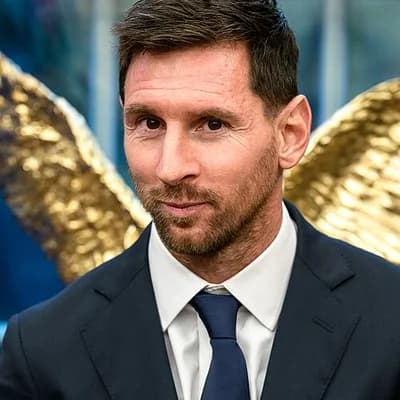
Hossein Zohrevand / Tasnim News Agency, 2022 · CC BY 4.0
Lionel Messi
The sky of a lifetime, read in reverse
Birth time from a 2020 video interview with Messi's mother. Not verified by birth certificate. House positions and angles are approximate.
The journey
January 1, 1995
January 1, 1995 · Age 7
Newell's Old Boys
Joins the youth academy of Newell's Old Boys in Rosario.
The natal chart
14 bodies positioned by NASA JPL DE441 ephemerides
| Body | Sign | Position | House |
|---|---|---|---|
| Sun | Cancer | 02°44' | H8 |
| Moon | Gemini | 16°56' | H7 |
| Mercury | Cancer | 16°19'Rx | H8 |
| Venus | Gemini | 16°32' | H7 |
| Mars | Cancer | 22°23' | H8 |
| Jupiter | Aries | 25°00' | H5 |
| Saturn | Sagittarius | 16°44'Rx | H1 |
| Uranus | Sagittarius | 24°23'Rx | H1 |
| Neptune | Capricorn | 06°43'Rx | H2 |
| Pluto | Scorpio | 07°18'Rx | H12 |
| Chiron | Gemini | 23°07' | H7 |
| Lilith | Cancer | 23°48' | H8 |
| North Node | Aries | 07°14' | H5 |
| South Node | Libra | 07°14' | H11 |
Pluto in Scorpio (1983-1995)
From the same generation
A parallel life
Lionel Andrés Messi Cuccittini was born on June 24, 1987, in Rosario, Argentina's third-largest city, sprawled along the western bank of the Paraná River. His father, Jorge Horacio Messi, worked at a steel factory. His mother, Celia María Cuccittini, cleaned offices. The family — parents and four children — lived in a modest house in the southern barrio of Las Heras.
He started kicking a ball almost as soon as he could walk. By age five he played for Grandoli, a neighborhood club coached by his father. At six he moved to Newell's Old Boys, one of Rosario's two major clubs, joining a youth squad called "The Machine of '87." In six seasons they lost one match.
Around age ten, a doctor diagnosed him with growth hormone deficiency. Without treatment, his bones would stop growing well short of adult height. The injections cost roughly $900 a month. Newell's covered part of it for a time. Then they stopped. His father's insurance picked up some of the bill. The family scraped together the rest.
In September 2000, a football agent named Horacio Gaggioli arranged a tryout at FC Barcelona. Carles Rexach, the club's sporting director, watched the thirteen-year-old play on a rainy pitch and decided within minutes. When the club's board hesitated, Rexach wrote the terms on whatever was at hand — by most accounts, a paper napkin. The contract was dated December 14, 2000.
In February 2001, the Messi family — Lionel, his father, and his mother — left Rosario for Barcelona. His older brothers stayed behind. His mother returned to Argentina after a year, unable to settle. The boy was left with his father in a foreign city, speaking a language he barely knew, smaller than every other kid at La Masia, Barcelona's youth residence.
He grew. The hormones worked. By fourteen he was playing against boys two and three years older. By sixteen he had reached the reserve team. On November 16, 2003, at age sixteen years and 145 days, he played his first friendly for the senior squad, against Porto. The following October — October 16, 2004 — he made his competitive debut against Espanyol in a derby, coming on as a substitute in the 82nd minute. He was seventeen.
On May 1, 2005, he scored his first official goal for Barcelona, a chip against Albacete, assisted by Ronaldinho. He was seventeen years, ten months, and seven days old — the youngest player to score a league goal for the club at that time. By the end of that season he had a first-team contract and a number: 30, then 19.
The 2005-06 season brought his first Champions League campaign. He scored against Panathinaikos in the group stage but tore his hamstring in March, missing the final in Paris. Injuries would recur — the right thigh, the left knee, a stress fracture in the foot. For three seasons between 2005 and 2008 he was intermittently sidelined, a talent that kept short-circuiting.
Then 2008-09 happened. Under Pep Guardiola, Barcelona played a style of football that looked less like a sport and more like an argument — possession as a form of control, the ball always moving, always found. Messi, now wearing the number 10, scored 38 goals in all competitions. He headed in the second goal in the Champions League final against Manchester United in Rome on May 27, 2009. Barcelona won the treble: league, Copa del Rey, Champions League. He was twenty-one.
In December 2009, he won the Ballon d'Or for the first time. He won it again in 2010, 2011, and 2012 — four consecutive awards, unprecedented. In 2012, he scored 91 goals in a calendar year, surpassing Gerd Müller's record of 85 from 1972. That number — ninety-one — became a kind of shorthand for the unreasonable.
Barcelona kept winning. The club took the Champions League again in 2011 (3-1 against Manchester United at Wembley, Messi scoring the third) and in 2015 (Juventus, 3-1 in Berlin, part of a second treble under Luis Enrique). Messi won La Liga ten times between 2005 and 2021. He scored 672 goals for Barcelona in 778 appearances — both records the club is unlikely to see broken.
Argentina was different. He played his first senior international at seventeen, his first World Cup at eighteen (Germany, 2006). He scored, but Argentina lost in the quarterfinals. In 2010 (South Africa), they lost in the same round, 4-0 to Germany. In 2014, in Brazil, Argentina reached the final. Messi played every minute of every match. They lost to Germany 1-0 in extra time at the Maracanã. He won the tournament's Golden Ball — best player — and looked, at the award ceremony, like a man holding someone else's trophy.
He lost the Copa América final in 2015 (Chile, on penalties) and again in 2016 (Chile, on penalties again). After the second loss, standing on the pitch at MetLife Stadium in New Jersey, he announced his retirement from international football. He was twenty-nine. He reversed the decision within weeks, but the pattern — brilliance in Barcelona, frustration with Argentina — had calcified into a narrative that followed him everywhere.
Off the pitch, trouble arrived on July 6, 2016, when a Spanish court sentenced Messi and his father Jorge to 21 months in prison for tax fraud — three counts, totaling 4.1 million euros in undeclared income between 2007 and 2009. Messi said he signed documents his father and advisors placed in front of him without reading them. The judge did not find this defense persuasive but suspended the sentence (under two years for a first offense in Spain). The prison term was later commuted to a fine of roughly €2 million.
He won a fifth Ballon d'Or in 2015, a sixth in 2019. The individual awards piled up — European Golden Shoe (six times), FIFA Best Player (twice), Pichichi Trophy (eight times). But by 2020, something had shifted. Barcelona's finances were unraveling. The squad was aging. In August 2020, Messi sent a burofax — a certified letter under Spanish law — asking to leave the club. Barcelona's president, Josep Maria Bartomeu, refused to honor the exit clause. Messi stayed, unhappily, for one more season.
On August 5, 2021, Barcelona held a press conference to announce that Messi would not be returning. La Liga's salary cap rules meant the club could not register his new contract. Messi cried at the podium. His wife Antonela sat in the audience, crying too. He was thirty-four, and the only professional club he had ever known could no longer afford him. "I wasn't ready for this," he said.
He signed with Paris Saint-Germain on August 10, 2021. Two seasons in Paris — 32 goals, 35 assists, a Ligue 1 title — but a strained relationship with the club and its fans, who booed him after a Champions League elimination in March 2023.
The redemption, if the word applies, came with Argentina. On July 10, 2021, a month before leaving Barcelona, Argentina beat Brazil 1-0 in the Copa América final at the Maracanã. Ángel Di María scored. Messi fell to his knees on the pitch, teammates piling on top of him. His first major international title, at thirty-four, in the same stadium where the 2014 final had ended the other way.
Then Qatar. The 2022 World Cup final, on December 18, is difficult to describe without hyperbole, so here are the facts: Argentina led France 2-0 (Messi scored the first, from the penalty spot, in the 23rd minute). Kylian Mbappé scored twice in 97 seconds to force extra time. Messi scored again in the 108th minute. Mbappé completed his hat trick from the penalty spot in the 118th. It ended 3-3. Argentina won on penalties, 4-2. Messi lifted the trophy in a bisht, a ceremonial Arab robe placed over his shoulders by the Emir of Qatar. He was thirty-five.
Seventh Ballon d'Or, November 2021, awarded partly for the Copa América. Eighth Ballon d'Or, October 2023, awarded for the World Cup. The tally — eight — has no precedent in the award's history, which dates to 1956.
On July 1, 2023, he signed with Inter Miami CF in Major League Soccer. The move was widely expected — Apple TV held a broadcast deal, Adidas had commercial interests, and David Beckham, Inter Miami's co-owner, had been courting him for years. He scored a free kick in stoppage time of his debut match, on July 21, against Cruz Azul in the Leagues Cup. He won the tournament, scoring ten goals in eight matches.
On July 14, 2024, Argentina won a second consecutive Copa América, beating Colombia 1-0 in extra time in Miami. Messi injured his right ankle during the final — a ligament tear — and left the pitch in tears in the second half. The team won without him. It was, by most measures, Argentina's most dominant stretch in international football: two Copa Américas and a World Cup in three years.
In 2024, he was named MLS Most Valuable Player. Inter Miami won the Supporters' Shield with 74 points, a league record. The following year, 2025, the club won the MLS Cup and the Eastern Conference title.
As of May 2026, Messi remains under contract with Inter Miami. He is thirty-eight. He has not announced his retirement. The question of when he will stop playing is asked constantly and answered, by him, almost never. He lives in Fort Lauderdale with Antonela Roccuzzo — married since 2017 — and their three sons: Thiago (born 2012), Mateo (2015), and Ciro (2018).
The numbers, stripped of context: 838 career club goals, 112 international goals, 45 major trophies with club and country, eight Ballons d'Or. Enough digits to fill a ledger, not enough words to explain why a left-footed kid from Rosario, too small for his own skeleton, ended up here.
Sources and notes
Natal data
Rodden Rating B. Biographical sources; original birth certificate not independently verified. Chart calculated by Astrian's engine using NASA JPL DE441 ephemerides, sub-arcsecond precision. Timezone: UTC-3 (Rosario).
Primary biographical sources
- Balague, Guillem. Messi. Orion Books, 2013.
- Lowe, Sid. Fear and Loathing in La Liga. Yellow Jersey Press, 2013.
- Burns, Jimmy. Messi: The Boy Who Became a Legend. Pan Macmillan, 2011.
The astronomical data in this profile is drawn from NASA JPL DE441 ephemerides, calculated using Astrian's engine. Astrological interpretation presents symbolic readings within the tradition's own framework. Astrian makes no claim that any planetary position caused, predicted, shaped, or determined any biographical event or personal characteristic.