PROFILE · SPORTS
Joe Frazier
Joseph William Frazier
boxer
Born 12 January 1944 · Beaufort, South Carolina, United States · 32.43° N, 80.69° WX
Source: Birth time not documented in publicly accessible records
About this chart
No birth time is documented for this person. The chart therefore shows planetary positions in their signs, the slow aspects between them, and the generational context — but not house placements, the Ascendant, or the Midheaven, which require an accurate birth time. The Moon's sign carries a ±6° margin: if it falls near a sign boundary, the sign could vary. Positions for all other planets are reliable.
Do you have a verified source for this birth time? Share it →
The sky at birth
No birth time is documented for Joe Frazier. The Ascendant, the Midheaven, and the house positions cannot be determined; the reading is confined to planetary sign placements and the aspects between planets. The positions below are calculated for noon local time and are accurate to a fraction of a degree for the slow-moving bodies.
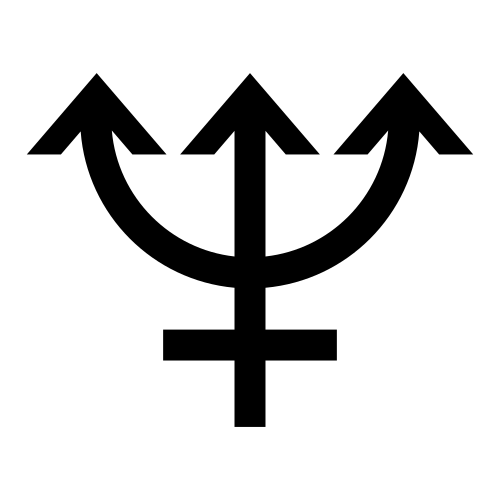
The Moon is near 15°54' Leo (noon position, ±7° margin). Sun is at 21°20' Capricorn. Mercury is at 12°42' Capricorn, retrograde. Venus is at 11°18' Sagittarius. Mars is at 4°53' Gemini. Jupiter is at 25°39' Leo, retrograde. Saturn is at 21°01' Gemini, retrograde. Uranus is at 5°13' Gemini, retrograde. Neptune is at 4°14' Libra, retrograde. Pluto is at 7°57' Leo, retrograde.
3 bodies occupy Leo (Moon, Jupiter and Pluto) and 3 bodies occupy Gemini (Mars, Saturn and Uranus) — a concentration that stands out as a structural feature of the chart.
The tightest major aspects between planets: Mars conjunct Uranus (0°20'); Mars trine Neptune (0°40'); Uranus trine Neptune (1°00'); Uranus sextile Pluto (2°43'); Mars sextile Pluto (3°04'); Venus trine Pluto (3°21').
Uranus trine Neptune (1°00') is structural but generational — an alignment of slow-moving outer planets shared across many birth years.
The engine also registers tight minor aspects involving asteroids and calculated points: Jupiter sesquiquadrate Pallas (0°01'); Moon semi-sextile Chiron (0°14'); Pallas sesquiquadrate Lilith (0°16'); Jupiter conjunct Lilith (0°17'). These are reported for completeness and carry less weight in traditional reading.
The chart was calculated using NASA JPL DE441 ephemerides, sub-arcsecond precision.
| Planet | Sign | Position |
|---|---|---|
| Sun | Capricorn | 21°20' |
| Moon | Leo | 15°54'±6° |
| Mercury | Capricorn | 12°42'retrograde |
| Venus | Sagittarius | 11°18' |
| Mars | Gemini | 04°53' |
| Jupiter | Leo | 25°39'retrograde |
| Saturn | Gemini | 21°01'retrograde |
| Uranus | Gemini | 05°13'retrograde |
| Neptune | Libra | 04°14'retrograde |
| Pluto | Leo | 07°57'retrograde |
| Chiron | Virgo | 15°39'retrograde |
 Sun
Sun Moon
Moon Mercury
 Venus
Venus Mars
Mars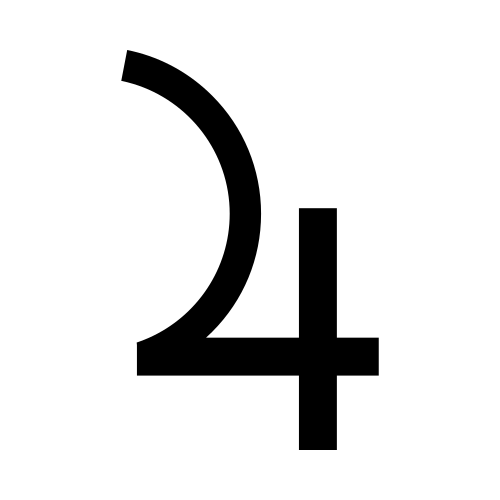 Jupiter
 Saturn
 Uranus
 Neptune
 Pluto
Pluto Chiron
Birth time unknown — house positions and Ascendant/MC are not available.
Astronomical context
Pluto moved through Leo from the late 1930s to the late 1950s. In astrological tradition this transit is associated with the collective transformation of self-expression, authority, and the cult of the individual — the cohort that rebuilt the post-war world and expanded mass culture.
Joe Frazier (born 1944) belongs to this generational configuration. Astrian groups profiles by such shared signatures rather than by any claim of shared destiny. Related profiles in Astrian: George Foreman · Óscar de la Hoya · Rocky Marciano. The symbolic reading is correlative, not causal.
Other profiles from this Pluto in Leo generation
Symbolic reading
The following describes what classical astrological tradition associates with these configurations. Astrian does not apply these descriptions to the person's biography.
The Sun in Capricorn is the most prominent structural feature available without a birth time, centring the chart on ambition, structure, and the long view. There is no Ascendant or Midheaven to anchor the angles, so the reading rests on sign placements and the aspects between planets rather than on houses.
Among the personal planets, the Moon in Leo is associated in tradition with expression, pride, and the creative self (the Moon's sign is given for the noon chart and may shift with an exact time); Mercury in Capricorn with ambition, structure, and the long view; Venus in Sagittarius with expansion, conviction, and the horizon; and Mars in Gemini with curiosity, exchange, and versatility. These placements describe registers of feeling, thought, attraction, and action as the tradition catalogues them, independent of the life that follows.
Mars conjunct Uranus (0°20'): tradition reads drive, assertion, and action fused with disruption and innovation.
Mars trine Neptune (0°40'): tradition reads drive, assertion, and action in easy flow with dissolution, imagination, and idealism.
Uranus trine Neptune (1°00'): tradition reads disruption and innovation in easy flow with dissolution, imagination, and idealism.
Uranus sextile Pluto (2°43'): tradition reads disruption and innovation in supportive contact with depth, power, and transformation.
These placements are presented as a symbolic portrait, correlative and never causal — a description within the tradition's vocabulary, not an explanation of the life that follows.
Astrology is a symbolic language with 2,500 years of literature. The reading above is interpretive, not explanatory.
Astrian does not claim that the natal chart of Joe Frazier caused or determined any of the above. Astrology is a symbolic system with 2,500 years of literature. Its capacity for retrospective description does not imply explanatory capacity.
A parallel life
The following are verified biographical facts. No connection to the natal chart is implied.
Joseph William Frazier was born on January 12, 1944, in Beaufort, South Carolina, one of thirteen children in a family of sharecroppers. He grew up in poverty in the rural South and moved to New York and later Philadelphia as a young man, working in a slaughterhouse while training at the Police Athletic League gym.
Frazier represented the United States at the 1964 Summer Olympics in Tokyo, where he won the heavyweight gold medal despite competing with a broken thumb. He turned professional shortly afterward and compiled a strong record in the late 1960s, claiming the New York State heavyweight title and then the undisputed heavyweight world championship in 1970 by defeating Jimmy Ellis.
Frazier's most celebrated period came through his rivalry with Muhammad Ali. On March 8, 1971, the two undefeated heavyweight champions met at Madison Square Garden in the fight billed as the "Fight of the Century." Frazier won by unanimous decision after knocking Ali down in the 15th round. This was the first professional loss of Ali's career. The two fought twice more: Ali won the rematch in 1974, and Ali stopped Frazier in their third meeting, the "Thrilla in Manila" in 1975, in one of the most physically demanding bouts in boxing history.
Frazier also faced George Foreman twice; he lost both fights, including the first, in Kingston, Jamaica in 1973, when Foreman knocked him down six times. Frazier retired from professional boxing in 1981 with a record of 32 wins, 4 losses, and 1 draw.
Joe Frazier died on November 7, 2011, in Philadelphia, Pennsylvania, from liver cancer. He was inducted into the International Boxing Hall of Fame in 1990 and is widely regarded as one of the greatest heavyweight boxers in history.
Biographical sources
- Fra.
This profile presents the sky at the birth of Joe Frazier and verified facts of their biography. Astrian does not claim that astrology has predictive capacity or that the natal chart determines the trajectory of a life. Astrology is a symbolic system with 2,500 years of literature. Its capacity for retrospective description does not imply explanatory capacity.
Related profiles
Calculate your own birth chart with the same NASA JPL DE441 precision.
Calculate my birth chartLast updated: June 14, 2026
Newsletter
A short reading once a month, in your inbox.
A note on the symbolism of the season, recent editorial pieces, and what to look for in next month's sky. No predictions.
Support this project
Independent, no venture funding, no ads. A contribution keeps Astrian precise and free.
Support on Ko-fi (opens in new tab)