PROFILE · SPORTS
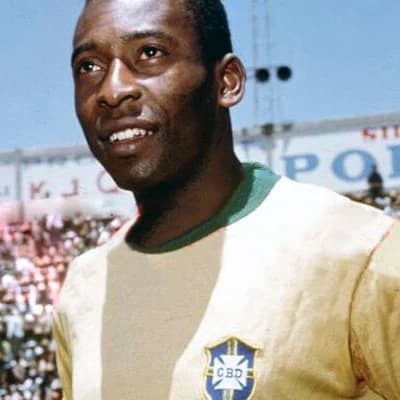
Pelé
Edson Arantes do Nascimento
footballer
Born 21 October 1940 · 03:00 · 15:14 UTC · Três Corações, Brazil · 21.73° S, 45.25° WA
Source: Memory / biography
The sky at birth
The Ascendant falls at 9°29' Virgo. Three planets occupy the first house: Mars at 10°06' Libra, Venus at 16°28' Virgo, and Neptune at 26°25' Virgo. Two of the three are in Virgo; Mars has crossed into Libra. The first house spans from Virgo 9°29' through the Virgo-Libra boundary into Libra.
The Sun at 27°41' Libra is in the second house, 2°19' before the Scorpio boundary. The Midheaven falls at 15°31' Gemini. The Moon at 22°00' Gemini is in the tenth house, 6°29' past the Midheaven cusp.
Mercury at 22°00' Scorpio is in the third house. Jupiter at 12°19' Taurus and Saturn at 12°23' Taurus are both in the eighth house, retrograde. Pluto at 4°17' Leo is in the eleventh house.
The tightest planet-to-planet aspect is Jupiter conjunct Saturn at 0°04': both at virtually the same degree of Taurus in the eighth house, retrograde. Jupiter and Saturn conjunctions recur approximately every twenty years; this one was among the tightest of the century.
The Moon at Gemini 22°00' and Mercury at Scorpio 22°00' form a quincunx — a 150° angle — at 0°00' orb. Both bodies share the same degree number in signs that are 150° apart. An exact quincunx of this precision is unusual.
Venus at Virgo 16°28' and Neptune at Virgo 26°25' share the first house in the same sign, separated by 9°57'. Mars at Libra 10°06' and Sun at Libra 27°41' share a sign, with Mars in the first house and the Sun in the second, separated by 17°35'.
The birth time carries Rodden rating A, derived from biographical sources. House cusps and the Ascendant carry more uncertainty than Rodden AA records.
The chart was calculated by Astrian's engine using NASA JPL DE441 ephemerides, sub-arcsecond precision (RMS error below 0.06 arcseconds). Timezone: Brasília Time, UTC −3:00, observed in Brazil. ---
| Planet | Sign | Position | House |
|---|---|---|---|
| Ascendant | Virgo | 09°30' | — |
| Midheaven | Gemini | 15°31' | — |
| Sun | Libra | 27°41' | H2 |
| Moon | Gemini | 22°00' | H10 |
| Mercury | Scorpio | 22°00' | H3 |
| Venus | Virgo | 16°28' | H1 |
| Mars | Libra | 10°06' | H1 |
| Jupiter | Taurus | 12°19'retrograde | H8 |
| Saturn | Taurus | 12°23'retrograde | H8 |
| Uranus | Taurus | 25°10'retrograde | H9 |
| Neptune | Virgo | 26°25' | H1 |
| Pluto | Leo | 04°17' | H11 |
| Chiron | Leo | 01°04' | H11 |
 Sun
Sun Moon
Moon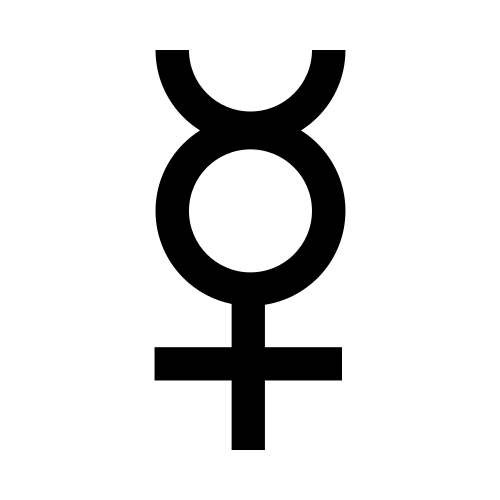 Mercury
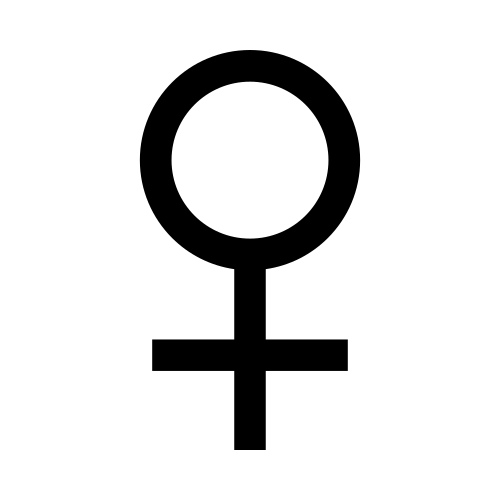 Venus
Venus Mars
Mars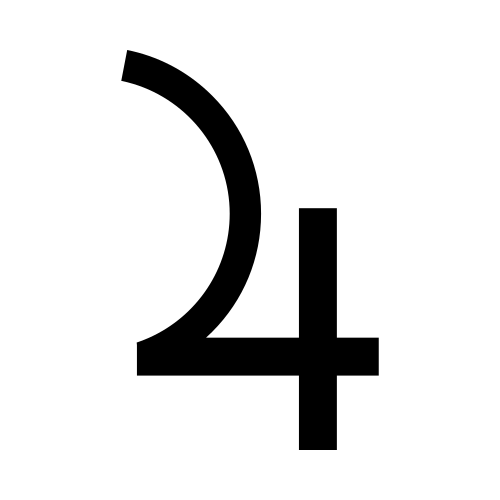 Jupiter
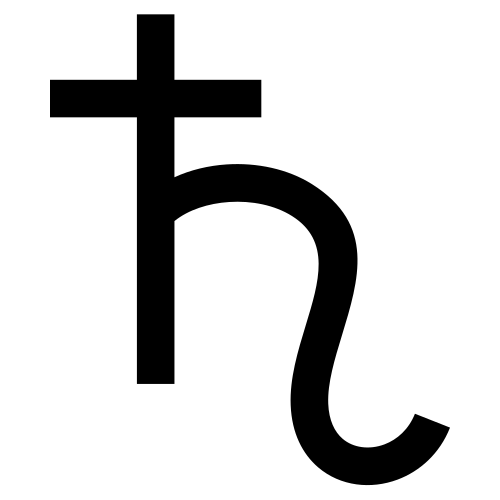 Saturn
 Uranus
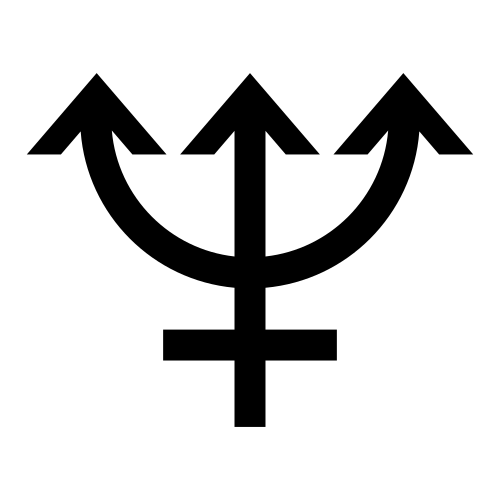 Neptune
 Pluto
Pluto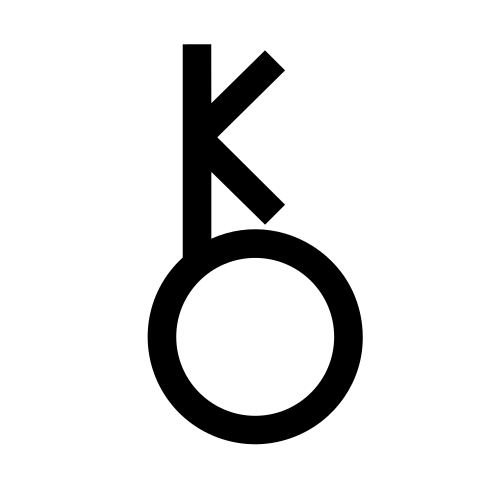 Chiron
Astronomical context
Those born between approximately 1937 and 1958 carried Pluto in Leo. Pelé was born in 1940, in the early part of this transit. The generation includes, among others, John Lennon (born 1940, Pluto in Leo) and Bob Dylan (born 1941, Pluto in Leo).
In astrological tradition, Pluto in Leo is associated with transformative pressure applied to the domains Leo governs: individual identity, self-expression, creative authority, performance, and the display of power. The historical period of this transit coincided with the Second World War and the postwar emergence of global mass media and celebrity culture — both of which concentrated attention on individual figures of exceptional ability or charisma with a new intensity and reach.
The generation that carried Pluto in Leo came of age as the first to be substantially shaped by television, international sports broadcasting, and recorded music. The mechanisms of mass reproduction and transmission that define modern celebrity did not predate them; this generation grew up inside their construction. The symbolic reading is correlative, not causal. ---
Other profiles from this Pluto in Leo generation
Symbolic reading
The following describes what classical astrological tradition associates with these configurations. Astrian does not apply these descriptions to the person's biography.
An Ascendant at 9°29' Virgo with three planets in the first house — Mars, Venus, Neptune — crowding the house of self-presentation and immediate physical projection. In traditional vocabulary, Mars carries associations with drive, physical force, and competitive energy; Venus with affinity and relational quality; Neptune with image, dissolution of the specific into the universal, and the projected rather than the actual. Three planets in the same house, spanning two signs, concentrates their vocabulary in the domain of how the person enters the world and presents to it.
Jupiter conjunct Saturn at 0°04' in Taurus, both retrograde in the eighth house: these are two planets whose traditional associations stand in opposition — Jupiter as expansion, abundance, and generosity; Saturn as contraction, structure, and the discipline of form — at the tightest orb in the chart, in the same sign and house, both moving backward through the sky at the moment of birth. In traditional vocabulary, the eighth house governs depth, hidden resources, and what cannot be immediately seen.
Moon at Gemini 22°00' quincunx Mercury at Scorpio 22°00' at 0°00' orb: the exact same degree in signs 150° apart. The quincunx, in traditional vocabulary, is an angle of adjustment between modes that cannot be reconciled by element or quality. Moon and Mercury share no element, no quality, no traditional relationship in Gemini and Scorpio. The exactness of the 0°00' orb at the same degree number is a structural observation.
The Moon at 22°00' Gemini is 6°29' past the Midheaven in the tenth house. In traditional vocabulary, the tenth house governs what is publicly visible — vocational trajectory, public position, the face the world sees. A body near the MC angle occupies a position of angular emphasis.
Astrology is a symbolic language with 2,500 years of literature. The reading above is interpretive, not explanatory.
Astrian does not claim that the natal chart of Pelé caused or determined any of the above. Astrology is a symbolic system with 2,500 years of literature. Its capacity for retrospective description does not imply explanatory capacity.
A parallel life
The following are verified biographical facts. No connection to the natal chart is implied.
Edson Arantes do Nascimento was born on October 21, 1940, in Três Corações, a small city in the state of Minas Gerais, Brazil. His father, João Ramos do Nascimento, known as Dondinho, was a semi-professional footballer whose career had been curtailed by injury. The family moved to Bauru in São Paulo state when Edson was a young child. They were poor; he played with improvised balls — stuffed socks, a grapefruit — in the streets of Bauru.
By his early teens, he had been noticed by Waldemar de Brito, a former member of the Brazilian national team, who arranged for him to trial at Santos FC, a professional club in the city of Santos. He signed with Santos in 1956 at the age of fifteen, taking the nickname he would carry for the rest of his life. The origin of the name Pelé is not documented; he himself claimed not to know its derivation.
In July 1957, at sixteen, he made his debut for the Brazilian national team. At the 1958 FIFA World Cup in Sweden, he became the youngest player to appear in a World Cup final at seventeen years and 249 days; Brazil defeated Sweden 5–2 in the final, and Pelé scored twice. He finished the tournament with six goals. At seventeen, he was the youngest player ever to win a World Cup.
Santos won the Campeonato Brasileiro in 1961, 1962, 1963, 1964, 1965, and 1968. In 1962 and 1963, Santos won the Copa Libertadores de América — the South American club championship — and the Intercontinental Cup (then the de facto world club championship), defeating the European champions in both years: Benfica in 1962 and AC Milan in 1963.
At the 1962 World Cup in Chile, Pelé was injured in the second group-stage match and did not play again in the tournament; Brazil won the championship without him. At the 1966 World Cup in England, he was repeatedly fouled in the opening rounds — kicked out of the tournament by opponents who had identified fouling as the effective strategy for stopping him — and Brazil was eliminated in the group stage. He publicly stated he did not wish to play in another World Cup.
He was persuaded to play in 1970. At the World Cup in Mexico, he played in what is routinely described as the greatest Brazil team ever assembled, alongside Rivelino, Jairzinho, Gerson, and Tostão. Brazil won all six matches. The team's opening goal in the final against Italy — a Pelé header — was followed by one of the most celebrated sequences of passing in the history of the sport. Brazil won 4–1. Pelé was named the tournament's best player.
He played for Santos until 1974. He retired briefly, then signed with the New York Cosmos in the North American Soccer League in 1975, in a deal widely understood as a deliberate effort to develop football's audience in the United States. He played his final official competitive match in October 1977. In a farewell game, he played the first half for the Cosmos and the second half for Santos; the match was watched by an estimated audience of 75 million on television.
His career goals total is the subject of ongoing debate: the figure most commonly cited by FIFA is 757 goals in 812 official matches, making him the record holder for goals in a single club (for Santos). Including unofficial matches, the total exceeds 1,000 by most counts.
He was appointed Brazil's Minister of Sport in 1995 under President Fernando Henrique Cardoso. He served until 1998, during which time he sponsored the Pelé Law (Lei Pelé), a major reform of Brazilian football's regulatory framework.
Pelé died on December 29, 2022, at the Albert Einstein Hospital in São Paulo, following complications from colon cancer diagnosed in 2021. He was eighty-two years old.
Biographical sources
- Bellos, Alex. Futebol: The Bra*.
This profile presents the sky at the birth of Pelé and verified facts of their biography. Astrian does not claim that astrology has predictive capacity or that the natal chart determines the trajectory of a life. Astrology is a symbolic system with 2,500 years of literature. Its capacity for retrospective description does not imply explanatory capacity.
Related profiles
Calculate your own birth chart with the same NASA JPL DE441 precision.
Calculate my birth chartLast updated: June 12, 2026
Newsletter
A short reading once a month, in your inbox.
A note on the symbolism of the season, recent editorial pieces, and what to look for in next month's sky. No predictions.
Support this project
Independent, no venture funding, no ads. A contribution keeps Astrian precise and free.
Support on Ko-fi (opens in new tab)