PROFILE · SPORTS
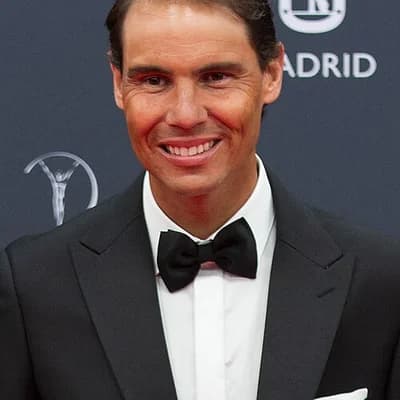
Rafael Nadal
Rafael Nadal Parera
tennis player
Born 3 June 1986 · Manacor, Majorca, Spain · 39.57° N, 3.21° EX
Source: Birth time not documented in publicly accessible records
About this chart
No birth time is documented for this person. The chart therefore shows planetary positions in their signs, the slow aspects between them, and the generational context — but not house placements, the Ascendant, or the Midheaven, which require an accurate birth time. The Moon's sign carries a ±6° margin: if it falls near a sign boundary, the sign could vary. Positions for all other planets are reliable.
Do you have a verified source for this birth time? Share it →
The sky at birth
No birth time is documented for Rafael Nadal. The Ascendant, Midheaven, and house positions cannot be determined. The planetary positions below are calculated for noon local time and are accurate to within a fraction of a degree for the slow-moving planets. The Moon's position carries a margin of approximately ±7°.
The Sun is at 12°32' Gemini. The Moon is at 27°07' Aries (noon position, ±7° margin). Mercury is at 25°47' Gemini. Venus is at 15°21' Cancer. Mars is at 22°55' Capricorn. Jupiter is at 20°28' Pisces. Saturn is at 5°56' Sagittarius R. Uranus is at 20°42' Sagittarius R. Neptune is at 5°01' Capricorn R. Pluto is at 4°59' Scorpio R.
Neptune at 5°01' Capricorn retrograde sextiles Pluto at 4°59' Scorpio retrograde (0°02') — functionally exact and the tightest aspect in the chart, though this is a generational configuration shared by everyone born in this period. Jupiter at 20°28' Pisces squares Uranus at 20°42' Sagittarius retrograde (0°14') — the tightest personal aspect, also functionally exact. The Moon at 27°07' Aries sextiles Mercury at 25°47' Gemini (1°20'), though this aspect carries the Moon's ±7° uncertainty. Mars at 22°55' Capricorn sextiles Jupiter (2°27'). The Moon squares Mars (4°12'), within the Moon's uncertainty margin.
The engine also identifies the following tight minor aspects involving asteroids and calculated points: neptune sextile pluto (0.03° app); sun semi-square northNode (0.16° app); mars semi-square juno (0.17° app); jupiter square uranus (0.25° app).
The tightest major aspects between planets: Neptune sextile Pluto (0°02'), Jupiter square Uranus (0°14'), Moon sextile Mercury (1°20'), Mars sextile Jupiter (2°27'), Moon square Mars (4°12').
The chart was calculated by Astrian's engine using NASA JPL DE441 ephemerides, sub-arcsecond precision. Timezone: Europe/Madrid (Central European Summer Time, UTC +2).
| Planet | Sign | Position |
|---|---|---|
| Sun | Gemini | 12°32' |
| Moon | Aries | 27°07'±6° |
| Mercury | Gemini | 25°47' |
| Venus | Cancer | 15°21' |
| Mars | Capricorn | 22°55' |
| Jupiter | Pisces | 20°28' |
| Saturn | Sagittarius | 05°56'retrograde |
| Uranus | Sagittarius | 20°42'retrograde |
| Neptune | Capricorn | 05°01'retrograde |
| Pluto | Scorpio | 04°59'retrograde |
| Chiron | Gemini | 14°55' |
 Sun
Sun Moon
Moon Mercury
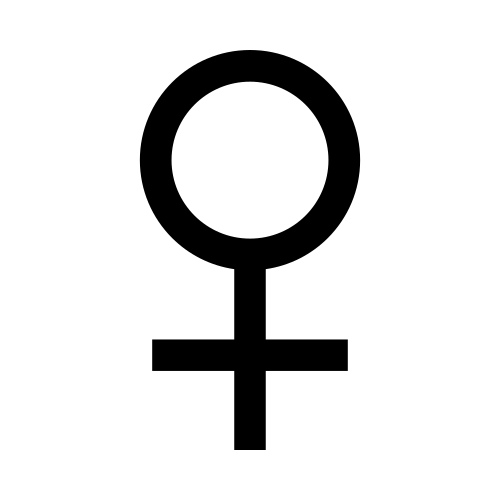 Venus
Venus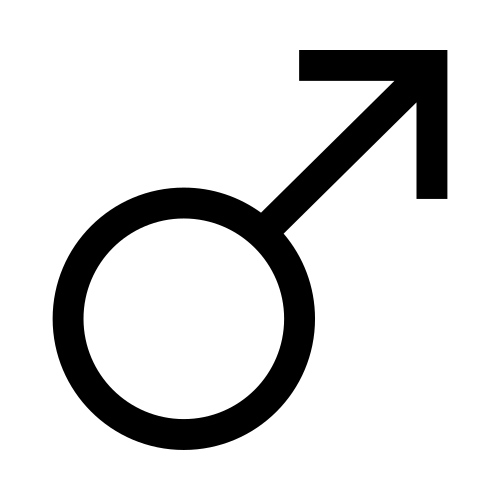 Mars
Mars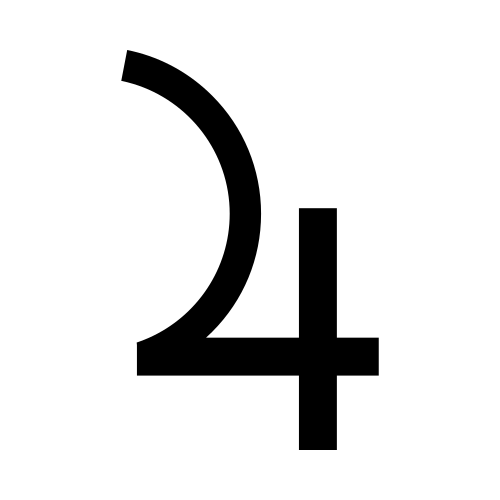 Jupiter
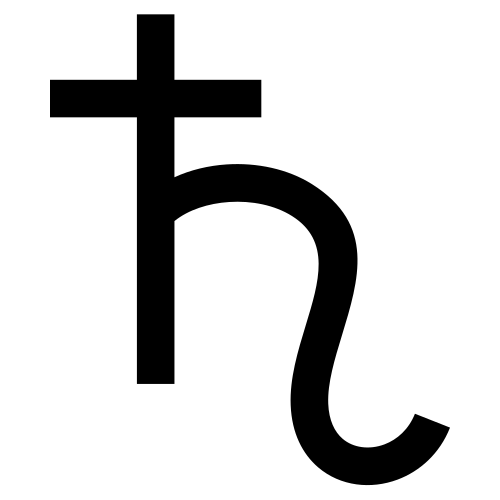 Saturn
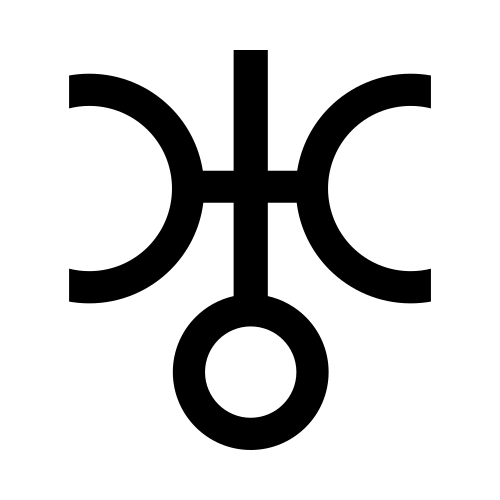 Uranus
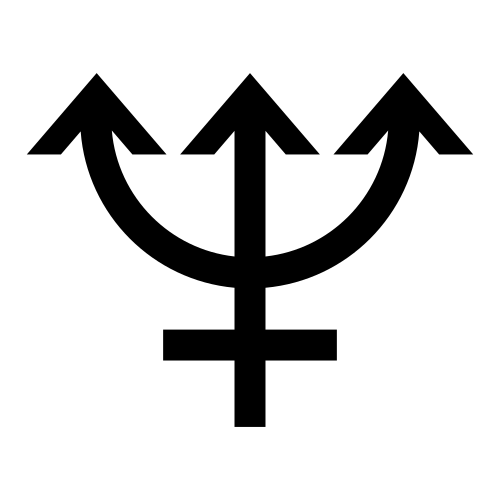 Neptune
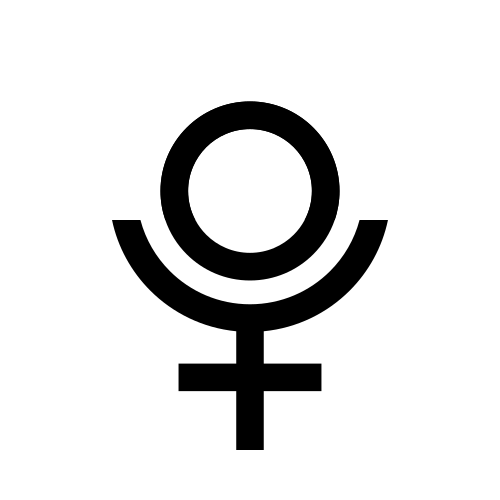 Pluto
Pluto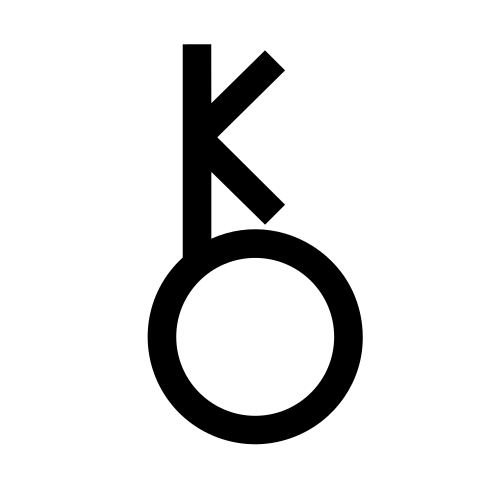 Chiron
Birth time unknown — house positions and Ascendant/MC are not available.
Astronomical context
Those born between approximately 1984 and 1995 carried Pluto in Scorpio. This generation arrived in the world during the final years of the Cold War, the fall of the Berlin Wall, the emergence of the internet as a mass medium, and the HIV/AIDS crisis that transformed public discourse around sexuality, mortality, and the body. They grew up in the digital transition — the last generation to remember life before the internet, the first to be shaped by it.
In astrological tradition, Pluto in Scorpio is associated with collective transformation of the domains that sign governs: power, sexuality, death, regeneration, psychological depth, and the hidden structures that operate beneath the visible surface of life. Scorpio is the sign of depth, of the investigator, of the one who descends into what is concealed in order to understand what is real. Pluto's transit through its own sign (Scorpio is ruled by Pluto in modern astrology) is read as a period of intensified transformation — the deepest structures of power, the most hidden mechanisms of control, subjected to their own methods. The symbolic reading is correlative, not causal.
Other profiles in the Astrian collection born under this configuration include Luka Modric (1985) and Neymar (1992). Rafael Nadal, born in 1986, belongs to the early years of this generational wave.
Other profiles from this Pluto in Scorpio generation
Symbolic reading
The following describes what classical astrological tradition associates with these configurations. Astrian does not apply these descriptions to the person's biography.
The Sun at 12°32' Gemini is the most prominent structural feature of this chart. Without a documented birth time, there is no Ascendant or Midheaven — the reading is confined to planetary positions by sign and the aspects between planets.
The Moon at 27°07' Aries represents the noon position; the actual placement falls within approximately 7° on either side. If born early in the day, the Moon could be near 20° Aries; if born late, near 4° Taurus — meaning the Moon's sign placement in Aries is probable but not certain for the entire day.
Mercury at 25°47' Gemini, Venus at 15°21' Cancer, and Mars at 22°55' Capricorn complete the personal planet picture. The Sun and Mercury in Gemini, Mars in Capricorn — a configuration that distributes the personal energies across signs of adaptability (Gemini) and disciplined execution (Capricorn).
### Jupiter square Uranus: expansion against disruption
The chart's tightest personal aspect is Jupiter at 20°28' Pisces square Uranus at 20°42' Sagittarius retrograde, orb 0°14' — functionally exact. Jupiter governs expansion, faith, and the instinct toward the large gesture. Uranus governs disruption, the unexpected, and the introduction of what has never been seen before. Their square creates structural tension: the expansive faculty and the disruptive faculty are in friction.
Jupiter in Pisces expands through the register of the intuitive, the fluid, the emotional — faith expressed through feeling rather than analysis. Uranus in Sagittarius retrograde disrupts through the register of philosophy, adventure, and the insistence on a larger truth. The square reads as a configuration where the capacity for belief and emotional expansion exists in constant tension with the impulse to break through established patterns. Neither faculty rests; each presses against the other. The result is not paralysis but a dynamic restlessness — a drive that expands and then disrupts its own expansion, that achieves and then reinvents the terms of achievement.
### Mars sextile Jupiter: disciplined action meets expansive will
Mars at 22°55' Capricorn sextiles Jupiter at 20°28' Pisces, orb 2°27'. Mars governs action, competition, and the physical will. Jupiter governs expansion and the instinct toward justice. The sextile connects them cooperatively. Mars in Capricorn is the most structured placement of the action faculty — disciplined, strategic, relentless, willing to endure. Jupiter in Pisces is the most fluid placement of the expansive faculty — intuitive, emotionally responsive, willing to trust. The sextile reads as a configuration where disciplined physical action (Mars in Capricorn) is amplified by an expansive faith (Jupiter in Pisces) — where the body works within strict discipline and the spirit works beyond it, and the two cooperate.
Mars in Capricorn also connects to the wider chart through its sextile to Jupiter, which in turn squares Uranus. The Mars-Jupiter-Uranus network creates a dynamic chain: disciplined action (Mars) is expanded (Jupiter) and then disrupted (Uranus) — a cycle of endurance, expansion, and reinvention that operates continuously.
### Moon sextile Mercury: feeling and communication
The Moon at 27°07' Aries sextiles Mercury at 25°47' Gemini, orb 1°20' — though this aspect carries the Moon's ±7° uncertainty. If the actual birth time places the Moon near its noon position, the emotional faculty (Moon in Aries — immediate, instinctive, impatient, the feelings that respond first and process later) flows cooperatively with the communication faculty (Mercury in Gemini — quick, adaptable, responsive to the moment). The reading is one of fast emotional intelligence — where the feelings and the mind work at the same speed, both oriented toward immediacy and action.
### Moon square Mars: the emotional confrontation with endurance
The Moon at 27°07' Aries squares Mars at 22°55' Capricorn, orb 4°12' — within the Moon's ±7° uncertainty, though wide enough that the aspect may not be operative if the actual birth time shifts the Moon substantially. If present, the square creates tension between the emotional faculty (Moon in Aries — impulsive, hot, fast) and the action faculty (Mars in Capricorn — disciplined, cold, slow to yield). The reading is one where the emotional immediacy of Aries presses against the strategic patience of Capricorn — where the instinct to respond now is in tension with the capacity to endure indefinitely.
The planetary pattern here is read as a symbolic portrait, not a causal explanation. No planet caused, predicted, or determined any event or characteristic.
Astrology is a symbolic language with 2,500 years of literature. The reading above is interpretive, not explanatory.
Astrian does not claim that the natal chart of Rafael Nadal caused or determined any of the above. Astrology is a symbolic system with 2,500 years of literature. Its capacity for retrospective description does not imply explanatory capacity.
A parallel life
The following are verified biographical facts. No connection to the natal chart is implied.
Rafael Nadal Parera was born on 3 June 1986 in Manacor, a town of approximately 40,000 in the eastern interior of Majorca, the largest of Spain's Balearic Islands. His father, Sebastián Nadal, was a businessman; his mother, Ana María Parera, worked in the family perfume business. The Nadal family was prominent in Manacor: his uncle Miguel Ángel Nadal was a professional footballer who played for FC Barcelona and the Spanish national team; another uncle, Toni Nadal, was a tennis coach who began training Rafael at age three.
Toni's coaching philosophy was austere. He forced Rafael to play left-handed, though the boy was naturally right-handed — a tactical decision that gave Nadal's forehand topspin an unusual trajectory that would become devastatingly effective on clay. Toni was deliberately harsh, refusing to give praise, insisting on humility, punishing any display of complaint or entitlement. Nadal later described the relationship as essential and painful in equal measure.
He turned professional at fifteen. At sixteen he became the youngest player to win an ATP match since 1994. At nineteen, at the 2005 French Open, he won his first Grand Slam title, defeating Mariano Puerta in the final. He would win Roland Garros fourteen times — a record at any single Grand Slam event that may never be surpassed. His record at the French Open was 112 wins and 4 losses.
His dominance on clay was absolute, but his career was defined by the rivalries that extended beyond it. The rivalry with Roger Federer, which began at the 2006 French Open final and reached its apotheosis at Wimbledon 2008 — a five-set match played in fading light and rain, widely described as the greatest tennis match ever played — produced a narrative of contrasts that the sport had never seen: the Swiss classicist against the Majorcan warrior, grass against clay, elegance against intensity, the right hand against the left. Nadal won that match 9-7 in the fifth set.
The later rivalry with Novak Djokovic was harder, longer, and more physically brutal. The three of them — Federer, Nadal, Djokovic — accumulated 66 Grand Slam titles among them and dominated men's tennis for nearly two decades, a concentration of excellence at the top of a professional sport that has few parallels.
Nadal's game was built on physical extremity. The left-handed forehand, struck with more topspin than any other shot in the history of the men's game (measured by Hawk-Eye at over 3,200 revolutions per minute), produced a ball that bounced above shoulder height on clay. His court coverage was superhuman. His willingness to extend rallies into the 20th, 30th, 40th shot — absorbing punishment and returning it with interest — made him the greatest defensive player in the sport's history. But the physical cost was catastrophic. His knees, his feet, his wrists, his abdomen — the body that made the game possible was systematically destroyed by the game itself.
He played with Müller-Weiss syndrome, a degenerative bone condition in his left foot, for much of his career. He underwent multiple surgeries. He missed months and sometimes years to injury. Each return was described as improbable; each proved that the capacity for endurance exceeded what had been thought possible.
Off the court, he remained rooted in Manacor. He did not move to Monaco or Dubai for tax purposes, as many of his contemporaries did. He married his childhood girlfriend, María Francisca Perelló, in 2019. Their son was born in 2022. His foundation, the Rafa Nadal Foundation, focused on education and social integration for disadvantaged youth. He opened a tennis academy in Manacor in 2016.
He retired from professional tennis in November 2024, at the age of thirty-eight, after representing Spain in the Davis Cup Finals in Malaga. His body, he said, could no longer compete at the level he demanded of it. He had won 22 Grand Slam titles — second only to Djokovic's 24 at the time of his retirement, level with the total he and Federer had shared at the top of the all-time list before Djokovic surpassed them both.
Biographical sources
- Nadal, Rafael, and John Carlin. Rafa. Hyperion 2011
- Tignor, Steve. High Strung: Björn Borg, John McEnroe, and the Untold Story of Tennis's Fiercest Rivalry. Harper 2011
- Clarey, Christopher. The Master: The Long Run and Beautiful Game of Roger Federer. Twelve 2021
This profile presents the sky at the birth of Rafael Nadal and verified facts of their biography. Astrian does not claim that astrology has predictive capacity or that the natal chart determines the trajectory of a life. Astrology is a symbolic system with 2,500 years of literature. Its capacity for retrospective description does not imply explanatory capacity.
Related profiles
Calculate your own birth chart with the same NASA JPL DE441 precision.
Calculate my birth chartLast updated: June 12, 2026
Newsletter
A short reading once a month, in your inbox.
A note on the symbolism of the season, recent editorial pieces, and what to look for in next month's sky. No predictions.
Support this project
Independent, no venture funding, no ads. A contribution keeps Astrian precise and free.
Support on Ko-fi (opens in new tab)