PROFILE · SCIENCE & TECHNOLOGY
Alexander von Humboldt
Friedrich Wilhelm Heinrich Alexander von Humboldt
naturalist and explorer
Born 14 September 1769 · Berlin, Prussia · 52.52° N, 13.38° EX
Source: Birth time not documented in publicly accessible records
About this chart
No birth time is documented for this person. The chart therefore shows planetary positions in their signs, the slow aspects between them, and the generational context — but not house placements, the Ascendant, or the Midheaven, which require an accurate birth time. The Moon's sign carries a ±6° margin: if it falls near a sign boundary, the sign could vary. Positions for all other planets are reliable.
Do you have a verified source for this birth time? Share it →
The sky at birth
No birth time is documented for Alexander von Humboldt. The Ascendant, the Midheaven, and the house positions cannot be determined; the reading is confined to planetary sign placements and the aspects between planets. The positions below are calculated for noon local time and are accurate to a fraction of a degree for the slow-moving bodies. One caveat: the Moon lies near a sign boundary, so without an exact time it cannot be fixed to a single sign — it sits close to 3°09' Pisces within a daily margin of about ±7°.
The Moon is near 3°09' Pisces (noon position, ±7° margin). Sun is at 21°50' Virgo. Mercury is at 1°45' Libra. Venus is at 8°39' Leo. Mars is at 1°20' Libra. Jupiter is at 19°03' Scorpio. Saturn is at 29°11' Cancer. Uranus is at 11°10' Taurus, retrograde. Neptune is at 9°48' Virgo. Pluto is at 13°13' Capricorn, retrograde.
The tightest major aspects between planets: Mercury conjunct Mars (0°25'); Uranus trine Neptune (1°22'); Uranus trine Pluto (2°02'); Mars sextile Saturn (2°10'); Venus square Uranus (2°31'); Mercury sextile Saturn (2°34').
Uranus trine Neptune (1°22') is structural but generational — an alignment of slow-moving outer planets shared across many birth years.
The engine also registers tight minor aspects involving asteroids and calculated points: Jupiter semi-sextile North Node (0°10'); Pluto semi-sextile Lilith (0°31'); Saturn sesquiquadrate Lilith (1°29'); Uranus quincunx Lilith (1°31'). These are reported for completeness and carry less weight in traditional reading.
The chart was calculated using NASA JPL DE441 ephemerides, sub-arcsecond precision.
| Planet | Sign | Position |
|---|---|---|
| Sun | Virgo | 21°50' |
| Moon | Pisces | 03°09'±6° |
| Mercury | Libra | 01°45' |
| Venus | Leo | 08°39' |
| Mars | Libra | 01°20' |
| Jupiter | Scorpio | 19°03' |
| Saturn | Cancer | 29°11' |
| Uranus | Taurus | 11°10'retrograde |
| Neptune | Virgo | 09°48' |
| Pluto | Capricorn | 13°13'retrograde |
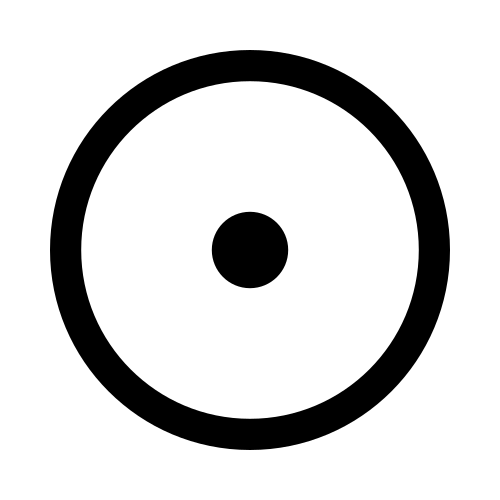 Sun
Sun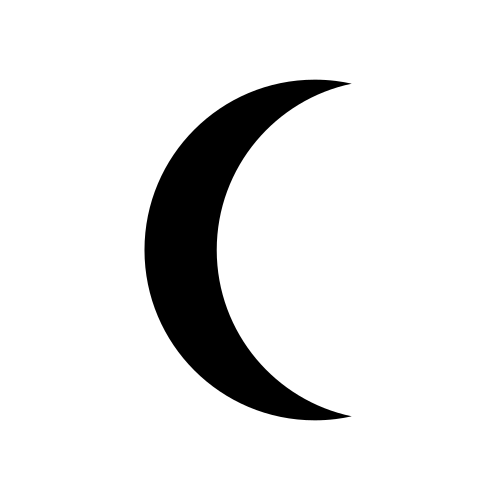 Moon
Moon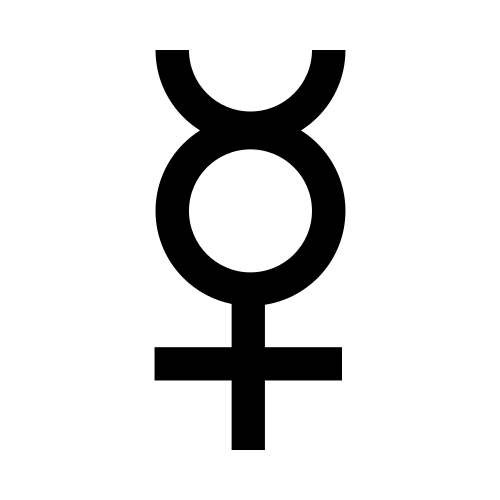 Mercury
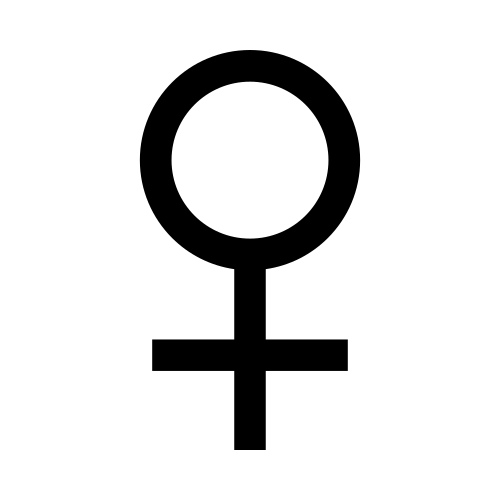 Venus
Venus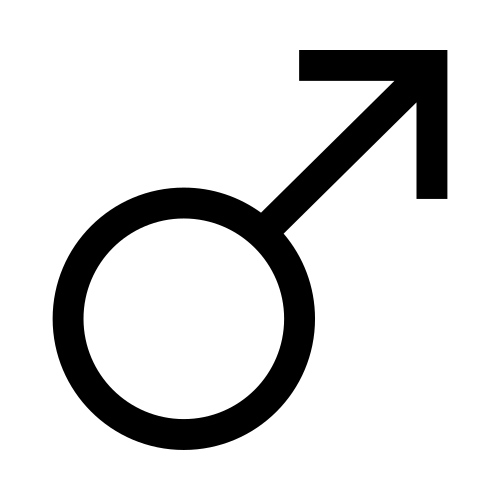 Mars
Mars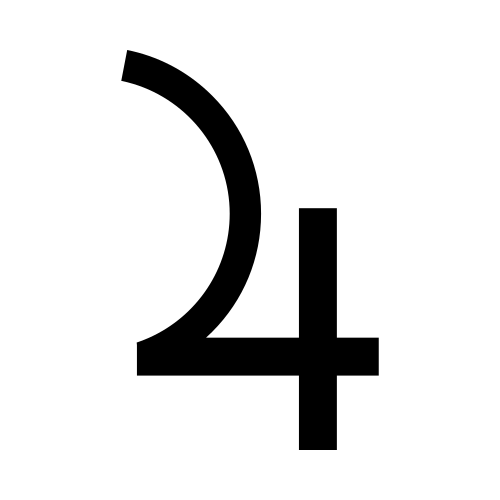 Jupiter
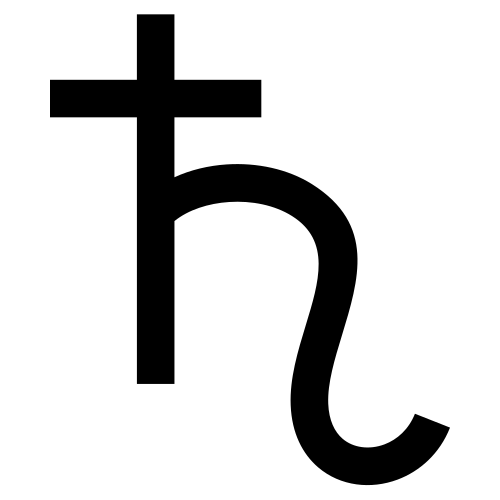 Saturn
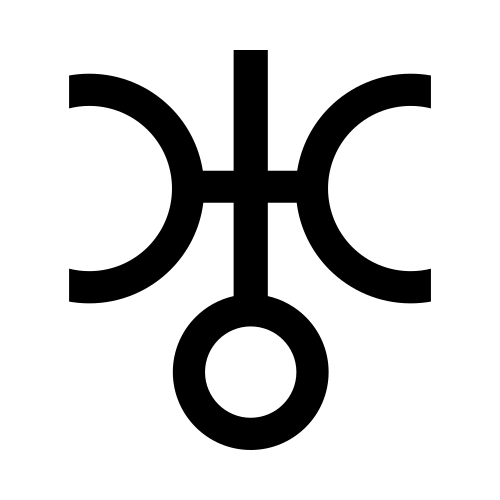 Uranus
 Neptune
 Pluto
PlutoBirth time unknown — house positions and Ascendant/MC are not available.
Astronomical context
Pluto travelled through Capricorn roughly from 1762 to 1778. In astrological tradition this transit is linked to the transformation of the state, institutions, and established order — the generation that came of age amid the Enlightenment and the questioning of inherited authority.
Alexander von Humboldt (born 1769) belongs to this generational configuration. Astrian groups profiles by such shared signatures rather than by any claim of shared destiny. Related profiles in Astrian: Charles Darwin · Louis Pasteur · Leonhard Euler. The symbolic reading is correlative, not causal.
Other profiles from this Pluto in Capricorn generation
More profiles from this generation are being researched.
Symbolic reading
The following describes what classical astrological tradition associates with these configurations. Astrian does not apply these descriptions to the person's biography.
The Sun in Virgo is the most prominent structural feature available without a birth time, centring the chart on analysis, craft, and the refinement of method. There is no Ascendant or Midheaven to anchor the angles, so the reading rests on sign placements and the aspects between planets rather than on houses.
Among the personal planets, the Moon in Pisces is associated in tradition with imagination, dissolution, and empathy (the Moon's sign is given for the noon chart and may shift with an exact time); Mercury in Libra with balance, relationship, and proportion; Venus in Leo with expression, pride, and the creative self; and Mars in Libra with balance, relationship, and proportion. These placements describe registers of feeling, thought, attraction, and action as the tradition catalogues them, independent of the life that follows.
Mercury conjunct Mars (0°25'): tradition reads thought and communication fused with drive, assertion, and action.
Uranus trine Neptune (1°22'): tradition reads disruption and innovation in easy flow with dissolution, imagination, and idealism.
Uranus trine Pluto (2°02'): tradition reads disruption and innovation in easy flow with depth, power, and transformation.
Mars sextile Saturn (2°10'): tradition reads drive, assertion, and action in supportive contact with structure, limitation, and discipline.
These placements are presented as a symbolic portrait, correlative and never causal — a description within the tradition's vocabulary, not an explanation of the life that follows.
Astrology is a symbolic language with 2,500 years of literature. The reading above is interpretive, not explanatory.
Astrian does not claim that the natal chart of Alexander von Humboldt caused or determined any of the above. Astrology is a symbolic system with 2,500 years of literature. Its capacity for retrospective description does not imply explanatory capacity.
A parallel life
The following are verified biographical facts. No connection to the natal chart is implied.
Friedrich Wilhelm Heinrich Alexander von Humboldt was born on September 14, 1769, in Berlin, then capital of the Kingdom of Prussia. His mother was of French Huguenot descent and ran a prosperous household; after her death in 1796, Humboldt inherited enough wealth to fund his own scientific expeditions. He studied at the universities of Frankfurt an der Oder, Berlin, and Göttingen, and at the Freiberg School of Mines, where he trained under the geologist Abraham Gottlob Werner.
In 1799, with the Spanish Crown's permission, Humboldt departed with the French botanist Aimé Bonpland on a five-year expedition to Spanish America. They traveled through Venezuela, Cuba, Colombia, Ecuador, Peru, and Mexico, covering approximately 6,000 miles on foot, by canoe, and on horseback. Humboldt climbed Mount Chimborazo in Ecuador, then believed to be the world's highest mountain, reaching an altitude that remained a world record for decades. He conducted detailed measurements of temperature, atmospheric pressure, magnetic declination, and altitude throughout the journey, and collected thousands of plant, animal, and rock specimens.
Among his most significant observations was the discovery of what is now called the Humboldt Current, a cold ocean current flowing northward along the Pacific coast of South America. He also mapped the Casiquiare canal, a natural waterway connecting the Orinoco and Amazon river systems. He made early observations linking altitude, climate, and vegetation zones in a systematic way, planting the seeds of modern biogeography.
Back in Europe, Humboldt spent decades publishing the results of the expedition in a multivolume work titled Voyage to the Equinoctial Regions of the New Continent. His most ambitious single work was Kosmos, begun in 1845 and left unfinished at his death, an attempt to synthesize all human knowledge of the physical world and present nature as a unified, dynamic, and interrelated whole.
Humboldt's approach to science was inherently interdisciplinary, linking geology, climatology, botany, zoology, oceanography, and astronomy through quantitative measurement and comparative analysis. His ideas directly influenced Charles Darwin, who carried Humboldt's Personal Narrative on the voyage of the Beagle.
Alexander von Humboldt died on May 6, 1859, in Berlin, at the age of eighty-nine, leaving behind one of the largest bodies of scientific writing produced by any individual in history.
Biographical sources
- Andrea Wulf, The Invention of Nature: Alexander von Humboldt's New World (Knopf, 2015).
- Alexander von Humboldt and Aimé Bonpland, Personal Narrative of Travels to the Equinoctial Regions of America, 1799-1804, 3 vols. (trans. Helen Maria Williams, Longman, 1814-1825).
- Alexander von Humboldt, Kosmos: A Sketch of a Physical Description of the Universe, 5 vols. (Stuttgart, 1845-1862).
- Nicholas Rupke, Alexander von Humboldt: A Metabiography (University of Chicago Press, 2008).
This profile presents the sky at the birth of Alexander von Humboldt and verified facts of their biography. Astrian does not claim that astrology has predictive capacity or that the natal chart determines the trajectory of a life. Astrology is a symbolic system with 2,500 years of literature. Its capacity for retrospective description does not imply explanatory capacity.
Calculate your own birth chart with the same NASA JPL DE441 precision.
Calculate my birth chartLast updated: June 14, 2026
Newsletter
A short reading once a month, in your inbox.
A note on the symbolism of the season, recent editorial pieces, and what to look for in next month's sky. No predictions.
Support this project
Independent, no venture funding, no ads. A contribution keeps Astrian precise and free.
Support on Ko-fi (opens in new tab)