PROFILE · SCIENCE & TECHNOLOGY
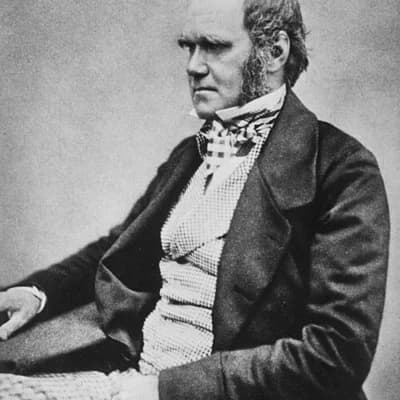
Charles Darwin
Charles Robert Darwin
naturalist
Born 12 February 1809 · Shrewsbury, Shropshire, United Kingdom · 52.71° N, 2.76° WX
Source: Birth time not documented in publicly accessible records
About this chart
No birth time is documented for this person. The chart therefore shows planetary positions in their signs, the slow aspects between them, and the generational context — but not house placements, the Ascendant, or the Midheaven, which require an accurate birth time. The Moon's sign carries a ±6° margin: if it falls near a sign boundary, the sign could vary. Positions for all other planets are reliable.
Do you have a verified source for this birth time? Share it →
The sky at birth
No birth time is documented for Charles Darwin. The Ascendant, Midheaven, and house positions cannot be determined. The planetary positions below are calculated for noon local time and are accurate to within a fraction of a degree for the slow-moving planets. The Moon's position carries a margin of approximately ±7°.
The Sun is at 23°25' Aquarius. The Moon is at 26°37' Capricorn (noon position, ±7° margin). Mercury is at 10°16' Pisces. Venus is at 7°25' Aries. Mars is at 25°29' Libra. Jupiter is at 22°04' Pisces. Saturn is at 3°08' Sagittarius. Uranus is at 9°40' Scorpio. Neptune is at 6°41' Sagittarius. Pluto is at 13°37' Pisces.
Three planets occupy Pisces: Mercury at 10°16', Jupiter at 22°04', and Pluto at 13°37'. This concentration in a single sign is a structural feature of the chart, independent of birth time. Saturn and Neptune are both in Sagittarius, at 3°08' and 6°41' respectively — a conjunction with an orb of 3°33'.
The tightest major aspects between planets: Mercury trine Uranus (0°36'), Venus trine Neptune (0°44'), Sun trine Mars (2°04'), Venus quincunx Uranus (2°15'), Mercury conjunct Pluto (3°21'), Saturn conjunct Neptune (3°33'), Mercury square Neptune (3°35').
The engine also identifies the following tight minor aspects involving asteroids and calculated points: jupiter sesquiquadrate northNode (0.15° sep); mercury sesquiquadrate mars (0.23° app); neptune semi-sextile northNode (0.24° app); moon trine lilith (0.26° sep).
The chart was calculated by Astrian's engine using NASA JPL DE441 ephemerides, sub-arcsecond precision. Timezone: Europe/London.
| Planet | Sign | Position |
|---|---|---|
| Sun | Aquarius | 23°25' |
| Moon | Capricorn | 26°38'±6° |
| Mercury | Pisces | 10°16' |
| Venus | Aries | 07°26' |
| Mars | Libra | 25°29' |
| Jupiter | Pisces | 22°04' |
| Saturn | Sagittarius | 03°08' |
| Uranus | Scorpio | 09°40' |
| Neptune | Sagittarius | 06°41' |
| Pluto | Pisces | 13°37' |
 Sun
Sun Moon
Moon Mercury
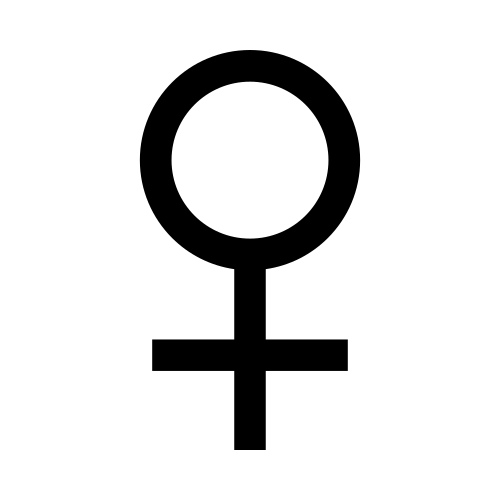 Venus
Venus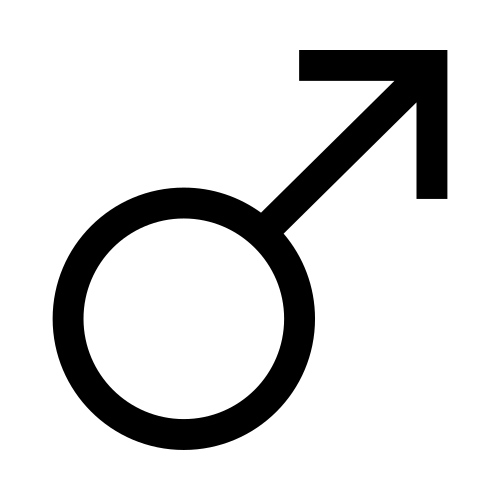 Mars
Mars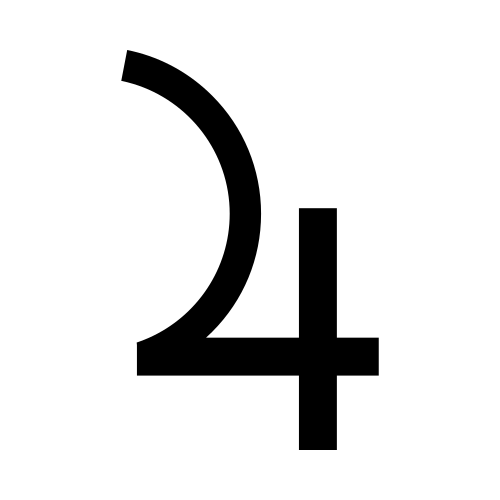 Jupiter
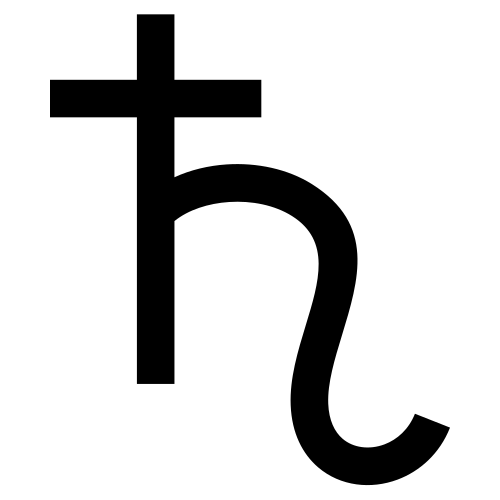 Saturn
 Uranus
 Neptune
 Pluto
PlutoBirth time unknown — house positions and Ascendant/MC are not available.
Astronomical context
Those born between approximately 1797 and 1823 carried Pluto in Pisces. This generation came of age during the aftermath of the French Revolution, the Napoleonic Wars, the early stages of industrialization, and the first serious cracks in the theological framework that had governed European intellectual life for centuries.
In astrological tradition, Pluto in Pisces is associated with collective transformation of the domains that sign governs: faith, the dissolution of established certainties, the boundary between the known and the unknown, and the slow erosion of categories once considered permanent. The generation that carried this placement inhabited a world where old orders were dissolving — political, religious, and intellectual — without yet being replaced by consolidated new ones. The symbolic reading is correlative, not causal.
Darwin was born in 1809, the same year as Abraham Lincoln. Within the Astrian profile collection, no other figures share this Pluto-in-Pisces placement, reflecting the dataset's concentration in the twentieth century. Isaac Newton and Galileo Galilei, who appear in the collection, belong to far earlier generational configurations.
Other profiles from this Pluto in Pisces generation
Symbolic reading
The following describes what classical astrological tradition associates with these configurations. Astrian does not apply these descriptions to the person's biography.
The Sun at 23°25' Aquarius is the most prominent structural feature of this chart. Without a documented birth time, there is no Ascendant or Midheaven — the reading is confined to planetary positions by sign and the aspects between planets.
The Moon at 26°37' Capricorn represents the noon position; the actual placement falls within approximately 7° on either side. If born in the morning, the Moon would be in the earlier degrees of Capricorn; if born late in the day, still in Capricorn but approaching the sign boundary. The Moon's sign placement in Capricorn is probable but not certain at the margins.
Mercury at 10°16' Pisces, Venus at 7°25' Aries, and Mars at 25°29' Libra complete the personal planet picture.
### The Pisces concentration
Three bodies in Pisces — Mercury, Jupiter, and Pluto — form the chart's densest cluster. Mercury and Pluto are within 3°21' of conjunction: a close alignment between the planet traditionally associated with perception, classification, and the naming of things, and the body associated in modern astrology with what lies beneath surfaces, with transformation, and with the dismantling of established structures. Jupiter, the traditional ruler of Pisces, occupies its own sign at 22°04', amplifying the Piscean emphasis. In the vocabulary of tradition, Jupiter in domicile operates with particular fluency.
The symbolic territory of Pisces concerns dissolution, permeability, and the crossing of boundaries — what lies between categories rather than within them. A concentration of Mercury, Jupiter, and Pluto in this sign is read, in the tradition, as a pattern that orients perception toward what is fluid, interconnected, and resistant to fixed classification.
### Mercury trine Uranus: the tightest major aspect
Mercury at 10°16' Pisces forms a trine to Uranus at 9°40' Scorpio with an orb of just 0°36'. This is the tightest major aspect in the chart. Mercury's register covers thought, analysis, and the classification of observations. Uranus, in modern astrology, is associated with disruption, originality, and the overturning of established frameworks. The trine is a harmonious aspect: a productive alignment rather than a friction.
Both planets occupy water signs — Pisces and Scorpio — which in traditional astrology share an emphasis on depth, intuition, and what is hidden beneath appearances. The water trine between Mercury and Uranus places the impulse toward original thought in a mode that is intuitive and pattern-seeking rather than abstract or deductive.
### Venus trine Neptune
Venus at 7°25' Aries forms a trine to Neptune at 6°41' Sagittarius, with an orb of 0°44'. Venus governs values, aesthetics, and what one finds beautiful or worth pursuing. Neptune's register involves the unbounded, the ideal, and the dissolution of clear edges. The fire trine (Aries to Sagittarius) gives this alignment an expansive, forward-reaching quality in the symbolic vocabulary.
### Sun trine Mars
The Sun at 23°25' Aquarius trines Mars at 25°29' Libra, orb 2°04'. Both are in air signs. The Sun represents the chart's central identity and vitality; Mars represents drive, assertion, and the capacity for sustained effort. Air signs in the tradition emphasize thought, communication, and social engagement. The trine between them describes, symbolically, a configuration where identity and drive align without significant friction.
### Saturn conjunct Neptune in Sagittarius
Saturn at 3°08' Sagittarius and Neptune at 6°41' Sagittarius form a conjunction with an orb of 3°33'. Saturn's register is structure, limitation, discipline, and the long term. Neptune's is dissolution, idealization, and what exists beyond fixed form. Conjunctions merge the two registers. In Sagittarius — a sign associated with philosophy, long journeys, and the expansion of understanding — this merger is read as a meeting of structure and boundlessness within the domain of broad inquiry.
The planetary pattern here is read as a symbolic portrait, not a causal explanation. No planet caused, predicted, or determined any event or characteristic.
Astrology is a symbolic language with 2,500 years of literature. The reading above is interpretive, not explanatory.
Astrian does not claim that the natal chart of Charles Darwin caused or determined any of the above. Astrology is a symbolic system with 2,500 years of literature. Its capacity for retrospective description does not imply explanatory capacity.
A parallel life
The following are verified biographical facts. No connection to the natal chart is implied.
Charles Robert Darwin was born on 12 February 1809 in Shrewsbury, Shropshire, the fifth of six children of Robert Waring Darwin, a prosperous physician, and Susannah Wedgwood, daughter of the potter Josiah Wedgwood. His paternal grandfather, Erasmus Darwin, had been a physician, naturalist, and poet whose own speculative writings on the transformation of species would later attract retrospective attention. Darwin's mother died in July 1817, when he was eight; his older sisters largely raised him thereafter.
He entered the University of Edinburgh in 1825 to study medicine, following his father's profession, but found surgery distressing and the lectures dull. He left after two years. His father, reportedly dismayed, sent him to Christ's College, Cambridge, in 1828, with the intention that he prepare for ordination in the Church of England. Darwin later wrote that the three years at Cambridge were the most joyful of his life, though not for the curriculum. He collected beetles obsessively, befriended the botanist John Stevens Henslow, and graduated in 1831 with an ordinary degree.
It was Henslow who recommended Darwin for the position of gentleman naturalist aboard HMS Beagle, a Royal Navy surveying vessel commanded by Captain Robert FitzRoy. The voyage lasted from December 1831 to October 1836 and circumnavigated the globe: Brazil, Argentina, Tierra del Fuego, Chile, the Galapagos Islands, Tahiti, New Zealand, Australia, and the Cape of Good Hope. Darwin was twenty-two when he boarded; he was twenty-seven when he returned. The notebooks he kept during the voyage — filled with observations on geology, coral reefs, fossils, and the distribution of species across isolated populations — would provide the empirical foundation for everything that followed.
The Galapagos archipelago, visited in September and October 1835, posed the decisive puzzle. The finches on different islands, though clearly related, showed variations in beak structure that corresponded to different food sources. The mockingbirds varied from island to island. The giant tortoises differed by island in ways the local inhabitants could identify at a glance. The pattern suggested that species were not fixed but had diverged from common ancestors in response to local conditions.
Darwin returned to England and married his cousin, Emma Wedgwood, on 29 January 1839. They moved to Down House in the village of Downe, Kent, in 1842, and he remained there for the rest of his life. They had ten children; seven survived to adulthood. The death of his daughter Anne, aged ten, in April 1851, affected him profoundly and, by his own account, extinguished whatever remained of his religious faith.
From the late 1830s onward, Darwin developed his theory of natural selection in private, aware of its implications and wary of the social upheaval it might provoke. He spent years accumulating evidence: barnacles, pigeons, seed dispersal, correspondence with naturalists worldwide. In June 1858, he received a letter from Alfred Russel Wallace, working independently in the Malay Archipelago, who had arrived at essentially the same mechanism. Mutual friends arranged a joint presentation to the Linnean Society on 1 July 1858. Neither Darwin nor Wallace attended.
On the Origin of Species by Means of Natural Selection was published on 24 November 1859. The first printing of 1,250 copies sold out on the day of publication. The book argued, across fourteen chapters of densely marshalled evidence, that species are not immutable, that they descend with modification from common ancestors, and that the principal mechanism of change is natural selection: the differential survival and reproduction of individuals better suited to their environments. The theory required no supernatural agency, no directing intelligence, no teleological plan — only variation, inheritance, and time.
The reaction was immediate and polarized. Thomas Henry Huxley became Darwin's most vigorous public champion. Bishop Samuel Wilberforce attacked the theory at the British Association meeting in Oxford in June 1860. Darwin himself avoided public debate almost entirely, constrained by chronic illness that had plagued him since the late 1830s — bouts of nausea, heart palpitations, fatigue, and digestive trouble whose cause remains debated among medical historians. Chagas disease, contracted during the Beagle voyage, is one hypothesis; psychosomatic illness is another; the evidence is inconclusive.
He continued to publish: The Variation of Animals and Plants Under Domestication (1868), The Descent of Man, and Selection in Relation to Sex (1871), which extended the theory explicitly to human origins, and The Expression of the Emotions in Man and Animals (1872). His final book, The Formation of Vegetable Mould Through the Action of Worms (1881), was a study of earthworms and soil — a characteristic return to the minute and the observable after decades of grand theory.
Darwin died at Down House on 19 April 1882. He had expected to be buried in the churchyard at Downe, but a petition from colleagues, including Huxley, secured his interment in Westminster Abbey, near the monument to Isaac Newton.
Biographical sources
- Browne, Janet. Charles Darwin: A Biography. Vol. 1, Voyaging (1995); Vol. 2, The Power of Place (2002). Princeton University Press
- Desmond, Adrian, and Moore, James. Darwin. Michael Joseph 1991
- Darwin, Charles. The Autobiography of Charles Darwin. Edited by Nora Barlow. Collins 1958
- van Wyhe, John, ed. The Complete Work of Charles Darwin Online. darwin-online.org.uk
This profile presents the sky at the birth of Charles Darwin and verified facts of their biography. Astrian does not claim that astrology has predictive capacity or that the natal chart determines the trajectory of a life. Astrology is a symbolic system with 2,500 years of literature. Its capacity for retrospective description does not imply explanatory capacity.
Related profiles
Calculate your own birth chart with the same NASA JPL DE441 precision.
Calculate my birth chartLast updated: June 12, 2026
Newsletter
A short reading once a month, in your inbox.
A note on the symbolism of the season, recent editorial pieces, and what to look for in next month's sky. No predictions.
Support this project
Independent, no venture funding, no ads. A contribution keeps Astrian precise and free.
Support on Ko-fi (opens in new tab)