PROFILE · SCIENCE & TECHNOLOGY
Leonhard Euler
mathematician
Born 15 April 1707 · Basel, Swiss Confederacy · 47.56° N, 7.59° EX
Source: Birth time not documented in publicly accessible records
About this chart
No birth time is documented for this person. The chart therefore shows planetary positions in their signs, the slow aspects between them, and the generational context — but not house placements, the Ascendant, or the Midheaven, which require an accurate birth time. The Moon's sign carries a ±6° margin: if it falls near a sign boundary, the sign could vary. Positions for all other planets are reliable.
Do you have a verified source for this birth time? Share it →
The sky at birth
No birth time is documented for Leonhard Euler. The Ascendant, the Midheaven, and the house positions cannot be determined; the reading is confined to planetary sign placements and the aspects between planets. The positions below are calculated for noon local time and are accurate to a fraction of a degree for the slow-moving bodies.
The Moon is near 7°06' Libra (noon position, ±7° margin). Sun is at 24°45' Aries. Mercury is at 14°28' Taurus. Venus is at 8°33' Pisces. Mars is at 5°04' Cancer. Jupiter is at 21°04' Leo, retrograde. Saturn is at 1°45' Gemini. Uranus is at 9°04' Leo, retrograde. Neptune is at 21°05' Aries. Pluto is at 20°40' Leo, retrograde.
3 bodies occupy Leo (Jupiter, Uranus and Pluto) — a concentration that stands out as a structural feature of the chart.
The tightest major aspects between planets: Jupiter trine Neptune (0°01'); Jupiter conjunct Pluto (0°23'); Neptune trine Pluto (0°24'); Moon sextile Uranus (1°59'); Moon square Mars (2°02'); Venus trine Mars (3°29').
Neptune trine Pluto (0°24') is structural but generational — an alignment of slow-moving outer planets shared across many birth years.
The engine also registers tight minor aspects involving asteroids and calculated points: Moon semi-square Lilith (0°47'); Sun conjunct North Node (1°42'); Neptune quincunx Lilith (1°48'); Jupiter square Lilith (1°49'). These are reported for completeness and carry less weight in traditional reading.
The chart was calculated using NASA JPL DE441 ephemerides, sub-arcsecond precision.
| Planet | Sign | Position |
|---|---|---|
| Sun | Aries | 24°45' |
| Moon | Libra | 07°06'±6° |
| Mercury | Taurus | 14°28' |
| Venus | Pisces | 08°33' |
| Mars | Cancer | 05°04' |
| Jupiter | Leo | 21°04'retrograde |
| Saturn | Gemini | 01°45' |
| Uranus | Leo | 09°04'retrograde |
| Neptune | Aries | 21°05' |
| Pluto | Leo | 20°40'retrograde |
 Sun
Sun Moon
Moon Mercury
 Venus
Venus Mars
Mars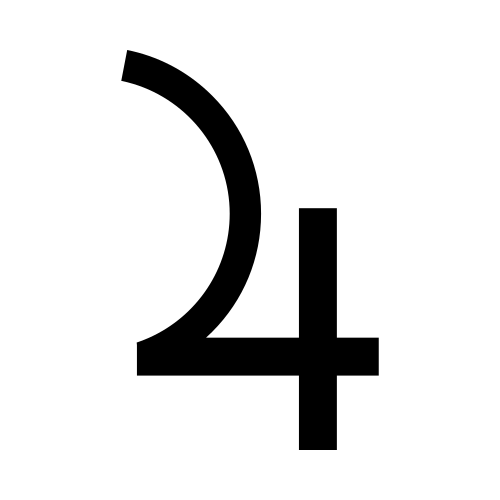 Jupiter
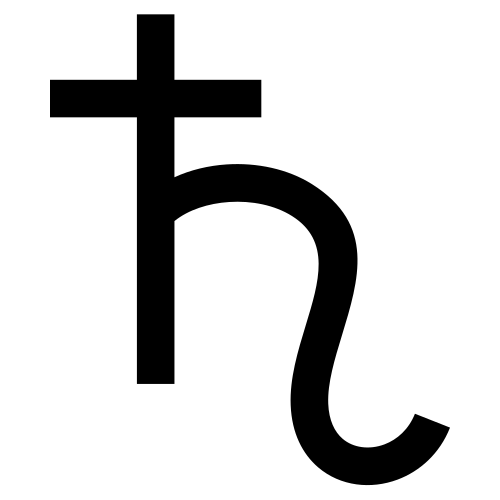 Saturn
 Uranus
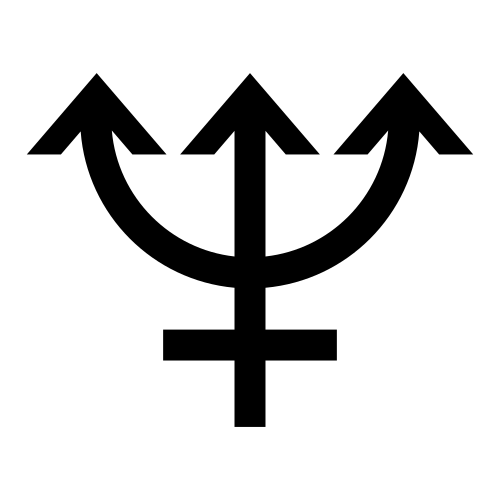 Neptune
 Pluto
PlutoBirth time unknown — house positions and Ascendant/MC are not available.
Astronomical context
Pluto moved through Leo from the late 1930s to the late 1950s. In astrological tradition this transit is associated with the collective transformation of self-expression, authority, and the cult of the individual — the cohort that rebuilt the post-war world and expanded mass culture.
Leonhard Euler (born 1707) belongs to this generational configuration. Astrian groups profiles by such shared signatures rather than by any claim of shared destiny. Related profiles in Astrian: Carl Friedrich Gauss · Srinivasa Ramanujan · John von Neumann. The symbolic reading is correlative, not causal.
Other profiles from this Pluto in Leo generation
Symbolic reading
The following describes what classical astrological tradition associates with these configurations. Astrian does not apply these descriptions to the person's biography.
The Sun in Aries is the most prominent structural feature available without a birth time, centring the chart on initiative, directness, and the will to begin. There is no Ascendant or Midheaven to anchor the angles, so the reading rests on sign placements and the aspects between planets rather than on houses.
Among the personal planets, the Moon in Libra is associated in tradition with balance, relationship, and proportion (the Moon's sign is given for the noon chart and may shift with an exact time); Mercury in Taurus with stability, persistence, and the tangible; Venus in Pisces with imagination, dissolution, and empathy; and Mars in Cancer with attachment, memory, and protection. These placements describe registers of feeling, thought, attraction, and action as the tradition catalogues them, independent of the life that follows.
Jupiter trine Neptune (0°01'): tradition reads expansion and meaning in easy flow with dissolution, imagination, and idealism.
Jupiter conjunct Pluto (0°23'): tradition reads expansion and meaning fused with depth, power, and transformation.
Neptune trine Pluto (0°24'): tradition reads dissolution, imagination, and idealism in easy flow with depth, power, and transformation.
Moon sextile Uranus (1°59'): tradition reads emotional life and instinct in supportive contact with disruption and innovation.
These placements are presented as a symbolic portrait, correlative and never causal — a description within the tradition's vocabulary, not an explanation of the life that follows.
Astrology is a symbolic language with 2,500 years of literature. The reading above is interpretive, not explanatory.
Astrian does not claim that the natal chart of Leonhard Euler caused or determined any of the above. Astrology is a symbolic system with 2,500 years of literature. Its capacity for retrospective description does not imply explanatory capacity.
A parallel life
The following are verified biographical facts. No connection to the natal chart is implied.
Leonhard Euler was born on April 15, 1707, in Basel, Switzerland, the son of a Calvinist pastor. He displayed exceptional mathematical ability early on and studied under Johann Bernoulli at the University of Basel, completing his master's degree at the age of 16. He received his doctorate from Basel in 1726 with a thesis comparing the philosophies of Descartes and Newton.
In 1727 Euler was appointed to the newly founded St Petersburg Academy of Sciences in Russia, where he spent many productive years. In 1741 he moved to the Berlin Academy of Sciences at the invitation of Frederick the Great, where he spent 25 years before returning to St Petersburg in 1766.
Euler's mathematical output was extraordinary in its volume and breadth. He authored more than 800 papers and books, and his complete works run to more than 80 volumes; much of his output was published posthumously. He made fundamental contributions to infinitesimal calculus, including the development of the theory of functions and work on differential equations. He introduced the concept of a function and much of the notation now standard in mathematics, including e for the base of the natural logarithm, i for the imaginary unit, and the use of the Greek letter sigma for summation.
Euler's identity, e to the power of i times pi plus 1 equals 0, is a relation connecting five fundamental mathematical constants and is frequently cited for its elegance. He proved that the sum of the reciprocals of the squares of the positive integers equals pi squared divided by six, a result known as the Basel problem, which had been unsolved for nearly a century.
In graph theory, Euler solved the Königsberg bridge problem in 1736, determining that it was impossible to walk through the city of Königsberg crossing each of its seven bridges exactly once. This paper is regarded as the foundation of the field of graph theory and of topology.
Euler also made important contributions to mechanics, optics, acoustics, the theory of music, and astronomy. He worked productively despite losing sight in his right eye around 1738 and going almost completely blind in 1766, dictating work to assistants.
Leonhard Euler died on September 18, 1783, in St Petersburg, Russia, following a stroke, at the age of 76.
Biographical sources
- Ronald Calinger, Leonhard Euler: Mathematical Genius in the Enlightenment (Princeton University Press, 2016).
- William Dunham, Euler: The Master of Us All (Mathematical Association of America, 1999).
- MacTutor History of Mathematics Archive: Leonhard Euler.
- https://mathshistory.st-andrews.ac.uk/Biographies/Euler/.
- L. Euler, Introductio in analysin infinitorum (Lausanne, 1748).
This profile presents the sky at the birth of Leonhard Euler and verified facts of their biography. Astrian does not claim that astrology has predictive capacity or that the natal chart determines the trajectory of a life. Astrology is a symbolic system with 2,500 years of literature. Its capacity for retrospective description does not imply explanatory capacity.
Related profiles
Calculate your own birth chart with the same NASA JPL DE441 precision.
Calculate my birth chartLast updated: June 14, 2026
Newsletter
A short reading once a month, in your inbox.
A note on the symbolism of the season, recent editorial pieces, and what to look for in next month's sky. No predictions.
Support this project
Independent, no venture funding, no ads. A contribution keeps Astrian precise and free.
Support on Ko-fi (opens in new tab)