PROFILE · SCIENCE & TECHNOLOGY
Louis Pasteur
chemist and microbiologist
Born 27 December 1822 · 02:00 · 12:30 UTC · Dole, France · 47.09° N, 5.49° EAA
Source: Astro-Databank (Rodden Rating AA)
The sky at birth
With a documented birth time, the full chart can be cast. The Ascendant falls at 28°14' Libra and the Midheaven at 5°46' Leo, which fixes the angular framework and allows the planets to be placed in houses.
Sun is at 4°49' Capricorn, house 3. Moon is at 18°02' Gemini, house 8. Mercury is at 0°45' Capricorn, house 3. Venus is at 5°36' Capricorn, house 3. Mars is at 24°30' Capricorn, house 3. Jupiter is at 27°37' Taurus, house 8, retrograde. Saturn is at 3°21' Taurus, house 7, retrograde. Uranus is at 7°20' Capricorn, house 3. Neptune is at 4°57' Capricorn, house 3. Pluto is at 28°56' Pisces, house 5.
6 bodies occupy Capricorn (Sun, Mercury, Venus, Mars, Uranus and Neptune) — a concentration that stands out as a structural feature of the chart.
The tightest major aspects between planets: Sun conjunct Neptune (0°08'); Venus conjunct Neptune (0°39'); Sun conjunct Venus (0°47'); Jupiter sextile Pluto (1°19'); Sun trine Saturn (1°28'); Saturn trine Neptune (1°35').
Uranus conjunct Neptune (2°23') is structural but generational — an alignment of slow-moving outer planets shared across many birth years.
The engine also registers tight minor aspects involving asteroids and calculated points: Uranus semi-sextile North Node (1°21'); Moon opposite Lilith (2°39'); Saturn square North Node (5°20'). These are reported for completeness and carry less weight in traditional reading.
The chart was calculated using NASA JPL DE441 ephemerides, sub-arcsecond precision.
| Planet | Sign | Position | House |
|---|---|---|---|
| Ascendant | Libra | 28°14' | — |
| Midheaven | Leo | 05°46' | — |
| Sun | Capricorn | 04°49' | H3 |
| Moon | Gemini | 18°02' | H8 |
| Mercury | Capricorn | 00°45' | H3 |
| Venus | Capricorn | 05°36' | H3 |
| Mars | Capricorn | 24°30' | H3 |
| Jupiter | Taurus | 27°37'retrograde | H8 |
| Saturn | Taurus | 03°21'retrograde | H7 |
| Uranus | Capricorn | 07°20' | H3 |
| Neptune | Capricorn | 04°57' | H3 |
| Pluto | Pisces | 28°56' | H5 |
 Sun
Sun Moon
Moon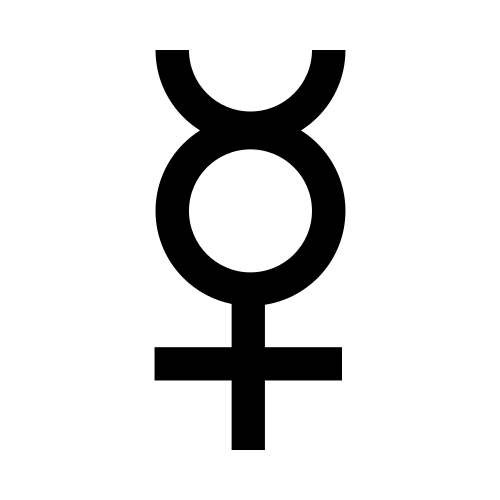 Mercury
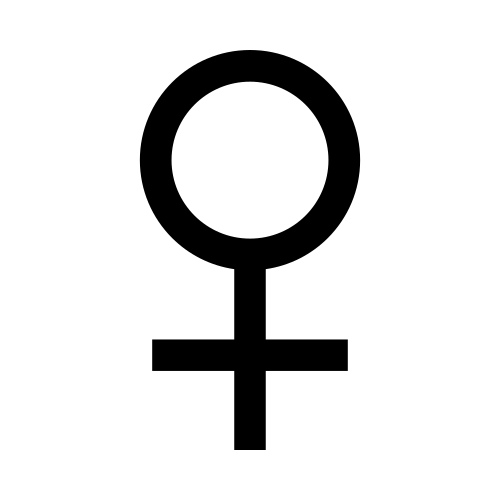 Venus
Venus Mars
Mars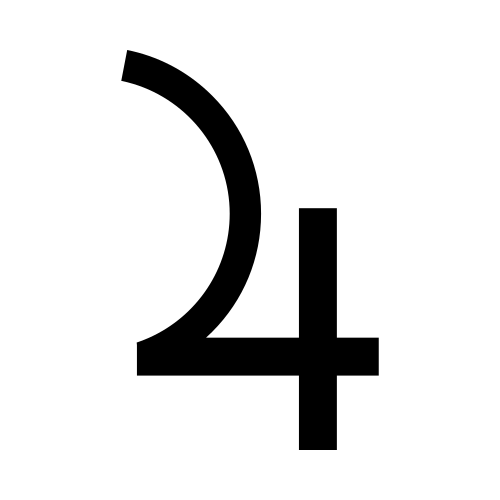 Jupiter
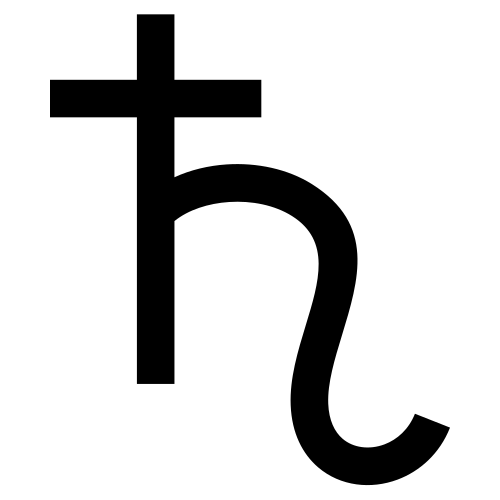 Saturn
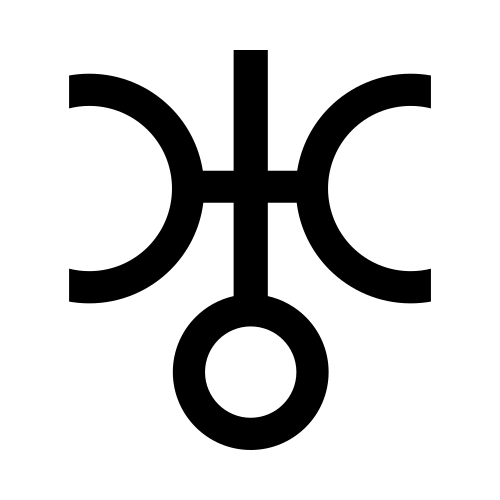 Uranus
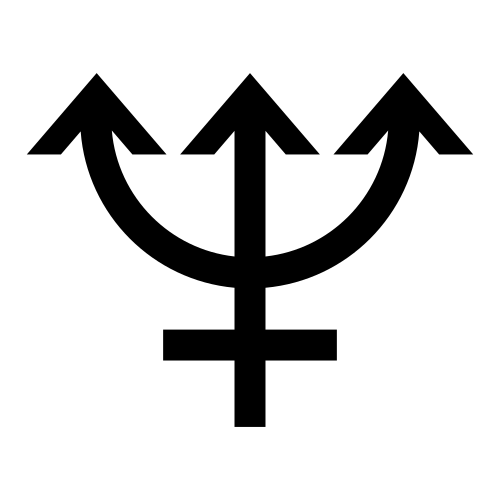 Neptune
 Pluto
PlutoAstronomical context
Pluto moved through Pisces roughly from 1798 to 1823. In astrological tradition this transit is linked to the transformation of belief, imagination, and the dissolution of old forms — the generation of early Romanticism and shifting spiritual horizons.
Louis Pasteur (born 1822) belongs to this generational configuration. Astrian groups profiles by such shared signatures rather than by any claim of shared destiny. Related profiles in Astrian: Alexander Fleming · Jonas Salk · Rosalind Franklin. The symbolic reading is correlative, not causal.
Other profiles from this Pluto in Pisces generation
Symbolic reading
The following describes what classical astrological tradition associates with these configurations. Astrian does not apply these descriptions to the person's biography.
The Sun in Capricorn centres the chart on ambition, structure, and the long view. With the Ascendant in Libra, tradition adds balance, relationship, and proportion as the threshold through which that energy meets the world; the Sun marks the central drive, the Ascendant the manner of approach.
Among the personal planets, the Moon in Gemini is associated in tradition with curiosity, exchange, and versatility; Mercury in Capricorn with ambition, structure, and the long view; Venus in Capricorn with ambition, structure, and the long view; and Mars in Capricorn with ambition, structure, and the long view. These placements describe registers of feeling, thought, attraction, and action as the tradition catalogues them, independent of the life that follows.
Sun conjunct Neptune (0°08'): tradition reads identity and central purpose fused with dissolution, imagination, and idealism.
Venus conjunct Neptune (0°39'): tradition reads values, attraction, and harmony fused with dissolution, imagination, and idealism.
Sun conjunct Venus (0°47'): tradition reads identity and central purpose fused with values, attraction, and harmony.
Jupiter sextile Pluto (1°19'): tradition reads expansion and meaning in supportive contact with depth, power, and transformation.
These placements are presented as a symbolic portrait, correlative and never causal — a description within the tradition's vocabulary, not an explanation of the life that follows.
Astrology is a symbolic language with 2,500 years of literature. The reading above is interpretive, not explanatory.
Astrian does not claim that the natal chart of Louis Pasteur caused or determined any of the above. Astrology is a symbolic system with 2,500 years of literature. Its capacity for retrospective description does not imply explanatory capacity.
A parallel life
The following are verified biographical facts. No connection to the natal chart is implied.
Louis Pasteur was born on 27 December 1822 in Dole, Jura, France. He studied chemistry in Paris, earning his doctorate from the Ecole Normale Superieure, where he later taught. His early research focused on the optical properties of crystals and molecular asymmetry, work that contributed to the founding of stereochemistry.
In the 1850s, Pasteur investigated fermentation and demonstrated that it was caused by living microorganisms rather than being a purely chemical process. This research brought him into conflict with the prevailing spontaneous generation hypothesis, the idea that living organisms could arise from non-living matter. Through a series of carefully designed experiments using swan-necked flasks, he provided strong evidence against spontaneous generation and in favour of the idea that microbial contamination came from the environment.
Pasteur applied these findings to practical problems. He developed a process of using controlled heat to reduce microbial content in perishable liquids, a technique that became known as pasteurisation. He also investigated silkworm diseases that were damaging the French silk industry, identifying the causative organisms and proposing preventive measures.
From the 1870s onwards, Pasteur worked more directly on infectious disease. He studied chicken cholera, anthrax, and other conditions, developing attenuated preparations that could provide protection against disease. His work on rabies led to the development of a treatment administered after exposure to the virus, tested first in animals and later used in human cases beginning in 1885.
Pasteur founded the Institut Pasteur in Paris in 1887, which became a major centre for biomedical research. He died on 28 September 1895 in Saint-Cloud, near Paris, and was interred in the Institut Pasteur.
Biographical sources
- Dubos, Rene J. Louis Pasteur: Free Lance of Science. Boston: Little, Brown, 1950..
- Geison, Gerald L. The Private Science of Louis Pasteur. Princeton: Princeton University Press, 1995..
- Pasteur, Louis. Germ Theory and Its Applications to Medicine and Surgery. Translated by H. C. Ernst. London: Sydenham Society, 1880..
- Ferdinand, Vallery-Radot. La vie de Pasteur. Paris: Hachette, 1900..
This profile presents the sky at the birth of Louis Pasteur and verified facts of their biography. Astrian does not claim that astrology has predictive capacity or that the natal chart determines the trajectory of a life. Astrology is a symbolic system with 2,500 years of literature. Its capacity for retrospective description does not imply explanatory capacity.
Related profiles
Calculate your own birth chart with the same NASA JPL DE441 precision.
Calculate my birth chartLast updated: June 14, 2026
Newsletter
A short reading once a month, in your inbox.
A note on the symbolism of the season, recent editorial pieces, and what to look for in next month's sky. No predictions.
Support this project
Independent, no venture funding, no ads. A contribution keeps Astrian precise and free.
Support on Ko-fi (opens in new tab)