PROFILE · SPORTS
Eliud Kipchoge
long-distance runner
Born 5 November 1984 · Kapsisiywa, Kenya, Kenya · 0.33° N, 35.05° EX
Source: Birth time not documented in publicly accessible records
About this chart
No birth time is documented for this person. The chart therefore shows planetary positions in their signs, the slow aspects between them, and the generational context — but not house placements, the Ascendant, or the Midheaven, which require an accurate birth time. The Moon's sign carries a ±6° margin: if it falls near a sign boundary, the sign could vary. Positions for all other planets are reliable.
Do you have a verified source for this birth time? Share it →
The sky at birth
No birth time is documented for Eliud Kipchoge. The Ascendant, the Midheaven, and the house positions cannot be determined; the reading is confined to planetary sign placements and the aspects between planets. The positions below are calculated for noon local time and are accurate to a fraction of a degree for the slow-moving bodies. One caveat: the Moon lies near a sign boundary, so without an exact time it cannot be fixed to a single sign — it sits close to 6°14' Aries within a daily margin of about ±7°.
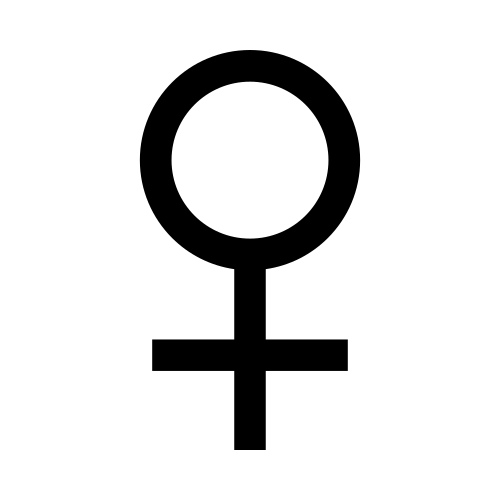
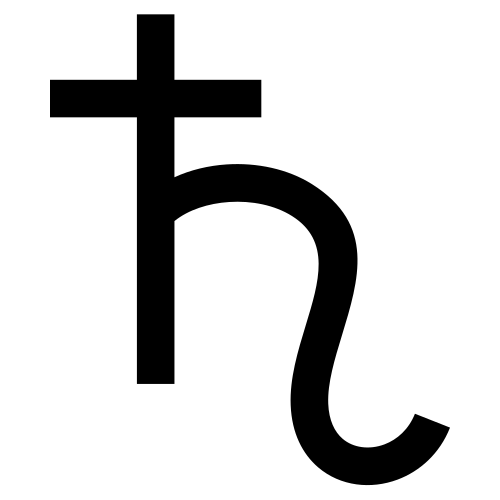
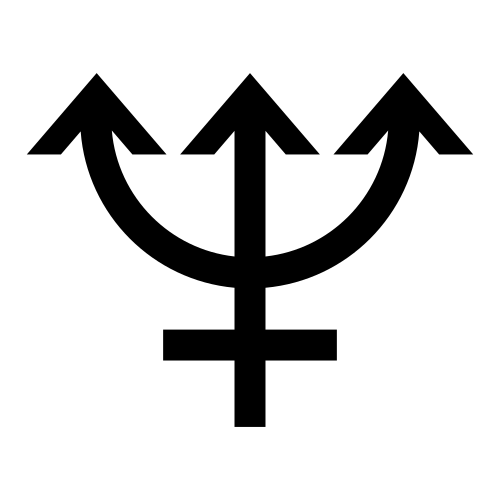
The Moon is near 6°14' Aries (noon position, ±7° margin). Sun is at 13°07' Scorpio. Mercury is at 28°20' Scorpio. Venus is at 19°35' Sagittarius. Mars is at 22°17' Capricorn. Jupiter is at 9°34' Capricorn. Saturn is at 18°21' Scorpio. Uranus is at 11°59' Sagittarius. Neptune is at 29°29' Sagittarius. Pluto is at 2°30' Scorpio.
4 bodies occupy Scorpio (Sun, Mercury, Saturn and Pluto) and 3 bodies occupy Sagittarius (Venus, Uranus and Neptune) — a concentration that stands out as a structural feature of the chart.
The tightest major aspects between planets: Neptune sextile Pluto (3°01'); Moon square Jupiter (3°20'); Sun sextile Jupiter (3°33'); Mars sextile Saturn (3°55'); Sun conjunct Saturn (5°14'); Moon trine Uranus (5°44').
Neptune sextile Pluto (3°01') is structural but generational — an alignment of slow-moving outer planets shared across many birth years.
The engine also registers tight minor aspects involving asteroids and calculated points: Venus quincunx Ceres (0°08'); Sun semi-square Vesta (0°10'); Mars sesquiquadrate Chiron (0°10'); Mercury opposite North Node (0°11'). These are reported for completeness and carry less weight in traditional reading.
The chart was calculated using NASA JPL DE441 ephemerides, sub-arcsecond precision.
| Planet | Sign | Position |
|---|---|---|
| Sun | Scorpio | 13°07' |
| Moon | Aries | 06°14'±6° |
| Mercury | Scorpio | 28°20' |
| Venus | Sagittarius | 19°35' |
| Mars | Capricorn | 22°17' |
| Jupiter | Capricorn | 09°34' |
| Saturn | Scorpio | 18°21' |
| Uranus | Sagittarius | 11°59' |
| Neptune | Sagittarius | 29°29' |
| Pluto | Scorpio | 02°30' |
| Chiron | Gemini | 07°07'retrograde |
 Sun
Sun Moon
Moon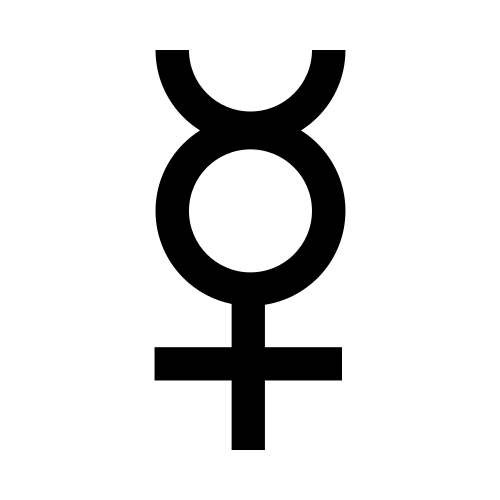 Mercury
 Venus
Venus Mars
Mars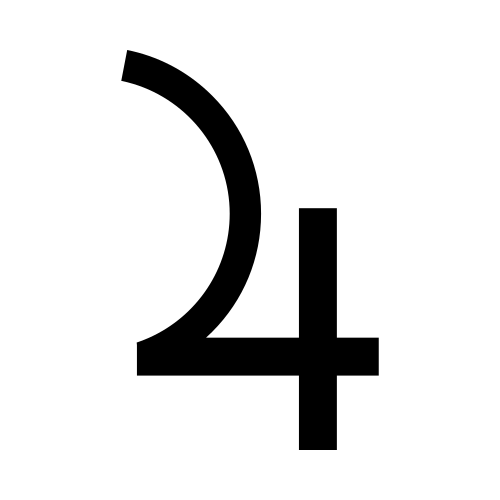 Jupiter
 Saturn
 Uranus
 Neptune
 Pluto
Pluto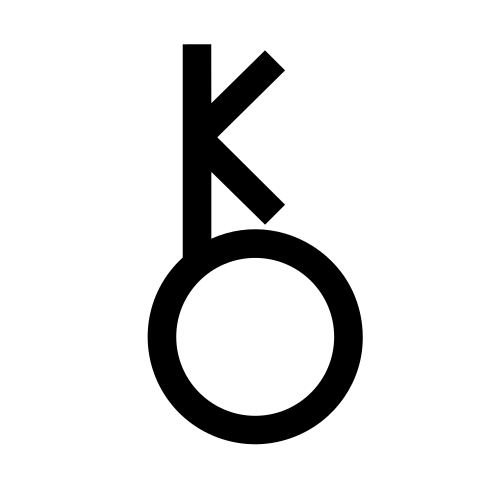 Chiron
Birth time unknown — house positions and Ascendant/MC are not available.
Astronomical context
Pluto moved through its own sign, Scorpio, from 1983 to 1995. In astrological tradition Pluto in Scorpio is read as an intensification of themes of power, depth, crisis, and regeneration — the generation that grew up amid the digital turn and a transformed relationship to risk.
Eliud Kipchoge (born 1984) belongs to this generational configuration. Astrian groups profiles by such shared signatures rather than by any claim of shared destiny. Related profiles in Astrian: Mo Farah · Carl Lewis · Jesse Owens. The symbolic reading is correlative, not causal.
Other profiles from this Pluto in Scorpio generation
Symbolic reading
The following describes what classical astrological tradition associates with these configurations. Astrian does not apply these descriptions to the person's biography.
The Sun in Scorpio is the most prominent structural feature available without a birth time, centring the chart on intensity, depth, and the will to transform. There is no Ascendant or Midheaven to anchor the angles, so the reading rests on sign placements and the aspects between planets rather than on houses.
Among the personal planets, the Moon in Aries is associated in tradition with initiative, directness, and the will to begin (the Moon's sign is given for the noon chart and may shift with an exact time); Mercury in Scorpio with intensity, depth, and the will to transform; Venus in Sagittarius with expansion, conviction, and the horizon; and Mars in Capricorn with ambition, structure, and the long view. These placements describe registers of feeling, thought, attraction, and action as the tradition catalogues them, independent of the life that follows.
Neptune sextile Pluto (3°01'): tradition reads dissolution, imagination, and idealism in supportive contact with depth, power, and transformation.
Moon square Jupiter (3°20'): tradition reads emotional life and instinct in friction with expansion and meaning.
Sun sextile Jupiter (3°33'): tradition reads identity and central purpose in supportive contact with expansion and meaning.
Mars sextile Saturn (3°55'): tradition reads drive, assertion, and action in supportive contact with structure, limitation, and discipline.
These placements are presented as a symbolic portrait, correlative and never causal — a description within the tradition's vocabulary, not an explanation of the life that follows.
Astrology is a symbolic language with 2,500 years of literature. The reading above is interpretive, not explanatory.
Astrian does not claim that the natal chart of Eliud Kipchoge caused or determined any of the above. Astrology is a symbolic system with 2,500 years of literature. Its capacity for retrospective description does not imply explanatory capacity.
A parallel life
The following are verified biographical facts. No connection to the natal chart is implied.
Eliud Kipchoge was born on November 5, 1984, in Kapsisiywa, a village in the Nandi Hills of Kenya's Rift Valley. He grew up in modest circumstances and ran several kilometers to school each day as a child. He was coached from an early age by Patrick Sang, a former Olympic steeplechaser, and began competing internationally as a teenager.
Kipchoge first gained international attention at the 2003 World Championships in Paris, where he won the 5,000 meters gold medal at the age of 18, defeating veterans Hicham El Guerrouj and Kenenisa Bekele. He subsequently won two silver medals at the Athens 2004 Olympics and one bronze at Beijing 2008, all in the 5,000 meters, before transitioning to the marathon in 2012.
In the marathon, Kipchoge established a record of dominance rarely seen in endurance sport. He won the Olympic marathon gold medals at Rio 2016 and Tokyo 2020. He also won the Berlin Marathon multiple times and set the official marathon world record in Berlin in 2022 with a time of 2:01:09, breaking his own previous record. His consistency across major marathons over a decade is widely documented.
In October 2019, Kipchoge completed a marathon in 1:59:40 in Vienna in the INEOS 1:59 Challenge, a specially organized time-trial with pacemakers, making him the first person to run a marathon distance in under two hours. The result does not count as an official world record under World Athletics rules because of the non-standard format.
Kipchoge trains at the Global Sports Communication camp in Kaptagat, Kenya, under Patrick Sang. He has written and spoken extensively about the philosophy and discipline of long-distance running. He received Kenya's Order of the Grand Warrior and has been recognized by multiple international sports bodies for his contributions to athletics.
Biographical sources
- Turnbull, Simon. "Eliud Kipchoge: The Marathon Man." The Independent, September 2018..
- World Athletics. "Eliud Kipchoge Profile." https://www.worldathletics.org..
- The New York Times. 2019
- Kipchoge, Eliud. "No Human Is Limited." INEOS 1:59 Challenge Documentation, 2019..
This profile presents the sky at the birth of Eliud Kipchoge and verified facts of their biography. Astrian does not claim that astrology has predictive capacity or that the natal chart determines the trajectory of a life. Astrology is a symbolic system with 2,500 years of literature. Its capacity for retrospective description does not imply explanatory capacity.
Related profiles
Calculate your own birth chart with the same NASA JPL DE441 precision.
Calculate my birth chartLast updated: June 14, 2026
Newsletter
A short reading once a month, in your inbox.
A note on the symbolism of the season, recent editorial pieces, and what to look for in next month's sky. No predictions.
Support this project
Independent, no venture funding, no ads. A contribution keeps Astrian precise and free.
Support on Ko-fi (opens in new tab)