PROFILE · MUSIC
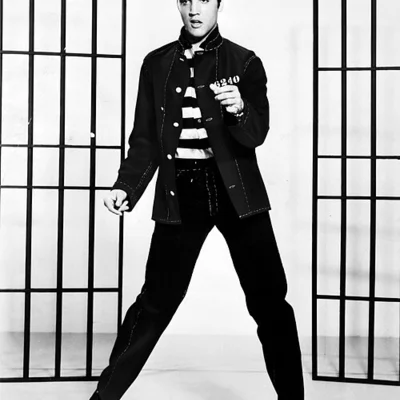
Elvis Presley
Elvis Aaron Presley
musician
Born 8 January 1935 · Tupelo, Mississippi, United States · 34.26° N, 88.70° WX
Source: Birth time not documented in publicly accessible records
About this chart
No birth time is documented for this person. The chart therefore shows planetary positions in their signs, the slow aspects between them, and the generational context — but not house placements, the Ascendant, or the Midheaven, which require an accurate birth time. The Moon's sign carries a ±6° margin: if it falls near a sign boundary, the sign could vary. Positions for all other planets are reliable.
Do you have a verified source for this birth time? Share it →
The sky at birth
No birth time is documented for Elvis Presley. The Ascendant, Midheaven, and house positions cannot be determined. The planetary positions below are calculated for noon local time and are accurate to within a fraction of a degree for the slow-moving planets. The Moon's position carries a margin of approximately ±7°.
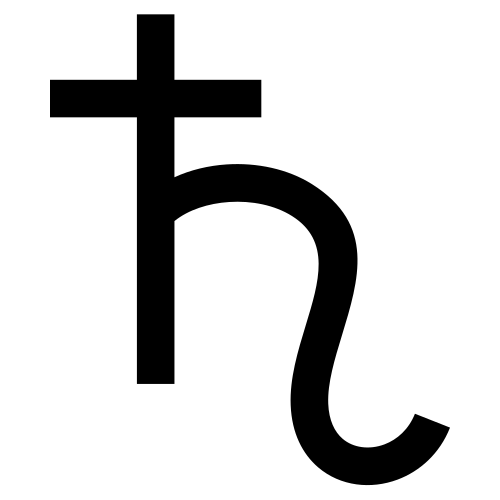
The Sun is at 17°32' Capricorn. The Moon is at 6°33' Pisces (noon position, ±7° margin). Mercury is at 22°49' Capricorn. Venus is at 29°45' Capricorn. Mars is at 12°57' Libra. Jupiter is at 18°07' Scorpio. Saturn is at 25°46' Aquarius. Uranus is at 27°30' Aries. Neptune is at 14°26' Virgo R. Pluto is at 25°07' Cancer R.
Three planets occupy Capricorn: the Sun at 17°32', Mercury at 22°49', and Venus at 29°45'. This concentration in a single sign is a structural feature independent of birth time. The chart features a T-square involving Venus, Pluto, and Uranus: Venus at 29°45' Capricorn opposes Pluto at 25°07' Cancer retrograde (4°38'), while Uranus at 27°30' Aries squares both Venus (2°15') and Pluto (2°23'). The Sun and Jupiter form a tight sextile: 17°32' Capricorn to 18°07' Scorpio (0°35').
The tightest major aspects between planets: Sun sextile Jupiter (0°35'), Saturn quincunx Pluto (0°39'), Saturn sextile Uranus (1°44'), Venus square Uranus (2°15'), Mercury opposition Pluto (2°18'), Uranus square Pluto (2°23'), Sun trine Neptune (3°06'), Jupiter sextile Neptune (3°41'), Sun square Mars (4°35'), Venus opposition Pluto (4°38').
The engine also identifies the following tight minor aspects involving asteroids and calculated points: moon sextile vesta (0.23° sep); venus sesquiquadrate neptune (0.31° sep); venus square pallas (0.31° app); juno conjunction northNode (0.44° app).
The chart was calculated by Astrian's engine using NASA JPL DE441 ephemerides, sub-arcsecond precision. Timezone: Central Standard Time (America/Chicago, UTC −6).
| Planet | Sign | Position |
|---|---|---|
| Sun | Capricorn | 17°32' |
| Moon | Pisces | 06°33'±6° |
| Mercury | Capricorn | 22°49' |
| Venus | Capricorn | 29°45' |
| Mars | Libra | 12°57' |
| Jupiter | Scorpio | 18°07' |
| Saturn | Aquarius | 25°46' |
| Uranus | Aries | 27°30' |
| Neptune | Virgo | 14°26'retrograde |
| Pluto | Cancer | 25°07'retrograde |
| Chiron | Gemini | 05°15'retrograde |
 Sun
Sun Moon
Moon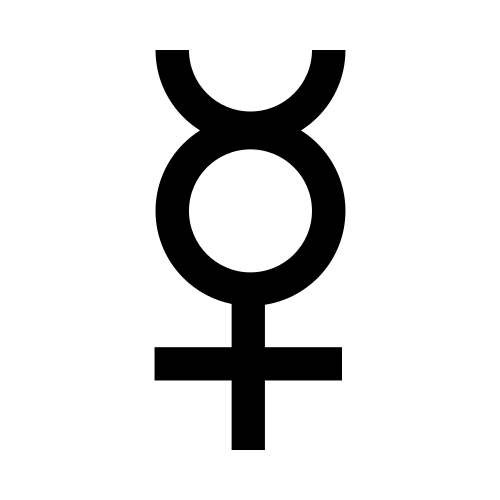 Mercury
 Venus
Venus Mars
Mars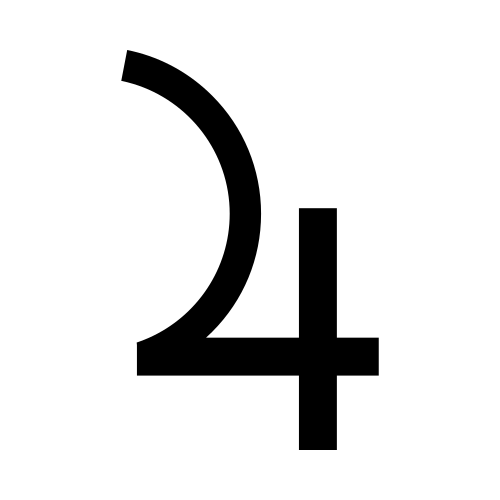 Jupiter
 Saturn
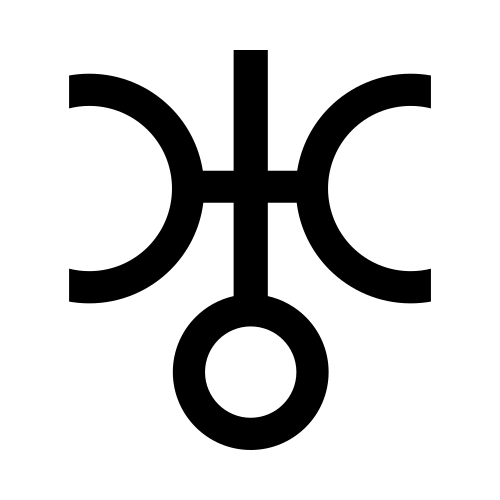 Uranus
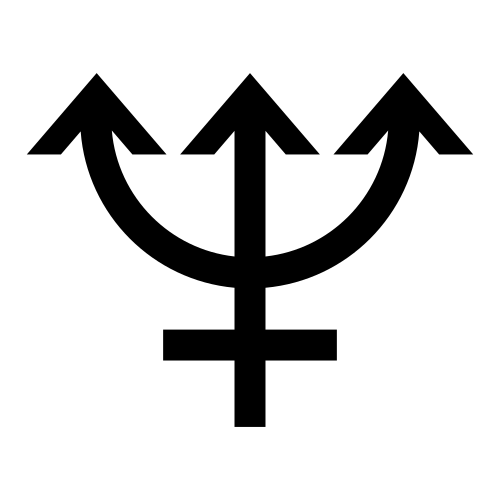 Neptune
 Pluto
Pluto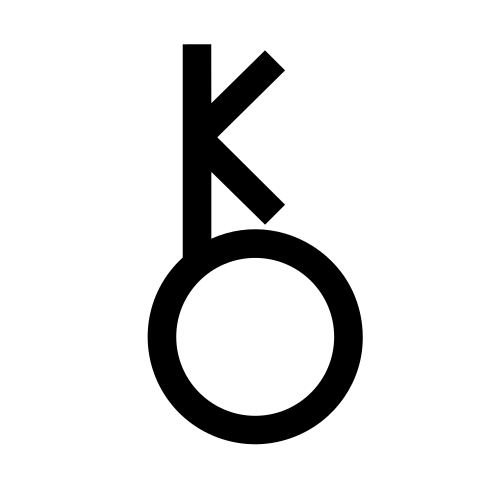 Chiron
Birth time unknown — house positions and Ascendant/MC are not available.
Astronomical context
Those born between approximately 1914 and 1939 carried Pluto in Cancer. This generation lived through the Great Depression and the Second World War — a time of radical transformation of home, nation, family, and collective security.
In astrological tradition, Pluto in Cancer is associated with collective transformation of the domains that sign governs: the family, the homeland, emotional security, the maternal bond, and the deep structures of belonging. Cancer is the sign of roots, nurture, and the private world of feeling. Pluto's transit through Cancer is read, symbolically, as a generational mandate to break apart and rebuild the foundations of domestic and national life. The symbolic reading is correlative, not causal.
Others in the Astrian collection born under this configuration include Alfredo Di Stéfano (1926) and Ferenc Puskás (1927). Presley, born in 1935, belongs to the final years of this generational wave.
Other profiles from this Pluto in Cancer generation
Symbolic reading
The following describes what classical astrological tradition associates with these configurations. Astrian does not apply these descriptions to the person's biography.
The Sun at 17°32' Capricorn is the most prominent structural feature of this chart. Without a documented birth time, there is no Ascendant or Midheaven — the reading is confined to planetary positions by sign and the aspects between planets.
The Moon at 6°33' Pisces represents the noon position; the actual placement falls within approximately 7° on either side. If born early in the day, the Moon would be near 0° Pisces or the very end of Aquarius; if born late, in the low teens of Pisces. The Moon's sign placement in Pisces is probable for most of the day.
Mercury at 22°49' Capricorn, Venus at 29°45' Capricorn, and Mars at 12°57' Libra complete the personal planet picture.
### The Capricorn concentration
Three planets in Capricorn — the Sun, Mercury, and Venus — constitute the chart's most prominent personal feature. They span from the Sun at 17°32' to Venus at 29°45', a range of just over 12° within the sign. The Sun and Mercury are within 5°17' of conjunction; Venus sits at the final degree of the sign.
In the vocabulary of the tradition, Capricorn governs structure, ambition, endurance, the relationship to authority, and the material architecture of worldly position. A three-planet concentration in this sign directs a significant proportion of the chart's energy toward these domains. The sign's register is grounded, practical, and oriented toward the long term.
### Sun sextile Jupiter
The Sun at 17°32' Capricorn sextiles Jupiter at 18°07' Scorpio, orb 0°35'. This is the tightest major aspect in the chart between classical planets. The Sun represents central identity and vitality. Jupiter represents expansion, abundance, and the amplification of what it touches. The sextile is a productive, cooperative aspect — it connects identity with the impulse to amplify in a relationship of easy flow. In an earth-water axis (Capricorn and Scorpio), this alignment operates with depth and material gravity rather than abstract idealism.
### The Venus-Uranus-Pluto T-square
The chart's most structurally complex configuration is a T-square involving three slow-moving and personal-outer planet interactions. Venus at 29°45' Capricorn opposes Pluto at 25°07' Cancer retrograde (4°38'). Uranus at 27°30' Aries squares both: Venus-Uranus at 2°15', Uranus-Pluto at 2°23'. Uranus, at the apex of the T-square, receives the combined pressure of the Venus-Pluto opposition.
Venus governs aesthetics, desire, the sense of beauty and value. Pluto governs transformation, intensity, power, and what operates beneath surfaces. In opposition across the Capricorn-Cancer axis — the axis of public authority and private belonging — Venus and Pluto create a polarity between aesthetic presentation and the psychological depths that lie behind it.
Uranus at the T-square's apex introduces disruption, radical originality, and the breaking of established form. In Aries, Uranus operates with the energy of the pioneer — impulsive, physical, fiercely individual. The T-square channels the Venus-Pluto intensity through Uranus, creating a configuration that the tradition reads as one where aesthetics are simultaneously conventional in their appeal and radically disruptive in their effect.
### Sun trine Neptune
The Sun at 17°32' Capricorn trines Neptune at 14°26' Virgo retrograde, orb 3°06'. The Sun represents identity; Neptune represents the ideal, the dissolving of boundaries, and the capacity for empathy, imagination, or transcendence. The trine connects these registers in an earth-sign axis (Capricorn and Virgo) that is practical and grounded — the ideal operates not in the abstract but through material form and embodied craft.
### Saturn sextile Uranus
Saturn at 25°46' Aquarius sextiles Uranus at 27°30' Aries, orb 1°44'. Saturn governs structure and tradition; Uranus governs disruption and originality. Their sextile places the conservative and the revolutionary in a cooperative relationship — a configuration where established structures can accommodate radical innovation without collapsing.
The planetary pattern here is read as a symbolic portrait, not a causal explanation. No planet caused, predicted, or determined any event or characteristic.
Astrology is a symbolic language with 2,500 years of literature. The reading above is interpretive, not explanatory.
Astrian does not claim that the natal chart of Elvis Presley caused or determined any of the above. Astrology is a symbolic system with 2,500 years of literature. Its capacity for retrospective description does not imply explanatory capacity.
A parallel life
The following are verified biographical facts. No connection to the natal chart is implied.
Elvis Aaron Presley was born on 8 January 1935 in a two-room shotgun house in Tupelo, Mississippi. His identical twin brother, Jesse Garon Presley, was delivered stillborn thirty-five minutes before him. His father, Vernon Elvis Presley, was a sharecropper, truck driver, and laborer; his mother, Gladys Love Presley (née Smith), worked as a sewing-machine operator. The family was poor. Vernon served eight months in the Mississippi State Penitentiary in 1938–39 for forging a check.
Elvis grew up attending the Assembly of God church, where he absorbed gospel music from infancy. The family moved to Memphis, Tennessee, in November 1948, settling in the Lauderdale Courts public housing project. He attended Humes High School and graduated in June 1953.
In the summer of 1953, he walked into the Memphis Recording Service — the commercial arm of Sun Studio — and paid $3.98 to record two songs, ostensibly as a birthday gift for his mother. Sam Phillips, the owner of Sun Records, heard his recording months later and, in June 1954, arranged a session with guitarist Scotty Moore and bassist Bill Black. Their recording of Arthur Crudup's "That's All Right" was aired on local radio and became an immediate regional sensation.
Between July 1954 and November 1955, Presley recorded a series of singles for Sun Records that fused African-American rhythm and blues with white country music in a style that would later be called rockabilly. These recordings — "That's All Right," "Good Rockin' Tonight," "Baby Let's Play House," "Mystery Train" — constituted one of the foundational moments of rock and roll.
Colonel Tom Parker became his manager in 1955. RCA Victor bought his Sun contract for $35,000 — then an unprecedented sum for a recording artist — in November 1955. His first RCA single, "Heartbreak Hotel" (January 1956), reached number one. Between 1956 and 1958, he released "Hound Dog," "Don't Be Cruel," "Love Me Tender," "All Shook Up," "Jailhouse Rock," and "(Let Me Be Your) Teddy Bear," among others. He appeared on The Ed Sullivan Show three times; the third appearance, in January 1957, famously showed him only from the waist up. He sold approximately 10 million singles in 1956 alone.
He was drafted into the United States Army in December 1957 and served in West Germany from October 1958 to March 1960. His mother, Gladys, died of a heart attack in August 1958, shortly before his deployment; her death devastated him.
After his discharge, he recorded a series of commercially successful but critically unremarkable soundtrack albums for a string of Hollywood films — thirty-one films between 1960 and 1969. His creative reputation stalled. In December 1968, the NBC television special Elvis (later known as the "'68 Comeback Special") restored his standing as a live performer. He began a residency at the International Hotel in Las Vegas in July 1969, performing two shows a night for four weeks; the residency continued intermittently until 1976.
He married Priscilla Ann Beaulieu on 1 May 1967 in Las Vegas. Their daughter, Lisa Marie, was born on 1 February 1968. They separated in February 1972 and divorced in October 1973.
Through the 1970s, his health deteriorated. He suffered from chronic insomnia, weight gain, and an escalating dependence on prescription medications — primarily amphetamines, barbiturates, and opioids, prescribed by his personal physician, Dr. George Nichopoulos.
He died on 16 August 1977 at Graceland, his Memphis estate. He was forty-two years old. The official cause of death was cardiac arrhythmia, later attributed to the combined effects of multiple prescription drugs and underlying heart disease.
He won three Grammy Awards, all for gospel recordings. He has sold an estimated 500 million records worldwide, making him one of the best-selling individual artists in history. Graceland, opened to the public in 1982, is the second most-visited private residence in the United States after the White House.
Biographical sources
- Guralnick, Peter. Last Train to Memphis: The Rise of Elvis Presley. Little, Brown 1994
- Guralnick, Peter. Careless Love: The Unmaking of Elvis Presley. Little, Brown 1999
This profile presents the sky at the birth of Elvis Presley and verified facts of their biography. Astrian does not claim that astrology has predictive capacity or that the natal chart determines the trajectory of a life. Astrology is a symbolic system with 2,500 years of literature. Its capacity for retrospective description does not imply explanatory capacity.
Calculate your own birth chart with the same NASA JPL DE441 precision.
Calculate my birth chartLast updated: June 12, 2026
Newsletter
A short reading once a month, in your inbox.
A note on the symbolism of the season, recent editorial pieces, and what to look for in next month's sky. No predictions.
Support this project
Independent, no venture funding, no ads. A contribution keeps Astrian precise and free.
Support on Ko-fi (opens in new tab)