PROFILE · SPORTS
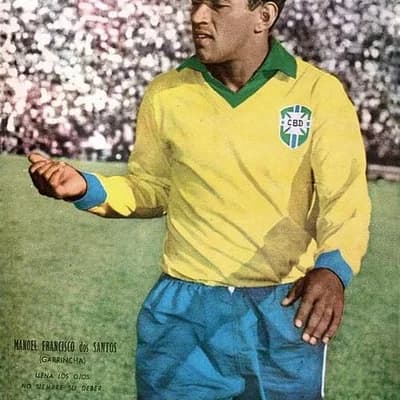
Garrincha
Manuel Francisco dos Santos
footballer
Born 28 October 1933 · Pau Grande, Brazil · 22.42° S, 43.50° WX
Source: Not documented
About this chart
No birth time is documented for this person. The chart therefore shows planetary positions in their signs, the slow aspects between them, and the generational context — but not house placements, the Ascendant, or the Midheaven, which require an accurate birth time. The Moon's sign carries a ±6° margin: if it falls near a sign boundary, the sign could vary. Positions for all other planets are reliable.
Do you have a verified source for this birth time? Share it →
The sky at birth
Without a documented birth time, house positions, the Ascendant, and the Midheaven are not calculated. Planetary positions in signs are derived from noon on the birth date.
Manuel Francisco dos Santos — known throughout football as Garrincha, the Little Bird — was born on 28 October 1933 in Pau Grande, a small factory town in the Serra dos Órgãos foothills of Rio de Janeiro state. The Sun at approximately 4° Scorpio falls in the early degrees of the sign — the phase where Scorpio's qualities of concentrated power, penetrating focus, and the capacity to transform apparent limitation into exceptional capability are at their most direct and instinctive expression. Scorpio at 4° describes the player who converts constraint into creation: who finds the movement where others see only the barrier, who generates the space from within the density of opposition.
Garrincha was born with physical conditions — his spine curved left, his right leg bent inward, his left leg shorter than his right — that medical opinion suggested should have precluded professional sport. His play was the contradiction of that opinion expressed in motion: the dribble that used the defender's certainty of the normal trajectory against them, the cut that arrived from an angle no other player produced, the speed that operated through the irregularity rather than despite it.
Saturn was in Aquarius (~13°) at his birth. Pluto was at approximately 23° Cancer, placing him in the Pluto in Cancer generation (1914–1939). Neptune was in Virgo (~9°). Jupiter was in Libra (~28°) at birth.
No birth time is documented for Garrincha. Planetary sign positions use a noon ephemeris and are approximate.
| Planet | Sign | Position |
|---|---|---|
| Sun | Scorpio | 04°44' |
| Moon | Pisces | 08°46'±6° |
| Mercury | Scorpio | 28°31' |
| Venus | Sagittarius | 19°56' |
| Mars | Sagittarius | 13°49' |
| Jupiter | Libra | 10°21' |
| Saturn | Aquarius | 09°52' |
| Uranus | Aries | 25°02'retrograde |
| Neptune | Virgo | 11°45' |
| Pluto | Cancer | 24°45'retrograde |
| Chiron | Gemini | 02°51'retrograde |
 Sun
Sun Moon
Moon Mercury
 Venus
Venus Mars
Mars Jupiter
 Saturn
 Uranus
 Neptune
 Pluto
Pluto Chiron
Birth time unknown — house positions and Ascendant/MC are not available.
Astronomical context
Garrincha belongs to the Pluto in Cancer generation (1914–1939), born in 1933 in Pau Grande — a company town built around the América Fabril textile factory, where his father worked and where almost everyone he knew growing up worked. His context was the Brazilian industrial proletariat of the Estado Novo era: a closed, tight community where football was the primary collective entertainment and the primary pathway toward any different life.
The Pluto in Cancer generation's deep connection to place, community, and the emotional bonds of the familiar group shaped Garrincha's biography in ways that both elevated and ultimately limited him. He played for Botafogo in Rio for thirteen years, frequently refusing transfers to larger European clubs for less than the financial guarantees he required. His loyalty to Botafogo, where he could live near Pau Grande and maintain the social world he knew, was the Pluto in Cancer quality at work.
He won two World Cups with Brazil — 1958 and 1962. In the 1962 tournament, after Pelé was injured in the second match, Garrincha effectively carried Brazil through the competition. He was named best player and best forward of the tournament. Brazil did not lose a competitive match in which he played.
Other profiles from this Pluto in Cancer generation
Symbolic reading
The following describes what classical astrological tradition associates with these configurations. Astrian does not apply these descriptions to the person's biography.
The Sun at 4° Scorpio describes the dribbler as transformer: the player who converts the opponent's committed action into the opening for his own movement, who is most dangerous not when he has space but when the defender believes there is no space left. Garrincha's dribbling was characterised by its use of the defender's certainty — the step-over that worked precisely because the defender was certain which way it would go, the acceleration that arrived when the defender had committed to the challenge.
The quality of Scorpio at this degree also describes the intensity that Garrincha brought to the individual contest: the duel with the defender was not tactical but personal, a test of will and skill at its most concentrated. Observers noted that he was often amused by the process, that the dribbling carried something of play in the deepest sense, the engagement with challenge for its own sake.
Saturn in Aquarius provides the structural independence that allowed Garrincha to play his own game within Brazil's collective framework: the freedom within the system that his teammates granted him because the results justified it.
The readings above are symbolic and archetypal. They do not constitute psychological diagnoses or predictions.
Astrian does not claim that the natal chart of Garrincha caused or determined any of the above. Astrology is a symbolic system with 2,500 years of literature. Its capacity for retrospective description does not imply explanatory capacity.
A parallel life
The following are verified biographical facts. No connection to the natal chart is implied.
Manuel Francisco dos Santos was born on 28 October 1933 in Pau Grande, Magé, Rio de Janeiro state. He was born with a spinal curvature and legs of different lengths and angles; his childhood was spent in Pau Grande near the factory where his family worked. He began playing for Botafogo's youth system in 1953 and made his professional debut the same year.
His performances with Botafogo through the late 1950s established him as the most exceptional winger in Brazilian football. He was included in the Brazil squad for the 1958 World Cup despite initial resistance; Brazil won the tournament, with Garrincha and Pelé forming the attacking combination in the knockout rounds. For the 1962 World Cup, Garrincha was the central figure after Pelé's injury — he scored two goals in the quarter-final against England and two in the semi-final against Chile. Brazil won the tournament. Brazil never lost a competitive match in which both Garrincha and Pelé played.
He died in 1983. He is considered by many players and commentators of his era, including Pelé, to have been the greatest player they ever saw.
Biographical sources
- Botafogo de Futebol e Regatas official records, 1953–1966..
- Bra.
This profile presents the sky at the birth of Garrincha and verified facts of their biography. Astrian does not claim that astrology has predictive capacity or that the natal chart determines the trajectory of a life. Astrology is a symbolic system with 2,500 years of literature. Its capacity for retrospective description does not imply explanatory capacity.
Calculate your own birth chart with the same NASA JPL DE441 precision.
Calculate my birth chartLast updated: June 12, 2026
Newsletter
A short reading once a month, in your inbox.
A note on the symbolism of the season, recent editorial pieces, and what to look for in next month's sky. No predictions.
Support this project
Independent, no venture funding, no ads. A contribution keeps Astrian precise and free.
Support on Ko-fi (opens in new tab)