PROFILE · SCIENCE & TECHNOLOGY
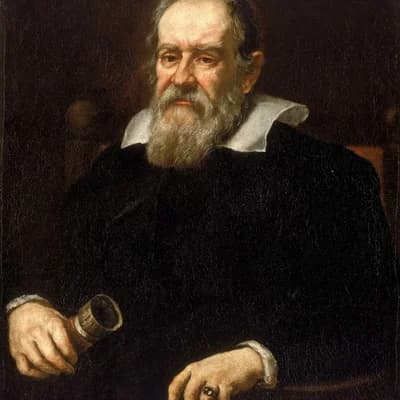
Galileo Galilei
Galileo di Vincenzo Bonaiuti de' Galilei
astronomer and physicist
Born 15 February 1564 · Pisa, Tuscany, Italy · 43.72° N, 10.40° EX
Source: Birth time not documented in publicly accessible records
About this chart
No birth time is documented for this person. The chart therefore shows planetary positions in their signs, the slow aspects between them, and the generational context — but not house placements, the Ascendant, or the Midheaven, which require an accurate birth time. The Moon's sign carries a ±6° margin: if it falls near a sign boundary, the sign could vary. Positions for all other planets are reliable.
Do you have a verified source for this birth time? Share it →
The sky at birth
No birth time is documented for Galileo Galilei. The Ascendant, Midheaven, and house positions cannot be determined. The planetary positions below are calculated for noon local time and are accurate to within a fraction of a degree for the slow-moving planets. The Moon's position carries a margin of approximately ±7°.
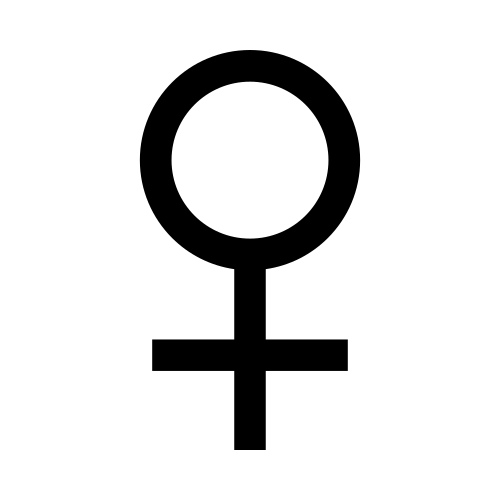
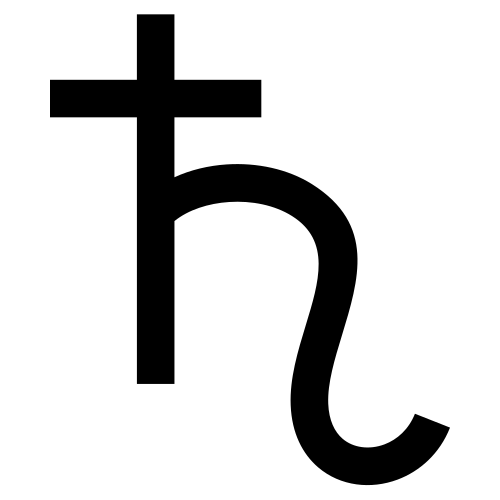
The Sun is at 25°54' Aquarius. The Moon is at 25°37' Scorpio (noon position, ±7° margin). Mercury is at 23°50' Aquarius. Venus is at 7°58' Pisces. Mars is at 23°37' Taurus. Jupiter is at 0°23' Leo R. Saturn is at 28°03' Cancer R. Uranus is at 7°37' Sagittarius. Neptune is at 5°05' Gemini. Pluto is at 13°37' Pisces.
Mercury at 23°50' Aquarius squares Mars at 23°37' Taurus (0°13') — the tightest major aspect in the chart. The Sun at 25°54' Aquarius squares the Moon at 25°37' Scorpio (0°17'), though this aspect carries the Moon's ±7° uncertainty. Venus at 7°58' Pisces squares Uranus at 7°37' Sagittarius (0°21'). The Moon opposes Mars (2°00'), also with lunar uncertainty. The Sun conjoins Mercury (2°04'). The Sun squares Mars (2°17'). Jupiter at 0°23' Leo retrograde conjoins Saturn at 28°03' Cancer retrograde (2°20'). The Moon trines Saturn (2°26'). Uranus at 7°37' Sagittarius opposes Neptune at 5°05' Gemini (2°32'). Venus squares Neptune (2°53'). Mars sextiles Saturn (4°26'). The Moon trines Jupiter (4°46').
The Sun, Mercury, Moon, and Mars form a fixed-sign T-square: the Sun-Mercury conjunction in Aquarius at the apex squares both the Moon in Scorpio and Mars in Taurus, which oppose each other across the fixed axis. This is the dominant structural pattern of the chart.
The engine also identifies the following tight minor aspects: neptune quincunx northNode (0.29° app); venus square uranus (0.34° sep).
The tightest major aspects between planets: Mercury square Mars (0°13'), Sun square Moon (0°17'), Venus square Uranus (0°21'), Moon opposition Mars (2°00'), Sun conjunction Mercury (2°04'), Sun square Mars (2°17'), Jupiter conjunction Saturn (2°20'), Moon trine Saturn (2°26'), Uranus opposition Neptune (2°32'), Venus square Neptune (2°53').
The chart was calculated by Astrian's engine using NASA JPL DE441 ephemerides, sub-arcsecond precision. Timezone: local mean time for Pisa (Europe/Rome, approximately UTC +0:42).
| Planet | Sign | Position |
|---|---|---|
| Sun | Aquarius | 25°52' |
| Moon | Scorpio | 25°12'±6° |
| Mercury | Aquarius | 23°47' |
| Venus | Pisces | 07°55' |
| Mars | Taurus | 23°36' |
| Jupiter | Leo | 00°24'retrograde |
| Saturn | Cancer | 28°03'retrograde |
| Uranus | Sagittarius | 07°37' |
| Neptune | Gemini | 05°05' |
| Pluto | Pisces | 13°37' |
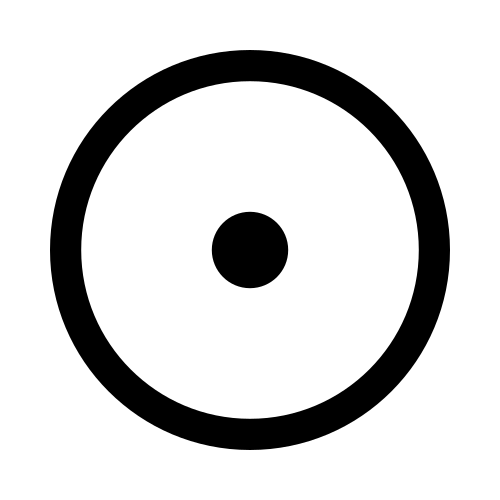 Sun
Sun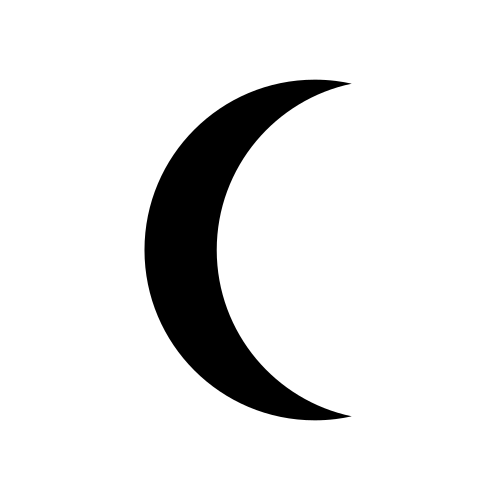 Moon
Moon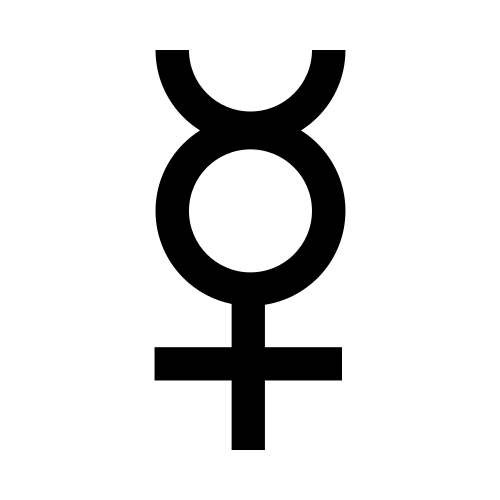 Mercury
 Venus
Venus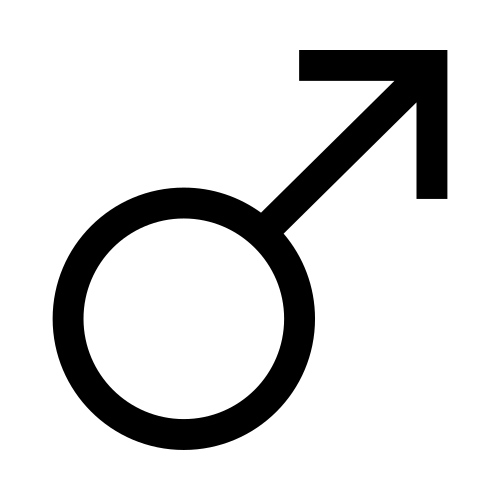 Mars
Mars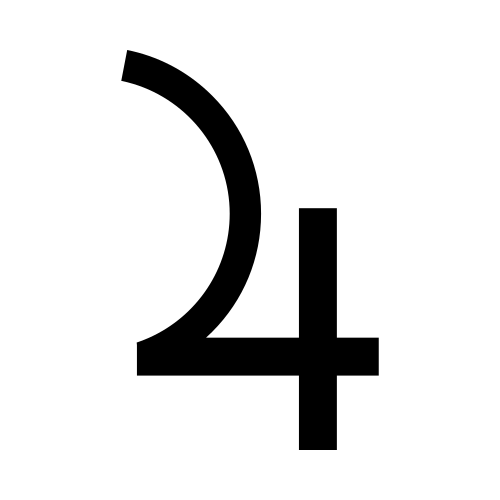 Jupiter
 Saturn
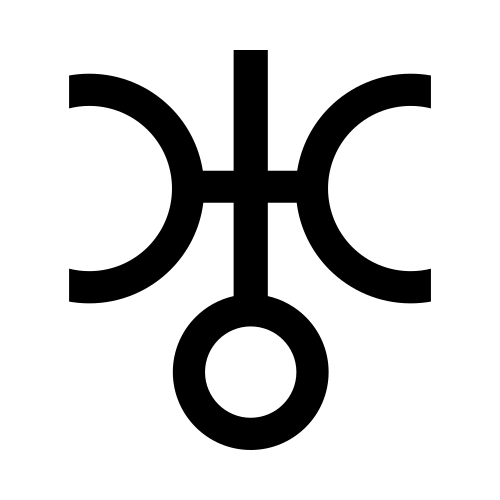 Uranus
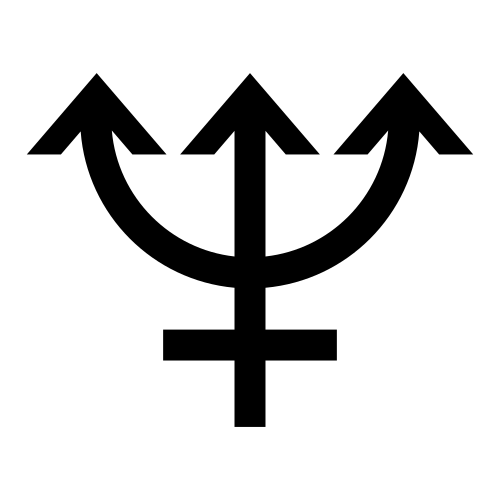 Neptune
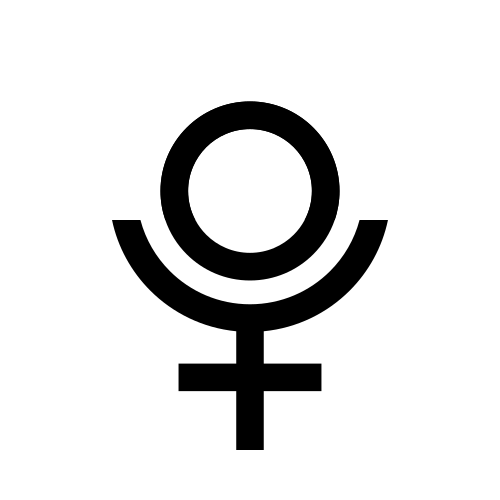 Pluto
PlutoBirth time unknown — house positions and Ascendant/MC are not available.
Astronomical context
Galileo was born with Pluto at 13°37' Pisces. This particular transit of Pluto through Pisces occurred during the sixteenth century, a period that encompassed the late Renaissance, the Counter-Reformation, the Age of Discovery, and the beginning of the transformation of European intellectual life by the encounter with the New World and the rediscovery of classical texts. The generation born during this transit inherited a world where the old cosmological certainties — the Ptolemaic universe, the Aristotelian physics, the Church's monopoly on the interpretation of the natural world — were under increasing pressure from observation, measurement, and the sheer accumulation of facts that refused to fit the inherited frameworks.
In astrological tradition, Pluto in Pisces is associated with collective transformation of the domains that sign governs: the imaginal, the spiritual, the boundaryless, the compassionate, and the dissolution of established forms. Pisces is the sign of the mystic, the artist, and the one who perceives what lies beyond the visible. Pluto's transit through Pisces is read, symbolically, as a period when the structures of faith, imagination, and the relationship between the visible and the invisible were subjected to deep structural pressure. The symbolic reading is correlative, not causal.
No other profiles in the Astrian collection share this specific Pluto-in-Pisces cycle from the sixteenth century.
Other profiles from this Pluto in Pisces generation
Symbolic reading
The following describes what classical astrological tradition associates with these configurations. Astrian does not apply these descriptions to the person's biography.
The Sun at 25°54' Aquarius is the most prominent structural feature of this chart. Without a documented birth time, there is no Ascendant or Midheaven — the reading is confined to planetary positions by sign and the aspects between planets.
The Moon at 25°37' Scorpio represents the noon position; the actual placement falls within approximately 7° on either side. If born early in the day, the Moon could be near 19° Scorpio; if born late, near 2° Sagittarius — the Moon's sign placement in Scorpio is not guaranteed for the entire day. Mercury at 23°50' Aquarius, Venus at 7°58' Pisces, and Mars at 23°37' Taurus complete the personal planet picture.
### The fixed T-square: mind against the material
The dominant structural pattern of this chart is a T-square in fixed signs. The Sun at 25°54' Aquarius and Mercury at 23°50' Aquarius form the apex. The Moon at 25°37' Scorpio and Mars at 23°37' Taurus form the base opposition. The four bodies are locked in a configuration of maximum tension: each squares or opposes at least two of the others.
Mercury squares Mars at 0°13' — the tightest individual aspect. Mercury governs the organisation of thought, the naming of things, and the communication of ideas. Mars governs action, the application of force, and the drive to test ideas against the physical world. The square in fixed signs places the intellect (Aquarius) in friction with the methodical, persistent drive to work with material reality (Taurus). The friction is exact: the mind and the world resist each other, and the resistance is the engine that drives the work forward.
The Sun squares the Moon at 0°17' (with the Moon's ±7° uncertainty). The Sun governs identity. The Moon governs the emotional faculty and the instinctive life. The square in Aquarius-Scorpio places the identity that operates through detached, systematic observation in tension with an emotional life that operates through depth, intensity, and the need to penetrate beneath the surface. The self that wants to see clearly must negotiate with the self that feels profoundly.
The Sun squares Mars at 2°17'. The identity that observes is in friction with the drive to act upon what is observed — the tension between the astronomer who sees and the experimenter who builds, measures, and demonstrates.
The Moon opposes Mars at 2°00' (with lunar uncertainty). The emotional depth of Scorpio faces the methodical persistence of Taurus across the axis of the fixed signs. The feelings are intense; the work is patient; the opposition holds them in permanent dialogue.
At the apex of the T-square, the Sun-Mercury conjunction (2°04') fuses identity with intellect. The self is experienced as a thinking instrument. In Aquarius, the thinking operates through systems, patterns, and the drive to understand the universal from the particular.
### Venus square Uranus: the senses jolted
Venus at 7°58' Pisces squares Uranus at 7°37' Sagittarius, orb 0°21'. Venus governs the perception of beauty and the organisation of sensory experience. Uranus governs originality, sudden insight, and the disruption of established patterns. The square places the aesthetic faculty in friction with the revolutionary impulse: what the senses perceive is continually disrupted by the arrival of new information, and the new information is received through the senses with the force of beauty. Venus in Pisces perceives through the register of the imaginal and the compassionate; Uranus in Sagittarius disrupts through the register of the philosophical quest. The square reads as a constitution where sensory perception is permanently jolted by the drive to see what has not yet been seen.
Venus also squares Neptune at 5°05' Gemini (2°53'), extending the disruption into the register of the ideal. The aesthetic faculty must negotiate with both the revolutionary (Uranus) and the dissolving (Neptune) — what is seen must accommodate what breaks the framework and what exceeds all frameworks.
### Jupiter conjunction Saturn: expansion and contraction
Jupiter at 0°23' Leo retrograde conjoins Saturn at 28°03' Cancer retrograde, orb 2°20'. The two planets are in adjacent signs but within conjunction orb. Jupiter governs expansion, generosity, and the search for meaning. Saturn governs contraction, discipline, and the demand for form. The conjunction places them in the same region of the chart: the drive to see more and the demand to prove what has been seen coexist within a single structural unit. Jupiter in early Leo (retrograde) expands through the creative, the performative, and the drive to make the vision visible. Saturn in late Cancer (retrograde) structures through the register of the ancestral, the established, and the inherited. The conjunction reads as a faculty where vision and discipline are fused — the capacity to see the large pattern and the obligation to demonstrate it rigorously.
The planetary pattern here is read as a symbolic portrait, not a causal explanation. No planet caused, predicted, or determined any event or characteristic.
Astrology is a symbolic language with 2,500 years of literature. The reading above is interpretive, not explanatory.
Astrian does not claim that the natal chart of Galileo Galilei caused or determined any of the above. Astrology is a symbolic system with 2,500 years of literature. Its capacity for retrospective description does not imply explanatory capacity.
A parallel life
The following are verified biographical facts. No connection to the natal chart is implied.
Galileo di Vincenzo Bonaiuti de' Galilei was born on 15 February 1564 in Pisa, in the Grand Duchy of Tuscany — the same year Michelangelo died and William Shakespeare was born. His father, Vincenzo Galilei, was a musician and music theorist of some distinction, a lutenist who conducted experiments on the relationship between string tension, length, and pitch; Galileo later acknowledged that his own experimental method owed something to his father's approach to acoustics. His mother, Giulia Ammannati, came from a family of modest standing.
He entered the University of Pisa in 1580 to study medicine, as his father wished, but turned almost immediately to mathematics and natural philosophy. He left without a degree in 1585. For the next four years he tutored privately and pursued independent research, publishing a short treatise on the hydrostatic balance and beginning the investigations into the physics of motion that would occupy the rest of his life.
In 1589 he was appointed to the chair of mathematics at Pisa — a poorly paid position at the bottom of the university hierarchy. In 1592 he moved to the University of Padua, in the Republic of Venice, where he spent eighteen years — a period he later called the happiest of his life. At Padua he taught geometry, mechanics, and military engineering; he developed an improved military compass (the compasso geometrico e militare) and began the systematic study of accelerated motion that would become the foundation of classical kinematics.
He never married. His long relationship with Marina Gamba, a Venetian woman of modest origin, produced three children: Virginia (later Sister Maria Celeste), Livia, and Vincenzio. The two daughters were placed in the convent of San Matteo in Arcetri; Virginia became his most devoted correspondent and the closest emotional relationship of his later life.
In the summer of 1609, reports reached Venice of a device made in the Netherlands that could magnify distant objects. Galileo, without seeing the original, constructed his own instrument — first at eight-power, then twenty, eventually thirty. He turned it on the night sky in the autumn of 1609 and the first months of 1610, and what he found demolished the Aristotelian cosmology that had structured European thought for two millennia. The Moon had mountains and valleys — it was not a perfect sphere. Jupiter had four moons — not everything orbited the Earth. Venus showed phases — it orbited the Sun. The Milky Way dissolved into individual stars.
Sidereus Nuncius (The Starry Messenger), published in March 1610, announced these observations to Europe. The reaction was immediate, immense, and polarised. He was appointed Chief Mathematician and Philosopher to Cosimo II de' Medici, Grand Duke of Tuscany — a position that gave him financial security and social standing but removed the protection of the Venetian Republic, which was the one Italian state that did not answer to the Pope.
In 1616 the Congregation of the Index declared heliocentrism "formally heretical" and prohibited the teaching of the Copernican system as physical truth. Galileo was warned privately by Cardinal Bellarmine but was not formally charged. He continued his work, publishing Il Saggiatore (The Assayer, 1623), a masterpiece of scientific rhetoric and method.
In 1632 he published the Dialogo sopra i due massimi sistemi del mondo (Dialogue Concerning the Two Chief World Systems), a work structured as a conversation among three characters — Salviati (the Copernican), Simplicio (the Aristotelian), and Sagredo (the intelligent layman). The argument for heliocentrism was presented with devastating clarity. The Pope, Urban VIII, who had previously been sympathetic, concluded that Simplicio — the character who lost every argument — was a caricature of himself.
In 1633 Galileo was summoned before the Inquisition in Rome. The trial lasted from April to June. He was found "vehemently suspect of heresy," forced to recant, and sentenced to house arrest for the remainder of his life. The Dialogo was placed on the Index of Prohibited Books, where it remained until 1835.
He spent his final years at his villa in Arcetri, near Florence, under the terms of his sentence. Despite failing eyesight — he was completely blind by 1638 — he completed the Discorsi e dimostrazioni matematiche intorno a due nuove scienze (Discourses and Mathematical Demonstrations Relating to Two New Sciences, 1638), smuggled out of Italy and published in Leiden by the Elzevirs. The Two New Sciences laid the foundations of materials science and kinematics; it is the work on which his reputation as a physicist rests at least as securely as on the telescopic observations.
His daughter Virginia died in 1634. He described her death as the greatest loss of his life.
He died at Arcetri on 8 January 1642, at the age of seventy-seven. The Grand Duke wished to erect a monument in his honour at Santa Croce in Florence; the Pope forbade it. The monument was not completed until 1737.
This profile presents the sky at the birth of Galileo Galilei and verified facts of their biography. Astrian does not claim that astrology has predictive capacity or that the natal chart determines the trajectory of a life. Astrology is a symbolic system with 2,500 years of literature. Its capacity for retrospective description does not imply explanatory capacity.
Related profiles
Calculate your own birth chart with the same NASA JPL DE441 precision.
Calculate my birth chartLast updated: June 12, 2026
Newsletter
A short reading once a month, in your inbox.
A note on the symbolism of the season, recent editorial pieces, and what to look for in next month's sky. No predictions.
Support this project
Independent, no venture funding, no ads. A contribution keeps Astrian precise and free.
Support on Ko-fi (opens in new tab)