PROFILE · SCIENCE & TECHNOLOGY
Ada Lovelace
Augusta Ada King, Countess of Lovelace
mathematician
Born 10 December 1815 · London, United Kingdom · 51.51° N, 0.13° WX
Source: Birth time not documented in publicly accessible records
About this chart
No birth time is documented for this person. The chart therefore shows planetary positions in their signs, the slow aspects between them, and the generational context — but not house placements, the Ascendant, or the Midheaven, which require an accurate birth time. The Moon's sign carries a ±6° margin: if it falls near a sign boundary, the sign could vary. Positions for all other planets are reliable.
Do you have a verified source for this birth time? Share it →
The sky at birth
No birth time is documented for Ada Lovelace. The Ascendant, the Midheaven, and the house positions cannot be determined; the reading is confined to planetary sign placements and the aspects between planets. The positions below are calculated for noon local time and are accurate to a fraction of a degree for the slow-moving bodies. One caveat: the Moon lies near a sign boundary, so without an exact time it cannot be fixed to a single sign — it sits close to 5°09' Aries within a daily margin of about ±7°.
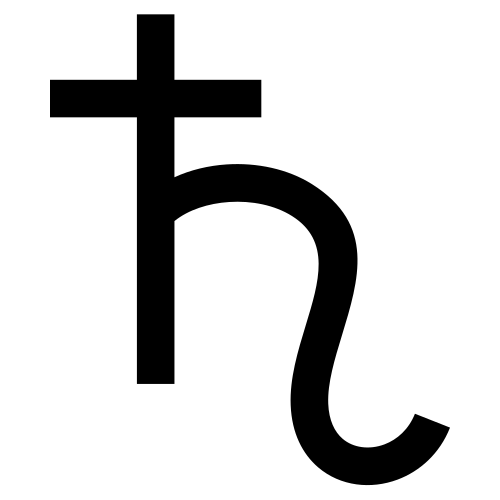
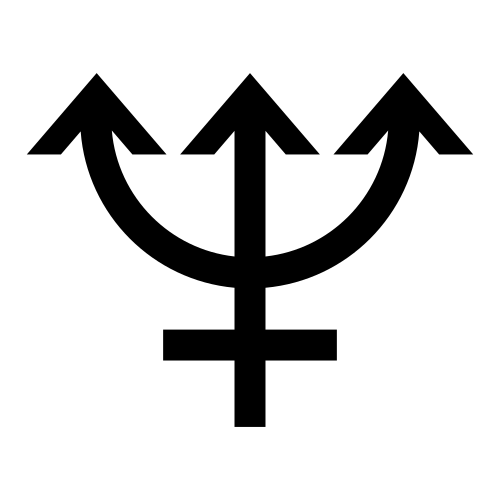
The Moon is near 5°09' Aries (noon position, ±7° margin). Sun is at 17°37' Sagittarius. Mercury is at 0°28' Sagittarius. Venus is at 1°30' Scorpio. Mars is at 20°22' Aries. Jupiter is at 2°14' Scorpio. Saturn is at 8°34' Aquarius. Uranus is at 7°47' Sagittarius. Neptune is at 19°34' Sagittarius. Pluto is at 20°53' Pisces.
4 bodies occupy Sagittarius (Sun, Mercury, Uranus and Neptune) — a concentration that stands out as a structural feature of the chart.
The tightest major aspects between planets: Venus conjunct Jupiter (0°44'); Saturn sextile Uranus (0°47'); Mars trine Neptune (0°49'); Neptune square Pluto (1°20'); Sun conjunct Neptune (1°56'); Moon trine Uranus (2°38').
Neptune square Pluto (1°20') is structural but generational — an alignment of slow-moving outer planets shared across many birth years.
The engine also registers tight minor aspects involving asteroids and calculated points: Moon semi-sextile Lilith (1°10'); Mars semi-square Lilith (1°23'); Saturn sesquiquadrate North Node (1°24'); Jupiter trine Lilith (1°46'). These are reported for completeness and carry less weight in traditional reading.
The chart was calculated using NASA JPL DE441 ephemerides, sub-arcsecond precision.
| Planet | Sign | Position |
|---|---|---|
| Sun | Sagittarius | 17°37' |
| Moon | Aries | 05°09'±6° |
| Mercury | Sagittarius | 00°28' |
| Venus | Scorpio | 01°30' |
| Mars | Aries | 20°22' |
| Jupiter | Scorpio | 02°14' |
| Saturn | Aquarius | 08°34' |
| Uranus | Sagittarius | 07°47' |
| Neptune | Sagittarius | 19°34' |
| Pluto | Pisces | 20°53' |
 Sun
Sun Moon
Moon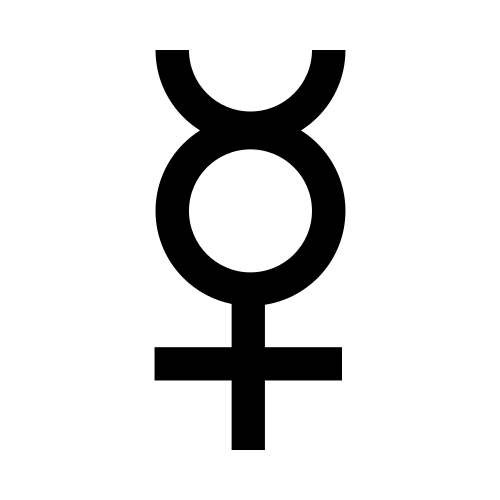 Mercury
 Venus
Venus Mars
Mars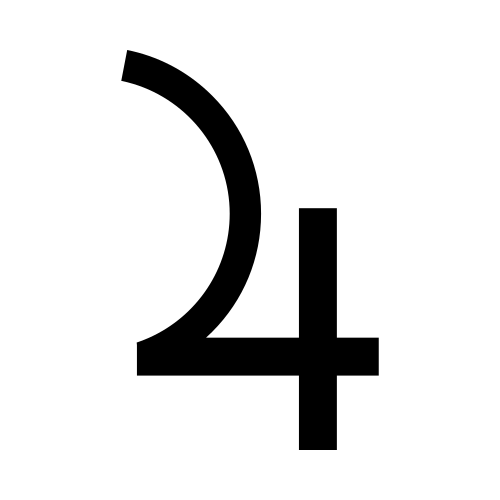 Jupiter
 Saturn
 Uranus
 Neptune
 Pluto
PlutoBirth time unknown — house positions and Ascendant/MC are not available.
Astronomical context
Pluto moved through Pisces roughly from 1798 to 1823. In astrological tradition this transit is linked to the transformation of belief, imagination, and the dissolution of old forms — the generation of early Romanticism and shifting spiritual horizons.
Ada Lovelace (born 1815) belongs to this generational configuration. Astrian groups profiles by such shared signatures rather than by any claim of shared destiny. Related profiles in Astrian: Charles Babbage · John von Neumann · Hedy Lamarr. The symbolic reading is correlative, not causal.
Other profiles from this Pluto in Pisces generation
Symbolic reading
The following describes what classical astrological tradition associates with these configurations. Astrian does not apply these descriptions to the person's biography.
The Sun in Sagittarius is the most prominent structural feature available without a birth time, centring the chart on expansion, conviction, and the horizon. There is no Ascendant or Midheaven to anchor the angles, so the reading rests on sign placements and the aspects between planets rather than on houses.
Among the personal planets, the Moon in Aries is associated in tradition with initiative, directness, and the will to begin (the Moon's sign is given for the noon chart and may shift with an exact time); Mercury in Sagittarius with expansion, conviction, and the horizon; Venus in Scorpio with intensity, depth, and the will to transform; and Mars in Aries with initiative, directness, and the will to begin. These placements describe registers of feeling, thought, attraction, and action as the tradition catalogues them, independent of the life that follows.
Venus conjunct Jupiter (0°44'): tradition reads values, attraction, and harmony fused with expansion and meaning.
Saturn sextile Uranus (0°47'): tradition reads structure, limitation, and discipline in supportive contact with disruption and innovation.
Mars trine Neptune (0°49'): tradition reads drive, assertion, and action in easy flow with dissolution, imagination, and idealism.
Neptune square Pluto (1°20'): tradition reads dissolution, imagination, and idealism in friction with depth, power, and transformation.
These placements are presented as a symbolic portrait, correlative and never causal — a description within the tradition's vocabulary, not an explanation of the life that follows.
Astrology is a symbolic language with 2,500 years of literature. The reading above is interpretive, not explanatory.
Astrian does not claim that the natal chart of Ada Lovelace caused or determined any of the above. Astrology is a symbolic system with 2,500 years of literature. Its capacity for retrospective description does not imply explanatory capacity.
A parallel life
The following are verified biographical facts. No connection to the natal chart is implied.
Augusta Ada King, Countess of Lovelace, was born on 10 December 1815 in London. She was the only legitimate child of the poet George Gordon Byron, though her parents separated shortly after her birth and she never knew her father, who died when she was eight. Her mother, Anne Isabella Milbanke, ensured that Ada received an education that emphasised mathematics and science, which was unusual for women of the period.
As a young woman, Lovelace came into contact with scientists and mathematicians in the social circles she frequented, including Mary Somerville, the Scottish mathematician and scientist, through whom she met Charles Babbage in 1833. Babbage was developing his concept for a mechanical computing device, the Analytical Engine, which was intended to perform general calculations and to be programmable using punched cards.
In 1842 and 1843, Lovelace translated from French into English an article by the Italian mathematician Luigi Menabrea describing Babbage's Analytical Engine. At Babbage's suggestion, she supplemented the translation with extensive notes of her own, which were substantially longer than the original article. The notes included a step-by-step procedure for calculating Bernoulli numbers using the Analytical Engine, which has been described by later scholars as the first algorithm specifically intended for implementation on a machine.
In the notes, Lovelace also reflected on the broader potential of the Analytical Engine beyond numerical calculation and discussed the limitations of what such a machine could be expected to do independently.
Lovelace maintained a correspondence and working relationship with Babbage throughout this period. In later years, her health deteriorated significantly. She died on 27 November 1852 in London, at the age of 36. Interest in her work was revived substantially in the second half of the twentieth century, and the programming language Ada, developed for the United States Department of Defense in the 1980s, was named in her honour.
Biographical sources
- Toole, Betty Alexandra. Ada, the Enchantress of Numbers: A Selection from the Letters of Lord Byron's Daughter and Her Description of the First Computer. Mill Valley, CA: Strawberry Press, 1992..
- Menabrea, Luigi F., and Ada Lovelace. Sketch of the Analytical Engine Invented by Charles Babbage. Translated and annotated by A. A. L. Taylor's Scientific Memoirs 3 (1843): 666-731..
- Fuegi, John, and Jo Francis. "Lovelace and Babbage and the Creation of the 1843 'Notes.'" IEEE Annals of the History of Computing 25, no. 4 (2003): 16-26..
- Swade, Doron. The Difference Engine: Charles Babbage and the Quest to Build the First Computer. New York: Viking, 2001..
This profile presents the sky at the birth of Ada Lovelace and verified facts of their biography. Astrian does not claim that astrology has predictive capacity or that the natal chart determines the trajectory of a life. Astrology is a symbolic system with 2,500 years of literature. Its capacity for retrospective description does not imply explanatory capacity.
Related profiles
Calculate your own birth chart with the same NASA JPL DE441 precision.
Calculate my birth chartLast updated: June 14, 2026
Newsletter
A short reading once a month, in your inbox.
A note on the symbolism of the season, recent editorial pieces, and what to look for in next month's sky. No predictions.
Support this project
Independent, no venture funding, no ads. A contribution keeps Astrian precise and free.
Support on Ko-fi (opens in new tab)