PROFILE · SCIENCE & TECHNOLOGY
Katherine Johnson
Katherine Coleman Goble Johnson
mathematician
Born 26 August 1918 · White Sulphur Springs, West Virginia, United States · 37.79° N, 80.30° WX
Source: Birth time not documented in publicly accessible records
About this chart
No birth time is documented for this person. The chart therefore shows planetary positions in their signs, the slow aspects between them, and the generational context — but not house placements, the Ascendant, or the Midheaven, which require an accurate birth time. The Moon's sign carries a ±6° margin: if it falls near a sign boundary, the sign could vary. Positions for all other planets are reliable.
Do you have a verified source for this birth time? Share it →
The sky at birth
No birth time is documented for Katherine Johnson. The Ascendant, the Midheaven, and the house positions cannot be determined; the reading is confined to planetary sign placements and the aspects between planets. The positions below are calculated for noon local time and are accurate to a fraction of a degree for the slow-moving bodies. One caveat: the Moon lies near a sign boundary, so without an exact time it cannot be fixed to a single sign — it sits close to 4°28' Taurus within a daily margin of about ±7°.
The Moon is near 4°28' Taurus (noon position, ±7° margin). Sun is at 2°35' Virgo. Mercury is at 14°20' Virgo, retrograde. Venus is at 9°40' Leo. Mars is at 5°59' Scorpio. Jupiter is at 9°00' Cancer. Saturn is at 19°59' Leo. Uranus is at 25°27' Aquarius, retrograde. Neptune is at 7°48' Leo. Pluto is at 6°19' Cancer.
3 bodies occupy Leo (Venus, Saturn and Neptune) — a concentration that stands out as a structural feature of the chart.
The tightest major aspects between planets: Mars trine Pluto (0°19'); Moon opposite Mars (1°31'); Mars square Neptune (1°48'); Moon sextile Pluto (1°50'); Venus conjunct Neptune (1°53'); Sun trine Moon (1°53').
The engine also registers tight minor aspects involving asteroids and calculated points: Sun quincunx Chiron (0°08'); Saturn semi-square Juno (0°10'); Uranus sesquiquadrate Vesta (0°13'); Moon quincunx Pallas (0°20'). These are reported for completeness and carry less weight in traditional reading.
The chart was calculated using NASA JPL DE441 ephemerides, sub-arcsecond precision.
| Planet | Sign | Position |
|---|---|---|
| Sun | Virgo | 02°35' |
| Moon | Taurus | 04°28'±6° |
| Mercury | Virgo | 14°20'retrograde |
| Venus | Leo | 09°40' |
| Mars | Scorpio | 05°59' |
| Jupiter | Cancer | 09°00' |
| Saturn | Leo | 19°59' |
| Uranus | Aquarius | 25°27'retrograde |
| Neptune | Leo | 07°48' |
| Pluto | Cancer | 06°19' |
| Chiron | Aries | 02°26'retrograde |
 Sun
Sun Moon
Moon Mercury
 Venus
Venus Mars
Mars Jupiter
 Saturn
 Uranus
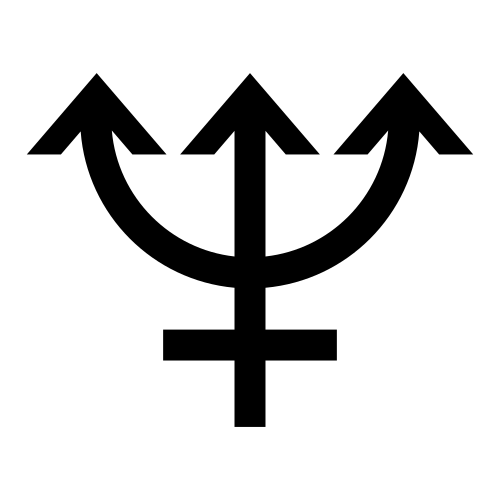 Neptune
 Pluto
Pluto Chiron
Birth time unknown — house positions and Ascendant/MC are not available.
Astronomical context
Pluto crossed Cancer from 1914 to 1939. In astrological tradition this transit is linked to the transformation of home, family, nation, and the sense of belonging — the generation whose lives were marked by the World Wars and a profound redefinition of the nation and the home.
Katherine Johnson (born 1918) belongs to this generational configuration. Astrian groups profiles by such shared signatures rather than by any claim of shared destiny. Related profiles in Astrian: Ada Lovelace · Neil Armstrong · Hedy Lamarr. The symbolic reading is correlative, not causal.
Other profiles from this Pluto in Cancer generation
Symbolic reading
The following describes what classical astrological tradition associates with these configurations. Astrian does not apply these descriptions to the person's biography.
The Sun in Virgo is the most prominent structural feature available without a birth time, centring the chart on analysis, craft, and the refinement of method. There is no Ascendant or Midheaven to anchor the angles, so the reading rests on sign placements and the aspects between planets rather than on houses.
Among the personal planets, the Moon in Taurus is associated in tradition with stability, persistence, and the tangible (the Moon's sign is given for the noon chart and may shift with an exact time); Mercury in Virgo with analysis, craft, and the refinement of method; Venus in Leo with expression, pride, and the creative self; and Mars in Scorpio with intensity, depth, and the will to transform. These placements describe registers of feeling, thought, attraction, and action as the tradition catalogues them, independent of the life that follows.
Mars trine Pluto (0°19'): tradition reads drive, assertion, and action in easy flow with depth, power, and transformation.
Moon opposite Mars (1°31'): tradition reads emotional life and instinct set in polarity with drive, assertion, and action.
Mars square Neptune (1°48'): tradition reads drive, assertion, and action in friction with dissolution, imagination, and idealism.
Moon sextile Pluto (1°50'): tradition reads emotional life and instinct in supportive contact with depth, power, and transformation.
These placements are presented as a symbolic portrait, correlative and never causal — a description within the tradition's vocabulary, not an explanation of the life that follows.
Astrology is a symbolic language with 2,500 years of literature. The reading above is interpretive, not explanatory.
Astrian does not claim that the natal chart of Katherine Johnson caused or determined any of the above. Astrology is a symbolic system with 2,500 years of literature. Its capacity for retrospective description does not imply explanatory capacity.
A parallel life
The following are verified biographical facts. No connection to the natal chart is implied.
Katherine Coleman Goble Johnson was born on August 26, 1918, in White Sulphur Springs, West Virginia. She demonstrated an exceptional aptitude for mathematics from an early age, entering college at West Virginia State at the age of 15. She graduated summa cum laude with degrees in mathematics and French in 1937.
In 1953, Johnson joined the National Advisory Committee for Aeronautics, the predecessor to NASA, working in a computing pool at the Langley Research Center in Virginia. The facility employed a group of African-American women mathematicians, referred to internally as "computers," who performed complex calculations by hand. Johnson quickly distinguished herself through her skill and precision.
Following the creation of NASA in 1958, Johnson transitioned to the Space Task Group, where she contributed calculations central to the trajectory analysis for Alan Shepard's 1961 suborbital flight, the first American human spaceflight. Her work extended to orbital mechanics for John Glenn's 1962 Friendship 7 mission; Glenn himself reportedly requested that Johnson personally verify the electronic computer's orbital entry calculations before he agreed to fly.
Johnson co-authored a 1960 NASA research report on equations for orbital spaceflight, becoming one of the first women at the agency to receive author credit on a technical report. She subsequently contributed to calculations for the Apollo program, including the lunar trajectory for the Apollo 11 mission in 1969 and contingency calculations for Apollo 13 in 1970.
She worked at NASA for 33 years, retiring in 1986. For most of her career her contributions remained little known to the public. Renewed recognition came significantly through the 2016 book and film "Hidden Figures," which documented the work of Johnson and her colleagues.
In 2015, President Barack Obama awarded Johnson the Presidential Medal of Freedom. NASA named a computational research facility at Langley the Katherine G. Johnson Computational Research Facility in 2016. She received honorary doctorates from several universities in her later years.
Katherine Johnson died on February 24, 2020, in Newport News, Virginia, at the age of 101.
Biographical sources
- NASA Biography: Katherine Johnson.
- https://www.nasa.gov/content/katherine-johnson-biography.
- Margot Lee Shetterly, Hidden Figures (William Morrow, 2016).
- Presidential Medal of Freedom citation, White House, 2015.
- Katherine G. Johnson, "Determination of A.
This profile presents the sky at the birth of Katherine Johnson and verified facts of their biography. Astrian does not claim that astrology has predictive capacity or that the natal chart determines the trajectory of a life. Astrology is a symbolic system with 2,500 years of literature. Its capacity for retrospective description does not imply explanatory capacity.
Calculate your own birth chart with the same NASA JPL DE441 precision.
Calculate my birth chartLast updated: June 14, 2026
Newsletter
A short reading once a month, in your inbox.
A note on the symbolism of the season, recent editorial pieces, and what to look for in next month's sky. No predictions.
Support this project
Independent, no venture funding, no ads. A contribution keeps Astrian precise and free.
Support on Ko-fi (opens in new tab)