PROFILE · SPORTS
Magnus Carlsen
Sven Magnus Øen Carlsen
chess player
Born 30 November 1990 · Tønsberg, Norway · 59.30° N, 10.42° EX
Source: Birth time not documented in publicly accessible records
About this chart
No birth time is documented for this person. The chart therefore shows planetary positions in their signs, the slow aspects between them, and the generational context — but not house placements, the Ascendant, or the Midheaven, which require an accurate birth time. The Moon's sign carries a ±6° margin: if it falls near a sign boundary, the sign could vary. Positions for all other planets are reliable.
Do you have a verified source for this birth time? Share it →
The sky at birth
No birth time is documented for Magnus Carlsen. The Ascendant, the Midheaven, and the house positions cannot be determined; the reading is confined to planetary sign placements and the aspects between planets. The positions below are calculated for noon local time and are accurate to a fraction of a degree for the slow-moving bodies.
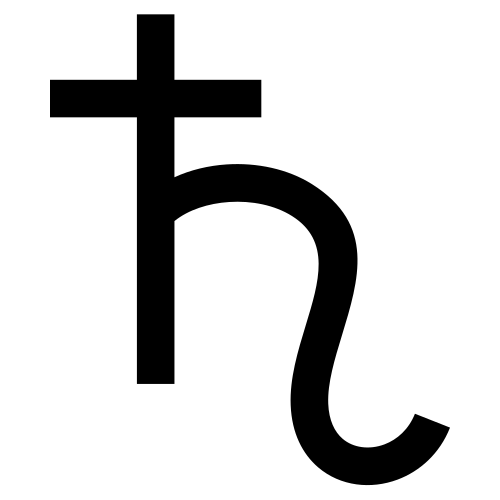
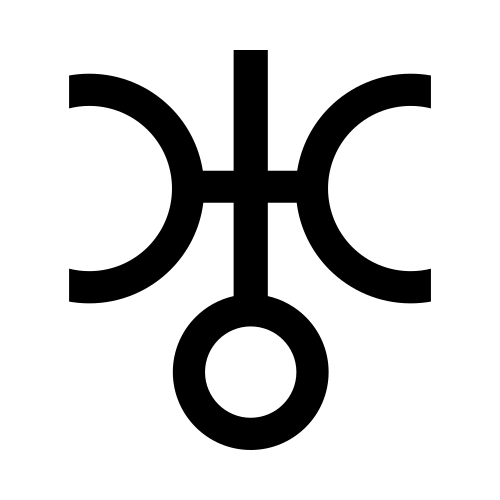
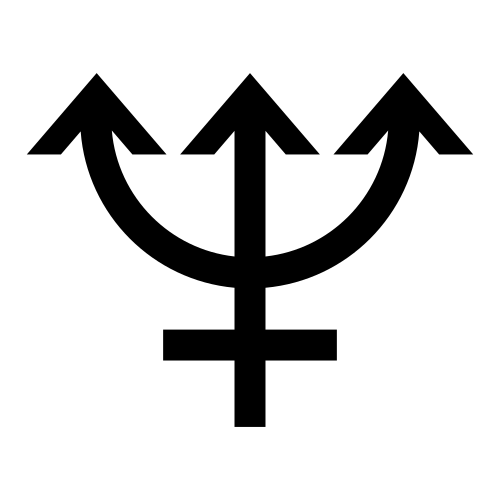
The Moon is near 11°24' Taurus (noon position, ±7° margin). Sun is at 7°58' Sagittarius. Mercury is at 28°01' Sagittarius. Venus is at 15°07' Sagittarius. Mars is at 4°22' Gemini, retrograde. Jupiter is at 13°35' Leo, retrograde. Saturn is at 22°16' Capricorn. Uranus is at 7°54' Capricorn. Neptune is at 12°59' Capricorn. Pluto is at 18°30' Scorpio.
3 bodies occupy Sagittarius (Sun, Mercury and Venus) and 3 bodies occupy Capricorn (Saturn, Uranus and Neptune) — a concentration that stands out as a structural feature of the chart.
The tightest major aspects between planets: Venus trine Jupiter (1°32'); Moon trine Neptune (1°35'); Moon square Jupiter (2°11'); Moon trine Uranus (3°30'); Sun opposite Mars (3°36'); Saturn sextile Pluto (3°46').
Uranus conjunct Neptune (5°05') is structural but generational — an alignment of slow-moving outer planets shared across many birth years.
The engine also registers tight minor aspects involving asteroids and calculated points: Jupiter trine Lilith (0°00'); Pallas sesquiquadrate North Node (0°26'); Venus conjunct Juno (0°31'); Neptune semi-sextile Lilith (0°37'). These are reported for completeness and carry less weight in traditional reading.
The chart was calculated using NASA JPL DE441 ephemerides, sub-arcsecond precision.
| Planet | Sign | Position |
|---|---|---|
| Sun | Sagittarius | 07°58' |
| Moon | Taurus | 11°24'±6° |
| Mercury | Sagittarius | 28°01' |
| Venus | Sagittarius | 15°07' |
| Mars | Gemini | 04°22'retrograde |
| Jupiter | Leo | 13°35'retrograde |
| Saturn | Capricorn | 22°16' |
| Uranus | Capricorn | 07°54' |
| Neptune | Capricorn | 12°59' |
| Pluto | Scorpio | 18°30' |
| Chiron | Cancer | 26°56'retrograde |
 Sun
Sun Moon
Moon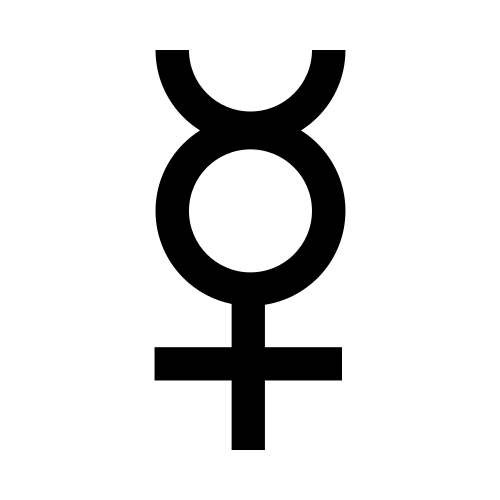 Mercury
 Venus
Venus Mars
Mars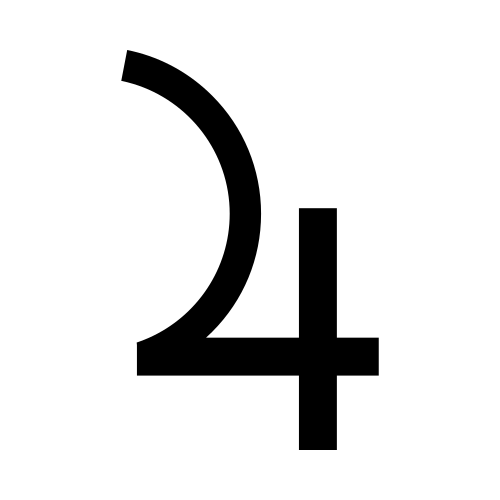 Jupiter
 Saturn
 Uranus
 Neptune
 Pluto
Pluto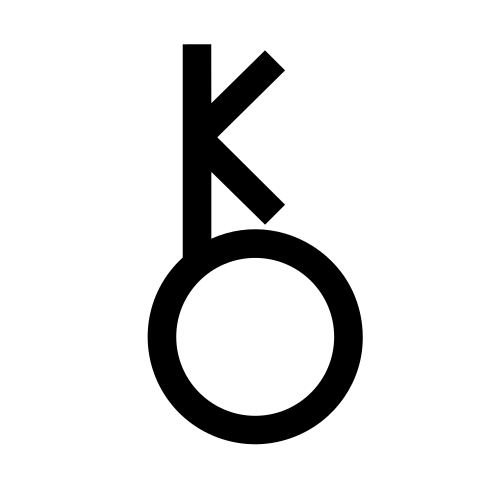 Chiron
Birth time unknown — house positions and Ascendant/MC are not available.
Astronomical context
Pluto moved through its own sign, Scorpio, from 1983 to 1995. In astrological tradition Pluto in Scorpio is read as an intensification of themes of power, depth, crisis, and regeneration — the generation that grew up amid the digital turn and a transformed relationship to risk.
Magnus Carlsen (born 1990) belongs to this generational configuration. Astrian groups profiles by such shared signatures rather than by any claim of shared destiny. Related profiles in Astrian: Khabib Nurmagomedov · Conor McGregor · Valentino Rossi. The symbolic reading is correlative, not causal.
Other profiles from this Pluto in Scorpio generation
Symbolic reading
The following describes what classical astrological tradition associates with these configurations. Astrian does not apply these descriptions to the person's biography.
The Sun in Sagittarius is the most prominent structural feature available without a birth time, centring the chart on expansion, conviction, and the horizon. There is no Ascendant or Midheaven to anchor the angles, so the reading rests on sign placements and the aspects between planets rather than on houses.
Among the personal planets, the Moon in Taurus is associated in tradition with stability, persistence, and the tangible (the Moon's sign is given for the noon chart and may shift with an exact time); Mercury in Sagittarius with expansion, conviction, and the horizon; Venus in Sagittarius with expansion, conviction, and the horizon; and Mars in Gemini with curiosity, exchange, and versatility. These placements describe registers of feeling, thought, attraction, and action as the tradition catalogues them, independent of the life that follows.
Venus trine Jupiter (1°32'): tradition reads values, attraction, and harmony in easy flow with expansion and meaning.
Moon trine Neptune (1°35'): tradition reads emotional life and instinct in easy flow with dissolution, imagination, and idealism.
Moon square Jupiter (2°11'): tradition reads emotional life and instinct in friction with expansion and meaning.
Moon trine Uranus (3°30'): tradition reads emotional life and instinct in easy flow with disruption and innovation.
These placements are presented as a symbolic portrait, correlative and never causal — a description within the tradition's vocabulary, not an explanation of the life that follows.
Astrology is a symbolic language with 2,500 years of literature. The reading above is interpretive, not explanatory.
Astrian does not claim that the natal chart of Magnus Carlsen caused or determined any of the above. Astrology is a symbolic system with 2,500 years of literature. Its capacity for retrospective description does not imply explanatory capacity.
A parallel life
The following are verified biographical facts. No connection to the natal chart is implied.
Sven Magnus Øen Carlsen was born on 30 November 1990 in Tønsberg, Norway. He showed exceptional aptitude for chess as a young child and developed rapidly, earning the grandmaster title at the age of thirteen and drawing international attention as a prodigy.
He rose to the top of the world rankings while still a teenager and went on to achieve the highest rating ever recorded in the game. In 2013 he won the World Chess Championship, and he successfully defended the title in a series of matches over the following decade, dominating the sport across classical, rapid, and blitz formats. He chose not to defend the classical world title in 2023, a decision that drew wide attention.
Beyond his results, he was credited with broadening the popularity of chess, particularly through online play and streaming, and through his prominence during a surge of public interest in the game in the early 2020s. He also founded a company in the chess and online-gaming space.
Known for a versatile, intuitive style and an ability to grind out advantages in seemingly equal positions, he became the defining player of his era and one of the most recognisable figures the game has produced.
Carlsen is regarded as one of the greatest chess players in history, his sustained dominance and record rating placing him at or near the summit of the game by most measures.
Biographical sources
- International Chess Federation (FIDE), official records and ratings..
- The New York Times.
- Chess.com and chess press, tournament archives..
- Reuters, news archives..
This profile presents the sky at the birth of Magnus Carlsen and verified facts of their biography. Astrian does not claim that astrology has predictive capacity or that the natal chart determines the trajectory of a life. Astrology is a symbolic system with 2,500 years of literature. Its capacity for retrospective description does not imply explanatory capacity.
Related profiles
Calculate your own birth chart with the same NASA JPL DE441 precision.
Calculate my birth chartLast updated: June 13, 2026
Newsletter
A short reading once a month, in your inbox.
A note on the symbolism of the season, recent editorial pieces, and what to look for in next month's sky. No predictions.
Support this project
Independent, no venture funding, no ads. A contribution keeps Astrian precise and free.
Support on Ko-fi (opens in new tab)