PROFILE · SCIENCE & TECHNOLOGY
Michael Faraday
physicist and chemist
Born 22 September 1791 · Newington Butts, London, Kingdom of Great Britain · 51.49° N, 0.10° WX
Source: Birth time not documented in publicly accessible records
About this chart
No birth time is documented for this person. The chart therefore shows planetary positions in their signs, the slow aspects between them, and the generational context — but not house placements, the Ascendant, or the Midheaven, which require an accurate birth time. The Moon's sign carries a ±6° margin: if it falls near a sign boundary, the sign could vary. Positions for all other planets are reliable.
Do you have a verified source for this birth time? Share it →
The sky at birth
No birth time is documented for Michael Faraday. The Ascendant, the Midheaven, and the house positions cannot be determined; the reading is confined to planetary sign placements and the aspects between planets. The positions below are calculated for noon local time and are accurate to a fraction of a degree for the slow-moving bodies.
The Moon is near 22°05' Cancer (noon position, ±7° margin). Sun is at 29°22' Virgo. Mercury is at 20°10' Libra, retrograde. Venus is at 3°14' Scorpio. Mars is at 7°28' Leo. Jupiter is at 9°08' Libra. Saturn is at 16°41' Aries, retrograde. Uranus is at 17°17' Leo. Neptune is at 26°22' Libra. Pluto is at 20°09' Aquarius, retrograde.
3 bodies occupy Libra (Mercury, Jupiter and Neptune) — a concentration that stands out as a structural feature of the chart.
The tightest major aspects between planets: Mercury trine Pluto (0°01'); Saturn trine Uranus (0°35'); Mars sextile Jupiter (1°40'); Moon square Mercury (1°55'); Uranus opposite Pluto (2°52'); Mercury sextile Uranus (2°53').
Uranus opposite Pluto (2°52') is structural but generational — an alignment of slow-moving outer planets shared across many birth years.
The engine also registers tight minor aspects involving asteroids and calculated points: Jupiter trine Lilith (0°25'); Mars sextile Lilith (1°16'); Moon semi-square Lilith (1°38'); Saturn opposite North Node (3°24'). These are reported for completeness and carry less weight in traditional reading.
The chart was calculated using NASA JPL DE441 ephemerides, sub-arcsecond precision.
| Planet | Sign | Position |
|---|---|---|
| Sun | Virgo | 29°22' |
| Moon | Cancer | 22°05'±6° |
| Mercury | Libra | 20°10'retrograde |
| Venus | Scorpio | 03°14' |
| Mars | Leo | 07°28' |
| Jupiter | Libra | 09°08' |
| Saturn | Aries | 16°41'retrograde |
| Uranus | Leo | 17°17' |
| Neptune | Libra | 26°22' |
| Pluto | Aquarius | 20°09'retrograde |
 Sun
Sun Moon
Moon Mercury
 Venus
Venus Mars
Mars Jupiter
 Saturn
 Uranus
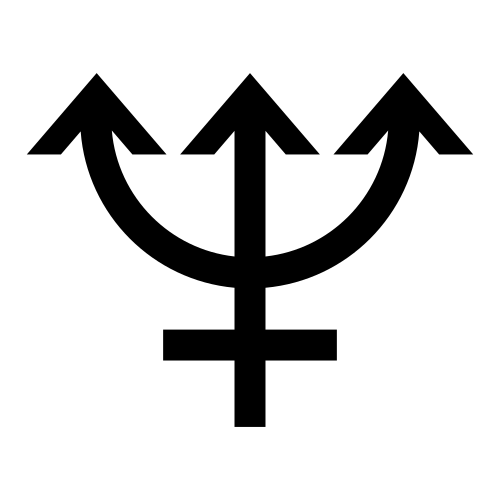 Neptune
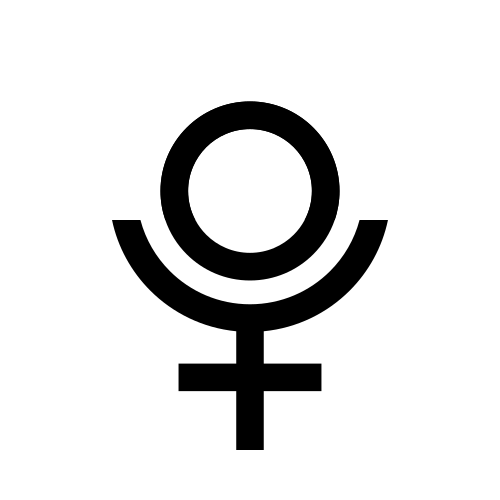 Pluto
PlutoBirth time unknown — house positions and Ascendant/MC are not available.
Astronomical context
Pluto crossed Aquarius roughly from 1778 to 1798. In astrological tradition this transit is associated with the transformation of ideals, science, and the notion of liberty — the cohort whose lifetimes spanned the revolutionary upheavals of the late eighteenth century.
Michael Faraday (born 1791) belongs to this generational configuration. Astrian groups profiles by such shared signatures rather than by any claim of shared destiny. Related profiles in Astrian: James Clerk Maxwell · Thomas Edison · Ernest Rutherford. The symbolic reading is correlative, not causal.
Other profiles from this Pluto in Aquarius generation
Symbolic reading
The following describes what classical astrological tradition associates with these configurations. Astrian does not apply these descriptions to the person's biography.
The Sun in Virgo is the most prominent structural feature available without a birth time, centring the chart on analysis, craft, and the refinement of method. There is no Ascendant or Midheaven to anchor the angles, so the reading rests on sign placements and the aspects between planets rather than on houses.
Among the personal planets, the Moon in Cancer is associated in tradition with attachment, memory, and protection (the Moon's sign is given for the noon chart and may shift with an exact time); Mercury in Libra with balance, relationship, and proportion; Venus in Scorpio with intensity, depth, and the will to transform; and Mars in Leo with expression, pride, and the creative self. These placements describe registers of feeling, thought, attraction, and action as the tradition catalogues them, independent of the life that follows.
Mercury trine Pluto (0°01'): tradition reads thought and communication in easy flow with depth, power, and transformation.
Saturn trine Uranus (0°35'): tradition reads structure, limitation, and discipline in easy flow with disruption and innovation.
Mars sextile Jupiter (1°40'): tradition reads drive, assertion, and action in supportive contact with expansion and meaning.
Moon square Mercury (1°55'): tradition reads emotional life and instinct in friction with thought and communication.
These placements are presented as a symbolic portrait, correlative and never causal — a description within the tradition's vocabulary, not an explanation of the life that follows.
Astrology is a symbolic language with 2,500 years of literature. The reading above is interpretive, not explanatory.
Astrian does not claim that the natal chart of Michael Faraday caused or determined any of the above. Astrology is a symbolic system with 2,500 years of literature. Its capacity for retrospective description does not imply explanatory capacity.
A parallel life
The following are verified biographical facts. No connection to the natal chart is implied.
Michael Faraday was born on September 22, 1791, in Newington Butts, Surrey, England, the son of a blacksmith. His family had modest means, and his formal education was limited to the basics of reading, writing, and arithmetic. At thirteen he was apprenticed to a bookbinder in London, and his access to books during this period proved formative. He read widely in science, particularly natural philosophy, and attended public lectures by the chemist Humphry Davy at the Royal Institution.
In 1812, after Davy was temporarily blinded in a laboratory accident, Faraday wrote to him enclosing notes from his lectures, hoping to secure a scientific position. In 1813, Davy hired him as a chemical assistant at the Royal Institution, where Faraday would spend the rest of his working life.
Faraday's early contributions were in chemistry. He liquefied chlorine and other gases, discovered benzene in 1825, and made important contributions to the understanding of optical glass. In electrochemistry, he formulated the two laws of electrolysis, which quantify the relationship between the amount of electricity passed through a solution and the mass of substance deposited at an electrode. The units of capacitance (the farad) and of charge (the coulomb) reflect concepts central to his work.
His most transformative contributions came in electromagnetism. In 1821, following Hans Christian Oersted's discovery that electric currents produce magnetic effects, Faraday built a device that converted electrical energy into mechanical motion, a forerunner of the electric motor. In 1831, he demonstrated electromagnetic induction: when a magnetic field changes, it induces an electric current in a nearby conductor. This discovery is the operating principle of the electric generator and the transformer, making it foundational to the generation and distribution of electrical power.
Faraday introduced the concept of lines of force to describe electric and magnetic fields, an approach that later provided the physical intuition for James Clerk Maxwell's mathematical theory of electromagnetism.
Though he received many honors and was twice offered the presidency of the Royal Society, which he declined, he remained throughout his life a man of quiet religious conviction and personal simplicity, a member of the small Sandemanian Christian sect.
Michael Faraday died on August 25, 1867, at Hampton Court, where he had lived in a house granted to him by Queen Victoria.
Biographical sources
- L. Pearce Williams, Michael Faraday: A Biography (Basic Books, 1965).
- Alan Hirshfeld, The Electric Life of Michael Faraday (Walker and Company, 2006).
- Frank A. J. L. James (ed.), The Correspondence of Michael Faraday, 6 vols. (Institution of Engineering and Technology, 1991-2012).
- Royal Institution archives, Faraday collections, rigb.org.
This profile presents the sky at the birth of Michael Faraday and verified facts of their biography. Astrian does not claim that astrology has predictive capacity or that the natal chart determines the trajectory of a life. Astrology is a symbolic system with 2,500 years of literature. Its capacity for retrospective description does not imply explanatory capacity.
Related profiles
Calculate your own birth chart with the same NASA JPL DE441 precision.
Calculate my birth chartLast updated: June 14, 2026
Newsletter
A short reading once a month, in your inbox.
A note on the symbolism of the season, recent editorial pieces, and what to look for in next month's sky. No predictions.
Support this project
Independent, no venture funding, no ads. A contribution keeps Astrian precise and free.
Support on Ko-fi (opens in new tab)