PROFILE · SCIENCE & TECHNOLOGY
Carl Friedrich Gauss
Johann Carl Friedrich Gauss
mathematician
Born 30 April 1777 · Brunswick, Duchy of Brunswick · 52.27° N, 10.52° EX
Source: Birth time not documented in publicly accessible records
About this chart
No birth time is documented for this person. The chart therefore shows planetary positions in their signs, the slow aspects between them, and the generational context — but not house placements, the Ascendant, or the Midheaven, which require an accurate birth time. The Moon's sign carries a ±6° margin: if it falls near a sign boundary, the sign could vary. Positions for all other planets are reliable.
Do you have a verified source for this birth time? Share it →
The sky at birth
No birth time is documented for Carl Friedrich Gauss. The Ascendant, the Midheaven, and the house positions cannot be determined; the reading is confined to planetary sign placements and the aspects between planets. The positions below are calculated for noon local time and are accurate to a fraction of a degree for the slow-moving bodies.
The Moon is near 7°11' Aquarius (noon position, ±7° margin). Sun is at 10°21' Taurus. Mercury is at 14°16' Taurus. Venus is at 17°26' Gemini. Mars is at 0°42' Libra, retrograde. Jupiter is at 18°56' Cancer. Saturn is at 29°18' Libra, retrograde. Uranus is at 9°15' Gemini. Neptune is at 24°38' Virgo, retrograde. Pluto is at 0°09' Aquarius.
The tightest major aspects between planets: Mars trine Pluto (0°33'); Saturn square Pluto (0°52'); Moon trine Uranus (2°04'); Sun square Moon (3°10'); Sun conjunct Mercury (3°55'); Mercury sextile Jupiter (4°40').
Neptune trine Pluto (5°31') is structural but generational — an alignment of slow-moving outer planets shared across many birth years.
The engine also registers tight minor aspects involving asteroids and calculated points: Lilith square North Node (1°14'); Uranus sesquiquadrate Lilith (1°18'); Neptune semi-sextile Lilith (1°41'); Jupiter conjunct North Node (2°48'). These are reported for completeness and carry less weight in traditional reading.
The chart was calculated using NASA JPL DE441 ephemerides, sub-arcsecond precision.
| Planet | Sign | Position |
|---|---|---|
| Sun | Taurus | 10°21' |
| Moon | Aquarius | 07°11'±6° |
| Mercury | Taurus | 14°16' |
| Venus | Gemini | 17°26' |
| Mars | Libra | 00°42'retrograde |
| Jupiter | Cancer | 18°56' |
| Saturn | Libra | 29°18'retrograde |
| Uranus | Gemini | 09°15' |
| Neptune | Virgo | 24°38'retrograde |
| Pluto | Aquarius | 00°09' |
 Sun
Sun Moon
Moon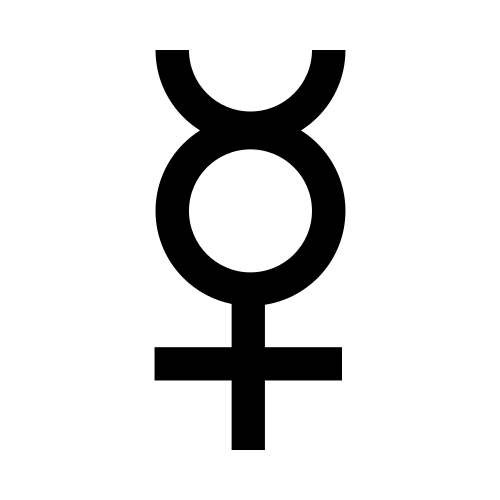 Mercury
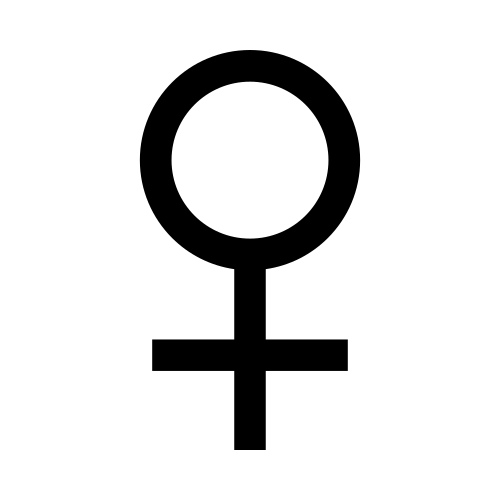 Venus
Venus Mars
Mars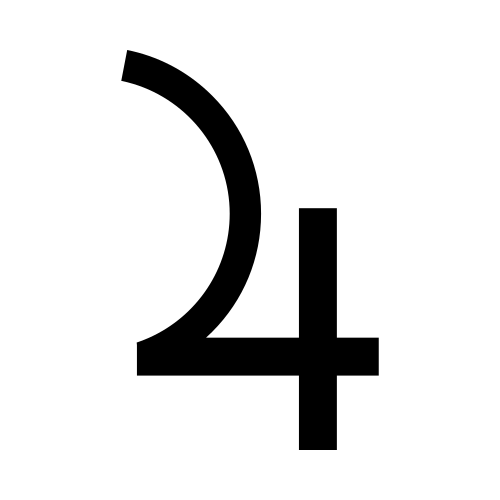 Jupiter
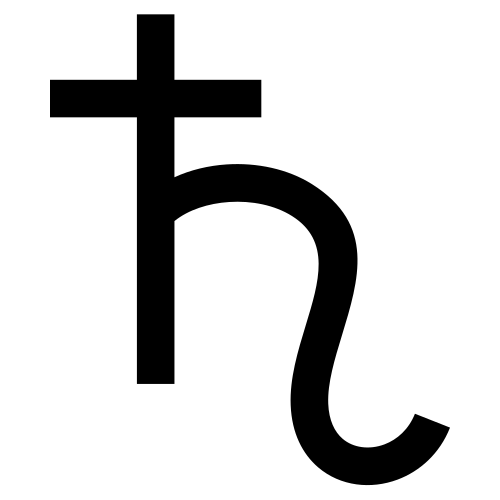 Saturn
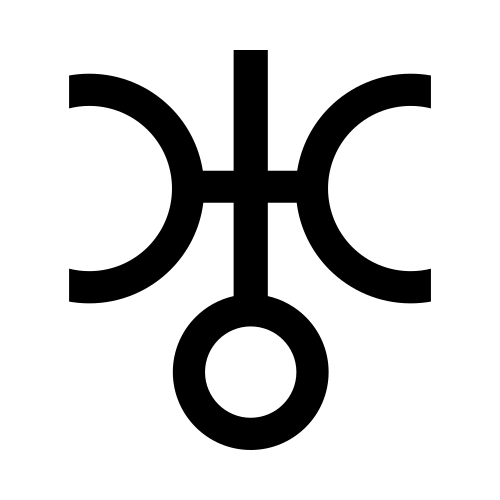 Uranus
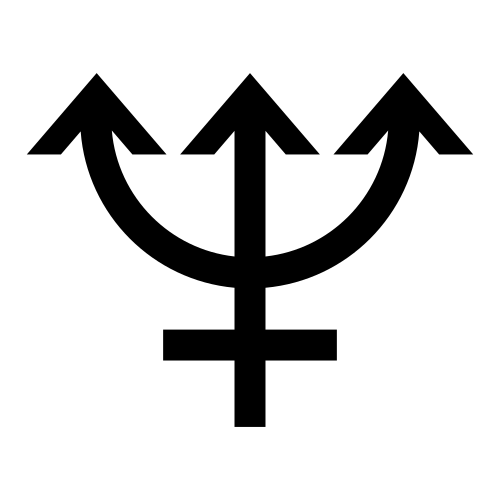 Neptune
 Pluto
PlutoBirth time unknown — house positions and Ascendant/MC are not available.
Astronomical context
Pluto crossed Aquarius roughly from 1778 to 1798. In astrological tradition this transit is associated with the transformation of ideals, science, and the notion of liberty — the cohort whose lifetimes spanned the revolutionary upheavals of the late eighteenth century.
Carl Friedrich Gauss (born 1777) belongs to this generational configuration. Astrian groups profiles by such shared signatures rather than by any claim of shared destiny. Related profiles in Astrian: Leonhard Euler · Srinivasa Ramanujan · James Clerk Maxwell. The symbolic reading is correlative, not causal.
Other profiles from this Pluto in Aquarius generation
Symbolic reading
The following describes what classical astrological tradition associates with these configurations. Astrian does not apply these descriptions to the person's biography.
The Sun in Taurus is the most prominent structural feature available without a birth time, centring the chart on stability, persistence, and the tangible. There is no Ascendant or Midheaven to anchor the angles, so the reading rests on sign placements and the aspects between planets rather than on houses.
Among the personal planets, the Moon in Aquarius is associated in tradition with independence, abstraction, and the collective (the Moon's sign is given for the noon chart and may shift with an exact time); Mercury in Taurus with stability, persistence, and the tangible; Venus in Gemini with curiosity, exchange, and versatility; and Mars in Libra with balance, relationship, and proportion. These placements describe registers of feeling, thought, attraction, and action as the tradition catalogues them, independent of the life that follows.
Mars trine Pluto (0°33'): tradition reads drive, assertion, and action in easy flow with depth, power, and transformation.
Saturn square Pluto (0°52'): tradition reads structure, limitation, and discipline in friction with depth, power, and transformation.
Moon trine Uranus (2°04'): tradition reads emotional life and instinct in easy flow with disruption and innovation.
Sun square Moon (3°10'): tradition reads identity and central purpose in friction with emotional life and instinct.
These placements are presented as a symbolic portrait, correlative and never causal — a description within the tradition's vocabulary, not an explanation of the life that follows.
Astrology is a symbolic language with 2,500 years of literature. The reading above is interpretive, not explanatory.
Astrian does not claim that the natal chart of Carl Friedrich Gauss caused or determined any of the above. Astrology is a symbolic system with 2,500 years of literature. Its capacity for retrospective description does not imply explanatory capacity.
A parallel life
The following are verified biographical facts. No connection to the natal chart is implied.
Johann Carl Friedrich Gauss was born on April 30, 1777, in Brunswick, in the Duchy of Brunswick-Wolfenbüttel (now Lower Saxony, Germany). He came from a working-class family; his mother was reportedly illiterate but recognised his exceptional abilities and encouraged his education. Gauss showed prodigious mathematical talent from very early childhood. One frequently cited story, which Gauss himself recounted, is that he corrected an error in his father's payroll calculation at the age of three.
The Duke of Brunswick supported Gauss financially, enabling him to study at the Collegium Carolinum in Brunswick and subsequently at the University of Göttingen from 1795. In 1796, at the age of 18, Gauss proved that a regular heptadecagon (17-sided polygon) could be constructed with compass and straightedge, a discovery that resolved a problem open since antiquity. This result stimulated his decision to pursue mathematics rather than philology.
In 1798 Gauss completed his doctoral dissertation at the University of Helmstedt, providing the first rigorous proof of the fundamental theorem of algebra, which states that every non-constant polynomial with complex coefficients has at least one complex root. In 1801 he published "Disquisitiones Arithmeticae," a systematic treatment of number theory that included the law of quadratic reciprocity, proof of which Gauss later gave in multiple ways, and which he called the "golden theorem."
Also in 1801, Gauss used his method of least squares and orbital mechanics calculations to predict the reappearance of the dwarf planet Ceres after it had been lost to view by astronomers. This prediction was confirmed when Ceres was rediscovered in late 1801, establishing his reputation beyond Germany.
From 1807 Gauss served as professor of astronomy and director of the astronomical observatory at the University of Göttingen, a position he held for the rest of his life. His work covered an enormous range, including the Gaussian distribution in probability theory, the Gauss-Bonnet theorem in differential geometry, contributions to the theory of curved surfaces, geomagnetic studies (the gauss is a unit of magnetic flux density named in his honour), and the development of an electric telegraph with Wilhelm Weber.
Gauss kept extensive mathematical diaries but published selectively, reportedly to release only complete and polished work. Some results later credited to others were found in his diary after his death.
Carl Friedrich Gauss died on February 23, 1855, in Göttingen, aged 77.
Biographical sources
- G. Waldo Dunnington, Carl Friedrich Gauss: Titan of Science (Mathematical Association of America, 2004).
- W.K. Bühler, Gauss: A Biographical Study (Springer, 1981).
- C.F. Gauss, Disquisitiones Arithmeticae (Fleischer, 1801; English translation Yale University Press, 1966).
- MacTutor History of Mathematics Archive: Carl Friedrich Gauss.
- https://mathshistory.st-andrews.ac.uk/Biographies/Gauss/.
This profile presents the sky at the birth of Carl Friedrich Gauss and verified facts of their biography. Astrian does not claim that astrology has predictive capacity or that the natal chart determines the trajectory of a life. Astrology is a symbolic system with 2,500 years of literature. Its capacity for retrospective description does not imply explanatory capacity.
Related profiles
Calculate your own birth chart with the same NASA JPL DE441 precision.
Calculate my birth chartLast updated: June 14, 2026
Newsletter
A short reading once a month, in your inbox.
A note on the symbolism of the season, recent editorial pieces, and what to look for in next month's sky. No predictions.
Support this project
Independent, no venture funding, no ads. A contribution keeps Astrian precise and free.
Support on Ko-fi (opens in new tab)