PROFILE · SCIENCE & TECHNOLOGY
Thomas Edison
Thomas Alva Edison
inventor and businessman
Born 11 February 1847 · Milan, Ohio, United States · 41.29° N, 82.60° WX
Source: Birth time not documented in publicly accessible records
About this chart
No birth time is documented for this person. The chart therefore shows planetary positions in their signs, the slow aspects between them, and the generational context — but not house placements, the Ascendant, or the Midheaven, which require an accurate birth time. The Moon's sign carries a ±6° margin: if it falls near a sign boundary, the sign could vary. Positions for all other planets are reliable.
Do you have a verified source for this birth time? Share it →
The sky at birth
No birth time is documented for Thomas Edison. The Ascendant, the Midheaven, and the house positions cannot be determined; the reading is confined to planetary sign placements and the aspects between planets. The positions below are calculated for noon local time and are accurate to a fraction of a degree for the slow-moving bodies. One caveat: the Moon lies near a sign boundary, so without an exact time it cannot be fixed to a single sign — it sits close to 0°37' Capricorn within a daily margin of about ±7°.
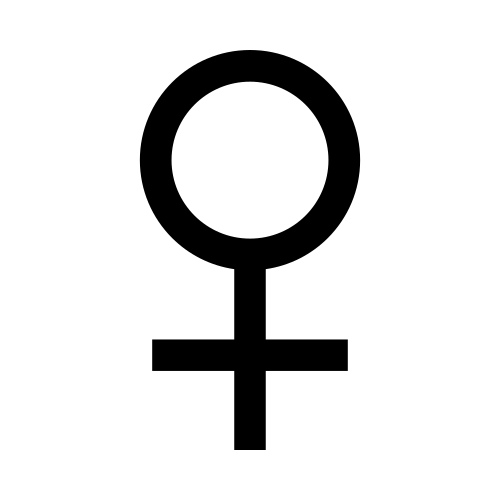
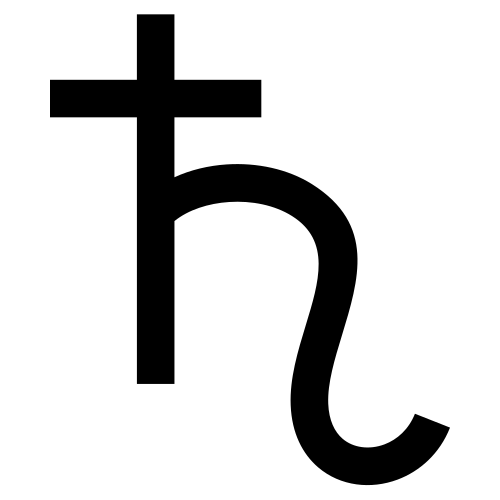
The Moon is near 0°37' Capricorn (noon position, ±7° margin). Sun is at 22°24' Aquarius. Mercury is at 18°36' Aquarius. Venus is at 6°09' Pisces. Mars is at 0°49' Capricorn. Jupiter is at 6°48' Gemini. Saturn is at 2°01' Pisces. Uranus is at 11°29' Aries. Neptune is at 27°38' Aquarius. Pluto is at 24°10' Aries.
3 bodies occupy Aquarius (Sun, Mercury and Neptune) — a concentration that stands out as a structural feature of the chart.
The tightest major aspects between planets: Moon conjunct Mars (0°12'); Venus square Jupiter (0°39'); Mars sextile Saturn (1°12'); Moon sextile Saturn (1°24'); Sun sextile Pluto (1°47'); Moon sextile Neptune (2°59').
Neptune sextile Pluto (3°28') is structural but generational — an alignment of slow-moving outer planets shared across many birth years.
The engine also registers tight minor aspects involving asteroids and calculated points: Jupiter sesquiquadrate North Node (0°13'); Sun trine North Node (0°22'); Venus sesquiquadrate North Node (0°52'); Uranus quincunx Lilith (0°59'). These are reported for completeness and carry less weight in traditional reading.
The chart was calculated using NASA JPL DE441 ephemerides, sub-arcsecond precision.
| Planet | Sign | Position |
|---|---|---|
| Sun | Aquarius | 22°24' |
| Moon | Capricorn | 00°37'±6° |
| Mercury | Aquarius | 18°36' |
| Venus | Pisces | 06°09' |
| Mars | Capricorn | 00°49' |
| Jupiter | Gemini | 06°48' |
| Saturn | Pisces | 02°01' |
| Uranus | Aries | 11°29' |
| Neptune | Aquarius | 27°38' |
| Pluto | Aries | 24°10' |
 Sun
Sun Moon
Moon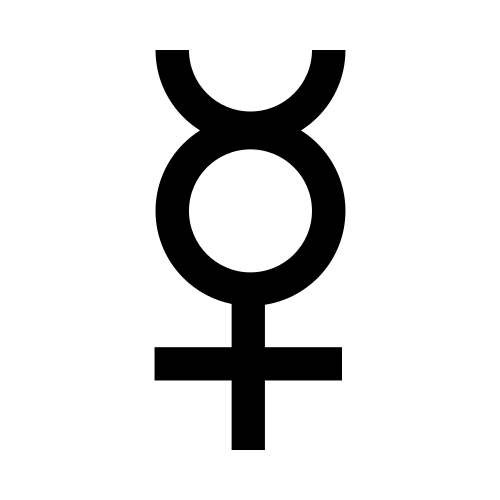 Mercury
 Venus
Venus Mars
Mars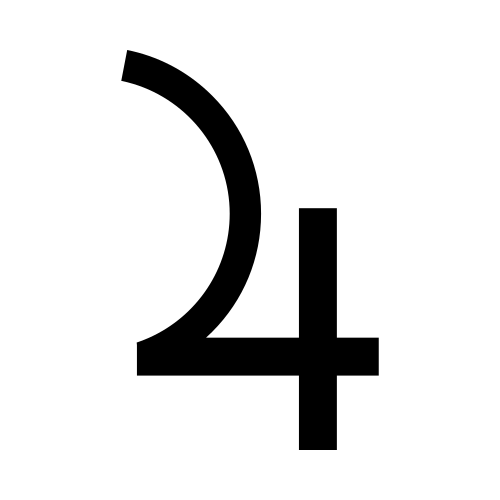 Jupiter
 Saturn
 Uranus
 Neptune
 Pluto
PlutoBirth time unknown — house positions and Ascendant/MC are not available.
Astronomical context
Pluto travelled through Aries roughly from 1822 to 1853. In astrological tradition this transit is associated with the transformation of initiative, force, and the will to begin anew — the generation that came of age amid industrial acceleration and new assertions of national energy.
Thomas Edison (born 1847) belongs to this generational configuration. Astrian groups profiles by such shared signatures rather than by any claim of shared destiny. Related profiles in Astrian: Nikola Tesla · Michael Faraday · Ada Lovelace. The symbolic reading is correlative, not causal.
Other profiles from this Pluto in Aries generation
Symbolic reading
The following describes what classical astrological tradition associates with these configurations. Astrian does not apply these descriptions to the person's biography.
The Sun in Aquarius is the most prominent structural feature available without a birth time, centring the chart on independence, abstraction, and the collective. There is no Ascendant or Midheaven to anchor the angles, so the reading rests on sign placements and the aspects between planets rather than on houses.
Among the personal planets, the Moon in Capricorn is associated in tradition with ambition, structure, and the long view (the Moon's sign is given for the noon chart and may shift with an exact time); Mercury in Aquarius with independence, abstraction, and the collective; Venus in Pisces with imagination, dissolution, and empathy; and Mars in Capricorn with ambition, structure, and the long view. These placements describe registers of feeling, thought, attraction, and action as the tradition catalogues them, independent of the life that follows.
Moon conjunct Mars (0°12'): tradition reads emotional life and instinct fused with drive, assertion, and action.
Venus square Jupiter (0°39'): tradition reads values, attraction, and harmony in friction with expansion and meaning.
Mars sextile Saturn (1°12'): tradition reads drive, assertion, and action in supportive contact with structure, limitation, and discipline.
Moon sextile Saturn (1°24'): tradition reads emotional life and instinct in supportive contact with structure, limitation, and discipline.
These placements are presented as a symbolic portrait, correlative and never causal — a description within the tradition's vocabulary, not an explanation of the life that follows.
Astrology is a symbolic language with 2,500 years of literature. The reading above is interpretive, not explanatory.
Astrian does not claim that the natal chart of Thomas Edison caused or determined any of the above. Astrology is a symbolic system with 2,500 years of literature. Its capacity for retrospective description does not imply explanatory capacity.
A parallel life
The following are verified biographical facts. No connection to the natal chart is implied.
Thomas Alva Edison was born on 11 February 1847 in Milan, Ohio. He was the seventh and youngest child of Samuel and Nancy Edison. In 1854, the family moved to Port Huron, Michigan. Edison had little formal schooling and was largely educated at home by his mother. He was partially deaf from an early age, a condition he attributed to various causes; the precise origin is uncertain.
As a teenager, Edison worked as a telegraph operator, a job that gave him practical experience with electrical systems. He moved between several cities working as a telegrapher before setting himself up as an independent inventor in the late 1860s. In 1869 he moved to New York City and developed several improvements to telegraph technology that he sold to Western Union, providing him with initial capital.
In 1876, Edison established a research laboratory in Menlo Park, New Jersey, which became one of the first institutions organized specifically to produce inventions systematically. In 1877 he developed the phonograph, a device capable of recording and reproducing sound, which attracted wide public attention. In 1879, following extensive experimentation, he demonstrated a practical incandescent electric light bulb with a long-burning carbon filament. Subsequent work at Menlo Park and a later, larger facility in West Orange, New Jersey, included the development of an electrical power distribution system for urban areas, improvements to the telephone transmitter, the kinetoscope (an early motion picture viewing device), and storage batteries, among many other projects.
Edison organized several companies to commercialize his inventions, including Edison Electric Light Company and companies that eventually became part of General Electric. He was involved in a well-documented commercial and technical dispute with George Westinghouse and Nikola Tesla over whether direct current or alternating current systems were preferable for electrical power distribution.
By the time of his death on 18 October 1931 in West Orange, New Jersey, Edison held 1,093 United States patents, a record that stood for many decades. He was eighty-four years old.
Biographical sources
- Israel, Paul. Edison: A Life of Invention. John Wiley and Sons, 1998..
- Jehl, Francis. Menlo Park Reminiscences. Edison Institute, 1936..
- Conot, Robert. A Streak of Luck: The Life and Legend of Thomas Alva Edison. Seaview Books, 1979..
- Thomas Edison National Historical Park. Thomas Edison Biography. nps.gov..
This profile presents the sky at the birth of Thomas Edison and verified facts of their biography. Astrian does not claim that astrology has predictive capacity or that the natal chart determines the trajectory of a life. Astrology is a symbolic system with 2,500 years of literature. Its capacity for retrospective description does not imply explanatory capacity.
Related profiles
Calculate your own birth chart with the same NASA JPL DE441 precision.
Calculate my birth chartLast updated: June 14, 2026
Newsletter
A short reading once a month, in your inbox.
A note on the symbolism of the season, recent editorial pieces, and what to look for in next month's sky. No predictions.
Support this project
Independent, no venture funding, no ads. A contribution keeps Astrian precise and free.
Support on Ko-fi (opens in new tab)