PROFILE · SCIENCE & TECHNOLOGY
Ernest Rutherford
Ernest Rutherford, 1st Baron Rutherford of Nelson
physicist
Born 30 August 1871 · Brightwater (Nelson), Colony of New Zealand · 41.29° S, 173.24° EX
Source: Birth time not documented in publicly accessible records
About this chart
No birth time is documented for this person. The chart therefore shows planetary positions in their signs, the slow aspects between them, and the generational context — but not house placements, the Ascendant, or the Midheaven, which require an accurate birth time. The Moon's sign carries a ±6° margin: if it falls near a sign boundary, the sign could vary. Positions for all other planets are reliable.
Do you have a verified source for this birth time? Share it →
The sky at birth
No birth time is documented for Ernest Rutherford. The Ascendant, the Midheaven, and the house positions cannot be determined; the reading is confined to planetary sign placements and the aspects between planets. The positions below are calculated for noon local time and are accurate to a fraction of a degree for the slow-moving bodies. One caveat: the Moon lies near a sign boundary, so without an exact time it cannot be fixed to a single sign — it sits close to 3°00' Pisces within a daily margin of about ±7°.
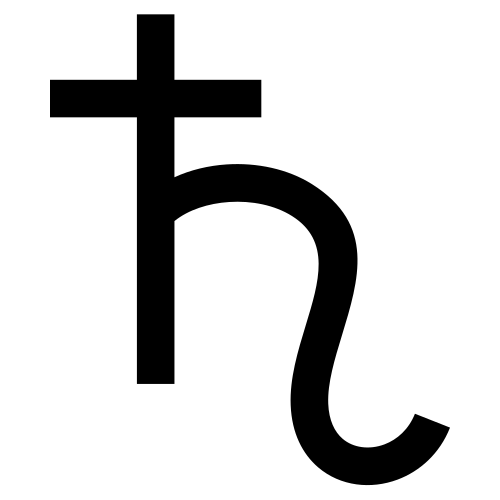
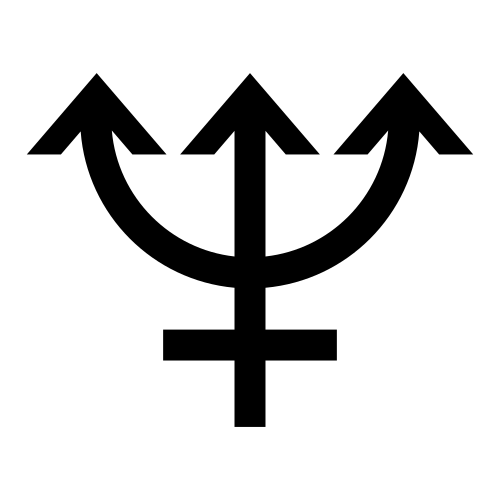
The Moon is near 3°00' Pisces (noon position, ±7° margin). Sun is at 6°10' Virgo. Mercury is at 1°37' Libra. Venus is at 10°02' Libra. Mars is at 10°56' Scorpio. Jupiter is at 21°18' Cancer. Saturn is at 3°19' Capricorn, retrograde. Uranus is at 29°14' Cancer. Neptune is at 23°47' Aries, retrograde. Pluto is at 19°52' Taurus, retrograde.
The tightest major aspects between planets: Moon sextile Saturn (0°20'); Jupiter sextile Pluto (1°26'); Mercury square Saturn (1°43'); Mercury sextile Uranus (2°22'); Jupiter square Neptune (2°29'); Sun trine Saturn (2°50').
Uranus square Neptune (5°27') is structural but generational — an alignment of slow-moving outer planets shared across many birth years.
The engine also registers tight minor aspects involving asteroids and calculated points: Jupiter semi-sextile Lilith (0°04'); Mars sesquiquadrate North Node (1°20'); Pluto semi-sextile Lilith (1°22'); Uranus semi-sextile North Node (1°58'). These are reported for completeness and carry less weight in traditional reading.
The chart was calculated using NASA JPL DE441 ephemerides, sub-arcsecond precision.
| Planet | Sign | Position |
|---|---|---|
| Sun | Virgo | 06°10' |
| Moon | Pisces | 03°00'±6° |
| Mercury | Libra | 01°37' |
| Venus | Libra | 10°02' |
| Mars | Scorpio | 10°56' |
| Jupiter | Cancer | 21°18' |
| Saturn | Capricorn | 03°19'retrograde |
| Uranus | Cancer | 29°14' |
| Neptune | Aries | 23°47'retrograde |
| Pluto | Taurus | 19°52'retrograde |
 Sun
Sun Moon
Moon Mercury
 Venus
Venus Mars
Mars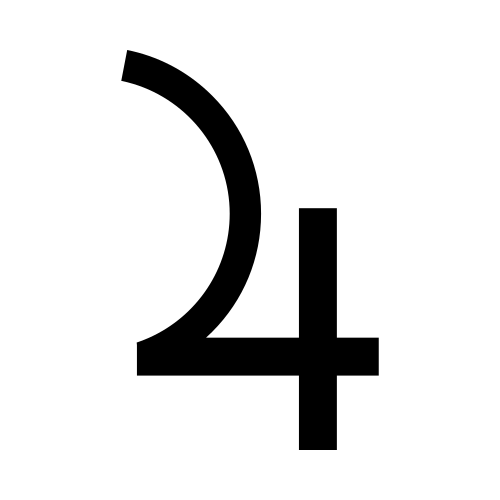 Jupiter
 Saturn
 Uranus
 Neptune
 Pluto
PlutoBirth time unknown — house positions and Ascendant/MC are not available.
Astronomical context
Pluto crossed Taurus roughly from 1853 to 1884. In astrological tradition this transit is linked to the transformation of value, resources, and the material world — the generation whose lifetimes coincided with the consolidation of industrial capital and new forms of wealth.
Ernest Rutherford (born 1871) belongs to this generational configuration. Astrian groups profiles by such shared signatures rather than by any claim of shared destiny. Related profiles in Astrian: Niels Bohr · Max Planck · J. Robert Oppenheimer. The symbolic reading is correlative, not causal.
Other profiles from this Pluto in Taurus generation
Symbolic reading
The following describes what classical astrological tradition associates with these configurations. Astrian does not apply these descriptions to the person's biography.
The Sun in Virgo is the most prominent structural feature available without a birth time, centring the chart on analysis, craft, and the refinement of method. There is no Ascendant or Midheaven to anchor the angles, so the reading rests on sign placements and the aspects between planets rather than on houses.
Among the personal planets, the Moon in Pisces is associated in tradition with imagination, dissolution, and empathy (the Moon's sign is given for the noon chart and may shift with an exact time); Mercury in Libra with balance, relationship, and proportion; Venus in Libra with balance, relationship, and proportion; and Mars in Scorpio with intensity, depth, and the will to transform. These placements describe registers of feeling, thought, attraction, and action as the tradition catalogues them, independent of the life that follows.
Moon sextile Saturn (0°20'): tradition reads emotional life and instinct in supportive contact with structure, limitation, and discipline.
Jupiter sextile Pluto (1°26'): tradition reads expansion and meaning in supportive contact with depth, power, and transformation.
Mercury square Saturn (1°43'): tradition reads thought and communication in friction with structure, limitation, and discipline.
Mercury sextile Uranus (2°22'): tradition reads thought and communication in supportive contact with disruption and innovation.
These placements are presented as a symbolic portrait, correlative and never causal — a description within the tradition's vocabulary, not an explanation of the life that follows.
Astrology is a symbolic language with 2,500 years of literature. The reading above is interpretive, not explanatory.
Astrian does not claim that the natal chart of Ernest Rutherford caused or determined any of the above. Astrology is a symbolic system with 2,500 years of literature. Its capacity for retrospective description does not imply explanatory capacity.
A parallel life
The following are verified biographical facts. No connection to the natal chart is implied.
Ernest Rutherford was born on August 30, 1871, in Brightwater, near Nelson, New Zealand. The fourth of twelve children, he grew up in a farming family and demonstrated early academic promise. He obtained his undergraduate and master's degrees from Canterbury College in Christchurch and in 1895 won a scholarship to the Cavendish Laboratory at Cambridge University, where he worked under J.J. Thomson.
At Cambridge, Rutherford studied the ionising effects of X-rays on gases. From 1898 he held a professorship at McGill University in Montreal, where he and Frederick Soddy conducted research on radioactivity. Their work established that radioactive decay involves the transmutation of one element into another, a finding that contradicted prevailing assumptions about the immutability of elements. This research contributed to Rutherford receiving the Nobel Prize in Chemistry in 1908.
In 1907 Rutherford moved to the University of Manchester. There, in 1909, he directed the famous gold foil experiment, conducted by Hans Geiger and Ernest Marsden. The experiment showed that a beam of alpha particles fired at a thin gold foil produced unexpected large-angle scattering. Rutherford concluded from these results in 1911 that the atom contains a small, dense, positively charged nucleus, surrounded by orbiting electrons. This nuclear model of the atom overturned the "plum pudding" model proposed by Thomson.
In 1919, at Manchester and subsequently at Cambridge as director of the Cavendish Laboratory, Rutherford demonstrated the first artificial transmutation of a nucleus by bombarding nitrogen with alpha particles to produce oxygen and hydrogen. He also predicted the existence of the neutron, which James Chadwick confirmed in 1932 at the Cavendish.
Rutherford was knighted in 1914 and made a baron in 1931, taking the title Lord Rutherford of Nelson. He served as president of the Royal Society from 1925 to 1930. He trained and influenced a remarkable number of future Nobel laureates, including Niels Bohr, James Chadwick, and John Cockcroft.
Ernest Rutherford died on October 19, 1937, in Cambridge, England, following a brief illness. He was buried in Westminster Abbey.
Biographical sources
- John Campbell, Rutherford: Scientist Supreme (AAS Publications, 1999).
- Noble Pri.
This profile presents the sky at the birth of Ernest Rutherford and verified facts of their biography. Astrian does not claim that astrology has predictive capacity or that the natal chart determines the trajectory of a life. Astrology is a symbolic system with 2,500 years of literature. Its capacity for retrospective description does not imply explanatory capacity.
Related profiles
Calculate your own birth chart with the same NASA JPL DE441 precision.
Calculate my birth chartLast updated: June 14, 2026
Newsletter
A short reading once a month, in your inbox.
A note on the symbolism of the season, recent editorial pieces, and what to look for in next month's sky. No predictions.
Support this project
Independent, no venture funding, no ads. A contribution keeps Astrian precise and free.
Support on Ko-fi (opens in new tab)