PROFILE · FILM & STAGE

Penélope Cruz
Penélope Cruz Sánchez
actor
Born 28 April 1974 · Alcobendas, Madrid, Spain · 40.55° N, 3.64° WX
Source: Birth time not documented in publicly accessible records
About this chart
No birth time is documented for this person. The chart therefore shows planetary positions in their signs, the slow aspects between them, and the generational context — but not house placements, the Ascendant, or the Midheaven, which require an accurate birth time. The Moon's sign carries a ±6° margin: if it falls near a sign boundary, the sign could vary. Positions for all other planets are reliable.
Do you have a verified source for this birth time? Share it →
The sky at birth
No birth time is documented for Penélope Cruz. The Ascendant, Midheaven, and house positions cannot be determined. The planetary positions below are calculated for noon local time and are accurate to within a fraction of a degree for the slow-moving planets. The Moon's position carries a margin of approximately ±7°.
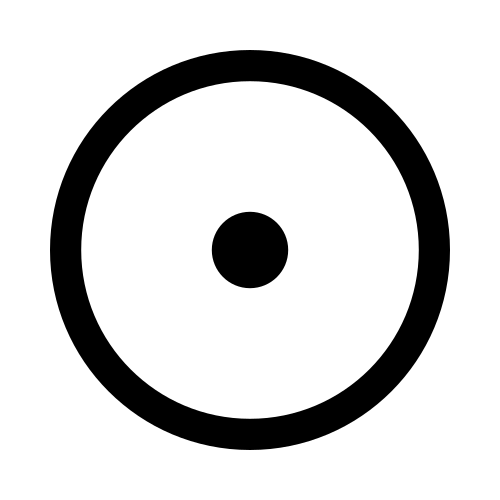
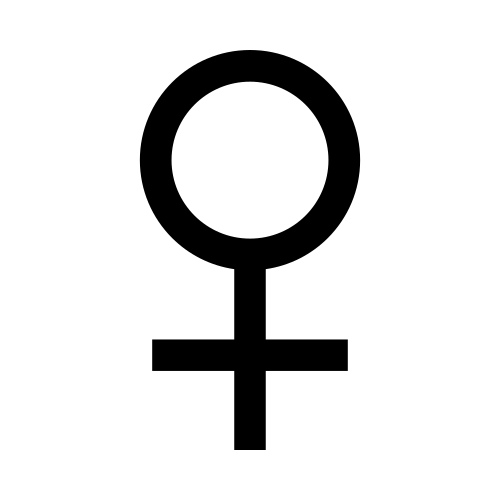
The Sun is at 7°46' Taurus. The Moon is at 26°25' Cancer (noon position, ±7° margin). Mercury is at 0°39' Taurus. Venus is at 22°58' Pisces. Mars is at 4°50' Cancer. Jupiter is at 10°50' Pisces. Saturn is at 0°51' Cancer. Uranus is at 25°13' Libra R. Neptune is at 9°02' Sagittarius R. Pluto is at 4°37' Libra R.
Mercury at 0°39' Taurus sextiles Saturn at 0°51' Cancer (0°12') — the tightest major aspect in the chart and one of the most exact Mercury-Saturn sextiles in the Astrian collection. Mars at 4°50' Cancer squares Pluto at 4°37' Libra retrograde (0°13'). The Moon at 26°25' Cancer squares Uranus at 25°13' Libra retrograde (1°12'), though this aspect carries the Moon's ±7° uncertainty. Jupiter at 10°50' Pisces squares Neptune at 9°02' Sagittarius retrograde (1°48'). The Sun at 7°46' Taurus sextiles Mars (2°56'). The Sun sextiles Jupiter (3°04'). The Moon trines Venus at 22°58' Pisces (3°27'). Mars conjoins Saturn (3°59'). Saturn squares Pluto (3°46'). Mercury sextiles Mars (4°11'). Neptune sextiles Pluto (4°25').
The engine also identifies the following tight minor aspects involving asteroids and calculated points: mars square vesta (0.06° sep); pluto conjunction vesta (0.16° app); sun semi-square venus (0.19° sep).
The tightest major aspects between planets: Mercury sextile Saturn (0°12'), Mars square Pluto (0°13'), Moon square Uranus (1°12'), Jupiter square Neptune (1°48'), Sun sextile Mars (2°56'), Sun sextile Jupiter (3°04'), Moon trine Venus (3°27'), Saturn square Pluto (3°46'), Mars conjunction Saturn (3°59').
The chart was calculated by Astrian's engine using NASA JPL DE441 ephemerides, sub-arcsecond precision. Timezone: Central European Summer Time (Europe/Madrid, UTC +2).
| Planet | Sign | Position |
|---|---|---|
| Sun | Taurus | 07°44' |
| Moon | Cancer | 25°49'±6° |
| Mercury | Taurus | 00°34' |
| Venus | Pisces | 22°55' |
| Mars | Cancer | 04°49' |
| Jupiter | Pisces | 10°49' |
| Saturn | Cancer | 00°50' |
| Uranus | Libra | 25°13'retrograde |
| Neptune | Sagittarius | 09°02'retrograde |
| Pluto | Libra | 04°37'retrograde |
| Chiron | Aries | 21°23' |
 Sun
Sun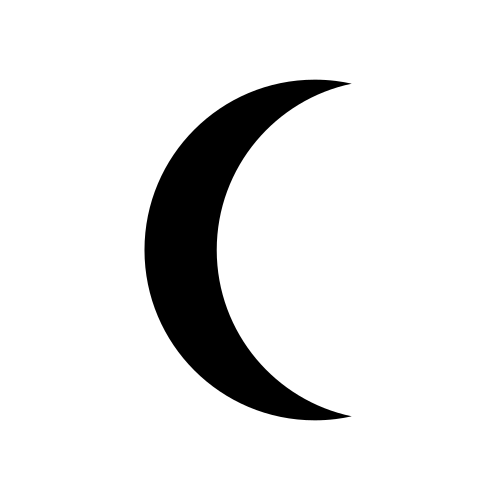 Moon
Moon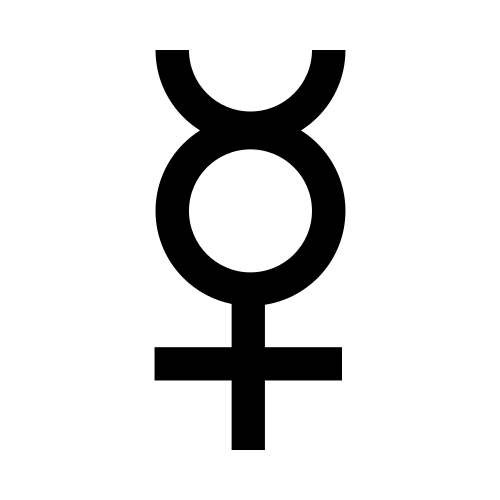 Mercury
 Venus
Venus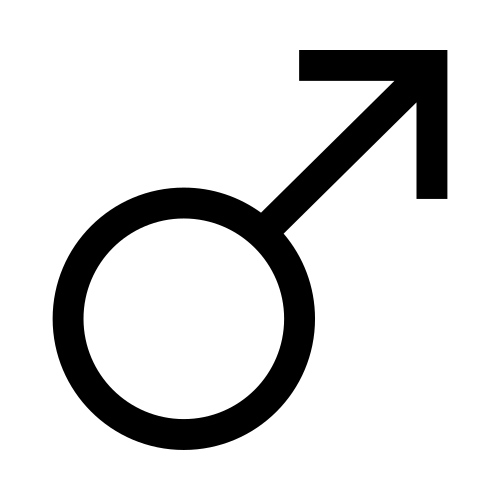 Mars
Mars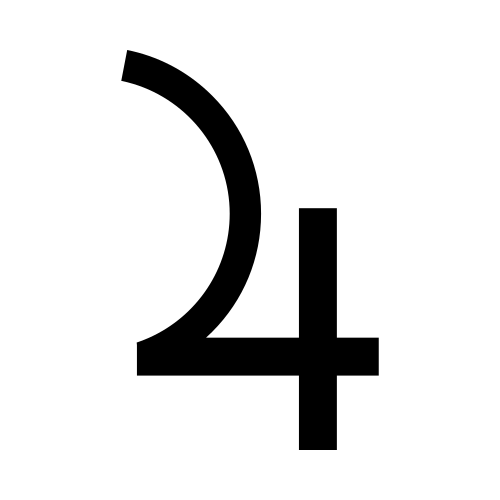 Jupiter
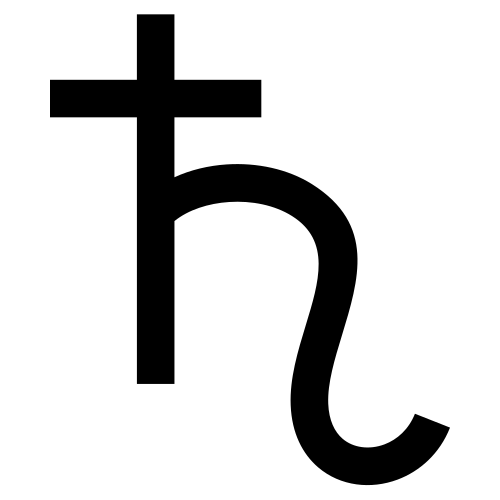 Saturn
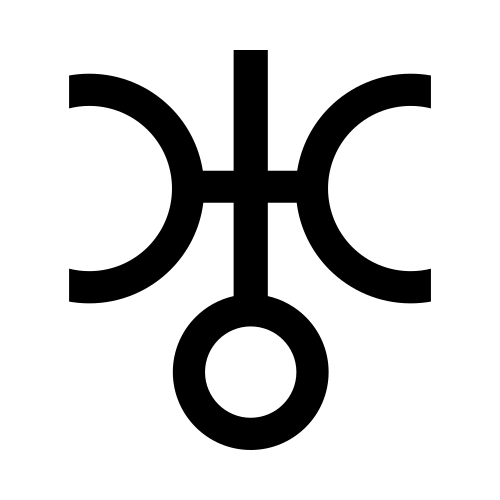 Uranus
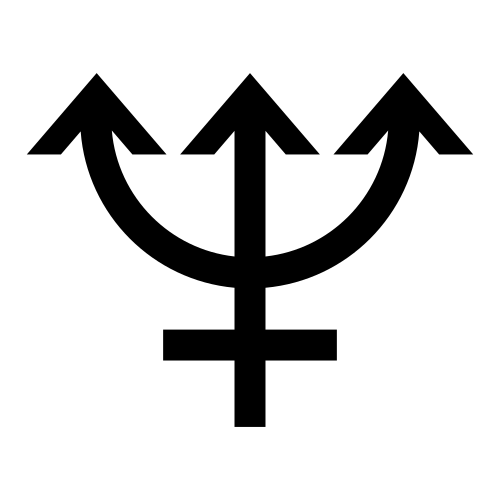 Neptune
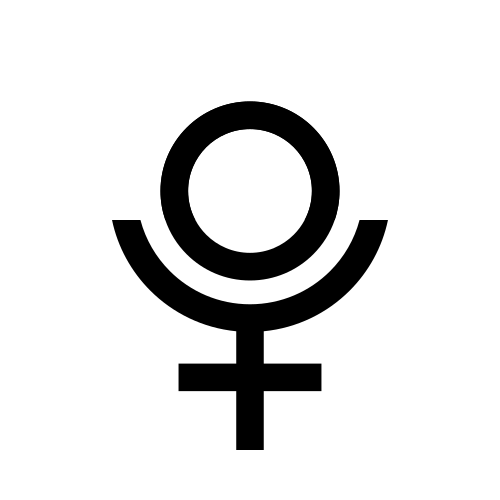 Pluto
Pluto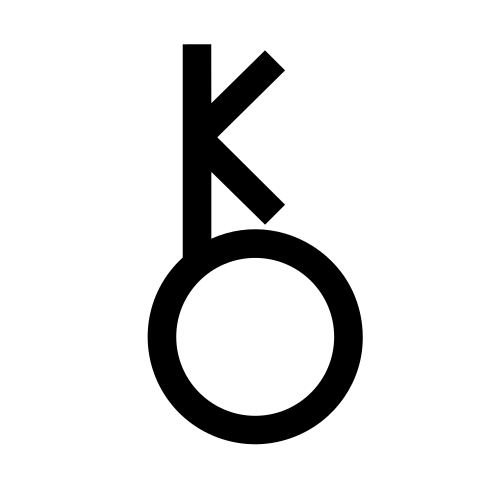 Chiron
Birth time unknown — house positions and Ascendant/MC are not available.
Astronomical context
Those born between approximately 1972 and 1984 carried Pluto in Libra. This generation grew up during the Cold War's final decade, the rise of personal computing, the beginning of the AIDS epidemic, and the first wave of economic deregulation that would reshape global markets. They came of age in the 1990s — the decade of the internet's emergence, the dissolution of the Soviet Union, and a brief, unstable period of American cultural hegemony.
In astrological tradition, Pluto in Libra is associated with collective transformation of the domains that sign governs: partnership, justice, aesthetic form, diplomacy, and the structures through which individuals negotiate with one another. Libra is the sign of the contract, the mirror, the other. Pluto's transit through Libra is read, symbolically, as a period when the institutions of relationship and fairness — marriage, international alliances, trade agreements, legal systems — were subjected to deep structural pressure. The symbolic reading is correlative, not causal.
Others in the Astrian collection born under this configuration include Beyoncé (1981), Shakira (1977), and Leonardo DiCaprio (1974). Penélope Cruz, born in 1974, belongs to the early years of this generational wave.
Other profiles from this Pluto in Libra generation
Symbolic reading
The following describes what classical astrological tradition associates with these configurations. Astrian does not apply these descriptions to the person's biography.
The Sun at 7°46' Taurus is the most prominent structural feature of this chart. Without a documented birth time, there is no Ascendant or Midheaven — the reading is confined to planetary positions by sign and the aspects between planets.
The Moon at 26°25' Cancer represents the noon position; the actual placement falls within approximately 7° on either side. If born early in the day, the Moon could be in the low twenties of Cancer; if born late, in the low single digits of Leo. The Moon's sign placement in Cancer is probable for most of the day, though a very late evening birth could push it into Leo.
Mercury at 0°39' Taurus, Venus at 22°58' Pisces, and Mars at 4°50' Cancer complete the personal planet picture.
### Venus in Pisces: the exalted aesthetic
Venus at 22°58' Pisces occupies the sign of her traditional exaltation — the position where Venus, in the vocabulary of classical astrology, operates at her fullest capacity. Venus governs aesthetics, desire, the sense of beauty, and the capacity to attract and be attracted. In Pisces, these faculties are expressed through the register of empathy, fluidity, and the dissolution of the boundaries between self and other. The aesthetic sense is not analytical but intuitive; beauty is not assessed but felt.
Venus in exaltation does not mean Venus without difficulty. It means that the Venusian faculties — connection, beauty, the impulse toward harmony — are operating in the register where the tradition considers them most naturally at home. The artistic impulse is inseparable from the emotional, and the emotional is inseparable from the imaginary.
### Mercury sextile Saturn: the disciplined mind
Mercury at 0°39' Taurus sextiles Saturn at 0°51' Cancer, orb 0°12' — the tightest major aspect in the chart. Mercury governs communication, perception, and the faculty of articulation. Saturn governs structure, discipline, and the demands of form. The sextile connects them cooperatively — the communicative faculty is naturally inclined toward precision, patience, and the kind of articulation that builds rather than improvises.
Mercury in Taurus perceives through the senses — slowly, deliberately, attentive to the material and the concrete. Saturn in Cancer structures through feeling, obligation, and the weight of inherited emotional patterns. The sextile between them reads as a perceptive faculty that is both sensually grounded and emotionally disciplined — the mind that takes its time, chooses its words with care, and does not speak until it has something substantive to say.
### Mars square Pluto: the transformative will
Mars at 4°50' Cancer squares Pluto at 4°37' Libra retrograde, orb 0°13' — functionally exact and the second tightest major aspect in the chart. Mars governs action, physical will, and the application of force. Pluto governs transformation, power, and the encounter with what lies beneath the surface of things. The square is the most dynamic of the major aspects — it does not blend its components but forces them into engagement that is productive precisely because it is uncomfortable.
Mars in Cancer acts through feeling — the will is not cold or abstract but driven by emotional investment, the protection of what matters, the defence of the vulnerable. Pluto in Libra retrograde transforms through relationship, aesthetic form, and the renegotiation of inherited structures of partnership. The square between them introduces a permanent tension between the impulse to act from emotional conviction and the impulse to transform the relational structures within which that action takes place. At 0°13', this tension is not occasional but woven into the chart's fundamental fabric.
Mars also conjoins Saturn at 0°51' Cancer (3°59'), and Saturn squares Pluto (3°46'). The three bodies form a loose T-square across Cancer and Libra — action (Mars), discipline (Saturn), and transformation (Pluto) are locked in a triangular configuration that demands constant negotiation between emotional engagement, structural responsibility, and the pressure to rebuild from the foundations.
### Jupiter square Neptune: the expanded imagination
Jupiter at 10°50' Pisces squares Neptune at 9°02' Sagittarius retrograde, orb 1°48'. Jupiter governs expansion, belief, and the impulse toward meaning that exceeds the immediate. Neptune governs the ideal, the imaginary, and the dissolution of ordinary boundaries. The square introduces a tension between two planetary principles that both tend toward the unbounded — Jupiter expands what Neptune dissolves, and Neptune dissolves what Jupiter expands. In the tradition, Jupiter-Neptune squares are read as configurations of enormous imaginative capacity that must contend with the difficulty of knowing where vision ends and illusion begins.
Jupiter in Pisces is in its own traditional domicile — belief and expansion operating through the most fluid and empathic of the signs. Neptune in Sagittarius retrograde operates through the register of philosophy, the search for meaning beyond local horizons. The square between them connects the most receptive form of faith with the most searching form of idealism.
### Sun sextile Mars and Jupiter: the productive connections
The Sun at 7°46' Taurus sextiles Mars at 4°50' Cancer (2°56') and sextiles Jupiter at 10°50' Pisces (3°04'). These two sextiles connect the identity to both the will to act (Mars) and the impulse to expand (Jupiter) through cooperative aspects in water and earth signs. The identity is supported by both emotional engagement and a natural sense of abundance. Mars and Jupiter are not themselves in aspect to each other at standard orbs, but both connect independently to the Sun, creating a pattern where the identity draws energy from action and meaning simultaneously.
The planetary pattern here is read as a symbolic portrait, not a causal explanation. No planet caused, predicted, or determined any event or characteristic.
Astrology is a symbolic language with 2,500 years of literature. The reading above is interpretive, not explanatory.
Astrian does not claim that the natal chart of Penélope Cruz caused or determined any of the above. Astrology is a symbolic system with 2,500 years of literature. Its capacity for retrospective description does not imply explanatory capacity.
A parallel life
The following are verified biographical facts. No connection to the natal chart is implied.
Penélope Cruz Sánchez was born on 28 April 1974 in Alcobendas, a municipality on the northern edge of Madrid, the eldest daughter of Eduardo Cruz, a retailer, and Encarna Sánchez, a hairdresser. Her younger sister Mónica became an actress and dancer; her younger brother Eduardo became a singer and songwriter. The household was working-class and close-knit.
She began studying classical ballet at the Royal Conservatory of Madrid at age four and continued for nine years. At fifteen, she won an audition at a talent agency among three hundred candidates and began appearing in Spanish television and music videos. The dance training — its discipline, its physical precision, its capacity to communicate through the body rather than through words — preceded and shaped the acting career that followed.
Her film debut came at eighteen with Bigas Luna's Jamón, Jamón (1992), an earthy comedy set in rural Spain that paired her for the first time with Javier Bardem, who would become her husband eighteen years later. Belle Époque (1992), directed by Fernando Trueba, won the Academy Award for Best Foreign Language Film and established her within the Spanish industry. The collaboration with Pedro Almodóvar began with Live Flesh (1997) and deepened through All About My Mother (1999), in which she played a pregnant nun with a quiet intensity that announced her capacity for serious dramatic work.
The transition to Hollywood was deliberate but not without friction. All the Pretty Horses (2000), Vanilla Sky (2001), and Blow (2001) placed her in major American productions, but the English-language roles often asked less of her than the Spanish ones. The industry's tendency to reduce her to an accent and a striking face was a constraint she would spend a decade dismantling.
Volver (2006) marked a turning point. Almodóvar's film about women, death, and the stubborn continuity of domestic life in La Mancha gave her the role of Raimunda — a working-class mother of ferocious protectiveness and suppressed grief — and earned her the Best Actress prize at Cannes (shared with the ensemble cast), a Goya Award, and the recognition that her best work happened when she operated in her own language. Vicky Cristina Barcelona (2008), directed by Woody Allen, brought the Academy Award for Best Supporting Actress — the first Oscar ever won by a Spanish actress. She played María Elena, a volatile painter whose jealousy and passion dominated every scene she entered.
Subsequent work moved between continents and registers. Elegy (2008), Nine (2009), Pirates of the Caribbean: On Stranger Tides (2011), and Zoolander 2 (2016) represented the Hollywood side; the continued Almodóvar collaborations — Broken Embraces (2009), Pain and Glory (2019), Parallel Mothers (2021) — represented the Spanish side, and the Spanish work was consistently stronger. Parallel Mothers brought a second Academy Award nomination and demonstrated that two decades after All About My Mother, the partnership with Almodóvar remained the most productive artistic relationship of her career.
She married Javier Bardem in 2010. They have two children, Leo (born 2011) and Luna (born 2013). The couple has been notably private about their family life, rarely discussing it in public. She has worked consistently as a fashion ambassador for Chanel and L'Oréal, and has been involved in charitable work related to children's welfare and humanitarian causes.
By 2025, she had appeared in more than fifty films across Spanish, English, Italian, and French productions. She remains the most internationally successful Spanish actress of her generation and one of the few European performers to sustain parallel careers on both sides of the Atlantic without sacrificing the quality of either.
Biographical sources
- Smith, Paul Julian. Desire Unlimited: The Cinema of Pedro Almodóvar. Verso 2000
- Sotinel, Thomas. Pedro Almodóvar. Cahiers du Cinéma 2007
This profile presents the sky at the birth of Penélope Cruz and verified facts of their biography. Astrian does not claim that astrology has predictive capacity or that the natal chart determines the trajectory of a life. Astrology is a symbolic system with 2,500 years of literature. Its capacity for retrospective description does not imply explanatory capacity.
Related profiles
Calculate your own birth chart with the same NASA JPL DE441 precision.
Calculate my birth chartLast updated: June 12, 2026
Newsletter
A short reading once a month, in your inbox.
A note on the symbolism of the season, recent editorial pieces, and what to look for in next month's sky. No predictions.
Support this project
Independent, no venture funding, no ads. A contribution keeps Astrian precise and free.
Support on Ko-fi (opens in new tab)