PROFILE · SPORTS
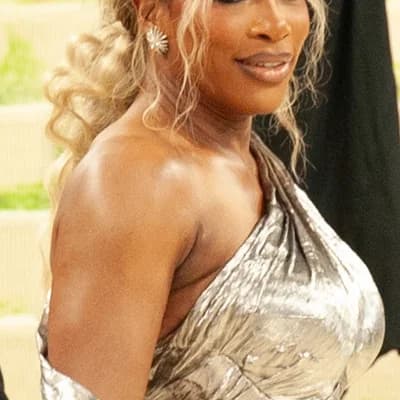
Serena Williams
Serena Jameka Williams
tennis player
Born 26 September 1981 · Saginaw, Michigan, United States · 43.42° N, 83.95° WX
Source: Birth time not documented in publicly accessible records
About this chart
No birth time is documented for this person. The chart therefore shows planetary positions in their signs, the slow aspects between them, and the generational context — but not house placements, the Ascendant, or the Midheaven, which require an accurate birth time. The Moon's sign carries a ±6° margin: if it falls near a sign boundary, the sign could vary. Positions for all other planets are reliable.
Do you have a verified source for this birth time? Share it →
The sky at birth
No birth time is documented for Serena Williams. The Ascendant, Midheaven, and house positions cannot be determined. The planetary positions below are calculated for noon local time and are accurate to within a fraction of a degree for the slow-moving planets. The Moon's position carries a margin of approximately ±7°.
The Sun is at 3°30' Libra. The Moon is at 16°25' Virgo (noon position, ±7° margin). Mercury is at 29°24' Libra. Venus is at 15°58' Scorpio. Mars is at 15°23' Leo. Jupiter is at 16°58' Libra. Saturn is at 11°40' Libra. Uranus is at 27°14' Scorpio. Neptune is at 22°14' Sagittarius. Pluto is at 23°26' Libra.
The Moon at 16°25' Virgo sextiles Venus at 15°58' Scorpio (0°27') — the tightest major aspect in the chart, though it carries the Moon's ±7° uncertainty. Venus at 15°58' Scorpio squares Mars at 15°23' Leo (0°35'). Mars sextiles Jupiter at 16°58' Libra (1°35'). Neptune at 22°14' Sagittarius sextiles Pluto at 23°26' Libra (1°12'). Mars sextiles Saturn at 11°40' Libra (3°43').
The engine also identifies the following tight minor aspects involving asteroids and calculated points: saturn semi-sextile juno (0.12° sep); neptune quincunx chiron (0.19° app); moon sextile venus (0.45° sep); uranus sextile ceres (0.45° sep).
The tightest major aspects between planets: Moon sextile Venus (0°27'), Venus square Mars (0°35'), Neptune sextile Pluto (1°12'), Mars sextile Jupiter (1°35'), Mars sextile Saturn (3°43').
The chart was calculated by Astrian's engine using NASA JPL DE441 ephemerides, sub-arcsecond precision. Timezone: America/Detroit (Eastern Daylight Time, UTC −4).
| Planet | Sign | Position |
|---|---|---|
| Sun | Libra | 03°28' |
| Moon | Virgo | 15°53'±6° |
| Mercury | Libra | 29°22' |
| Venus | Scorpio | 15°55' |
| Mars | Leo | 15°21' |
| Jupiter | Libra | 16°57' |
| Saturn | Libra | 11°40' |
| Uranus | Scorpio | 27°14' |
| Neptune | Sagittarius | 22°14' |
| Pluto | Libra | 23°26' |
| Chiron | Taurus | 22°25'retrograde |
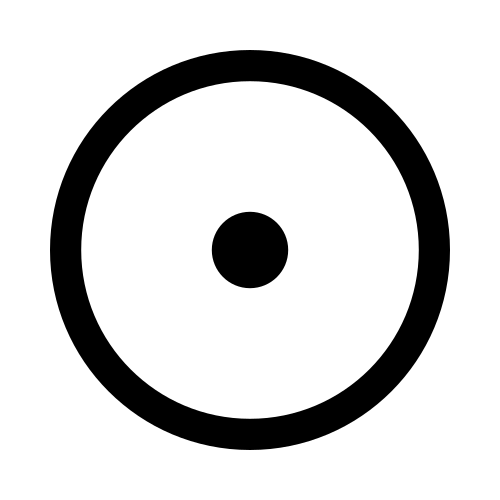 Sun
Sun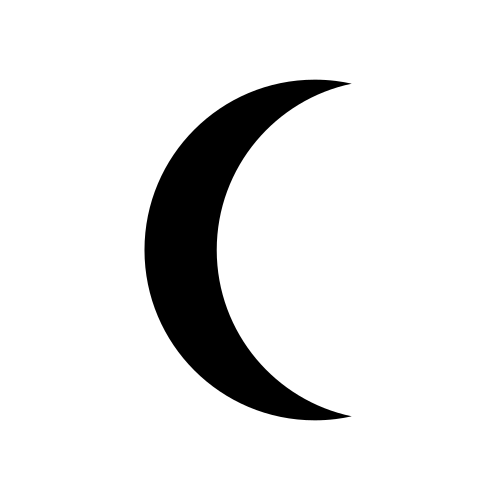 Moon
Moon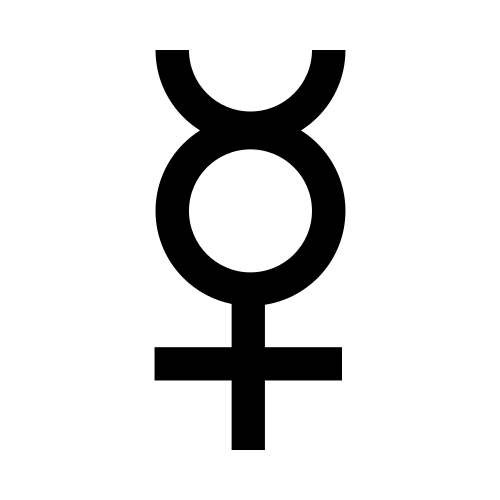 Mercury
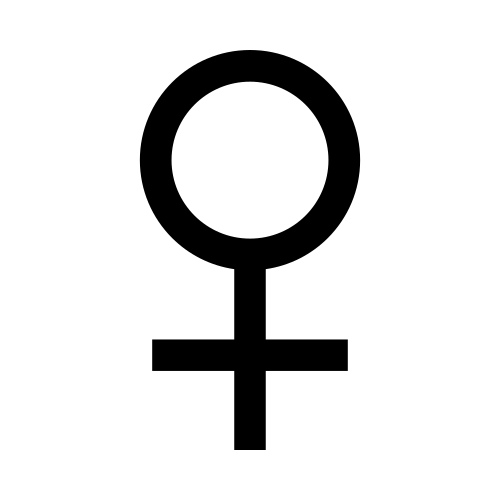 Venus
Venus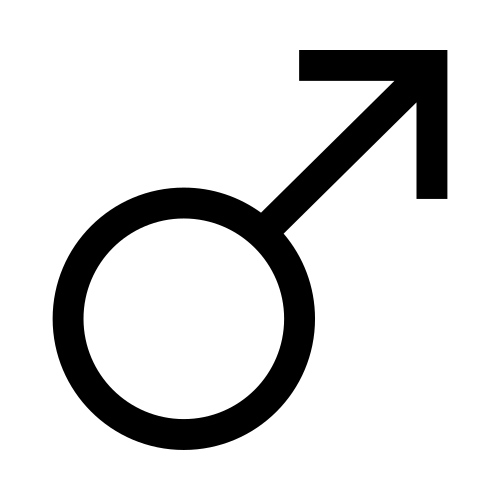 Mars
Mars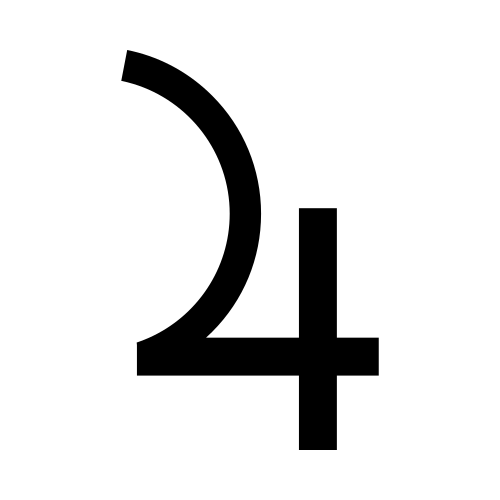 Jupiter
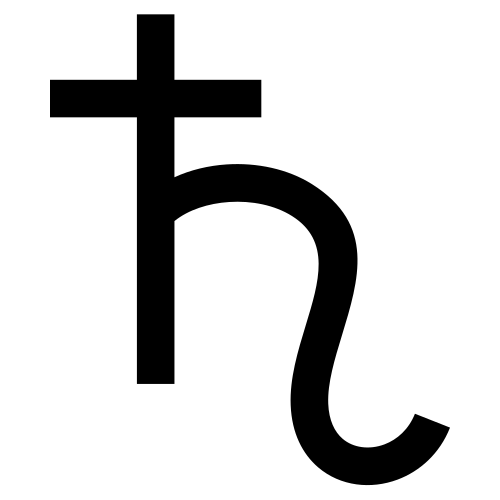 Saturn
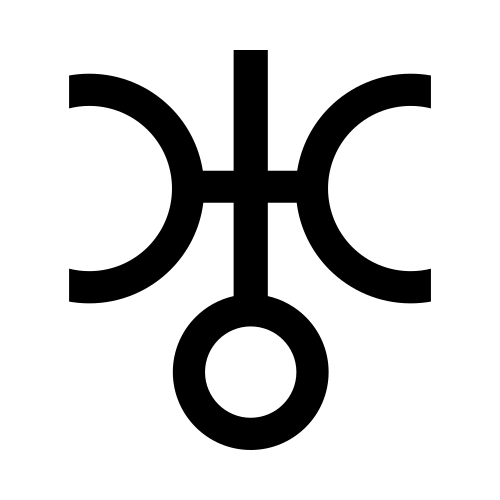 Uranus
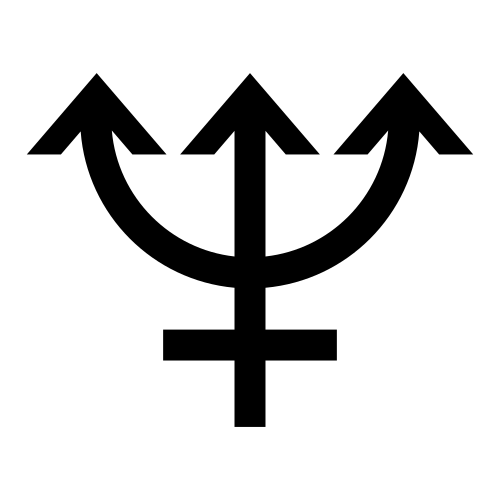 Neptune
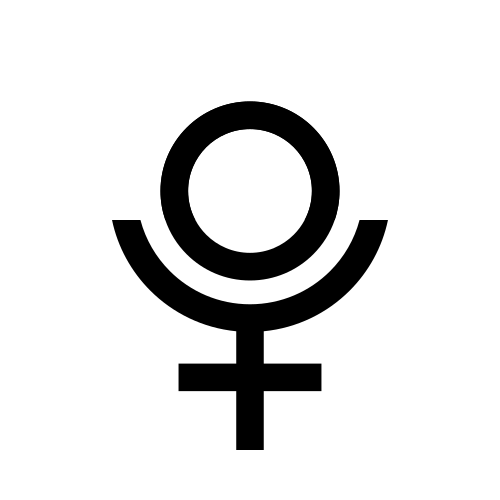 Pluto
Pluto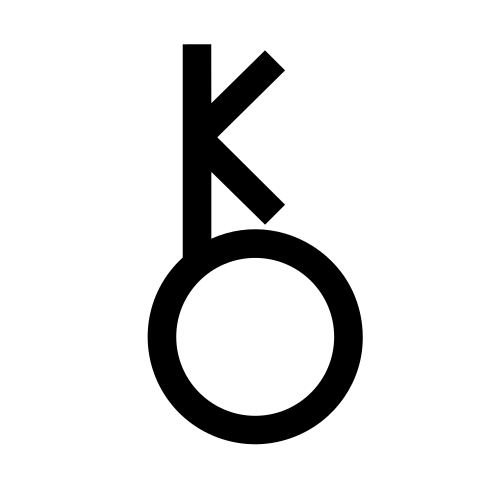 Chiron
Birth time unknown — house positions and Ascendant/MC are not available.
Astronomical context
Those born between approximately 1972 and 1984 carried Pluto in Libra. This generation came of age during the last decade of the Cold War, the rise of neoliberal economics, the early HIV/AIDS crisis, and the cultural transitions of the 1980s — the emergence of MTV, the personal computer, and the globalisation of consumer culture. They inherited a world where the traditional structures of partnership, marriage, and social contract were being renegotiated under pressure.
In astrological tradition, Pluto in Libra is associated with collective transformation of the domains that sign governs: relationships, partnerships, justice, aesthetics, and the negotiation of power between equals. Libra is the sign of the diplomat, the aesthete, the one who seeks balance and fairness in all exchanges. Pluto's transit through Libra is read, symbolically, as a period when the structures of partnership and justice were subjected to deep structural pressure — when the nature of relationships, contracts, and the distribution of power between individuals was transformed at the root. The generation that carries this placement inherited a world where the old forms of partnership were no longer sufficient and new ones had not yet solidified. The symbolic reading is correlative, not causal.
Other profiles in the Astrian collection born under this configuration include Zinedine Zidane (1972) and Ronaldo Nazário (1976). Serena Williams, born in 1981, belongs to the later years of this generational wave.
Other profiles from this Pluto in Libra generation
Symbolic reading
The following describes what classical astrological tradition associates with these configurations. Astrian does not apply these descriptions to the person's biography.
The Sun at 3°30' Libra is the most prominent structural feature of this chart. Without a documented birth time, there is no Ascendant or Midheaven — the reading is confined to planetary positions by sign and the aspects between planets.
The Moon at 16°25' Virgo represents the noon position; the actual placement falls within approximately 7° on either side. If born early in the day, the Moon could be near 9° Virgo; if born late, near 23° Virgo. The Moon's sign placement in Virgo is stable for the entire day.
Mercury at 29°24' Libra, Venus at 15°58' Scorpio, and Mars at 15°23' Leo complete the personal planet picture. The chart concentrates four planets in Libra (Sun, Mercury, Jupiter, Saturn) — a stellium that defines the sign emphasis. Mars in Leo, the sign of its classical association with display and dominance, stands apart from the Libra concentration.
### Venus square Mars: desire against will
The chart's tightest personal aspect is Venus at 15°58' Scorpio square Mars at 15°23' Leo, orb 0°35'. Venus governs aesthetics, value, desire, and the capacity for pleasure. Mars governs action, assertion, competition, and the will to dominate. Their square creates structural friction: what is desired and what is fought for do not align smoothly. The desire faculty (Venus in Scorpio — intense, deep, all-or-nothing in its commitments) stands in tension with the action faculty (Mars in Leo — dramatic, commanding, demanding centre stage).
In the tradition, Venus-Mars squares are read as configurations of enormous drive — the tension between the two faculties generates energy rather than paralysis. The desire is intense; the will to act is fierce; and the friction between them produces a compressed force that finds release through competition, performance, and the assertion of dominance. Venus in Scorpio does not desire gently; Mars in Leo does not compete quietly. The square fuses intensity with spectacle.
### Moon sextile Venus: the body and the feeling
The Moon at 16°25' Virgo sextiles Venus at 15°58' Scorpio, orb 0°27' — though this aspect carries the Moon's ±7° uncertainty. The sextile is cooperative. The Moon in Virgo — the emotional faculty operating through the register of precision, physical awareness, and the disciplined attention to what the body needs — flows cooperatively with Venus in Scorpio (desire in its most intense form). The reading is one where the emotional life and the desire faculty support each other: what is felt is aligned with what is wanted, and both operate through a register of physical intelligence and depth.
### Mars sextile Jupiter: action and expansion
Mars at 15°23' Leo sextiles Jupiter at 16°58' Libra, orb 1°35'. Mars governs competition and the will to act. Jupiter governs expansion, generosity, and the instinct toward justice. The sextile connects them cooperatively: the competitive faculty (Mars in Leo — the drive to dominate, to command attention, to be the best) is expanded and amplified by Jupiter in Libra (justice, fairness, and the capacity to operate within structures of partnership and public expectation). The reading is one where competitive action naturally expands beyond the individual — where the drive to win carries an awareness of its larger context, of the justice or injustice of the structures within which it operates.
Mars also sextiles Saturn at 11°40' Libra (3°43'), connecting the competitive faculty to Saturnian discipline. The Mars-Jupiter-Saturn network creates a configuration where action (Mars) is simultaneously expanded (Jupiter) and structured (Saturn) — a drive that is fierce, large in scale, and disciplined in execution.
### The Libra stellium: justice, structure, and the public stage
The Sun, Mercury, Jupiter, and Saturn all occupy Libra. This is the chart's defining sign concentration. Libra governs balance, justice, partnership, and the aesthetic sense. Four planets in Libra — including Saturn (discipline and authority) and Jupiter (expansion and justice) — read as a configuration fundamentally oriented toward the public negotiation of fairness. The identity (Sun), the communication faculty (Mercury), the expansive instinct (Jupiter), and the capacity for disciplined structure (Saturn) all operate through the same register: the register of balance, of measured response, of justice as both an aesthetic and a structural principle.
Pluto at 23°26' Libra adds generational depth to this concentration: the sign emphasis is not just personal but carries the transformative weight of the Pluto-in-Libra generation.
The planetary pattern here is read as a symbolic portrait, not a causal explanation. No planet caused, predicted, or determined any event or characteristic.
Astrology is a symbolic language with 2,500 years of literature. The reading above is interpretive, not explanatory.
Astrian does not claim that the natal chart of Serena Williams caused or determined any of the above. Astrology is a symbolic system with 2,500 years of literature. Its capacity for retrospective description does not imply explanatory capacity.
A parallel life
The following are verified biographical facts. No connection to the natal chart is implied.
Serena Jameka Williams was born on 26 September 1981 in Saginaw, Michigan, the youngest of five daughters of Richard Williams and Oracene Price. The family moved to Compton, California, when she was a child. Her father — who had no formal tennis training — developed a 78-page plan for his daughters' tennis careers before they were born, based on watching Virginia Ruzici win the 1978 French Open on television. He and Oracene coached Serena and her older sister Venus on the cracked public courts of Compton, amid gang activity and gunfire that the family later described as a constant backdrop to their childhood.
She turned professional at fourteen. At seventeen, she won the 1999 US Open — her first Grand Slam title, achieved before Venus had won hers, reversing the order that their father's plan had anticipated. The rivalry and partnership between the two sisters — who faced each other in nine Grand Slam finals — became one of the defining narratives of women's tennis.
What followed was the most dominant career in the history of women's professional sport, measured by any reasonable standard. Twenty-three Grand Slam singles titles — the most in the Open Era, one short of Margaret Court's all-time record of 24 (set in a different competitive era). Fourteen Grand Slam doubles titles, all won with Venus. Four Olympic gold medals. 319 weeks ranked world number one.
The statistics describe a career but not the nature of the dominance. Williams played a game that had no precedent in women's tennis. Her serve — routinely clocked above 120 miles per hour — was the most powerful in the women's game. Her return of serve was the most aggressive. Her movement, for a woman of her height and build (5'9", 155 pounds at her peak), was exceptional. She hit the ball harder, from deeper in the court, with more topspin and more angle, than anyone who had come before. She did not simply win; she remade the physical parameters of what was considered possible.
She did so while navigating an industry that had not been designed for her. Women's tennis in the 1990s and 2000s was overwhelmingly white. The racism she and Venus encountered — from the crowd abuse at Indian Wells in 2001 (which she boycotted for fourteen years) to the persistent scrutiny of her body, her clothing, her expression of emotion on court — was a constant feature of her career. She did not perform within the existing framework of how a female tennis champion was expected to look and behave; she forced the framework to accommodate her.
Thirteen of her twenty-three Grand Slam titles came after the age of thirty — a statistical anomaly in a sport where careers typically peak in the early to mid-twenties. During those years she survived a pulmonary embolism in 2011 that nearly killed her, recovered from multiple knee and ankle injuries, gave birth to her daughter Olympia in September 2017 (by emergency C-section, followed by a pulmonary embolism and a week of bed rest), and returned to Grand Slam finals within months of giving birth.
Off the court, she built a commercial empire: endorsement deals with Nike (a reported $40 million annually), Gatorade, JPMorgan Chase, and others. Serena Ventures, her venture capital firm, invested in over 70 early-stage companies. Her fashion line, S by Serena, launched in 2018. She married Alexis Ohanian, co-founder of Reddit, in 2017.
She announced her departure from professional tennis in August 2022, in a first-person essay published in Vogue, using the word "evolving" rather than "retiring." She played her final match at the 2022 US Open, losing in the third round to Ajla Tomljanovic before a capacity crowd at Arthur Ashe Stadium. She was forty.
Biographical sources
- Williams, Serena. On the Line. Grand Central Publishing 2009
- Williams, Richard. Black and White: The Way I See It. Atria Books 2014
- The New York Times. 2022
This profile presents the sky at the birth of Serena Williams and verified facts of their biography. Astrian does not claim that astrology has predictive capacity or that the natal chart determines the trajectory of a life. Astrology is a symbolic system with 2,500 years of literature. Its capacity for retrospective description does not imply explanatory capacity.
Related profiles
Calculate your own birth chart with the same NASA JPL DE441 precision.
Calculate my birth chartLast updated: June 12, 2026
Newsletter
A short reading once a month, in your inbox.
A note on the symbolism of the season, recent editorial pieces, and what to look for in next month's sky. No predictions.
Support this project
Independent, no venture funding, no ads. A contribution keeps Astrian precise and free.
Support on Ko-fi (opens in new tab)