PROFILE · SPORTS

Ronaldo Nazário
Ronaldo Luís Nazário de Lima
footballer
Born 18 September 1976 · Itaguaí, Brazil · 22.86° S, 43.77° WX
Source: Not documented
About this chart
No birth time is documented for this person. The chart therefore shows planetary positions in their signs, the slow aspects between them, and the generational context — but not house placements, the Ascendant, or the Midheaven, which require an accurate birth time. The Moon's sign carries a ±6° margin: if it falls near a sign boundary, the sign could vary. Positions for all other planets are reliable.
Do you have a verified source for this birth time? Share it →
The sky at birth
The birth time is not documented; house positions, Ascendant, and Midheaven are not available for this chart. Planetary positions in signs are derived from noon on the birth date.
Ronaldo Luís Nazário de Lima was born on 18 September 1976 in Itaguaí, a municipality west of Rio de Janeiro. The Sun at approximately 25° Virgo sits in the late degrees of the sign, where Virgo's qualities of technical mastery, physical precision, and analytical refinement reach their most concentrated expression. Virgo at 25° describes the player whose execution is so refined it appears effortless: the dribble that covers maximum distance with minimum movement, the body feint that neutralizes the defender without excess, the acceleration that reaches peak speed in the shortest possible time.
The Moon at approximately 17° Cancer (noon position, with a margin of approximately ±6° depending on actual birth time) is associated in the tradition with deep emotional instinct, attachment to origins, and a protective quality directed at family and home. The Moon's position in Cancer is stable for the full range of possible birth times on this date.
Mercury at approximately 2° Libra is retrograde, a position the tradition reads as a mind that revisits, refines, and reconsiders rather than deciding once. Mercury retrograde in Libra is associated with aesthetic judgment that loops back on itself, correcting and adjusting until the action matches the internal standard. Mercury forms a trine to Jupiter at approximately 1° Gemini, an aspect traditionally associated with expansive thinking and an ability to process tactical information rapidly and across a wide field.
Venus at approximately 20° Libra and Mars at approximately 16° Libra form a conjunction, placing desire and action together in the sign of balance and proportion. Pluto at approximately 10° Libra completes a stellium of four bodies in Libra (Mercury, Venus, Mars, Pluto), the most concentrated cluster in the chart. The tradition reads a Libra stellium as a life organized around questions of partnership, aesthetics, and the integration of opposites — strength with elegance, power with grace.
The Moon in Cancer forms a square to both Mars and Venus in Libra, an aspect the tradition associates with tension between emotional instinct and the drive toward aesthetic action. Saturn at approximately 12° Leo trines Neptune at approximately 11° Sagittarius, linking discipline with vision. Saturn also forms a sextile to Pluto, an aspect associated with the slow accumulation of structural power.
No birth time is documented for Ronaldo Nazário. Planetary sign positions use a noon ephemeris and are approximate.
| Planet | Sign | Position |
|---|---|---|
| Sun | Virgo | 25°48' |
| Moon | Cancer | 17°52'±6° |
| Mercury | Libra | 02°48'retrograde |
| Venus | Libra | 20°44' |
| Mars | Libra | 16°29' |
| Jupiter | Gemini | 01°12' |
| Saturn | Leo | 12°44' |
| Uranus | Scorpio | 04°59' |
| Neptune | Sagittarius | 11°23' |
| Pluto | Libra | 10°58' |
| Chiron | Taurus | 01°03'retrograde |
 Sun
Sun Moon
Moon Mercury
 Venus
Venus Mars
Mars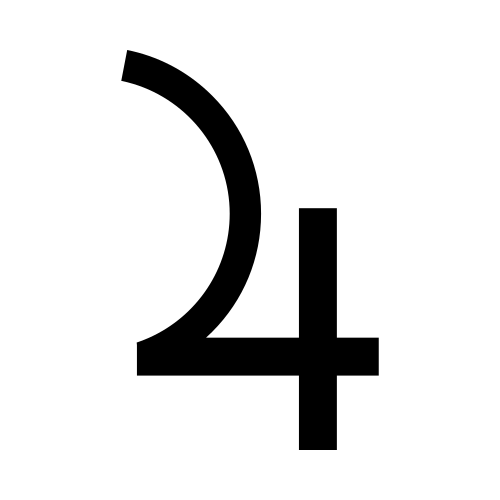 Jupiter
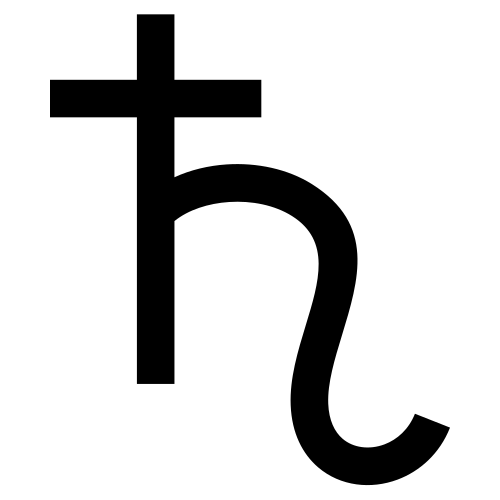 Saturn
 Uranus
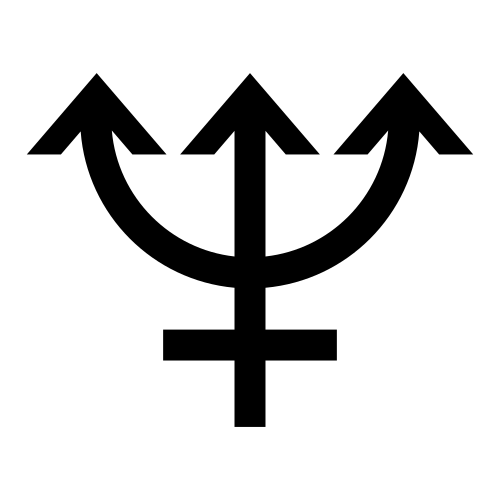 Neptune
 Pluto
Pluto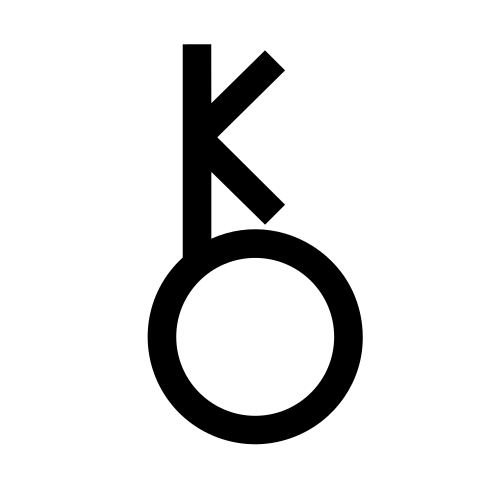 Chiron
Birth time unknown — house positions and Ascendant/MC are not available.
Astronomical context
Ronaldo Nazário belongs to the Pluto in Libra generation (1971–1984), born in 1976 in Itaguaí, on the western fringe of the Rio de Janeiro metropolitan region. His biographical context is the end of Brazil's military dictatorship and the economic instability that followed: inflation, currency crises, and a social structure in which football was one of the few reliable instruments of upward mobility for a boy from a working-class family in the Baixada Fluminense.
The Pluto in Libra generation carried themes of transformation through relationship, partnership, and the aesthetic dimension of collective life. In football terms, the generation produced players whose defining quality was the integration of physical power with technical beauty. Ronaldo's play at his peak embodied this integration more completely than any contemporary: not power or technique applied separately, but both simultaneously, in proportions that made the distinction meaningless.
His childhood was spent in Bento Ribeiro, in northern Rio, playing futsal on concrete courts. Cruzeiro identified him at fifteen. At sixteen he was scoring professionally. By seventeen he had 44 goals in 47 appearances for Cruzeiro, and PSV Eindhoven had signed him. By twenty, after a season at Barcelona that produced 47 goals in 49 games, he had moved to Inter Milan for a world-record fee. The velocity of the ascent was itself a Pluto in Libra signature: beauty and intensity compressed into the shortest possible timeline.
The injuries of November 1999 and April 2000 — two ruptures of the right patellar tendon, nearly three years lost — interrupted the trajectory at its steepest. His return for the 2002 World Cup, where he scored eight goals including two in the final against Germany, remains one of the most compelling narratives of physical reconstruction in sport.
Other profiles from this Pluto in Libra generation
Symbolic reading
The following describes what classical astrological tradition associates with these configurations. Astrian does not apply these descriptions to the person's biography.
### Sun in Virgo: precision without a personal anchor
The Sun at 25° Virgo has no tight major aspect to any other planet in the chart. The tradition reads an unaspected or loosely aspected Sun as a core identity that operates somewhat independently of the rest of the personality — the essential self that does its work without needing external validation from other chart factors. For a forward whose defining quality was the combination of physical intelligence and technical economy, Virgo's late degrees describe the instrument perfected: the body that understands its own capabilities with scientific precision and deploys them accordingly.
### Venus-Mars conjunction in Libra with Pluto
Venus and Mars together in Libra, with Pluto in the same sign, describe a life in which desire and action are inseparable from questions of beauty, proportion, and transformative intensity. The tradition associates Venus-Mars conjunctions with a fusion of the receptive and assertive principles — the quality that, in football, produces the player who both creates and finishes, who is both artist and executioner. Pluto's presence in the same sign deepens the conjunction's expression: this is not decorative beauty but beauty that carries the weight of transformation.
### Moon in Cancer square Mars-Venus in Libra
The Moon in Cancer — home, instinct, the body's emotional memory — forms a square to Mars and Venus in Libra. The tradition reads this configuration as a tension between what the emotions need (security, belonging, the familiar) and what the drive toward action demands (balance, partnership, aesthetic refinement). In biographical terms, the tension maps onto the pattern of a player who left Brazil at eighteen, moved across four countries in six years, and carried the emotional weight of displacement alongside the professional demands of elite performance.
### Mercury retrograde trine Jupiter
Mercury retrograde at 2° Libra trine Jupiter at 1° Gemini is associated in the tradition with a mind that processes information expansively but through revision — the thinker who sees the whole field, reconsiders, and then acts. For a forward, this describes the quality of tactical vision that operates slightly behind the immediate moment: the pause that creates time, the feint that opens the angle, the decision that arrives after the defender has already committed.
The readings above are symbolic and archetypal. They do not constitute psychological diagnoses or predictions.
Astrian does not claim that the natal chart of Ronaldo Nazário caused or determined any of the above. Astrology is a symbolic system with 2,500 years of literature. Its capacity for retrospective description does not imply explanatory capacity.
A parallel life
The following are verified biographical facts. No connection to the natal chart is implied.
Ronaldo Luís Nazário de Lima was born on 18 September 1976 in Itaguaí, Rio de Janeiro state, Brazil. His father, Nélio Nazário de Lima, and mother, Sônia dos Santos Barata, raised him in Bento Ribeiro, in northern Rio. He grew up in poverty and played futsal as a child before entering organized football.
Cruzeiro signed him at fifteen. His professional debut came at sixteen; by the time he left for PSV Eindhoven in 1994, he had scored 44 goals in 47 games. At PSV he scored 54 goals in 57 appearances across two seasons. Barcelona signed him in 1996; his single season there produced 47 goals in 49 games. Inter Milan signed him in 1997 for a then-world-record transfer fee.
At Inter, severe knee injuries interrupted his career: a ruptured patellar tendon in the right knee in November 1999, and a second rupture in April 2000. He missed nearly three years. Before the 1998 World Cup final against France, he suffered a seizure or convulsive episode whose full medical details have never been publicly clarified; Brazil lost the match 3–0.
He returned for the 2002 World Cup and scored eight goals in seven matches, including both goals in the 2–0 final victory over Germany. He was awarded the Golden Ball as the tournament's best player. Real Madrid signed him in 2002; across five seasons he scored 104 goals in 177 appearances. He moved to AC Milan in 2007, then to Corinthians in 2009, and retired in February 2011.
With the Brazilian national team he earned 98 caps and scored 62 goals. He won two World Cups as a squad member (1994, though he did not play, and 2002). He was named FIFA World Player of the Year in 1996, 1997, and 2002, and won the Ballon d'Or in 1997 and 2002. He is known as "O Fenômeno."
After retirement, he became a businessman and football executive, serving as president of Real Valladolid (2018–2023) and president of Cruzeiro (2022–2023).
Biographical sources
- Moura, Rodrigo. Ronaldo: O Fenômeno. Sextante 2019
- Bellos, Alex. Futebol: The Bra*.
This profile presents the sky at the birth of Ronaldo Nazário and verified facts of their biography. Astrian does not claim that astrology has predictive capacity or that the natal chart determines the trajectory of a life. Astrology is a symbolic system with 2,500 years of literature. Its capacity for retrospective description does not imply explanatory capacity.
Related profiles
Calculate your own birth chart with the same NASA JPL DE441 precision.
Calculate my birth chartLast updated: June 12, 2026
Newsletter
A short reading once a month, in your inbox.
A note on the symbolism of the season, recent editorial pieces, and what to look for in next month's sky. No predictions.
Support this project
Independent, no venture funding, no ads. A contribution keeps Astrian precise and free.
Support on Ko-fi (opens in new tab)