PROFILE · SPORTS
Sugar Ray Robinson
Walker Smith Jr.
boxer
Born 3 May 1921 · Ailey, Georgia, United States · 32.19° N, 82.57° WX
Source: Birth time not documented in publicly accessible records
About this chart
No birth time is documented for this person. The chart therefore shows planetary positions in their signs, the slow aspects between them, and the generational context — but not house placements, the Ascendant, or the Midheaven, which require an accurate birth time. The Moon's sign carries a ±6° margin: if it falls near a sign boundary, the sign could vary. Positions for all other planets are reliable.
Do you have a verified source for this birth time? Share it →
The sky at birth
No birth time is documented for Sugar Ray Robinson. The Ascendant, the Midheaven, and the house positions cannot be determined; the reading is confined to planetary sign placements and the aspects between planets. The positions below are calculated for noon local time and are accurate to a fraction of a degree for the slow-moving bodies.
The Moon is near 21°31' Pisces (noon position, ±7° margin). Sun is at 12°39' Taurus. Mercury is at 4°47' Taurus. Venus is at 25°59' Aries, retrograde. Mars is at 28°18' Taurus. Jupiter is at 8°56' Virgo, retrograde. Saturn is at 18°13' Virgo, retrograde. Uranus is at 8°56' Pisces. Neptune is at 10°59' Leo. Pluto is at 7°09' Cancer.
3 bodies occupy Taurus (Sun, Mercury and Mars) — a concentration that stands out as a structural feature of the chart.
The tightest major aspects between planets: Jupiter opposite Uranus (0°01'); Sun square Neptune (1°40'); Jupiter sextile Pluto (1°47'); Uranus trine Pluto (1°47'); Mercury sextile Pluto (2°22'); Moon opposite Saturn (3°18').
Uranus trine Pluto (1°47') is structural but generational — an alignment of slow-moving outer planets shared across many birth years.
The engine also registers tight minor aspects involving asteroids and calculated points: Sun semi-sextile Vesta (0°01'); Pluto semi-sextile Pallas (0°04'); Ceres opposite Juno (0°23'); Mars semi-square Ceres (0°23'). These are reported for completeness and carry less weight in traditional reading.
The chart was calculated using NASA JPL DE441 ephemerides, sub-arcsecond precision.
| Planet | Sign | Position |
|---|---|---|
| Sun | Taurus | 12°39' |
| Moon | Pisces | 21°31'±6° |
| Mercury | Taurus | 04°47' |
| Venus | Aries | 25°59'retrograde |
| Mars | Taurus | 28°18' |
| Jupiter | Virgo | 08°56'retrograde |
| Saturn | Virgo | 18°13'retrograde |
| Uranus | Pisces | 08°56' |
| Neptune | Leo | 10°59' |
| Pluto | Cancer | 07°09' |
| Chiron | Aries | 11°47' |
 Sun
Sun Moon
Moon Mercury
 Venus
Venus Mars
Mars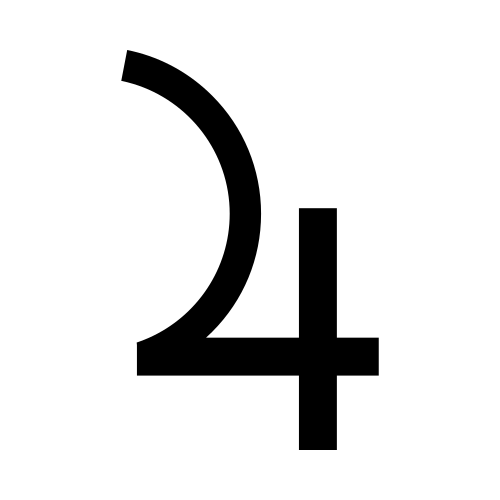 Jupiter
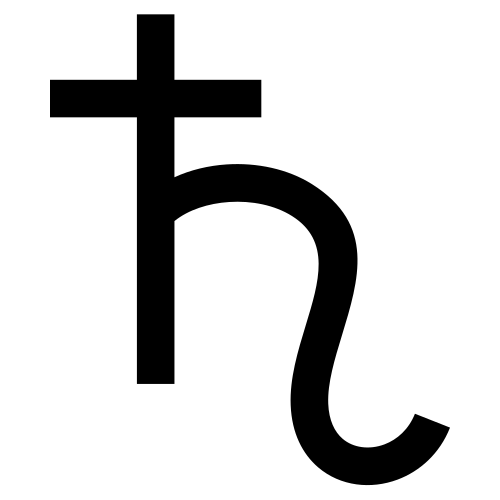 Saturn
 Uranus
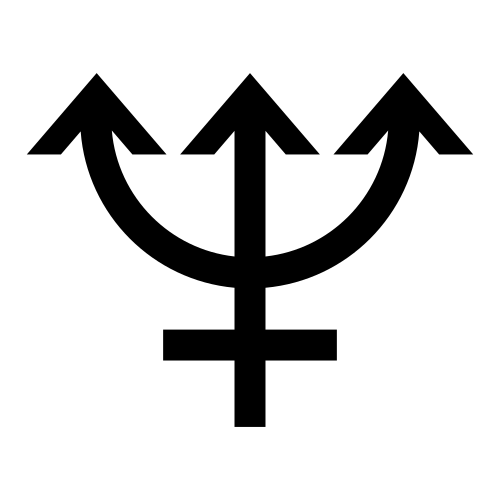 Neptune
 Pluto
Pluto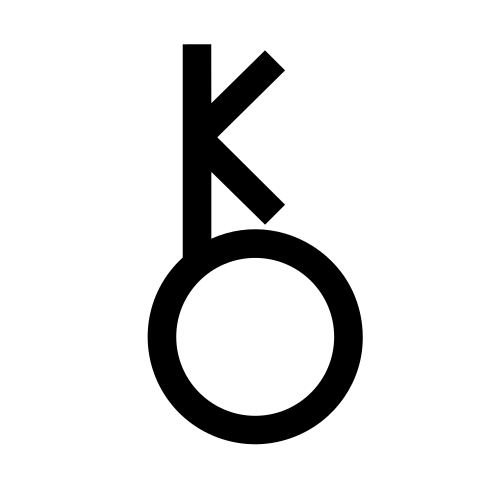 Chiron
Birth time unknown — house positions and Ascendant/MC are not available.
Astronomical context
Pluto crossed Cancer from 1914 to 1939. In astrological tradition this transit is linked to the transformation of home, family, nation, and the sense of belonging — the generation whose lives were marked by the World Wars and a profound redefinition of the nation and the home.
Sugar Ray Robinson (born 1921) belongs to this generational configuration. Astrian groups profiles by such shared signatures rather than by any claim of shared destiny. Related profiles in Astrian: Rocky Marciano · Joe Frazier · George Foreman. The symbolic reading is correlative, not causal.
Other profiles from this Pluto in Cancer generation
Symbolic reading
The following describes what classical astrological tradition associates with these configurations. Astrian does not apply these descriptions to the person's biography.
The Sun in Taurus is the most prominent structural feature available without a birth time, centring the chart on stability, persistence, and the tangible. There is no Ascendant or Midheaven to anchor the angles, so the reading rests on sign placements and the aspects between planets rather than on houses.
Among the personal planets, the Moon in Pisces is associated in tradition with imagination, dissolution, and empathy (the Moon's sign is given for the noon chart and may shift with an exact time); Mercury in Taurus with stability, persistence, and the tangible; Venus in Aries with initiative, directness, and the will to begin; and Mars in Taurus with stability, persistence, and the tangible. These placements describe registers of feeling, thought, attraction, and action as the tradition catalogues them, independent of the life that follows.
Jupiter opposite Uranus (0°01'): tradition reads expansion and meaning set in polarity with disruption and innovation.
Sun square Neptune (1°40'): tradition reads identity and central purpose in friction with dissolution, imagination, and idealism.
Jupiter sextile Pluto (1°47'): tradition reads expansion and meaning in supportive contact with depth, power, and transformation.
Uranus trine Pluto (1°47'): tradition reads disruption and innovation in easy flow with depth, power, and transformation.
These placements are presented as a symbolic portrait, correlative and never causal — a description within the tradition's vocabulary, not an explanation of the life that follows.
Astrology is a symbolic language with 2,500 years of literature. The reading above is interpretive, not explanatory.
Astrian does not claim that the natal chart of Sugar Ray Robinson caused or determined any of the above. Astrology is a symbolic system with 2,500 years of literature. Its capacity for retrospective description does not imply explanatory capacity.
A parallel life
The following are verified biographical facts. No connection to the natal chart is implied.
Walker Smith Jr. was born on May 3, 1921, in Ailey, Georgia, and grew up in Detroit, Michigan, after his family relocated north during his childhood. He began boxing as an amateur using a borrowed identity card belonging to a fighter named Ray Robinson, a name he would carry throughout his career. His amateur record was exceptional, and he turned professional in 1940 under the name Sugar Ray Robinson, a moniker reportedly coined by a sportswriter who described his style as "sweet as sugar."
Robinson compiled a professional record that stood as a benchmark for generations. He went undefeated in his first 40 professional bouts and captured the world welterweight championship in 1946 with a victory over Tommy Bell. His skills combined speed, power, and technical precision in a manner seldom seen at any weight class, earning consistent praise from analysts, fellow fighters, and sports historians.
In 1951, Robinson moved up to the middleweight division and won the world title by defeating Jake LaMotta, their sixth and final meeting. Over the following decade he would win and lose and regain the middleweight championship five times in total, a run of competitive longevity that cemented his reputation. Notable victories came against LaMotta, Carl Olson, Gene Fullmer, and Carmen Basilio, among many others.
Beyond the ring, Robinson was known for traveling with an entourage that included a barber, a valet, and a secretary, projecting an image of style and independence unusual for Black athletes of his era. He was involved in entertainment and business ventures during and after his fighting career, and his influence extended well beyond boxing into broader American culture.
Robinson retired definitively in 1965 after 202 professional bouts, with a record of 173 wins, 19 losses, and 6 draws. He was inducted into the International Boxing Hall of Fame in its inaugural class in 1990. Walker Smith Jr., known to the world as Sugar Ray Robinson, died on April 12, 1989, in Culver City, California, at the age of 67.
Biographical sources
- Hauser, Thomas. "The Black Lights: Inside the World of Professional Boxing." New York: McGraw-Hill, 1986..
- Ortega, Carlos. "Sugar Ray Robinson: The Definitive Biography." London: Robson Books, 2005..
- International Boxing Hall of Fame. "Inductee: Sugar Ray Robinson." Canastota, NY, 1990. https://www.ibhof.com.
- Kram, Mark. "Ghosts of Manila." New York: HarperCollins, 2001..
This profile presents the sky at the birth of Sugar Ray Robinson and verified facts of their biography. Astrian does not claim that astrology has predictive capacity or that the natal chart determines the trajectory of a life. Astrology is a symbolic system with 2,500 years of literature. Its capacity for retrospective description does not imply explanatory capacity.
Calculate your own birth chart with the same NASA JPL DE441 precision.
Calculate my birth chartLast updated: June 14, 2026
Newsletter
A short reading once a month, in your inbox.
A note on the symbolism of the season, recent editorial pieces, and what to look for in next month's sky. No predictions.
Support this project
Independent, no venture funding, no ads. A contribution keeps Astrian precise and free.
Support on Ko-fi (opens in new tab)