Eclipses: what they are, what they move, and how to read the total solar eclipse of 12 August 2026
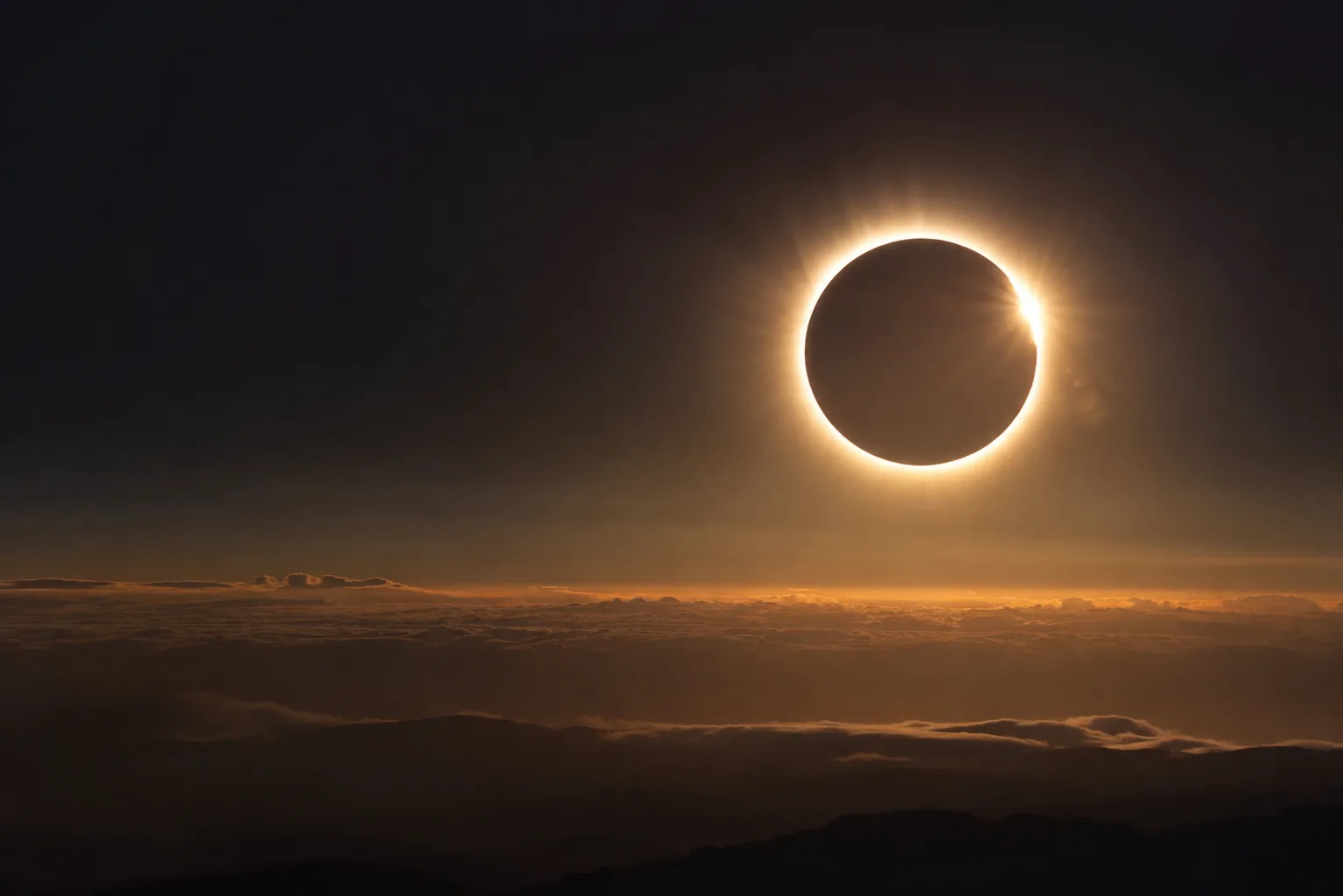
On 12 August 2026, shortly before sunset, the Moon will fully cover the Sun over the north of the Iberian Peninsula. It will be the first total solar eclipse visible from mainland Spain in over a century. An eclipse is, astronomically, a precise alignment of Sun, Moon and Earth; in the astrological tradition, it is read as a threshold — a moment convention associates with endings, revelations and beginnings. This article keeps those two layers clearly apart — the verifiable fact and its symbolic reading — and applies both to this summer's eclipse.
This is a long read, meant to be taken whole or in sections: what an eclipse is, what it symbolises, what being born on one means, and then a detailed reading of the 12 August eclipse by degree, sign, nodal axis, the twelve houses, that day's retrograde planets, and Lilith.
What an eclipse is, astronomically
An eclipse happens when the Moon, Earth and Sun align closely enough for one shadow to fall on another. There are two kinds.
In a solar eclipse, the Moon passes between Earth and the Sun and casts its shadow onto a strip of Earth's surface. It always occurs at the new Moon. When the Moon covers the solar disc entirely, we call it total; when a ring of sun remains, annular; when only part is covered, partial.
In a lunar eclipse, Earth sits between Sun and Moon, and it is Earth's shadow that darkens the Moon. It always occurs at the full Moon.
If there were an eclipse at every new and full Moon, we would have two a month. There aren't, because the Moon's orbit is tilted about 5 degrees to the plane in which Earth circles the Sun. Only when the new or full Moon coincides with one of the two points where those planes cross — the lunar nodes — is the alignment exact enough to produce an eclipse. That is why eclipses arrive in seasons: roughly 35-day windows, twice a year, in which at least two (sometimes three) are inevitable, spaced about a fortnight apart.
The 12 August 2026 eclipse does not travel alone. A partial lunar eclipse follows on 28 August 2026, with close to 96% of the Moon entering Earth's shadow. Both belong to the same eclipse season.
Eclipses also cluster into families called Saros series: each gathers eclipses about 18 years and 11 days apart, of near-identical geometry, drifting slowly across the globe over more than a thousand years. The 12 August eclipse belongs to solar Saros 126, of which it is the 48th of 72.
None of this is symbolic yet. It is celestial mechanics: geometry, shadows and periods calculable centuries ahead. The distinction matters, because almost everything said about eclipses blends this verifiable layer with a very different one.
What an eclipse is, in the astrological tradition
For most of history, eclipses unsettled people. The Sun — source of light, orientation and the measure of time — vanishing in broad daylight was, for nearly every ancient culture, a charged event. Babylonians, Chinese, Greeks and Maya recorded eclipses with remarkable precision, partly to anticipate them and partly because they read them as signs.
Two ideas the tradition keeps come from there.
The first is the lunar nodes. Astronomy defines them as the points where the Moon's orbit crosses the ecliptic. The tradition inherited older names: the north node as the "dragon's head" and the south node as the "dragon's tail," the mythical creature that, in several cultures, swallowed the Sun during an eclipse. In modern astrology the nodal axis is read symbolically as an axis of development: the north node points to what is being learned, the south node to what is already mastered and tends to be released.
The second is the eclipse as accelerator. Where an ordinary transit is associated with gradual processes, an eclipse is associated with thresholds — changes that do not announce themselves slowly. This is an interpretive convention, not a demonstrable claim, but it explains why astrology gives eclipses attention it does not give an ordinary new Moon.
To be clear: that a millennia-old tradition has read eclipses a certain way does not make them the cause of anything. Astrology is not a predictive science, and this article does not present it as one. What follows is symbolism — a vocabulary for thinking, not a forecast of events.
What eclipses "move"
Astronomically, an eclipse moves nothing beyond a shadow. It does not affect the tides any differently from any new or full Moon, does not alter Earth's orbit, and has no physical effect on people. Light withdraws for a few minutes and returns.
Symbolically, the tradition gives eclipses the function of a threshold, and distinguishes two gestures. A solar eclipse occurs at the new Moon: the tradition reads it as a starting point whose symbolism unfolds over the following months. A lunar eclipse occurs at the full Moon: it leans toward revelation, toward something in shadow coming to light.
A second distinction follows the node. North-node eclipses are associated with what is taken on or opened; south-node eclipses with what is released, closed or exhausted. The 12 August 2026 eclipse is a south-node eclipse.
In a non-predictive reading, an eclipse does not announce what will happen: it poses a question about the area of life it touches. That is why the sign — which sets the general tone, the same for everyone — and the house — which particularises the reading in each birth chart — both matter.
The open question: if an eclipse predicts nothing, what is it for? For the same thing a solstice or a change of season is for: a mark in time that invites you to look deliberately at an area of life that, the rest of the year, goes unnoticed.
What being born on an eclipse means
Astronomically, being born during an eclipse has no physical consequence. It means being born at a moment when Sun and Moon were closely aligned near a node. The birth chart records a very exact conjunction or opposition of Sun and Moon, near the nodal axis. It is an astronomical position, not a mark on the person.
Symbolically, the tradition has said very different things, and not all age well. Older texts often treated eclipse births warily, sometimes fatalistically — a reading from a time when the eclipse was, above all, an omen. Contemporary psychological astrology reframed it: someone born with Sun and Moon in tight conjunction has, symbolically, their conscious identity (Sun) and emotional life (Moon) closely fused. That can be read as intensity of purpose or as difficulty separating what one wants from what one feels. Neither is a verdict.
Being born on an eclipse makes no one special or marked. It is a position the tradition interprets in certain ways and which, like the whole chart, works better as a tool for self-knowledge than as a sentence.
The open question: if your chart carries an eclipse's signature, the interesting question is not "what am I fated to," but "where do I struggle to tell what I want from what I feel, and what would change if I looked at them separately?"
The eclipse of 12 August 2026: the facts
| Detail | Value |
|---|---|
| Type | Total solar eclipse (new Moon) |
| Date | Wednesday 12 August 2026 |
| Greatest eclipse | around 17:46 UTC, over the North Atlantic, between Greenland and Iceland |
| Magnitude | 1.0386 |
| Maximum totality | 2 min 18 s (at the point of greatest eclipse) |
| Node | Descending (south node) |
| Saros series | Solar Saros 126 (48 of 72) |
| Path of totality | Arctic, Greenland, western Iceland, North Atlantic, northern Spain, NE Portugal |
| Astrological degree | 20° Leo (tropical) |
In Spain, totality falls in the evening, around 20:27–20:35 local time, with the Sun very low on the western horizon — between about 2° and 12° high depending on location. The path crosses the peninsula diagonally from northwest to southeast, near A Coruña, Oviedo, León, Burgos, Bilbao, Zaragoza, Valencia and the Balearics, with up to nearly 1 minute 50 seconds of totality along the centreline.
It is historically exceptional: the first total solar eclipse visible from mainland Spain since 30 August 1905. It also opens a rare Iberian triad — total on 12 August 2026, total on 2 August 2027, annular on 26 January 2028 — after which no total eclipse is visible from Spain until 2053.
Astrologically it falls at 20° Leo, on the Leo–Aquarius axis, with the south node in Leo.
Local circumstances, town by town
Times in mainland Spanish time (CEST, UTC+2). C1 is first contact, when the Moon touches the solar disc; C2 and C3 mark the start and end of totality. Altitude is the Sun's height above the horizon at maximum.
See the circumstances in all 273 places along the path ▸
| Town | Province | C1 | Totality begins | Maximum | Totality ends | Duration | Sun altitude |
|---|---|---|---|---|---|---|---|
| Coaña | Asturias | 1 min 50 s | 11° | ||||
| Navia | Asturias | 1 min 50 s | 11° | ||||
| Valdés | Asturias | 1 min 50 s | 11° | ||||
| Belmonte de Miranda | Asturias | 1 min 49 s | 10° | ||||
| Candamo | Asturias | 1 min 49 s | 10° | ||||
| Cudillero | Asturias | 1 min 49 s | 11° | ||||
| El Franco | Asturias | 1 min 49 s | 11° | ||||
| Grado | Asturias | 1 min 49 s | 10° | ||||
| Las Regueras | Asturias | 1 min 49 s | 10° | ||||
| Lena | Asturias | 1 min 49 s | 10° | ||||
| Mieres | Asturias | 1 min 49 s | 10° | ||||
| Morcín | Asturias | 1 min 49 s | 10° | ||||
| Pravia | Asturias | 1 min 49 s | 10° | ||||
| Proaza | Asturias | 1 min 49 s | 10° | ||||
| Quirós | Asturias | 1 min 49 s | 10° | ||||
| Ribera de Arriba | Asturias | 1 min 49 s | 10° | ||||
| Riosa | Asturias | 1 min 49 s | 10° | ||||
| Salas | Asturias | 1 min 49 s | 10° | ||||
| Santo Adriano | Asturias | 1 min 49 s | 10° | ||||
| Tapia de Casariego | Asturias | 1 min 49 s | 11° | ||||
| Tineo | Asturias | 1 min 49 s | 11° | ||||
| Villayón | Asturias | 1 min 49 s | 11° | ||||
| Yernes y Tameza | Asturias | 1 min 49 s | 10° | ||||
| Aller | Asturias | 1 min 48 s | 10° | ||||
| Boal | Asturias | 1 min 48 s | 11° | ||||
| Boñar | León | 1 min 48 s | 10° | ||||
| Burela | Lugo | 1 min 48 s | 11° | ||||
| Cármenes | León | 1 min 48 s | 10° | ||||
| Castrillón | Asturias | 1 min 48 s | 10° | ||||
| Castropol | Asturias | 1 min 48 s | 11° | ||||
| Cebanico | León | 1 min 48 s | 9° | ||||
| Cistierna | León | 1 min 48 s | 9° | ||||
| Illas | Asturias | 1 min 48 s | 10° | ||||
| La Ercina | León | 1 min 48 s | 9° | ||||
| La Vecilla | León | 1 min 48 s | 10° | ||||
| Langreo | Asturias | 1 min 48 s | 10° | ||||
| Laviana | Asturias | 1 min 48 s | 10° | ||||
| Llanera | Asturias | 1 min 48 s | 10° | ||||
| Matallana de Torío | León | 1 min 48 s | 10° | ||||
| Muros de Nalón | Asturias | 1 min 48 s | 10° | ||||
| Oviedo | Asturias | 1 min 48 s | 10° | ||||
| Puebla de Lillo | León | 1 min 48 s | 10° | ||||
| Reyero | León | 1 min 48 s | 10° | ||||
| Ribadeo | Lugo | 1 min 48 s | 11° | ||||
| Sabero | León | 1 min 48 s | 9° | ||||
| San Martín del Rey Aurelio | Asturias | 1 min 48 s | 10° | ||||
| Somiedo | Asturias | 1 min 48 s | 10° | ||||
| Soto del Barco | Asturias | 1 min 48 s | 10° | ||||
| Teverga | Asturias | 1 min 48 s | 10° | ||||
| Valdelugueros | León | 1 min 48 s | 10° | ||||
| Valdepiélago | León | 1 min 48 s | 10° | ||||
| Vegacervera | León | 1 min 48 s | 10° | ||||
| Vegaquemada | León | 1 min 48 s | 10° | ||||
| Villamanín | León | 1 min 48 s | 10° | ||||
| Abia de las Torres | Palencia | 1 min 47 s | 9° | ||||
| Acebedo | León | 1 min 47 s | 10° | ||||
| Almanza | León | 1 min 47 s | 9° | ||||
| Avilés | Asturias | 1 min 47 s | 10° | ||||
| Ayuela | Palencia | 1 min 47 s | 9° | ||||
| Bárcena de Campos | Palencia | 1 min 47 s | 9° | ||||
| Barreiros | Lugo | 1 min 47 s | 11° | ||||
| Bimenes | Asturias | 1 min 47 s | 10° | ||||
| Buenavista de Valdavia | Palencia | 1 min 47 s | 9° | ||||
| Bustillo de la Vega | Palencia | 1 min 47 s | 9° | ||||
| Caso | Asturias | 1 min 47 s | 10° | ||||
| Castrillo de Villavega | Palencia | 1 min 47 s | 9° | ||||
| Cervo | Lugo | 1 min 47 s | 11° | ||||
| Congosto de Valdavia | Palencia | 1 min 47 s | 9° | ||||
| Corvera de Asturias | Asturias | 1 min 47 s | 10° | ||||
| Crémenes | León | 1 min 47 s | 9° | ||||
| Cubillas de Rueda | León | 1 min 47 s | 9° | ||||
| Foz | Lugo | 1 min 47 s | 11° | ||||
| Fresno del Río | Palencia | 1 min 47 s | 9° | ||||
| Garrafe de Torío | León | 1 min 47 s | 10° | ||||
| Gradefes | León | 1 min 47 s | 9° | ||||
| Guardo | Palencia | 1 min 47 s | 9° | ||||
| Illano | Asturias | 1 min 47 s | 11° | ||||
| La Pola de Gordón | León | 1 min 47 s | 10° | ||||
| La Robla | León | 1 min 47 s | 10° | ||||
| Mantinos | Palencia | 1 min 47 s | 9° | ||||
| Maraña | León | 1 min 47 s | 10° | ||||
| Noreña | Asturias | 1 min 47 s | 10° | ||||
| Pedrosa de la Vega | Palencia | 1 min 47 s | 9° | ||||
| Pino del Río | Palencia | 1 min 47 s | 9° | ||||
| Poza de la Vega | Palencia | 1 min 47 s | 9° | ||||
| Prado de la Guzpeña | León | 1 min 47 s | 9° | ||||
| Prioro | León | 1 min 47 s | 9° | ||||
| Riaño | León | 1 min 47 s | 9° | ||||
| Saldaña | Palencia | 1 min 47 s | 9° | ||||
| San Emiliano | León | 1 min 47 s | 10° | ||||
| Santa Colomba de Curueño | León | 1 min 47 s | 10° | ||||
| Sena de Luna | León | 1 min 47 s | 10° | ||||
| Siero | Asturias | 1 min 47 s | 10° | ||||
| Sobrescobio | Asturias | 1 min 47 s | 10° | ||||
| Valderrueda | León | 1 min 47 s | 9° | ||||
| Vegadeo | Asturias | 1 min 47 s | 11° | ||||
| Vegas del Condado | León | 1 min 47 s | 10° | ||||
| Villamartín de Don Sancho | León | 1 min 47 s | 9° | ||||
| Villaselán | León | 1 min 47 s | 9° | ||||
| Villazanzo de Valderaduey | León | 1 min 47 s | 9° | ||||
| Xove | Lugo | 1 min 47 s | 11° | ||||
| Gijón | Asturias | 1 min 46 s | 10° | ||||
| Viveiro | Lugo | 1 min 46 s | 12° | ||||
| Almazán | Soria | 1 min 44 s | 7° | ||||
| Burgo de Osma-Ciudad de Osma | Soria | 1 min 44 s | 7° | ||||
| Burgos | Burgos | 1 min 44 s | 8° | ||||
| León | León | 1 min 44 s | 10° | ||||
| San Andrés del Rabanedo | León | 1 min 44 s | 10° | ||||
| Aguilar de Campoo | Palencia | 1 min 43 s | 9° | ||||
| Aranda de Duero | Burgos | 1 min 42 s | 8° | ||||
| Calamocha | Teruel | 1 min 42 s | 6° | ||||
| Palencia | Palencia | 1 min 42 s | 9° | ||||
| Soria | Soria | 1 min 42 s | 7° | ||||
| Calatayud | Zaragoza | 1 min 41 s | 6° | ||||
| Venta de Baños | Palencia | 1 min 41 s | 9° | ||||
| Benicarló | Castelló/Castellón | 1 min 39 s | 4° | ||||
| Andorra | Teruel | 1 min 37 s | 5° | ||||
| Ólvega | Soria | 1 min 37 s | 7° | ||||
| Briviesca | Burgos | 1 min 36 s | 8° | ||||
| Calanda | Teruel | 1 min 36 s | 5° | ||||
| Palma | Illes Balears | 1 min 36 s | 2° | ||||
| Ágreda | Soria | 1 min 34 s | 7° | ||||
| Castelló de la Plana/Castellón de la Plana | Castelló/Castellón | 1 min 34 s | 4° | ||||
| Inca | Illes Balears | 1 min 34 s | 2° | ||||
| Manacor | Illes Balears | 1 min 34 s | 2° | ||||
| Teruel | Teruel | 1 min 34 s | 5° | ||||
| Alcañiz | Teruel | 1 min 33 s | 5° | ||||
| Astorga | León | 1 min 33 s | 10° | ||||
| Narón | A Coruña | 1 min 33 s | 12° | ||||
| La Bañeza | León | 1 min 31 s | 10° | ||||
| Tortosa | Tarragona | 1 min 31 s | 4° | ||||
| Vila-real | Castelló/Castellón | 1 min 31 s | 4° | ||||
| Borriana/Burriana | Castelló/Castellón | 1 min 30 s | 4° | ||||
| Ferrol | A Coruña | 1 min 29 s | 12° | ||||
| Cuarte de Huerva | Zaragoza | 1 min 28 s | 6° | ||||
| Valladolid | Valladolid | 1 min 27 s | 9° | ||||
| Cistérniga | Valladolid | 1 min 26 s | 8° | ||||
| Haro | La Rioja | 1 min 26 s | 8° | ||||
| Arnedo | La Rioja | 1 min 25 s | 7° | ||||
| Cantalejo | Segovia | 1 min 25 s | 8° | ||||
| Cintruénigo | Navarra | 1 min 25 s | 7° | ||||
| la Vall d'Uixó | Castelló/Castellón | 1 min 25 s | 4° | ||||
| Arroyo de la Encomienda | Valladolid | 1 min 24 s | 9° | ||||
| Lardero | La Rioja | 1 min 24 s | 7° | ||||
| Miranda de Ebro | Burgos | 1 min 24 s | 8° | ||||
| Ponferrada | León | 1 min 24 s | 10° | ||||
| Utebo | Zaragoza | 1 min 24 s | 6° | ||||
| Zaragoza | Zaragoza | 1 min 24 s | 6° | ||||
| Corella | Navarra | 1 min 23 s | 7° | ||||
| Laguna de Duero | Valladolid | 1 min 23 s | 9° | ||||
| Lugo | Lugo | 1 min 23 s | 11° | ||||
| Benavente | Zamora | 1 min 22 s | 9° | ||||
| Cuéllar | Segovia | 1 min 22 s | 8° | ||||
| Medina de Pomar | Burgos | 1 min 22 s | 8° | ||||
| Logroño | La Rioja | 1 min 21 s | 7° | ||||
| Tudela | Navarra | 1 min 21 s | 7° | ||||
| Torrelavega | Cantabria | 1 min 20 s | 9° | ||||
| Calahorra | La Rioja | 1 min 17 s | 7° | ||||
| Oyón-Oion | Araba/Álava | 1 min 17 s | 7° | ||||
| A Coruña | A Coruña | 1 min 16 s | 12° | ||||
| Sarria | Lugo | 1 min 12 s | 11° | ||||
| Rubiá | Ourense | 1 min 11 s | 10° | ||||
| Camargo | Cantabria | 1 min 9 s | 9° | ||||
| El Astillero | Cantabria | 1 min 9 s | 9° | ||||
| Maó | Illes Balears | 1 min 9 s | 2° | ||||
| Marchamalo | Guadalajara | 1 min 9 s | 7° | ||||
| Salou | Tarragona | 1 min 7 s | 4° | ||||
| Guadalajara | Guadalajara | 1 min 6 s | 7° | ||||
| Arteixo | A Coruña | 1 min 5 s | 12° | ||||
| Fraga | Huesca | 1 min 5 s | 5° | ||||
| Landete | Cuenca | 1 min 5 s | 5° | ||||
| Eivissa | Illes Balears | 1 min 4 s | 3° | ||||
| Ejea de los Caballeros | Zaragoza | 1 min 4 s | 6° | ||||
| Vitoria-Gasteiz | Araba/Álava | 1 min 4 s | 8° | ||||
| Cabanillas del Campo | Guadalajara | 1 min 3 s | 7° | ||||
| Santander | Cantabria | 1 min 3 s | 9° | ||||
| Burjassot | València/Valencia | 1 min 2 s | 4° | ||||
| O Barco de Valdeorras | Ourense | 1 min 2 s | 11° | ||||
| Reus | Tarragona | 1 min 2 s | 4° | ||||
| Paterna | València/Valencia | 1 min 1 s | 4° | ||||
| Amurrio | Araba/Álava | 1 min 0 s | 8° | ||||
| La Lastrilla | Segovia | 1 min 0 s | 8° | ||||
| Tarragona | Tarragona | 1 min 0 s | 4° | ||||
| Alovera | Guadalajara | 59 s | 7° | ||||
| València | València/Valencia | 59 s | 4° | ||||
| Mislata | València/Valencia | 58 s | 4° | ||||
| Medina del Campo | Valladolid | 57 s | 9° | ||||
| Segovia | Segovia | 56 s | 8° | ||||
| Sariñena | Huesca | 55 s | 5° | ||||
| A Rúa | Ourense | 54 s | 11° | ||||
| Azuqueca de Henares | Guadalajara | 54 s | 7° | ||||
| Cuenca | Cuenca | 53 s | 6° | ||||
| Agurain/Salvatierra | Araba/Álava | 51 s | 8° | ||||
| Estella-Lizarra | Navarra | 51 s | 7° | ||||
| Laudio/Llodio | Araba/Álava | 51 s | 8° | ||||
| Real Sitio de San Ildefonso | Segovia | 50 s | 8° | ||||
| Tafalla | Navarra | 50 s | 7° | ||||
| Zaidín | Huesca | 49 s | 5° | ||||
| Torrent | València/Valencia | 47 s | 4° | ||||
| Carballo | A Coruña | 45 s | 12° | ||||
| Toro | Zamora | 44 s | 9° | ||||
| Almudévar | Huesca | 42 s | 6° | ||||
| Alcarràs | Lleida | 41 s | 5° | ||||
| Castro-Urdiales | Cantabria | 41 s | 8° | ||||
| Monforte de Lemos | Lugo | 41 s | 11° | ||||
| Colmenar Viejo | Madrid | 40 s | 7° | ||||
| Eskoriatza | Gipuzkoa | 40 s | 8° | ||||
| Alcalá de Henares | Madrid | 39 s | 7° | ||||
| Arcas | Cuenca | 38 s | 6° | ||||
| El Vendrell | Tarragona | 38 s | 4° | ||||
| Huete | Cuenca | 38 s | 6° | ||||
| Palacios de Goda | Ávila | 38 s | 8° | ||||
| San Sebastián de los Reyes | Madrid | 36 s | 7° | ||||
| Agolada | Pontevedra | 35 s | 11° | ||||
| Barakaldo | Bizkaia | 35 s | 8° | ||||
| Aretxabaleta | Gipuzkoa | 33 s | 8° | ||||
| les Borges Blanques | Lleida | 32 s | 5° | ||||
| Villar de Olalla | Cuenca | 32 s | 6° | ||||
| Arévalo | Ávila | 28 s | 8° | ||||
| Bilbao | Bizkaia | 28 s | 8° | ||||
| Lleida | Lleida | 28 s | 5° | ||||
| Portugalete | Bizkaia | 28 s | 8° | ||||
| Santurtzi | Bizkaia | 28 s | 8° | ||||
| Oñati | Gipuzkoa | 27 s | 8° | ||||
| Torrejón de Ardoz | Madrid | 26 s | 7° | ||||
| Villaralbo | Zamora | 26 s | 9° | ||||
| A Pobra de Trives | Ourense | 25 s | 11° | ||||
| Binaced | Huesca | 24 s | 5° | ||||
| Cubelles | Barcelona | 24 s | 4° | ||||
| Alcobendas | Madrid | 23 s | 7° | ||||
| Arrasate/Mondragón | Gipuzkoa | 23 s | 8° | ||||
| Alpicat | Lleida | 22 s | 5° | ||||
| Sinlabajos | Ávila | 20 s | 8° | ||||
| Castro Caldelas | Ourense | 19 s | 11° | ||||
| Zamora | Zamora | 16 s | 9° | ||||
| Almacelles | Lleida | 15 s | 5° | ||||
| Getxo | Bizkaia | 15 s | 8° | ||||
| Moraleja del Vino | Zamora | 15 s | 9° | ||||
| Aldeaseca | Ávila | 13 s | 8° | ||||
| Vilanova i la Geltrú | Barcelona | 11 s | 4° | ||||
| Adanero | Ávila | 10 s | 8° | ||||
| Rodeiro | Pontevedra | 10 s | 11° | ||||
| Castellet i la Gornal | Barcelona | 9 s | 4° | ||||
| Legazpi | Gipuzkoa | 6 s | 8° | ||||
| Huesca | Huesca | — | — | Partial, 99.9% of the Sun’s diameter | 6° | ||
| Madrid | Madrid | — | — | Partial, 99.9% of the Sun’s diameter | 7° | ||
| Pamplona/Iruña | Navarra | — | — | Partial, 99.9% of the Sun’s diameter | 7° | ||
| Ávila | Ávila | — | — | Partial, 99.8% of the Sun’s diameter | 8° | ||
| Barcelona | Barcelona | — | — | Partial, 99.8% of the Sun’s diameter | 4° | ||
| Ourense | Ourense | — | — | Partial, 99.8% of the Sun’s diameter | 11° | ||
| Donostia/San Sebastián | Gipuzkoa | — | — | Partial, 99.7% of the Sun’s diameter | 8° | ||
| Pontevedra | Pontevedra | — | — | Partial, 99.6% of the Sun’s diameter | 12° | ||
| Salamanca | Salamanca | — | — | Partial, 99.6% of the Sun’s diameter | 9° | ||
| Albacete | Albacete | — | — | Partial, 99.3% of the Sun’s diameter | 5° | ||
| Toledo | Toledo | — | — | Partial, 99.3% of the Sun’s diameter | 7° | ||
| Alacant/Alicante | Alacant/Alicante | — | — | Partial, 99.1% of the Sun’s diameter | 4° | ||
| Girona | Girona | — | — | Partial, 98.9% of the Sun’s diameter | 4° | ||
| Ciudad Real | Ciudad Real | — | — | Partial, 98.2% of the Sun’s diameter | 7° | ||
| Murcia | Murcia | — | — | Partial, 98.2% of the Sun’s diameter | 4° | ||
| Cáceres | Cáceres | — | — | Partial, 97.4% of the Sun’s diameter | 9° | ||
| Jaén | Jaén | — | — | Partial, 96.5% of the Sun’s diameter | 6° | ||
| Badajoz | Badajoz | — | — | Partial, 96.1% of the Sun’s diameter | 9° | ||
| Córdoba | Córdoba | — | — | Partial, 96.1% of the Sun’s diameter | 7° | ||
| Almería | Almería | — | — | Partial, 95.8% of the Sun’s diameter | 4° | ||
| Granada | Granada | — | — | Partial, 95.7% of the Sun’s diameter | 5° | ||
| Málaga | Málaga | — | — | Partial, 94.5% of the Sun’s diameter | 6° | ||
| Sevilla | Sevilla | — | — | Partial, 94.5% of the Sun’s diameter | 7° | ||
| Huelva | Huelva | — | — | Partial, 93.7% of the Sun’s diameter | 8° | ||
| Cádiz | Cádiz | — | — | Partial, 92.9% of the Sun’s diameter | 7° | ||
| Melilla | Melilla | — | — | Partial, 92.9% of the Sun’s diameter | 4° | ||
| Ceuta | Ceuta | — | — | Partial, 92.5% of the Sun’s diameter | 6° | ||
| Las Palmas de Gran Canaria | Las Palmas | — | — | Partial, 69.7% of the Sun’s diameter | 10° | ||
| Santa Cruz de Tenerife | Santa Cruz de Tenerife | — | — | Partial, 69.7% of the Sun’s diameter | 11° |
273 towns: every provincial capital, the hundred longest totalities, and the most populated municipalities of each province the path crosses. Computed by us from NASA JPL DE441 (Celesta) · elementos besselianos canónicos.
The eclipse in Leo: light withdrawing from the centre
The Sun rules Leo. A total solar eclipse in Leo therefore carries a symbolic irony: light withdraws from the very sign the tradition associates with light, the centre and visibility.
Leo is fixed fire. Its symbolism turns on expressive identity — the wish to be seen, authorship, leadership, play, creativity. It makes no one a type; it marks a vital question about the permission to occupy the centre. An eclipse here offers an image hard to ignore: the spotlight goes out on stage. The tradition reads it as an invitation to ask what remains when attention withdraws.
The full axis is Leo–Aquarius. With the south node in Leo and the north node in Aquarius, the tradition sets individual brilliance (Leo) against the collective (Aquarius). A south-node eclipse in Leo reads as a moment that presses one to release a certain form of prominence and turn toward what is shared. A theme, not an order.
The eclipse in symbolic astrology
This section deliberately enters the symbolic layer — the oldest and richest — without abandoning the fact/symbol distinction: nothing here predicts events.
The image: conscious light, covered. In symbolic astrology the Sun is the conscious centre — identity, will; the Moon is the instinctual and emotional. In a solar eclipse the Moon covers the Sun: the instinctual covers the conscious. Read archetypally, close to how Carl Jung would frame it, the image is of the conscious self briefly eclipsed by something older. Not a catastrophe: an interruption in which something may reorder itself while the usual light isn't looking.
Leo: the heart, the sun, the sovereign. Three symbols overlap. The heart: traditional medical astrology gives Leo and the Sun rulership of the heart, the organ at the centre. The sovereign: Leo is the sign of royalty and authorship, and the spotlight going out on whoever stands at the centre echoes the archetype of the king and his vulnerability. Individuation: in Jungian terms the Sun is the Self, the centre toward which becoming-who-one-is tends. The eclipse asks where legitimate self-expression ends and the need to be watched begins.
The dragon's tail: what is released. As a south-node eclipse — the dragon's tail — the tradition associates it with what is already mastered and asks to be let go. In Leo, it points to loosening dependence on recognition as the measure of one's worth.
The axis: the hero and the network. Leo–Aquarius draws the axis of individual against collective: the hero against the network, the sovereign against the republic. The eclipse proposes a shift from "how do I stand out?" toward "what do we belong to?"
Regulus: the echo of falling kings. The tradition ties Leo to Regulus, the royal star of power and its fall. Astronomical honesty: through precession, Regulus is no longer at 20° Leo but around 0° Virgo, some ten degrees from the eclipse. The symbolic motif belongs to the sign; the star itself has moved. Better to hold the symbol than to fake a conjunction that isn't there.
The open question: when the spotlight goes out — on a role, an image, a way of standing out — what in me keeps beating with no one watching?
The sky that day
An eclipse is not read in isolation but with its company.
- A south-node eclipse in Leo: less about fresh initiative, more about releasing patterns that have run their course.
- The Sun as dispositor, in domicile: the eclipse's ruler is the Sun itself, in Leo. The focus doesn't scatter — it reinforces the question of identity.
- Mercury conjunct the eclipse, and direct: often assumed otherwise, Mercury is not retrograde on 12 August (its summer retrograde ended 23 July). It is associated with the word and the story around the threshold. Its opposition to Pluto adds the note of conversation touching what is deep.
- Jupiter in Leo, direct, since 30 June 2026: it widens the sign's tone — recognition, generosity — with the flip side of excess.
- A single major aspect: a trine to Saturn in Aries, retrograde: Saturn is in fall in Aries. The trine is a flowing aspect; the reading pairs the withdrawal of light with an easy — perhaps too easy — relation to structure and authority.
- An air grand trine, with a kite: Venus in Libra, Uranus in Gemini and Pluto in Aquarius form a grand trine; Mercury, from Leo, opposes Pluto and closes it into a kite. A backdrop of ideas, communication and power around the eclipse.
The eclipse through the twelve houses
The sign sets the tone; the house where 20° Leo falls in each chart particularises it. As a south-node eclipse, the tone is less "begin" than "recognise what is ready to be released."
House 1 — identity and presence. What part of how I show up no longer represents me? House 2 — resources and self-worth. Where do I confuse what I have with what I'm worth? House 3 — the everyday mind and near surroundings. What conversation have I long avoided, or repeated with no way out? House 4 — home and roots. What of my family history do I keep out of habit rather than choice? House 5 — creativity and self-expression. The most Leonine ground: where do I seek applause, and what would I create if it didn't depend on being watched? House 6 — daily work and health. Which habit truly sustains me, and which only keeps me busy? House 7 — bonds and pacts. What agreement — spoken or unspoken — asks to be revisited? House 8 — the shared and the deep. What have I kept silent about what is "ours" and not only "mine"? House 9 — meaning and horizon. What idea about the world have I stopped examining? House 10 — vocation and public role. Especially sharp here: what part of my identity depends on the title or the status? House 11 — community and future. The Aquarian pole: toward what "we" do I want to shift the energy I spend standing out alone? House 12 — inner life and closure. What do I need to release quietly, with no audience, before beginning again?
The retrograde planets of 12 August 2026
Astronomically, no planet moves backward. Retrograde motion is a matter of perspective: as Earth overtakes a planet, it appears to slip backward against the stars, the way a slower car seems to move back as you pass it. It is parallax. The Sun and Moon never retrograde. Symbolically, the tradition associates these periods with review and turning inward.
Exact positions on 12 August 2026:
| Body | State | Sign | Retrograde since |
|---|---|---|---|
| Saturn | Retrograde | Aries | 26 July 2026 |
| Neptune | Retrograde | Aries | 7 July 2026 |
| Pluto | Retrograde | Aquarius | 6 May 2026 |
| Chiron | Retrograde | Aries | 3 August 2026 |
| Mercury | Direct | Leo | — |
| Venus | Direct | Libra | — |
| Mars | Direct | Gemini | — (no retrograde in 2026) |
| Jupiter | Direct | Leo | — |
| Uranus | Direct | Gemini | — |
Four bodies retrograde, five direct. Two observations. First, the Aries retrograde cluster: Saturn, Neptune and Chiron review that ground together; Saturn and Neptune met in exact conjunction at 0° Aries earlier in 2026, and Aries is the very sign the eclipse trines. Second, Pluto retrograde in Aquarius, which closes the air grand trine and receives Mercury's opposition — a review of power dynamics at scale. Against this slow, inward backdrop, the fast planets run direct.
The open question: with four slow bodies "reviewing" and the fast ones moving, what is worth pausing rather than launching, and what is genuinely ready to go forward?
The signs: the fixed axis
Leo belongs to the fixed cross of the zodiac, with Taurus, Scorpio and Aquarius. Fixed signs share a gesture: to hold, consolidate, resist change. An eclipse in a fixed sign stirs something long settled.
The direct axis is Leo–Aquarius: the individual brilliance the tradition invites you to release (Leo, south node) against the collective it points toward (Aquarius, north node). Taurus and Scorpio receive the eclipse by square: themes of security and possession (Taurus) or intimacy and transformation (Scorpio) can surface as they meet the Leonine question of identity.
For anyone with important planets or points near 20° of Leo, Aquarius, Taurus or Scorpio, the eclipse axis falls closer to the chart. Not a mark of fortune or misfortune — the ground where the reflection resonates most.
Lilith in the eclipse
There are several "Liliths" in astrology. The most used is Black Moon Lilith, not a physical body but a mathematical point: the apogee of the Moon's orbit. Symbolically it is associated with what is repressed, the instinctual that doesn't fit expectation.
On 12 August 2026, mean Black Moon Lilith is in Sagittarius, the same fire element as the Leo eclipse, forming a wide trine to the eclipse degree. In Sagittarius it points to the untamed in the realm of belief, freedom and meaning. A technical caveat: mean and true (osculating) Black Moon Lilith can differ by several degrees, sometimes by sign, so an exact aspect should be checked in the individual chart. Here it serves best as a question: what part of me — the part that seeks neither applause nor permission — asks for room now?
How to watch the eclipse from Spain
Totality falls with the Sun very low on the western horizon, around 20:30 local time. You need a clear horizon toward the west-northwest. The warning is non-negotiable: never look at the Sun without certified protection (ISO 12312-2 glasses), not even during the partial phases, and not through a camera, binoculars or telescope without a solar filter. The only moment you may look with the naked eye is full totality, and only while it lasts.
For technical planning and photography — local times, Sun altitude, how to protect a phone or camera — see the eclipse observation and photography guide.
Frequently asked questions
Does an eclipse cause bad things? Not in any demonstrable sense. Astronomically it is a passing shadow with no physical effect on people. The tradition reads it as a symbolic threshold, not a cause of events.
What degree and sign is the 12 August 2026 eclipse? 20° Leo (tropical), on the Leo–Aquarius axis, at the south node. Greatest eclipse is around 17:46 UTC.
Is it a north-node or south-node eclipse? South node, in Leo — associated with releasing familiar patterns.
Is Mercury retrograde during the eclipse? No. It is direct, in Leo, beside the eclipse. The retrograde bodies that day are Saturn, Neptune, Pluto and Chiron.
What does being born on an eclipse mean? Astronomically, being born with Sun and Moon closely aligned near a node. Symbolically, psychological astrology reads it as a closely fused conscious identity and emotional life — a question for self-knowledge, not a destiny.
Who does this eclipse affect most? Symbolically, those with planets or points near 20° of the fixed signs — Leo, Aquarius, Taurus, Scorpio. The house 20° Leo falls in personalises it.
Why is it historic for Spain? It is the first total solar eclipse visible from mainland Spain since 1905, opening a unique Iberian triad from 2026 to 2028.
Does this eclipse predict specific events? No. Nor does any other. It offers an area of life to reflect on; it announces no events.
The takeaway
On 12 August 2026, a total solar eclipse at 20° Leo withdraws light from the sign of prominence, with the south node inviting release, the mind wide awake, and a backdrop of weakened structure and power under review. Over northern Spain it is, besides, an astronomical event unrepeatable for over a century.
The two layers coexist without merging. The astronomical is calculated. The symbolic is interpreted, and its value lies not in guessing what will happen but in choosing what to look at. A Leo eclipse asks about the place where we seek to be seen. The sky does not give the answer.
To see which house 20° Leo falls in on your chart, calculate your full birth chart.
Astronomical data computed with precision ephemerides (NASA JPL DE441 base) and cross-checked against reference astronomical sources. Last updated: 25 July 2026. Astrology is an interpretive tradition, not a science; this article distinguishes throughout between the verifiable astronomical fact and its symbolic reading.
Continue reading
Newsletter
A short reading once a month, in your inbox.
A note on the symbolism of the season, recent editorial pieces, and what to look for in next month's sky. No predictions.
Support this project
Independent, no venture funding, no ads. A contribution keeps Astrian precise and free.
Support on Ko-fi (opens in new tab)