PROFILE · SCIENCE & TECHNOLOGY
John von Neumann
mathematician
Born 28 December 1903 · Budapest, Austria-Hungary · 47.50° N, 19.04° EX
Source: Birth time not documented in publicly accessible records
About this chart
No birth time is documented for this person. The chart therefore shows planetary positions in their signs, the slow aspects between them, and the generational context — but not house placements, the Ascendant, or the Midheaven, which require an accurate birth time. The Moon's sign carries a ±6° margin: if it falls near a sign boundary, the sign could vary. Positions for all other planets are reliable.
Do you have a verified source for this birth time? Share it →
The sky at birth
No birth time is documented for John von Neumann. The Ascendant, the Midheaven, and the house positions cannot be determined; the reading is confined to planetary sign placements and the aspects between planets. The positions below are calculated for noon local time and are accurate to a fraction of a degree for the slow-moving bodies.
The Moon is near 20°59' Aries (noon position, ±7° margin). Sun is at 5°32' Capricorn. Mercury is at 24°26' Capricorn. Venus is at 21°04' Scorpio. Mars is at 12°33' Aquarius. Jupiter is at 17°13' Pisces. Saturn is at 7°37' Aquarius. Uranus is at 26°23' Sagittarius. Neptune is at 4°31' Cancer, retrograde. Pluto is at 19°23' Gemini, retrograde.
The tightest major aspects between planets: Sun opposite Neptune (1°02'); Moon sextile Pluto (1°36'); Jupiter square Pluto (2°10'); Mercury sextile Venus (3°22'); Moon square Mercury (3°27'); Venus trine Jupiter (3°51').
Uranus opposite Pluto (6°59') is structural but generational — an alignment of slow-moving outer planets shared across many birth years.
The engine also registers tight minor aspects involving asteroids and calculated points: Uranus quincunx Vesta (0°05'); Mercury sextile Ceres (0°08'); Lilith sesquiquadrate North Node (0°23'); Jupiter semi-sextile Lilith (0°35'). These are reported for completeness and carry less weight in traditional reading.
The chart was calculated using NASA JPL DE441 ephemerides, sub-arcsecond precision.
| Planet | Sign | Position |
|---|---|---|
| Sun | Capricorn | 05°32' |
| Moon | Aries | 20°59'±6° |
| Mercury | Capricorn | 24°26' |
| Venus | Scorpio | 21°04' |
| Mars | Aquarius | 12°33' |
| Jupiter | Pisces | 17°13' |
| Saturn | Aquarius | 07°37' |
| Uranus | Sagittarius | 26°23' |
| Neptune | Cancer | 04°31'retrograde |
| Pluto | Gemini | 19°23'retrograde |
| Chiron | Capricorn | 22°07' |
 Sun
Sun Moon
Moon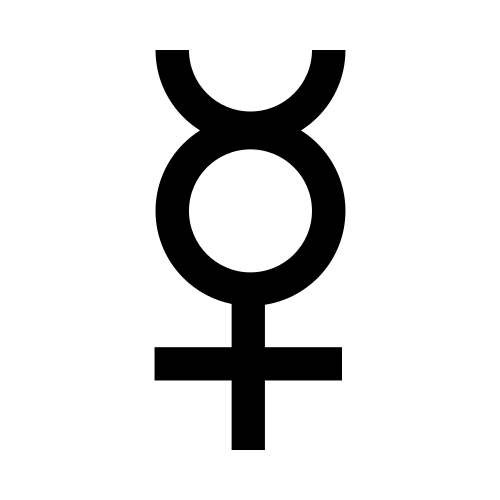 Mercury
 Venus
Venus Mars
Mars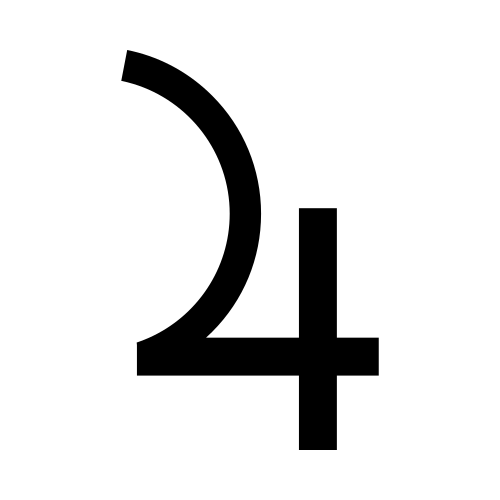 Jupiter
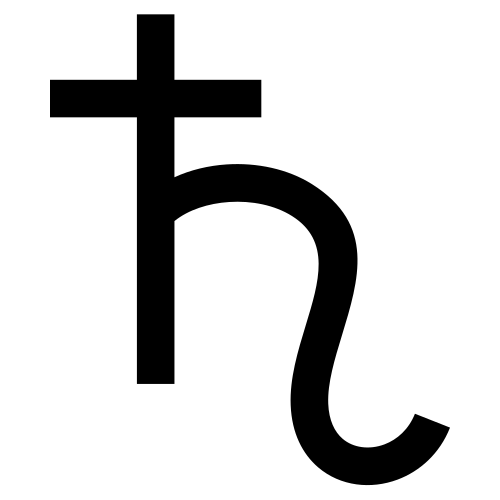 Saturn
 Uranus
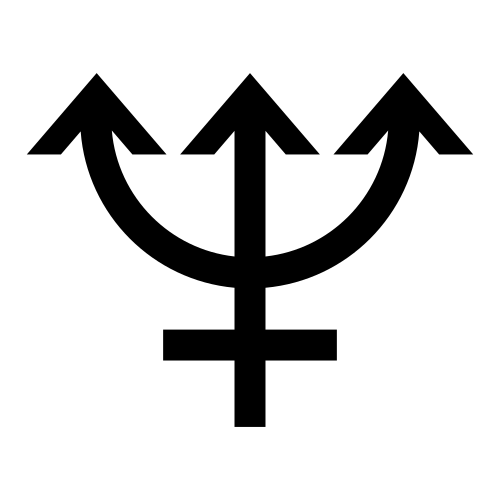 Neptune
 Pluto
Pluto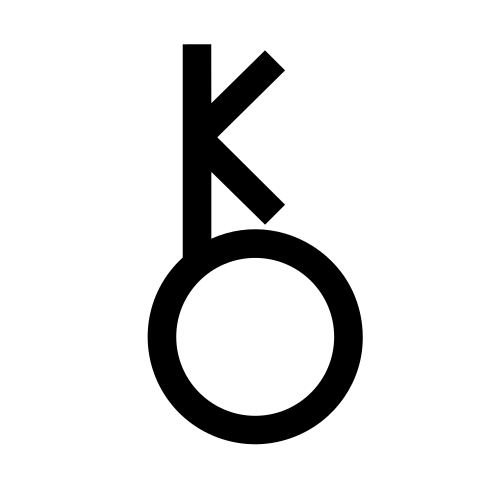 Chiron
Birth time unknown — house positions and Ascendant/MC are not available.
Astronomical context
Pluto travelled through Gemini from the mid-1880s to 1914. In astrological tradition this transit is associated with the transformation of communication, ideas, transport, and the press — the generation that came of age amid the spread of mass media, the telephone, and accelerating mobility.
John von Neumann (born 1903) belongs to this generational configuration. Astrian groups profiles by such shared signatures rather than by any claim of shared destiny. Related profiles in Astrian: Kurt Gödel · Erwin Schrödinger · J. Robert Oppenheimer. The symbolic reading is correlative, not causal.
Other profiles from this Pluto in Gemini generation
Symbolic reading
The following describes what classical astrological tradition associates with these configurations. Astrian does not apply these descriptions to the person's biography.
The Sun in Capricorn is the most prominent structural feature available without a birth time, centring the chart on ambition, structure, and the long view. There is no Ascendant or Midheaven to anchor the angles, so the reading rests on sign placements and the aspects between planets rather than on houses.
Among the personal planets, the Moon in Aries is associated in tradition with initiative, directness, and the will to begin (the Moon's sign is given for the noon chart and may shift with an exact time); Mercury in Capricorn with ambition, structure, and the long view; Venus in Scorpio with intensity, depth, and the will to transform; and Mars in Aquarius with independence, abstraction, and the collective. These placements describe registers of feeling, thought, attraction, and action as the tradition catalogues them, independent of the life that follows.
Sun opposite Neptune (1°02'): tradition reads identity and central purpose set in polarity with dissolution, imagination, and idealism.
Moon sextile Pluto (1°36'): tradition reads emotional life and instinct in supportive contact with depth, power, and transformation.
Jupiter square Pluto (2°10'): tradition reads expansion and meaning in friction with depth, power, and transformation.
Mercury sextile Venus (3°22'): tradition reads thought and communication in supportive contact with values, attraction, and harmony.
These placements are presented as a symbolic portrait, correlative and never causal — a description within the tradition's vocabulary, not an explanation of the life that follows.
Astrology is a symbolic language with 2,500 years of literature. The reading above is interpretive, not explanatory.
Astrian does not claim that the natal chart of John von Neumann caused or determined any of the above. Astrology is a symbolic system with 2,500 years of literature. Its capacity for retrospective description does not imply explanatory capacity.
A parallel life
The following are verified biographical facts. No connection to the natal chart is implied.
John von Neumann was born on 28 December 1903 in Budapest, then part of Austria-Hungary, into a wealthy Jewish family. He showed exceptional mathematical ability from childhood. He received a doctorate in mathematics from the University of Budapest and simultaneously a diploma in chemical engineering from the ETH Zurich in 1926.
In the late 1920s, von Neumann contributed to the mathematical foundations of quantum mechanics, developing a rigorous framework for the theory in his 1932 book, which established Hilbert space methods as the standard mathematical language for the field. He also contributed to operator theory and the mathematical foundations of set theory.
In 1933, von Neumann joined the newly founded Institute for Advanced Study in Princeton, New Jersey, where he remained for the rest of his career. During this period, he developed the theory of games, publishing the foundational work on game theory with Oskar Morgenstern in 1944. This work introduced methods for analysing strategic decision-making that found applications in economics and other fields.
During the Second World War, von Neumann was involved in the Manhattan Project, contributing expertise in mathematics and hydrodynamics relevant to the design of implosion-type weapons. He was also associated with the development of early electronic computers, and the architecture in which a computer stores both its program and its data in the same memory space is often referred to by his name, though its precise attribution has been debated by historians.
Von Neumann contributed to the early development of numerical weather prediction and to the theory of automata and self-replicating systems. He died on 8 February 1957 in Washington, D.C., following an illness diagnosed as cancer.
Biographical sources
- Macrae, Norman. John von Neumann: The Scientific Genius Who Pioneered the Modern Computer, Game Theory, Nuclear Deterrence, and Much More. New York: Pantheon, 1992..
- Von Neumann, John, and Oskar Morgenstern. Theory of Games and Economic Behavior. Princeton: Princeton University Press, 1944..
- Redei, Miklos, ed. John von Neumann: Selected Letters. Providence: American Mathematical Society, 2005..
- Ulam, Stanislaw. Adventures of a Mathematician. New York: Scribner, 1976..
This profile presents the sky at the birth of John von Neumann and verified facts of their biography. Astrian does not claim that astrology has predictive capacity or that the natal chart determines the trajectory of a life. Astrology is a symbolic system with 2,500 years of literature. Its capacity for retrospective description does not imply explanatory capacity.
Related profiles
Calculate your own birth chart with the same NASA JPL DE441 precision.
Calculate my birth chartLast updated: June 14, 2026
Newsletter
A short reading once a month, in your inbox.
A note on the symbolism of the season, recent editorial pieces, and what to look for in next month's sky. No predictions.
Support this project
Independent, no venture funding, no ads. A contribution keeps Astrian precise and free.
Support on Ko-fi (opens in new tab)