PROFILE · SCIENCE & TECHNOLOGY
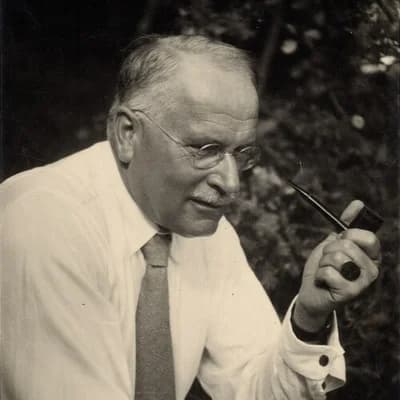
Carl Jung
Carl Gustav Jung
psychiatrist and psychologist
Born 26 July 1875 · Kesswil, Thurgau, Switzerland · 47.60° N, 9.32° EX
Source: Birth time not documented in publicly accessible records
About this chart
No birth time is documented for this person. The chart therefore shows planetary positions in their signs, the slow aspects between them, and the generational context — but not house placements, the Ascendant, or the Midheaven, which require an accurate birth time. The Moon's sign carries a ±6° margin: if it falls near a sign boundary, the sign could vary. Positions for all other planets are reliable.
Do you have a verified source for this birth time? Share it →
The sky at birth
No birth time is documented for Carl Jung. The Ascendant, Midheaven, and house positions cannot be determined. The planetary positions below are calculated for noon local time and are accurate to within a fraction of a degree for the slow-moving planets. The Moon's position carries a margin of approximately ±7°.
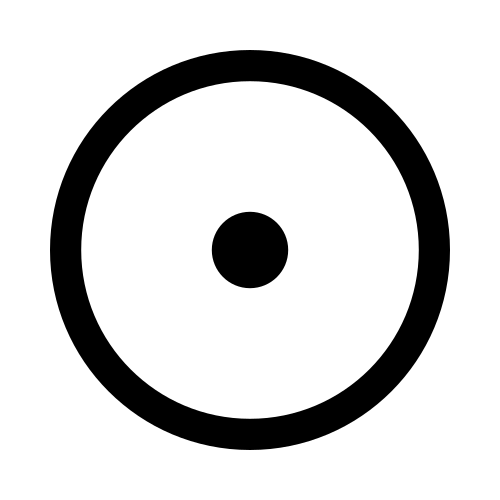
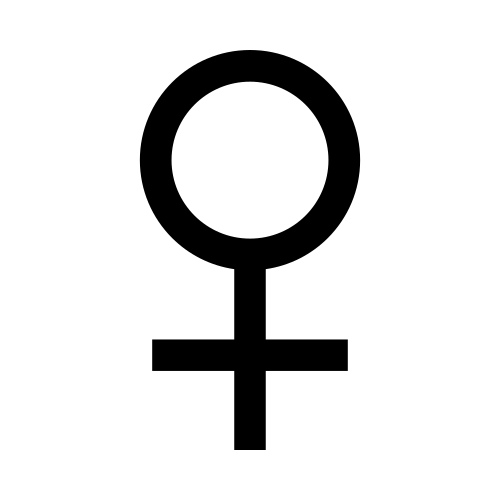
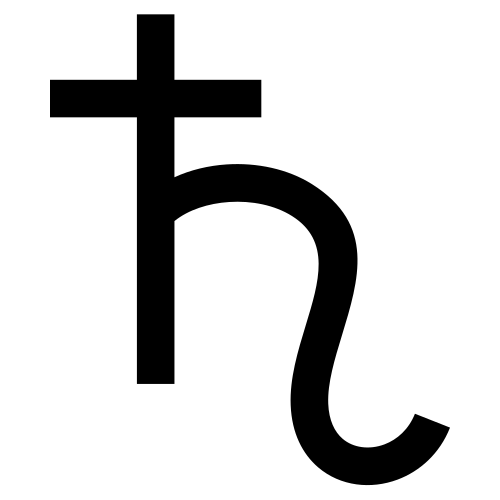
The Sun is at 2°59' Leo. The Moon is at 10°50' Taurus (noon position, ±7° margin). Mercury is at 13°29' Cancer. Venus is at 17°05' Cancer. Mars is at 21°22' Sagittarius. Jupiter is at 23°45' Libra. Saturn is at 24°13' Aquarius R. Uranus is at 14°47' Leo. Neptune is at 3°02' Taurus. Pluto is at 23°30' Taurus.
The Sun at 2°59' Leo squares Neptune at 3°02' Taurus (0°03') — the tightest major aspect in the chart and one of the tightest Sun-Neptune squares in the Astrian collection. Jupiter at 23°45' Libra trines Saturn at 24°13' Aquarius retrograde (0°28'). Saturn squares Pluto at 23°30' Taurus (0°43'). Mars at 21°22' Sagittarius sextiles Jupiter (2°23'). The Moon at 10°50' Taurus sextiles Mercury at 13°29' Cancer (2°39'), though this aspect carries the Moon's ±7° uncertainty. Mars sextiles Saturn (2°51'). Mercury conjoins Venus at 17°05' Cancer (3°36'). The Moon squares Uranus at 14°47' Leo (3°57'), also with lunar uncertainty.
The engine also identifies the following tight minor aspects: jupiter quincunx pluto (0.25° sep); sun square neptune (0.05° app).
The tightest major aspects between planets: Sun square Neptune (0°03'), Jupiter trine Saturn (0°28'), Saturn square Pluto (0°43'), Mars sextile Jupiter (2°23'), Moon sextile Mercury (2°39'), Mars sextile Saturn (2°51'), Mercury conjunction Venus (3°36'), Moon square Uranus (3°57').
The chart was calculated by Astrian's engine using NASA JPL DE441 ephemerides, sub-arcsecond precision. Timezone: Bern Mean Time (Europe/Zurich, approximately UTC +0:30).
| Planet | Sign | Position |
|---|---|---|
| Sun | Leo | 03°00' |
| Moon | Taurus | 11°08'±6° |
| Mercury | Cancer | 13°30' |
| Venus | Cancer | 17°07' |
| Mars | Sagittarius | 21°22' |
| Jupiter | Libra | 23°46' |
| Saturn | Aquarius | 24°13'retrograde |
| Uranus | Leo | 14°47' |
| Neptune | Taurus | 03°02' |
| Pluto | Taurus | 23°30' |
 Sun
Sun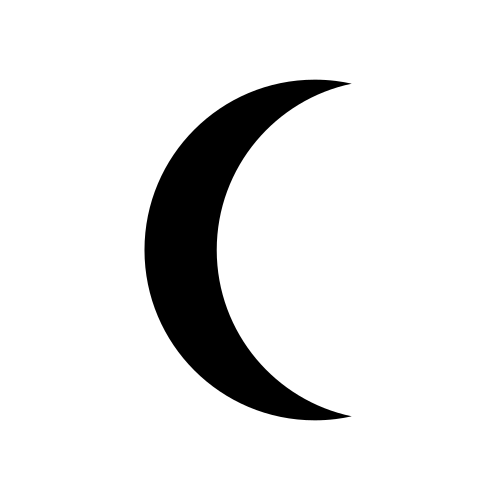 Moon
Moon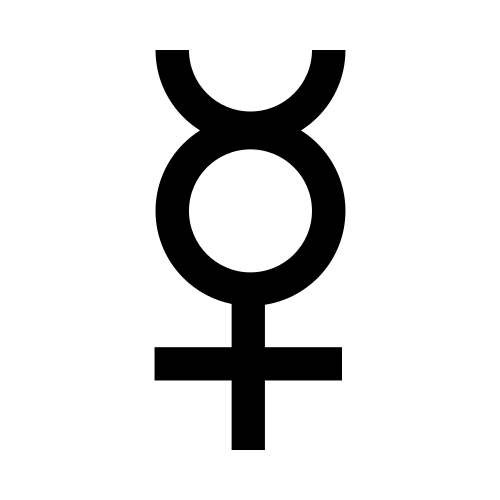 Mercury
 Venus
Venus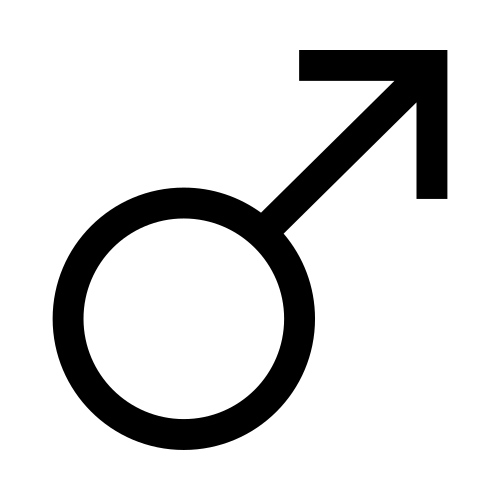 Mars
Mars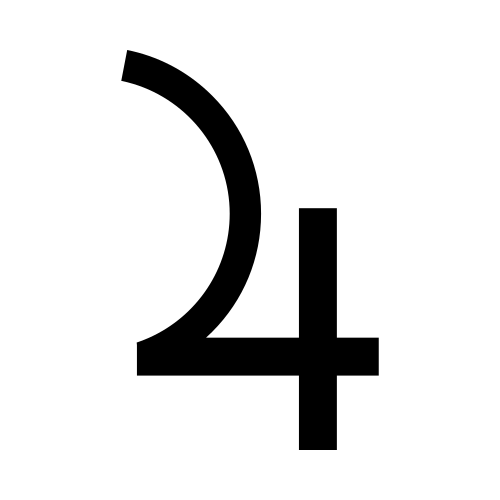 Jupiter
 Saturn
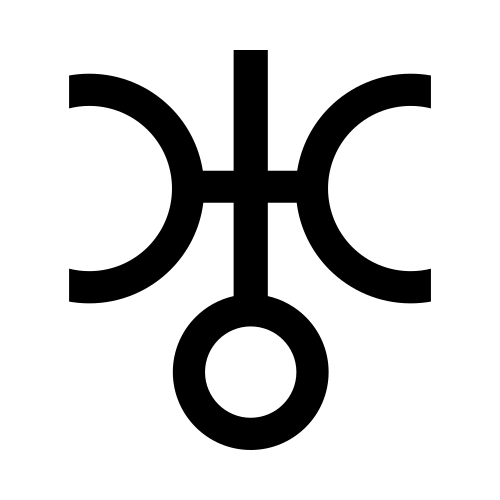 Uranus
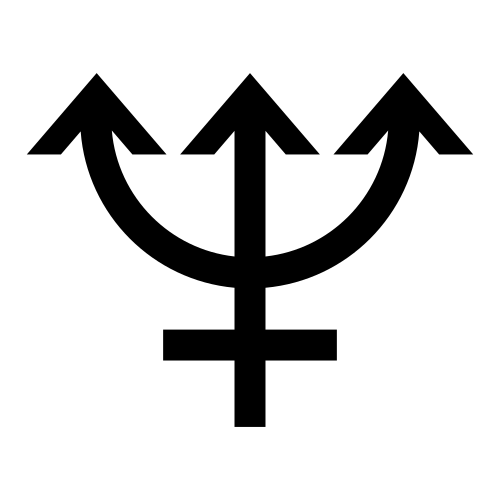 Neptune
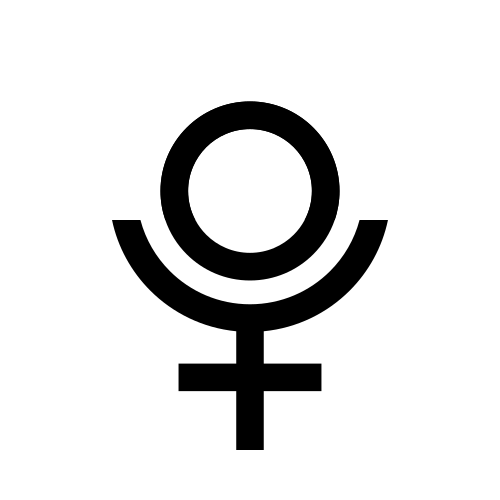 Pluto
PlutoBirth time unknown — house positions and Ascendant/MC are not available.
Astronomical context
Those born between approximately 1852 and 1884 carried Pluto in Taurus. This generation grew up during the high tide of the Industrial Revolution — the restructuring of agriculture, the emergence of industrial capitalism, the transformation of mass labour, and the radical remaking of the material conditions of life. They inherited a world where the relationship between human beings and the physical world was being altered at a speed and scale without precedent.
In astrological tradition, Pluto in Taurus is associated with collective transformation of the domains that sign governs: the material, the physical, the valued, the possessed, the sensory, and the stable. Taurus is the sign of the builder, the farmer, the one who works with the earth and with what endures. Pluto's transit through Taurus is read, symbolically, as a period when the structures of material security, economic production, and the relationship between the human and the natural world were subjected to deep structural pressure — the old frameworks of how wealth was produced, how land was worked, and how stability was maintained were torn apart and rebuilt. The generation that carries this placement inherited a world where the nature of material existence itself was being radically transformed. The symbolic reading is correlative, not causal.
Other profiles in the Astrian collection born under this configuration include Albert Einstein (1879) and Helen Keller (1880). Carl Jung, born in 1875, belongs to the middle years of this generational wave.
Other profiles from this Pluto in Taurus generation
Symbolic reading
The following describes what classical astrological tradition associates with these configurations. Astrian does not apply these descriptions to the person's biography.
The Sun at 2°59' Leo is the most prominent structural feature of this chart. Without a documented birth time, there is no Ascendant or Midheaven — the reading is confined to planetary positions by sign and the aspects between planets.
The Moon at 10°50' Taurus represents the noon position; the actual placement falls within approximately 7° on either side. If born early in the day, the Moon could be in the low single digits of Taurus; if born late, near 18°. The Moon's sign placement in Taurus is secure for the entire day.
Mercury at 13°29' Cancer, Venus at 17°05' Cancer, and Mars at 21°22' Sagittarius complete the personal planet picture.
### Sun square Neptune: identity and the numinous
The chart's defining feature is the Sun at 2°59' Leo squaring Neptune at 3°02' Taurus, orb 0°03' — functionally exact to the arc-minute. This is one of the tightest Sun-Neptune aspects in the Astrian collection. The Sun governs identity, the central organising principle of the self. Neptune governs the imaginal, the dissolving, the boundary between the known and the unknowable. The square forces them into confrontation: the self must negotiate with forces that exceed its capacity for definition, and the forces that dissolve definition must be given a form by the self that encounters them.
The Sun in Leo seeks a coherent, central identity — the self as the protagonist of its own story, radiant, visible, and whole. Neptune in Taurus operates through the register of the material and the sensory, dissolving the boundary between the solid and the imagined within the realm of what can be touched and built. The square reads as a constitution where the drive for heroic selfhood is permanently interrupted by the experience of something larger, older, and less amenable to the will — and where the confrontation with that something is not a defeat but the central task. The self cannot be whole until it has acknowledged what is not-self, and the acknowledgment is not intellectual but lived.
### Jupiter trine Saturn: the architecture of thought
Jupiter at 23°45' Libra trines Saturn at 24°13' Aquarius retrograde, orb 0°28'. Jupiter governs expansion, the search for meaning, and the capacity to see the whole. Saturn governs contraction, limitation, and the demand for structure. The trine connects them cooperatively in air signs — the expansive and the limiting work together rather than at cross purposes.
Jupiter in Libra seeks meaning through relationship, balance, and the encounter with the other. Saturn in Aquarius retrograde structures through systems, collective frameworks, and the internalised demand for intellectual rigour. The trine reads as a faculty for building large intellectual architectures that balance expansive philosophical vision with disciplined systematic form — frameworks that hold together because the vision and the structure reinforce one another.
Mars at 21°22' Sagittarius sextiles both Jupiter (2°23') and Saturn (2°51'), forming a pattern that links the drive to act to both the philosophical vision and the systematic discipline. Mars in Sagittarius acts through the register of the quest — the search for knowledge, the journey toward distant understanding. The sextiles to Jupiter and Saturn provide the quest with both scope and structure.
### Saturn square Pluto: structure under pressure
Saturn at 24°13' Aquarius retrograde squares Pluto at 23°30' Taurus, orb 0°43'. This is a slower-moving aspect shared by a cohort born in the mid-1870s, but it operates within the individual chart as a tension between systematic order and the forces that destroy and remake it. Saturn demands form, system, and the preservation of what has been built. Pluto demands transformation, the destruction of what is no longer viable, and the regeneration that follows destruction. The square forces confrontation: the intellectual systems must accommodate the eruptive, the archaic, and the destructive without being destroyed by them, and the eruptive forces must find a systematic framework without being domesticated.
### Mercury conjunction Venus in Cancer: the thinking heart
Mercury at 13°29' Cancer conjoins Venus at 17°05' Cancer, orb 3°36'. Mercury governs the organisation of thought and the naming of things. Venus governs aesthetics, value, and the perception of beauty. The conjunction fuses them in Cancer — the sign of memory, nurture, and the felt connection to origins. The mind and the aesthetic faculty share the same register: what is thought is felt, and what is valued is remembered. The intellectual process does not operate in the abstract but through the medium of emotional connection and the recovery of what has been lost or buried.
### Moon square Uranus: the disrupted familiar
The Moon at 10°50' Taurus squares Uranus at 14°47' Leo, orb 3°57' — though this aspect carries the Moon's ±7° uncertainty. If the actual birth time places the Moon near its noon position, this is a moderately tight square: the emotional faculty (Moon) in Taurus, which seeks stability, comfort, and the familiar, is disrupted by Uranus in Leo, which demands originality, sudden change, and the assertion of what is new. The square reads as an emotional life that is periodically shaken out of its settled patterns by insights or experiences that arrive without warning and demand a fundamental reorientation.
The planetary pattern here is read as a symbolic portrait, not a causal explanation. No planet caused, predicted, or determined any event or characteristic.
Astrology is a symbolic language with 2,500 years of literature. The reading above is interpretive, not explanatory.
Astrian does not claim that the natal chart of Carl Jung caused or determined any of the above. Astrology is a symbolic system with 2,500 years of literature. Its capacity for retrospective description does not imply explanatory capacity.
A parallel life
The following are verified biographical facts. No connection to the natal chart is implied.
Carl Gustav Jung was born on 26 July 1875 in Kesswil, a village on the shore of Lake Constance in the canton of Thurgau, Switzerland. His father, Paul Achilles Jung, was a pastor of the Swiss Reformed Church — a man whom Jung later described as kind but intellectually defeated, who had lost his faith without finding anything to replace it. His mother, Emilie Preiswerk, came from a family with a reputation for spiritualism and unconventional religious experience; she suffered periods of severe depression and was hospitalised when Jung was three. The early experience of a mother who was intermittently present and intermittently frightening, and a father who represented an institutional religion drained of living content, shaped the questions that occupied the rest of his life.
The family moved to Laufen, near Basel, when Jung was an infant, and later to Klein-Hüningen. He was a solitary child who spent long hours in imaginative play and developed an early awareness of two distinct personalities within himself — one the ordinary schoolboy, the other an older, authoritative figure connected to something deeper and less personal. He would later theorise this childhood experience into the framework of the archetypes.
He studied medicine at the University of Basel from 1895 to 1900, choosing psychiatry as his specialisation — a field then considered the least prestigious branch of medicine. In 1900 he joined the Burghölzli psychiatric hospital in Zurich as an assistant under Eugen Bleuler, one of the leading psychiatrists of the era. His early research on word association tests, which demonstrated the existence of emotionally charged clusters of ideas that operated below conscious awareness, established his scientific reputation and led directly to his concept of the complex.
In 1903 he married Emma Rauschenbach, the daughter of a wealthy industrialist family. The marriage lasted until her death in 1955; they had five children. Emma Jung became a significant analytical psychologist in her own right, and the marriage, though complicated by Jung's long relationship with Toni Wolff, endured as an intellectual and emotional partnership.
He first contacted Sigmund Freud in 1906, sending him a copy of his word association studies. They met in Vienna in February 1907 and talked for thirteen hours. Freud saw in Jung a potential heir — younger, non-Jewish, Swiss, and capable of carrying psychoanalysis beyond the Viennese circle. Jung saw in Freud a revolutionary thinker whose mapping of the unconscious corresponded to his own clinical experience. The alliance was intense, productive, and ultimately unsustainable. The break came gradually between 1911 and 1913, driven by irreconcilable disagreements over the nature of the libido — Jung rejected the exclusively sexual interpretation — and over the nature of the unconscious itself. For Jung, the unconscious was not merely a repository of repressed personal material but a deeper stratum shared by all human beings, structured by patterns he would call archetypes.
The years following the break with Freud were the most dangerous and the most generative of his life. Between 1913 and approximately 1917, he underwent what he called his "confrontation with the unconscious" — a period of intense inner turmoil that included visions, fantasies that bordered on the hallucinatory, and a deliberate descent into psychic material that would have been classified as pathological by any clinical standard of his time. He documented this experience in what became the Red Book (Liber Novus), a manuscript of extraordinary visual and textual elaboration that he worked on from 1914 to approximately 1930, and that was not published until 2009 — nearly half a century after his death.
From this confrontation emerged the theoretical framework of Analytical Psychology. The collective unconscious — a stratum of the psyche shared across cultures and epochs, structured not by personal experience but by inherited patterns of image and behaviour. The archetypes — the Shadow (the rejected and denied aspects of the self), the Anima and Animus (the contrasexual images that mediate between the ego and the unconscious), the Self (the organising centre of the total psyche, encompassing both conscious and unconscious), the Persona (the social mask), and others. Individuation — the lifelong process by which the personality integrates its conscious and unconscious elements into a more complete whole. Psychological types — the distinction between introversion and extraversion, and the four functions of thinking, feeling, sensation, and intuition, published in Psychological Types (1921) and subsequently absorbed into general culture, corporate assessment, and personality psychology.
He built the Tower at Bollingen beginning in 1923 — a stone structure on the upper shore of Lake Zurich that he constructed largely with his own hands over three decades, adding sections as his inner development progressed. It had no electricity and no telephone; he described it as a representation in stone of his psyche.
His later work moved increasingly toward alchemy, Gnosticism, comparative religion, and the symbolic systems of pre-modern cultures, which he understood not as superstition but as the projective imagery through which earlier generations had encountered the same archetypal realities that modern depth psychology was rediscovering. Aion (1951), Answer to Job (1952), and Mysterium Coniunctionis (1955-1956) represent the culmination of this synthesis.
His relationship with National Socialism and the question of antisemitism remain contested. As president of the International General Medical Society for Psychotherapy and editor of its journal, the Zentralblatt für Psychotherapie, from 1933 to 1940, he made statements that have been read by some scholars as accommodating the regime and by others as attempts to preserve an international framework for psychotherapy during a period of political collapse. The evidence is complex, the interpretations diverge, and the biographical record does not support simple conclusions.
Memories, Dreams, Reflections (1961), prepared with his associate Aniela Jaffé, was published shortly after his death. It remains the most widely read account of his inner life, though Jung himself noted that it was not an autobiography in the conventional sense but an attempt to narrate the development of a psyche.
He died at Küsnacht, on Lake Zurich, on 6 June 1961, at the age of eighty-five.
Biographical sources
- Bair, Deirdre. Jung: A Biography. Little, Brown and Company 2003
- Hannah, Barbara. Jung: His Life and Work. G.P. Putnam's Sons 1976
This profile presents the sky at the birth of Carl Jung and verified facts of their biography. Astrian does not claim that astrology has predictive capacity or that the natal chart determines the trajectory of a life. Astrology is a symbolic system with 2,500 years of literature. Its capacity for retrospective description does not imply explanatory capacity.
Calculate your own birth chart with the same NASA JPL DE441 precision.
Calculate my birth chartLast updated: June 12, 2026
Newsletter
A short reading once a month, in your inbox.
A note on the symbolism of the season, recent editorial pieces, and what to look for in next month's sky. No predictions.
Support this project
Independent, no venture funding, no ads. A contribution keeps Astrian precise and free.
Support on Ko-fi (opens in new tab)