PROFILE · SCIENCE & TECHNOLOGY
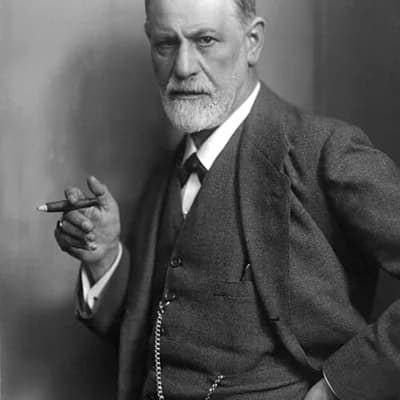
Sigmund Freud
Sigismund Schlomo Freud
neurologist_psychoanalyst
Born 6 May 1856 · 18:30 · 15:14 UTC · Příbor, Czech Republic · 49.55° N, 18.15° EAA
Source: Birth record, Freiberg in Mähren
The sky at birth
The Ascendant falls at 10°20' Scorpio. The seventh house holds three planets: Sun at 16°19' Taurus, Mercury at 27°47' Taurus, and Uranus at 20°35' Taurus. All three occupy Taurus and the seventh house; the Sun and Uranus are separated by 4°15', and Mercury stands at the far end of the sign, 7°27' past Uranus.
The Midheaven falls at 23°50' Leo. Moon at 14°40' Gemini and Saturn at 27°32' Gemini are both in the eighth house, separated by 12°52' in the same sign. Jupiter at 29°34' Pisces is in the fifth house. Neptune at 19°51' Pisces is in the fourth house; Jupiter and Neptune are in the same sign, separated by 9°43'.
Venus at 26°11' Aries is in the sixth house. Pluto at 4°27' Taurus is in the sixth house. Mars at 3°22' Libra is in the eleventh house, retrograde.
The tightest aspect in the chart is Uranus sextile Neptune at 0°43': Uranus at Taurus 20°35' and Neptune at Pisces 19°51'. This is a generational sextile — both outer planets move slowly enough that this aspect was present across many charts in the same decade — but it is the narrowest angular relationship in this particular configuration. The next tightest is Sun sextile Neptune at 3°31': Sun at Taurus 16°19' and Neptune at Pisces 19°51'.
The Sun conjunct Uranus in the seventh house carries an orb of 4°15'. Both bodies are in Taurus; Uranus was still a relatively recently discovered planet in 1856 (discovered 1781).
Moon and Saturn share the eighth house in Gemini, at 14°40' and 27°32' respectively. They are in the same sign but separated by 12°52'.
The Ascendant at 10°20' Scorpio is in opposition to the seventh-house Sun: ASC-Sun separation across the first-seventh axis = 180° minus 5°59', placing the Sun in the descending hemisphere, below the horizon and west of the meridian at the time of birth.
The chart was calculated by Astrian's engine using NASA JPL DE441 ephemerides, sub-arcsecond precision (RMS error below 0.06 arcseconds). Timezone: Local Mean Time, UTC +1:12:37, derived from Příbor's geographic longitude 18°09'E. ---
| Planet | Sign | Position | House |
|---|---|---|---|
| Ascendant | Scorpio | 10°21' | — |
| Midheaven | Leo | 23°50' | — |
| Sun | Taurus | 16°19' | H7 |
| Moon | Gemini | 14°40' | H8 |
| Mercury | Taurus | 27°47' | H7 |
| Venus | Aries | 26°11' | H6 |
| Mars | Libra | 03°22'retrograde | H11 |
| Jupiter | Pisces | 29°34' | H5 |
| Saturn | Gemini | 27°32' | H8 |
| Uranus | Taurus | 20°35' | H7 |
| Neptune | Pisces | 19°51' | H4 |
| Pluto | Taurus | 04°27' | H6 |
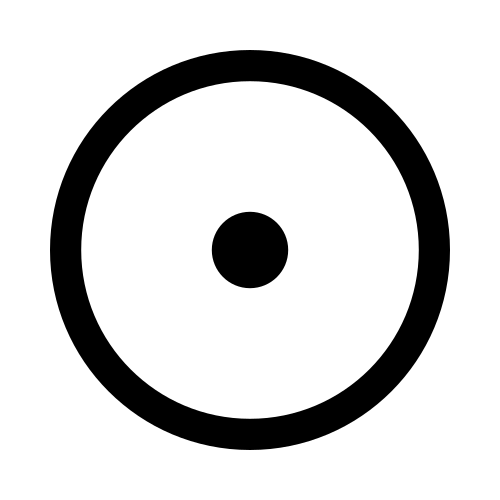 Sun
Sun Moon
Moon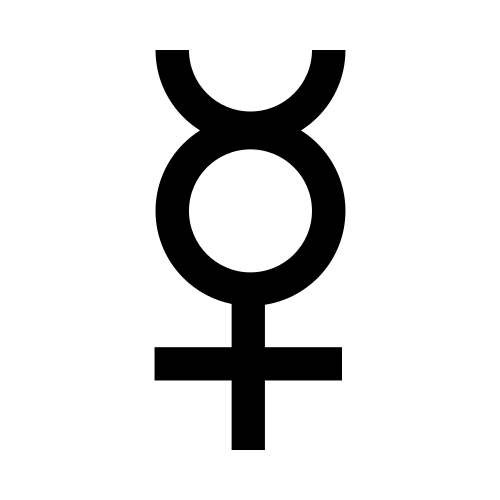 Mercury
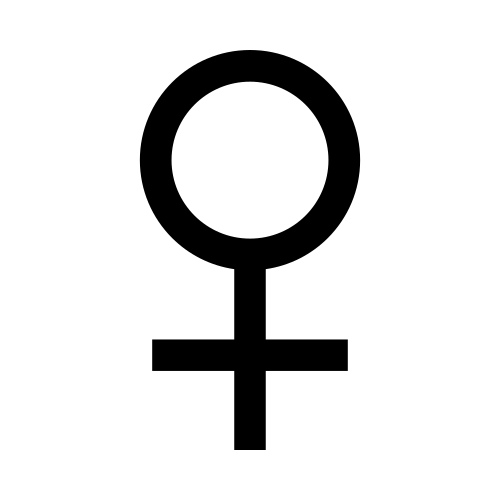 Venus
Venus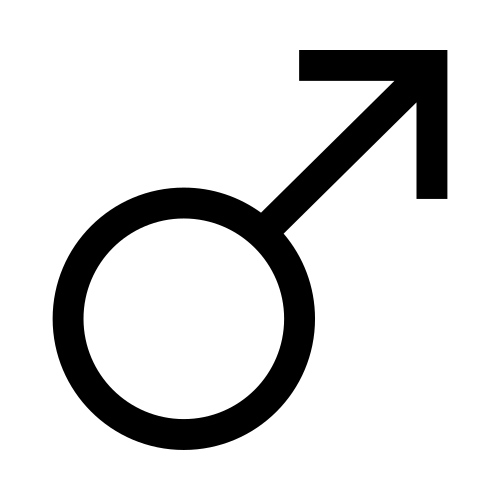 Mars
Mars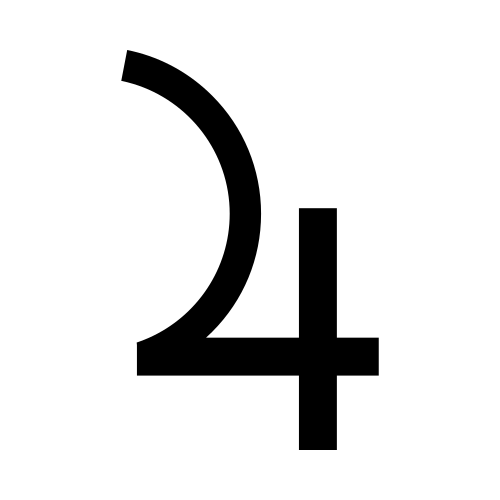 Jupiter
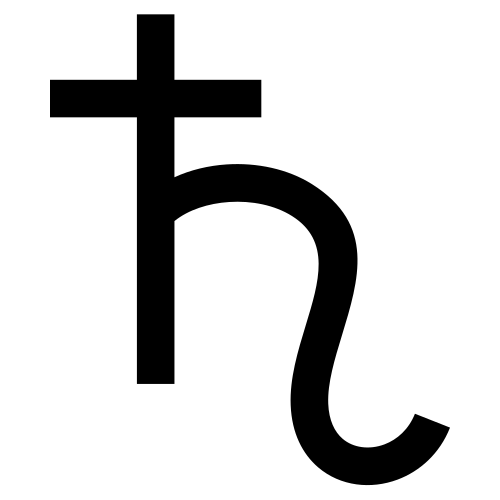 Saturn
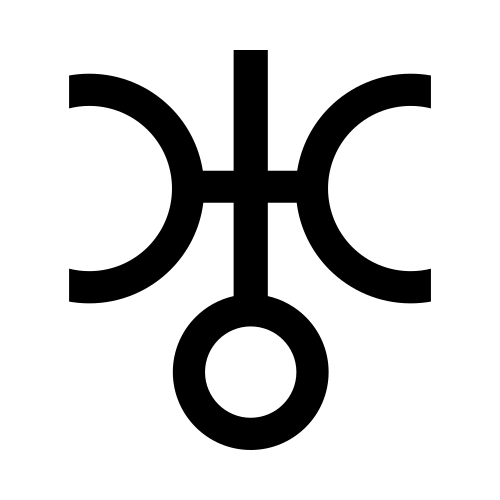 Uranus
 Neptune
 Pluto
PlutoAstronomical context
Those born between approximately 1851 and 1882 carried Pluto in Taurus. Freud was born in 1856, in the early part of this transit. The generation includes, among others, Oscar Wilde (born 1854, Pluto in Taurus) and Marie Curie (born 1867, Pluto in Taurus).
In astrological tradition, Pluto in Taurus is associated with transformative pressure applied to the domains Taurus governs: material resources, economic structures, the physical world, land, accumulation, and the body. The historical period of this transit coincided with the industrial revolution's expansion into every domain of material life — the transformation of agriculture, the emergence of industrial capitalism, mass urbanization, and the restructuring of the relationship between labor and accumulated wealth. Karl Marx published Das Kapital in 1867, during this transit.
The generation that carried Pluto in Taurus grew up inside this material transformation. Many later contributed to the intellectual frameworks through which the 19th century understood or contested its own economic and physical arrangements. The symbolic reading is correlative, not causal. ---
Other profiles from this Pluto in Taurus generation
Symbolic reading
The following describes what classical astrological tradition associates with these configurations. Astrian does not apply these descriptions to the person's biography.
An Ascendant at 10°20' Scorpio, with the seventh house holding three planets in Taurus: Sun, Uranus, and Mercury. In traditional astrological vocabulary, Scorpio governs what is hidden, the process of investigation into concealed material, and the encounter with what lies beneath the surface. The opposition between a Scorpio Ascendant and a Taurus seventh house places this axis between the approach to the world (Scorpio) and the encounter with others (Taurus) under structural tension.
The Sun conjunct Uranus at 4°15' orb in Taurus, placed in the seventh house: the seventh house governs the encounter with others — partners, interlocutors, those who respond and reflect. Uranus carries traditional associations with disruption of established pattern, the overthrow of convention, and the introduction of frameworks that deviate from inherited structures. A Sun-Uranus conjunction in the house of the other places this quality directly at the point of encounter with external reality.
The Moon and Saturn in Gemini in the eighth house, wide conjunction at 12°52': the eighth house is associated in traditional vocabulary with what remains beneath articulation — depth, transformation, the hidden interior of things. Moon and Saturn together in the same house and sign carry a dual valence in the tradition: the Moon governs instinct and emotional response, Saturn governs structure, limitation, and the work of form. Both in Gemini, a sign associated with language, duality, and the articulation of connections.
Jupiter at 29°34' Pisces in the fifth house and Neptune at 19°51' Pisces in the fourth: both bodies in Pisces (Jupiter's traditional domicile), spanning the houses associated with creation and with what lies beneath articulation. Neptune carries associations with the dissolution of boundaries and the world of image and symbol; Jupiter in its own sign amplifies.
The Sun sextile Neptune at 3°31' links the Sun in Taurus to Neptune in Pisces across houses. The Uranus-Neptune sextile at 0°43' is the most precise angular relationship in the chart, though as a generational outer-planet aspect, it describes the era rather than the individual.
Astrology is a symbolic language with 2,500 years of literature. The reading above is interpretive, not explanatory.
Astrian does not claim that the natal chart of Sigmund Freud caused or determined any of the above. Astrology is a symbolic system with 2,500 years of literature. Its capacity for retrospective description does not imply explanatory capacity.
A parallel life
The following are verified biographical facts. No connection to the natal chart is implied.
Sigismund Schlomo Freud was born on May 6, 1856, in Freiberg in Mähren, a small town in the Austrian Empire (now Příbor in the Czech Republic). His father, Jacob Freud, was a Jewish wool merchant. His mother, Amalia Nathansohn, was Jacob's third wife and twenty years his junior. Freud was the first child of their marriage. The family moved to Leipzig in 1859 and to Vienna in 1860, where they settled in the Jewish quarter of Leopoldstadt.
He entered the University of Vienna in 1873. His studies extended beyond medicine to include comparative anatomy under Carl Claus and physiology under Ernst Wilhelm von Brücke. He graduated with a medical degree in 1881. At Brücke's laboratory he had conducted research on the neural anatomy of fish and other organisms, developing the histological techniques and analytical habits that would characterize his later work.
In 1882 he became engaged to Martha Bernays; they married in 1886 and had six children. Between 1885 and 1886 he studied in Paris under Jean-Martin Charcot at the Salpêtrière, observing Charcot's work with hysteria and hypnosis. Returning to Vienna, he began private practice and collaborated with the internist Josef Breuer. Their joint publication Studies on Hysteria (1895), based on cases including the patient known as Anna O., introduced the concept of the cathartic method — the idea that symptoms might be resolved through verbally revisiting their origin.
The Interpretation of Dreams was published in November 1899 (dated 1900 by the publisher). The book argued that dreams were the disguised fulfillment of repressed wishes and introduced the theoretical distinction between manifest and latent content. The Psychopathology of Everyday Life followed in 1901, analyzing slips of the tongue and memory errors as evidence of unconscious mental activity. Three Essays on the Theory of Sexuality appeared in 1905, extending his theoretical framework to include infantile sexuality and the developmental history of sexual organization.
He founded the International Psychoanalytic Association in 1910, with Carl Jung as the first president. Disagreements over theory led to breaks with Adler in 1911 and Jung in 1912-13. His later theoretical revisions included the introduction of the death drive in Beyond the Pleasure Principle (1920) and a revised model of mental structure — id, ego, superego — in The Ego and the Id (1923).
In 1923 he was diagnosed with oral cancer — attributed to his heavy cigar use — and underwent the first of over thirty surgical operations on his jaw and palate. He continued to write and practice through the final sixteen years of his life, though with increasing physical difficulty.
After Germany's annexation of Austria in March 1938, the Gestapo searched his apartment and interrogated his daughter Anna. Ernest Jones and the American diplomat William Bullitt facilitated his exit: Freud left Vienna for London in June 1938 with his immediate family. He died in London on September 23, 1939. He was eighty-three years old. His physician Max Schur, at Freud's request, administered the morphine doses that ended his life.
Biographical sources
- Jones, Ernest. The Life and Work of Sigmund Freud. 3 vols. Basic Books, 1953–1957
- Gay, Peter. Freud: A Life for Our Time. W. W. Norton 1988
- Sulloway, Frank J. Freud, Biologist of the Mind. Basic Books 1979
This profile presents the sky at the birth of Sigmund Freud and verified facts of their biography. Astrian does not claim that astrology has predictive capacity or that the natal chart determines the trajectory of a life. Astrology is a symbolic system with 2,500 years of literature. Its capacity for retrospective description does not imply explanatory capacity.
Related profiles
Calculate your own birth chart with the same NASA JPL DE441 precision.
Calculate my birth chartLast updated: June 12, 2026
Newsletter
A short reading once a month, in your inbox.
A note on the symbolism of the season, recent editorial pieces, and what to look for in next month's sky. No predictions.
Support this project
Independent, no venture funding, no ads. A contribution keeps Astrian precise and free.
Support on Ko-fi (opens in new tab)