PROFILE · SCIENCE & TECHNOLOGY
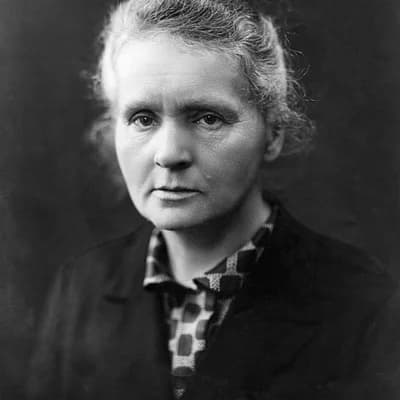
Marie Curie
Maria Skłodowska-Curie
physicist
Born 7 November 1867 · Warsaw, Poland · 52.23° N, 21.01° EX
Source: Birth time not documented
About this chart
No birth time is documented for this person. The chart therefore shows planetary positions in their signs, the slow aspects between them, and the generational context — but not house placements, the Ascendant, or the Midheaven, which require an accurate birth time. The Moon's sign carries a ±6° margin: if it falls near a sign boundary, the sign could vary. Positions for all other planets are reliable.
Do you have a verified source for this birth time? Share it →
The sky at birth
No birth time is documented for Marie Curie. The Ascendant, Midheaven, and house positions cannot be determined. The planetary positions below are calculated for noon LMT (12:00, UTC +1:24:03) and are accurate to within a fraction of a degree for the slow-moving planets. The Moon's position is approximate: the Moon moves approximately 13° per day, placing it within ±7° of the noon figure regardless of the actual birth time.
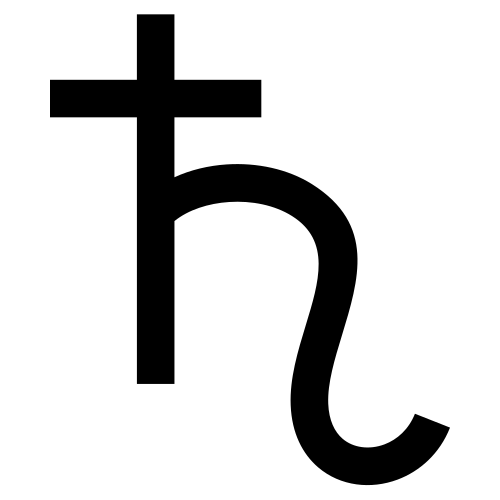
The Sun is at 14°34' Scorpio. Four planets cluster in Scorpio: Sun at 14°34', Venus at 25°34', Saturn at 25°16', and Mars at 29°36'. The closest conjunction within this grouping is Venus and Saturn, separated by 0°18'. Mars and Venus are separated by 4°02'; Mars and Saturn by 4°20'.
Mercury is at 6°38' Sagittarius. Jupiter is at 28°00' Aquarius.
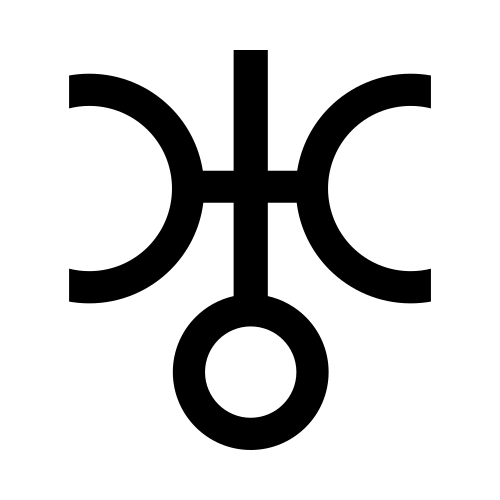
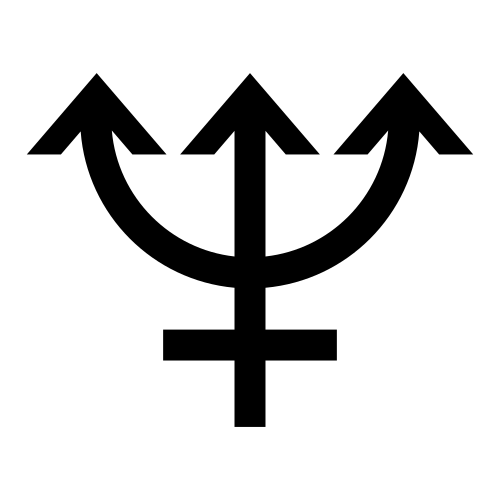
Uranus is at 12°43' Cancer, retrograde. Neptune is at 12°50' Aries, retrograde. The Uranus-Neptune square carries an orb of 0°07': both outer planets at virtually the same degree in their respective signs, 90° apart. This is a generational configuration — the Uranus-Neptune square was present across many charts of the same era — but it is the most precisely defined angular relationship in this particular configuration.
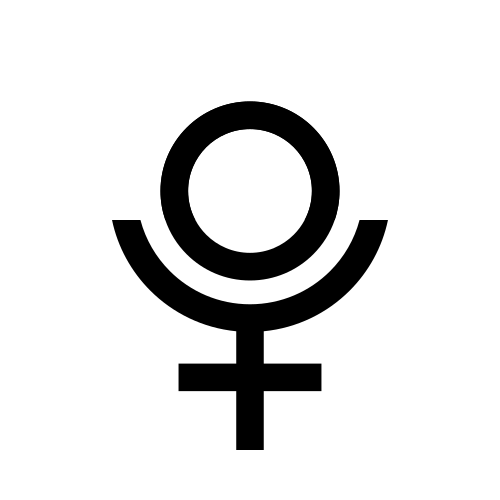
Pluto is at 15°07' Taurus, retrograde. The Moon at the noon position is 16°28' Pisces; given the uncertainty in birth time, the actual lunar position falls somewhere between approximately 9° and 23° Pisces.
The Venus-Saturn conjunction at 0°18' in Scorpio is the tightest personal aspect in the chart and the only individual-planet conjunction within 1°.
The chart was calculated by Astrian's engine using NASA JPL DE441 ephemerides, sub-arcsecond precision (RMS error below 0.06 arcseconds). Timezone: Local Mean Time, UTC +1:24:03, derived from Warsaw's geographic longitude 21°01'E. ---
| Planet | Sign | Position |
|---|---|---|
| Sun | Scorpio | 14°34' |
| Moon | Pisces | 16°28'±6° |
| Mercury | Sagittarius | 06°38' |
| Venus | Scorpio | 25°34' |
| Mars | Scorpio | 29°36' |
| Jupiter | Aquarius | 28°00' |
| Saturn | Scorpio | 25°16' |
| Uranus | Cancer | 12°43'retrograde |
| Neptune | Aries | 12°50'retrograde |
| Pluto | Taurus | 15°07'retrograde |
 Sun
Sun Moon
Moon Mercury
 Venus
Venus Mars
Mars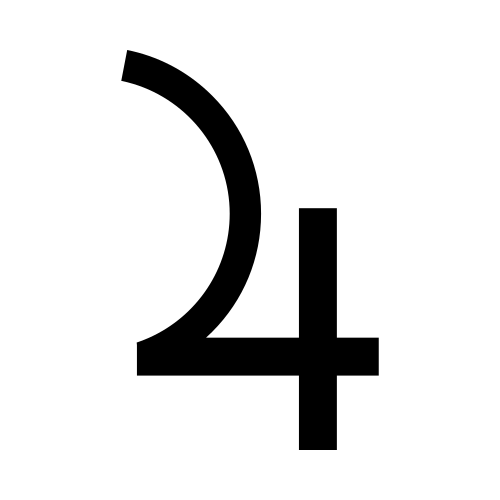 Jupiter
 Saturn
 Uranus
 Neptune
 Pluto
PlutoBirth time unknown — house positions and Ascendant/MC are not available.
Astronomical context
Those born between approximately 1851 and 1882 carried Pluto in Taurus. Curie was born in 1867, in the middle of this transit. The generation includes, among others, Sigmund Freud (born 1856, Pluto in Taurus) and Helen Keller (born 1880, Pluto in Taurus).
In astrological tradition, Pluto in Taurus is associated with transformative pressure applied to the domains Taurus governs: material resources, economic structures, the physical world, land, accumulation, and the body. The historical period of this transit coincided with the expansion of the industrial revolution into every domain of material life — the transformation of agriculture, the emergence of industrial capitalism, mass urbanization, and the restructuring of the relationship between labor and accumulated wealth. Karl Marx published Das Kapital in 1867 — the year of Curie's birth.
The generation that carried Pluto in Taurus grew up inside this material transformation. Many later contributed to the intellectual and scientific frameworks through which the late 19th century reconceived the material world at its most fundamental level. The symbolic reading is correlative, not causal. ---
Other profiles from this Pluto in Taurus generation
Symbolic reading
The following describes what classical astrological tradition associates with these configurations. Astrian does not apply these descriptions to the person's biography.
Four planets in Scorpio: Sun at 14°34', Venus at 25°34', Saturn at 25°16', Mars at 29°36'. In the absence of a birth time, house placements are unavailable; the observation is confined to sign positions. In traditional astrological vocabulary, Scorpio is associated with depth, investigation, hidden structures, and the encounter with what is not immediately visible. A concentration of four planets in one sign is a structural feature regardless of house placement.
The tightest personal conjunction in the chart is Venus conjunct Saturn at 0°18': two bodies whose traditional associations stand in opposition — Venus with affinity, beauty, and relational warmth; Saturn with limitation, structure, and the discipline of form — in tight alignment in the same degree of Scorpio.
Mars also participates in this grouping: Mars conjunct Venus (4°02') and Mars conjunct Saturn (4°20'), all in Scorpio. The three-body cluster — Mars, Venus, Saturn — in a sign associated with depth and persistence is a structural observation.
Uranus square Neptune at 0°07': both bodies retrograde, both at virtually the same degree in their respective signs, 90° apart. As a slow outer-planet aspect, this describes the era as much as the individual. But its extreme precision — 0°07' — places it at the narrowest angular relationship in this chart.
The Sun at 14°34' Scorpio stands apart from the Venus-Mars-Saturn cluster by approximately 11°, at the center of the sign. Mercury at 6°38' Sagittarius is in the sign adjacent to the Scorpio stellium, having already moved past the sign boundary.
Astrology is a symbolic language with 2,500 years of literature. The reading above is interpretive, not explanatory.
Astrian does not claim that the natal chart of Marie Curie caused or determined any of the above. Astrology is a symbolic system with 2,500 years of literature. Its capacity for retrospective description does not imply explanatory capacity.
A parallel life
The following are verified biographical facts. No connection to the natal chart is implied.
Maria Skłodowska was born on November 7, 1867, in Warsaw, then under Russian imperial administration. Her father, Władysław Skłodowski, was a teacher of physics and mathematics; her mother, Bronisława, a schoolteacher and headmistress. Her mother died of tuberculosis in 1878, when Maria was ten years old.
Under Russian rule, the University of Warsaw was closed to women. To pursue higher education, Maria and her older sister Bronisława entered into a practical arrangement: Maria would work as a governess in Poland to fund Bronisława's medical studies in Paris; once Bronisława had established herself, she would in turn support Maria's studies. Maria spent five years as a governess in the Polish countryside, largely in the employ of the Żorawski family, during which time she taught herself advanced mathematics and continued her education informally. She also taught workers' children in violation of Russian laws prohibiting Polish-language instruction.
She arrived in Paris in November 1891. She studied physics and mathematics at the Sorbonne (then the Faculté des Sciences of the University of Paris), completing her physics degree in 1893 — first in her class — and her mathematics degree in 1894. She met the physicist Pierre Curie in 1894; they married in July 1895. They had two daughters: Irène (born 1897) and Ève (born 1904).
Her doctoral research focused on uranium rays, following Wilhelm Röntgen's discovery of X-rays in 1895 and Henri Becquerel's discovery that uranium salts emitted radiation spontaneously. She coined the term "radioactivity" to describe this phenomenon. Working in a damp, poorly ventilated shed at the School of Physics and Chemistry, she and Pierre systematically processed tons of pitchblende to isolate first polonium (named for her homeland, July 1898) and then radium (December 1898). Both were new elements.
She completed her doctoral dissertation in 1903 — the first woman in France to earn a doctorate in physics. In December 1903, Marie, Pierre, and Henri Becquerel shared the Nobel Prize in Physics. Marie was the first woman to receive a Nobel Prize.
Pierre Curie was killed in April 1906 when he slipped and fell under a horse-drawn wagon on a Paris street. The University of Paris appointed Marie to his professorship at the Sorbonne — the first woman to hold a full professorship at the institution. She continued their shared research program and, in 1910, succeeded in isolating pure metallic radium.
In 1911, she was awarded the Nobel Prize in Chemistry — for the discovery of radium and polonium and for her work in isolating radium and studying its properties. She became the first person to win Nobel Prizes in two different scientific disciplines. That same year, she became the subject of a public scandal when her relationship with the physicist Paul Langevin was reported in the French press; the Swedish Academy, responding to the controversy, suggested she not attend the Nobel ceremony. She attended regardless and delivered her Nobel lecture.
During the First World War, she developed mobile radiography units — known as "petites Curies" — that could be deployed close to the front lines to assist battlefield surgery. She trained over 150 women as radiology technicians and operated the units herself. She estimated that approximately one million soldiers were treated with these mobile units during the war.
After the war, she traveled to the United States twice — in 1921 and 1929 — to raise funds for her Radium Institute in Warsaw and her laboratory in Paris. President Harding presented her with a gram of radium on her first visit.
Marie Curie died on July 4, 1934, at a sanatorium in Passy, Haute-Savoie, France. She was sixty-six years old. The cause of death was aplastic anemia, attributed to decades of exposure to ionizing radiation. She had no knowledge of the biological dangers of radiation during the years when the hazards were most acute; she routinely carried radioactive isotopes in her pockets and stored them in unlabeled bottles in her desk drawer. Her laboratory notebooks, which remain radioactive, are stored in lead-lined boxes at the Bibliothèque nationale de France and are available to researchers who sign a waiver.
Biographical sources
- Quinn, Susan. Marie Curie: A Life. Simon & Schuster 1995
- Giroud, Françoise. Marie Curie: A Life. Holmes & Meier 1986
- Curie, Ève. Madame Curie: A Biography. Doubleday 1937
This profile presents the sky at the birth of Marie Curie and verified facts of their biography. Astrian does not claim that astrology has predictive capacity or that the natal chart determines the trajectory of a life. Astrology is a symbolic system with 2,500 years of literature. Its capacity for retrospective description does not imply explanatory capacity.
Related profiles
Calculate your own birth chart with the same NASA JPL DE441 precision.
Calculate my birth chartLast updated: June 12, 2026
Newsletter
A short reading once a month, in your inbox.
A note on the symbolism of the season, recent editorial pieces, and what to look for in next month's sky. No predictions.
Support this project
Independent, no venture funding, no ads. A contribution keeps Astrian precise and free.
Support on Ko-fi (opens in new tab)