PROFILE · SCIENCE & TECHNOLOGY
Srinivasa Ramanujan
Srinivasa Ramanujan Aiyangar
mathematician
Born 22 December 1887 · 18:20 · 12:30 UTC · Erode, British India · 11.34° N, 77.72° EB
Source: Astro-Databank (Rodden Rating B)
The sky at birth
With a documented birth time, the full chart can be cast. The Ascendant falls at 7°28' Cancer and the Midheaven at 3°29' Aries, which fixes the angular framework and allows the planets to be placed in houses.
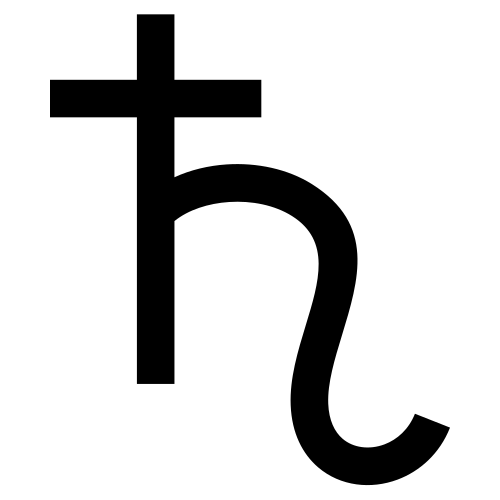
Sun is at 0°25' Capricorn, house 6. Moon is at 3°07' Aries, house 9. Mercury is at 15°19' Sagittarius, house 6. Venus is at 14°47' Scorpio, house 5. Mars is at 8°12' Libra, house 4. Jupiter is at 25°40' Scorpio, house 5. Saturn is at 5°27' Leo, house 2, retrograde. Uranus is at 16°49' Libra, house 4. Neptune is at 27°50' Taurus, house 11, retrograde. Pluto is at 3°33' Gemini, house 11, retrograde.
The tightest major aspects between planets: Moon sextile Pluto (0°26'); Mercury sextile Uranus (1°29'); Saturn sextile Pluto (1°55'); Jupiter opposite Neptune (2°10'); Moon trine Saturn (2°20'); Sun square Moon (2°43').
Neptune conjunct Pluto (5°43') is structural but generational — an alignment of slow-moving outer planets shared across many birth years.
The engine also registers tight minor aspects involving asteroids and calculated points: Jupiter quincunx Lilith (0°38'); Venus square North Node (3°02'); Mars sextile North Node (3°33'); Mercury trine North Node (3°35'). These are reported for completeness and carry less weight in traditional reading.
The chart was calculated using NASA JPL DE441 ephemerides, sub-arcsecond precision.
| Planet | Sign | Position | House |
|---|---|---|---|
| Ascendant | Cancer | 07°28' | — |
| Midheaven | Aries | 03°29' | — |
| Sun | Capricorn | 00°25' | H6 |
| Moon | Aries | 03°07' | H9 |
| Mercury | Sagittarius | 15°19' | H6 |
| Venus | Scorpio | 14°47' | H5 |
| Mars | Libra | 08°12' | H4 |
| Jupiter | Scorpio | 25°40' | H5 |
| Saturn | Leo | 05°27'retrograde | H2 |
| Uranus | Libra | 16°49' | H4 |
| Neptune | Taurus | 27°50'retrograde | H11 |
| Pluto | Gemini | 03°33'retrograde | H11 |
 Sun
Sun Moon
Moon Mercury
 Venus
Venus Mars
Mars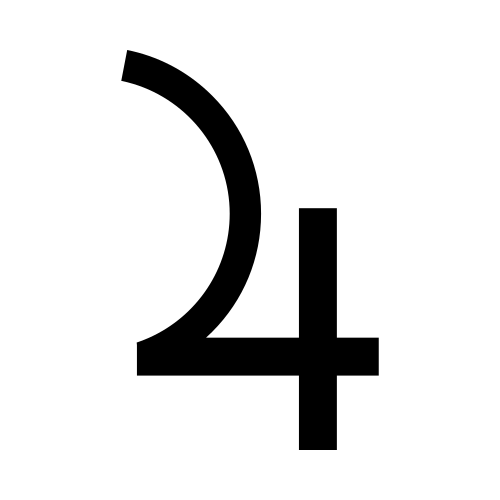 Jupiter
 Saturn
 Uranus
 Neptune
 Pluto
PlutoAstronomical context
Pluto travelled through Gemini from the mid-1880s to 1914. In astrological tradition this transit is associated with the transformation of communication, ideas, transport, and the press — the generation that came of age amid the spread of mass media, the telephone, and accelerating mobility.
Srinivasa Ramanujan (born 1887) belongs to this generational configuration. Astrian groups profiles by such shared signatures rather than by any claim of shared destiny. Related profiles in Astrian: Carl Friedrich Gauss · Leonhard Euler · Kurt Gödel. The symbolic reading is correlative, not causal.
Other profiles from this Pluto in Gemini generation
Symbolic reading
The following describes what classical astrological tradition associates with these configurations. Astrian does not apply these descriptions to the person's biography.
The Sun in Capricorn centres the chart on ambition, structure, and the long view. With the Ascendant in Cancer, tradition adds attachment, memory, and protection as the threshold through which that energy meets the world; the Sun marks the central drive, the Ascendant the manner of approach.
Among the personal planets, the Moon in Aries is associated in tradition with initiative, directness, and the will to begin; Mercury in Sagittarius with expansion, conviction, and the horizon; Venus in Scorpio with intensity, depth, and the will to transform; and Mars in Libra with balance, relationship, and proportion. These placements describe registers of feeling, thought, attraction, and action as the tradition catalogues them, independent of the life that follows.
Moon sextile Pluto (0°26'): tradition reads emotional life and instinct in supportive contact with depth, power, and transformation.
Mercury sextile Uranus (1°29'): tradition reads thought and communication in supportive contact with disruption and innovation.
Saturn sextile Pluto (1°55'): tradition reads structure, limitation, and discipline in supportive contact with depth, power, and transformation.
Jupiter opposite Neptune (2°10'): tradition reads expansion and meaning set in polarity with dissolution, imagination, and idealism.
These placements are presented as a symbolic portrait, correlative and never causal — a description within the tradition's vocabulary, not an explanation of the life that follows.
Astrology is a symbolic language with 2,500 years of literature. The reading above is interpretive, not explanatory.
Astrian does not claim that the natal chart of Srinivasa Ramanujan caused or determined any of the above. Astrology is a symbolic system with 2,500 years of literature. Its capacity for retrospective description does not imply explanatory capacity.
A parallel life
The following are verified biographical facts. No connection to the natal chart is implied.
Srinivasa Ramanujan Aiyangar was born on 22 December 1887 in Erode, in the Madras Presidency of British India. He grew up in Kumbakonam, where he showed an early and intense interest in mathematics. With limited access to formal instruction beyond school-level texts, he worked through problems independently and began filling notebooks with results, many of which were entirely original.
Ramanujan's formal education was interrupted when his absorption in mathematics led to failures in other subjects, causing him to lose scholarships. He worked for a time as a clerk at the Madras Port Trust while continuing to develop his mathematical ideas. In 1913 he wrote to the British mathematician G. H. Hardy at the University of Cambridge, enclosing a selection of his results. Hardy, recognising the extraordinary nature of the work, arranged for Ramanujan to travel to Cambridge.
Between 1914 and 1919, Ramanujan worked in Cambridge alongside Hardy and J. E. Littlewood. The collaboration was highly productive. Ramanujan contributed results in areas including the theory of partitions, the properties of highly composite numbers, modular equations, and approximations to pi. He and Hardy jointly developed what became known as the Hardy-Ramanujan asymptotic formula for the partition function.
Ramanujan was elected a Fellow of the Royal Society in 1918, one of the youngest individuals to receive that distinction at the time, and was elected a Fellow of Trinity College, Cambridge, the same year.
His health deteriorated significantly during his years in England, partly due to the climate and difficulties in maintaining his dietary practices. He returned to India in 1919. He died on 26 April 1920 in Chetput, Madras, at the age of 32. The notebooks he left behind, including what is known as the lost notebook discovered in 1976, continued to yield significant mathematical results decades after his death.
Biographical sources
- Kanigel, Robert. The Man Who Knew Infinity: A Life of the Genius Ramanujan. New York: Charles Scribner's Sons, 1991..
- Hardy, G. H. Ramanujan: Twelve Lectures on Subjects Suggested by His Life and Work. Cambridge: Cambridge University Press, 1940..
- Berndt, Bruce C., and Robert A. Rankin, eds. Ramanujan: Letters and Commentary. Providence: American Mathematical Society, 1995..
- Andrews, George E., and Bruce C. Berndt. Ramanujan's Lost Notebook. 5 vols. New York: Springer, 2005-2018..
This profile presents the sky at the birth of Srinivasa Ramanujan and verified facts of their biography. Astrian does not claim that astrology has predictive capacity or that the natal chart determines the trajectory of a life. Astrology is a symbolic system with 2,500 years of literature. Its capacity for retrospective description does not imply explanatory capacity.
Related profiles
Calculate your own birth chart with the same NASA JPL DE441 precision.
Calculate my birth chartLast updated: June 14, 2026
Newsletter
A short reading once a month, in your inbox.
A note on the symbolism of the season, recent editorial pieces, and what to look for in next month's sky. No predictions.
Support this project
Independent, no venture funding, no ads. A contribution keeps Astrian precise and free.
Support on Ko-fi (opens in new tab)