PROFILE · VISUAL ARTS
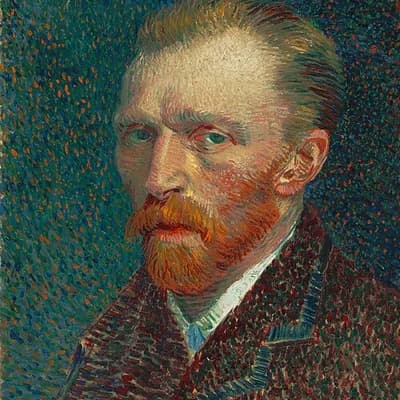
Vincent van Gogh
Vincent Willem van Gogh
painter
Born 30 March 1853 · Zundert, North Brabant, Netherlands · 51.47° N, 4.66° EX
Source: Birth time not documented in publicly accessible records
About this chart
No birth time is documented for this person. The chart therefore shows planetary positions in their signs, the slow aspects between them, and the generational context — but not house placements, the Ascendant, or the Midheaven, which require an accurate birth time. The Moon's sign carries a ±6° margin: if it falls near a sign boundary, the sign could vary. Positions for all other planets are reliable.
Do you have a verified source for this birth time? Share it →
The sky at birth
No birth time is documented for Vincent van Gogh. The Ascendant, Midheaven, and house positions cannot be determined. The planetary positions below are calculated for noon local time and are accurate to within a fraction of a degree for the slow-moving planets. The Moon's position carries a margin of approximately ±7°.
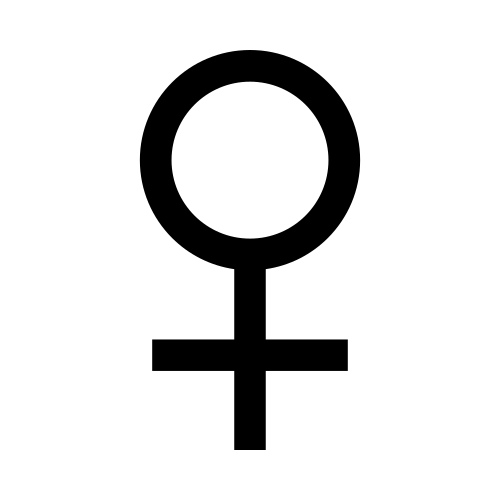
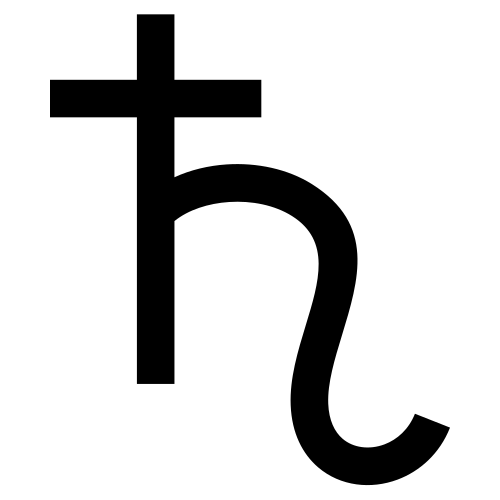
The Sun is at 9°42' Aries. The Moon is at 21°30' Sagittarius (noon position, ±7° margin). Mercury is at 25°36' Aries. Venus is at 28°07' Pisces. Mars is at 26°10' Pisces. Jupiter is at 24°16' Sagittarius. Saturn is at 15°57' Taurus. Uranus is at 6°47' Taurus. Neptune is at 12°13' Pisces. Pluto is at 0°46' Taurus.
Mercury at 25°36' Aries trines Jupiter at 24°16' Sagittarius (1°20') — the tightest major aspect in the chart. Mars at 26°10' Pisces squares Jupiter at 24°16' Sagittarius (1°54'). Venus at 28°07' Pisces conjoins Mars at 26°10' Pisces (1°57'). The Moon at 21°30' Sagittarius conjoins Jupiter at 24°16' Sagittarius (2°46'), though this aspect carries the Moon's ±7° uncertainty. Saturn at 15°57' Taurus sextiles Neptune at 12°13' Pisces (3°44'). Venus at 28°07' Pisces squares Jupiter (3°51'). The Moon trines Mercury (4°06'), under the Moon's uncertainty. The Moon squares Mars (4°40'), also under uncertainty. Mercury at 25°36' Aries conjoins Pluto at 0°46' Taurus (5°10') — an out-of-sign conjunction across the Aries-Taurus boundary. Uranus at 6°47' Taurus conjoins Pluto (6°01').
The engine also identifies the following tight minor aspects involving asteroids and calculated points: moon sesquiquadrate uranus (0.29° app); moon quincunx lilith (0.37° app); mercury semi-sextile mars (0.56° sep); jupiter opposition northNode (0.79° sep).
The tightest major aspects between planets: Mercury trine Jupiter (1°20'), Mars square Jupiter (1°54'), Venus conjunct Mars (1°57'), Moon conjunct Jupiter (2°46'), Saturn sextile Neptune (3°44'), Venus square Jupiter (3°51'), Moon trine Mercury (4°06'), Moon square Mars (4°40'), Mercury conjunct Pluto (5°10'), Uranus conjunct Pluto (6°01').
The chart was calculated by Astrian's engine using NASA JPL DE441 ephemerides, sub-arcsecond precision. Timezone: Europe/Amsterdam (Local Mean Time, UTC +0:20).
| Planet | Sign | Position |
|---|---|---|
| Sun | Aries | 09°41' |
| Moon | Sagittarius | 21°20'±6° |
| Mercury | Aries | 25°36' |
| Venus | Pisces | 28°06' |
| Mars | Pisces | 26°09' |
| Jupiter | Sagittarius | 24°16' |
| Saturn | Taurus | 15°57' |
| Uranus | Taurus | 06°47' |
| Neptune | Pisces | 12°13' |
| Pluto | Taurus | 00°46' |
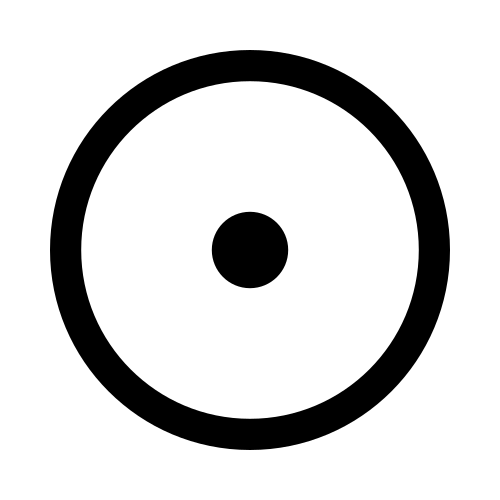 Sun
Sun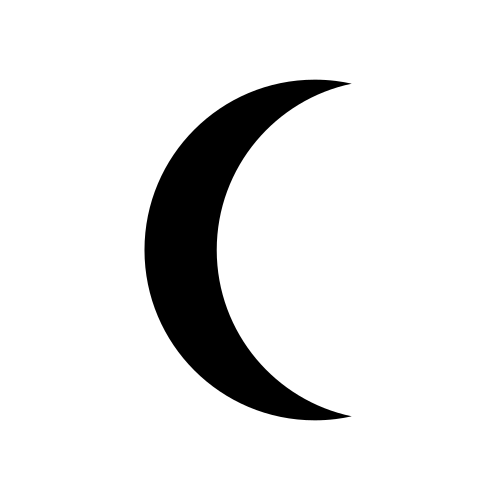 Moon
Moon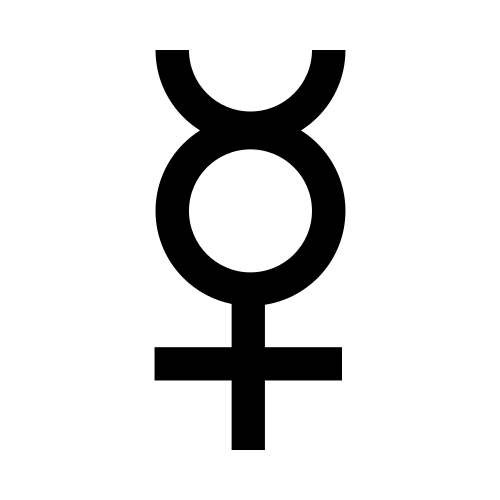 Mercury
 Venus
Venus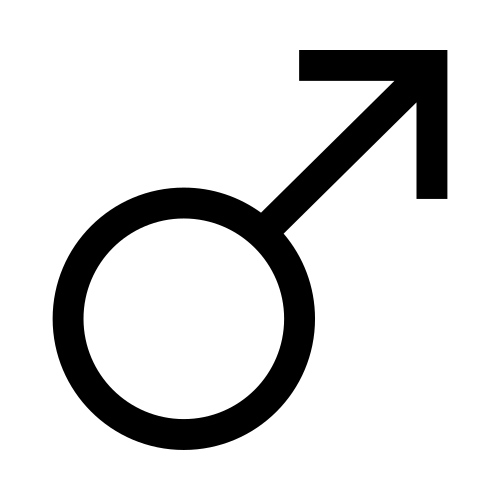 Mars
Mars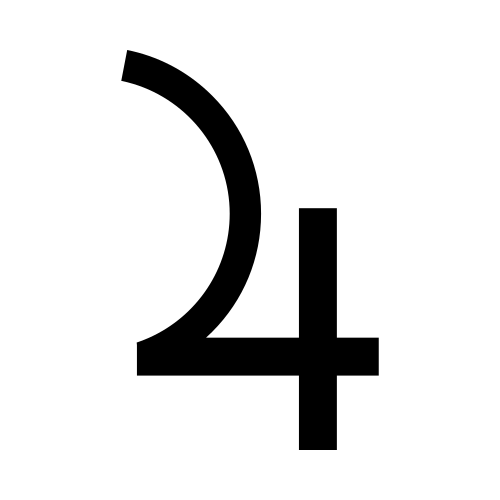 Jupiter
 Saturn
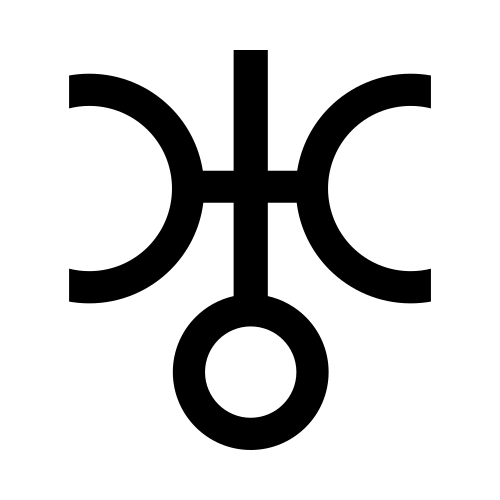 Uranus
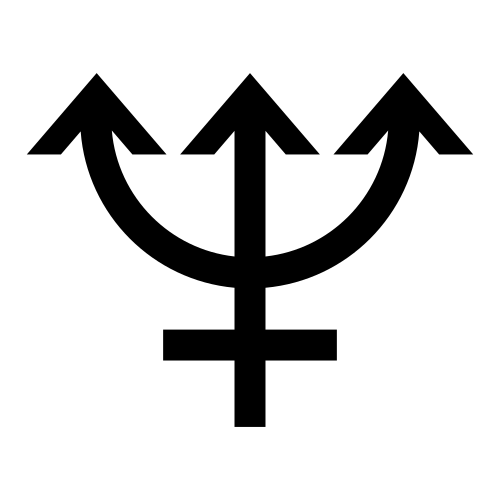 Neptune
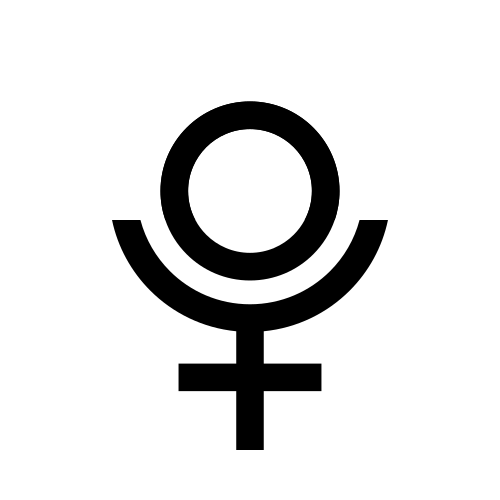 Pluto
PlutoBirth time unknown — house positions and Ascendant/MC are not available.
Astronomical context
Those born between approximately 1852 and 1884 carried Pluto in Taurus. This generation grew up inside the industrialization of the material world — the restructuring of agriculture, the rise of industrial capitalism, the transformation of mass labour, and the systematic exploitation of raw materials that produced the wealth of the Belle Époque and the colonial empires that sustained it. They came of age in a Europe where the old order was being dismantled by machines, markets, and the accumulation of capital at a scale never before seen.
In astrological tradition, Pluto in Taurus is associated with collective transformation of the domains that sign governs: material value, property, the physical body, the earth itself, and the slow accumulation of what endures. Taurus is the sign of the builder, of the one who makes what can be touched and possessed. Pluto's transit through Taurus coincided with the rise of industrial monopolies, the gold standard debates, the enclosure of common lands, and the first mass movements demanding that material value be distributed rather than hoarded. The symbolic reading is correlative, not causal.
Other profiles in the Astrian collection born under this configuration include Sigmund Freud (1856), Helen Keller (1880), and Pablo Picasso (1881). Vincent van Gogh, born in 1853, belongs to the earliest years of this generational wave.
Other profiles from this Pluto in Taurus generation
Symbolic reading
The following describes what classical astrological tradition associates with these configurations. Astrian does not apply these descriptions to the person's biography.
The Sun at 9°42' Aries is the most prominent structural feature of this chart. Without a documented birth time, there is no Ascendant or Midheaven — the reading is confined to planetary positions by sign and the aspects between planets.
The Moon at 21°30' Sagittarius represents the noon position; the actual placement falls within approximately 7° on either side. The Moon remains in Sagittarius for the entire day. Mercury at 25°36' Aries, Venus at 28°07' Pisces, and Mars at 26°10' Pisces complete the personal planet picture.
The chart is distributed across three signs: Aries (Sun and Mercury), Pisces (Venus, Mars, and Neptune), and Taurus (Saturn, Uranus, and Pluto). The fire and water signs carry the personal planets; the earth sign carries the structural and generational ones. There is a notable absence of planets in air signs, and the concentration in Pisces — the sign of dissolution, imagination, and the transcendence of material limits — is striking.
### Mercury trine Jupiter: the mind that reaches
Mercury at 25°36' Aries trines Jupiter at 24°16' Sagittarius, orb 1°20' — the tightest major aspect in the chart. Mercury governs communication, information processing, and the patterns by which the mind organizes reality. Jupiter governs expansion, generosity, and the instinct toward the large gesture. The trine connects them without friction: the communicative faculty and the expansive faculty flow together naturally.
Mercury in Aries processes with speed, directness, and the impulse to say what is seen before it is fully understood. Jupiter in Sagittarius expands through the register of meaning — the search for significance, the conviction that what is perceived has a larger truth beneath it. The trine reads as a mind that reaches instinctively toward the universal in the particular, that sees in a wheat field or a starry night something more than what is merely present.
### Venus conjunct Mars in Pisces: desire and action dissolved
Venus at 28°07' Pisces conjoins Mars at 26°10' Pisces, orb 1°57'. Venus governs value, desire, and the aesthetic sense. Mars governs action, assertion, and the physical body's capacity for effort. Their conjunction in Pisces places both faculties in the sign of dissolution, compassion, and the transcendence of form.
Venus-Mars conjunctions in the tradition are read as configurations where desire and action are fused — where what is wanted and what is done are not easily separated. In Pisces, this fusion operates through the register of the emotional, the spiritual, and the boundaryless. The desire is not for what is present but for what lies beyond; the action is not strategic but compulsive, driven by feeling rather than calculation.
Both square Jupiter at 24°16' Sagittarius (Mars 1°54', Venus 3°51'), creating a T-square. Jupiter in Sagittarius amplifies: the desire-action conjunction in Pisces is expanded to a scale that cannot be contained. The T-square connects the aesthetic impulse (Venus), the drive to act (Mars), and the expansive instinct (Jupiter) in a single configuration of tension — a pattern where the impulse to create is vast, the means of expression are fluid, and the pressure is relentless.
### The Pisces concentration: Venus, Mars, Neptune
Three planets in Pisces — Venus, Mars, and Neptune — create a substantial concentration in the sign of imagination, dissolution, and the transcendence of material limits. Neptune at 12°13' Pisces is the ruler of Pisces in modern astrology, operating in its own sign with full force. Saturn at 15°57' Taurus sextiles Neptune (3°44'), connecting the structuring faculty to the visionary one — a channel through which the dissolving, imagining capacity of Pisces can be given form.
The Moon at 21°30' Sagittarius (if near its noon position) conjoins Jupiter (2°46'), placing the emotional faculty alongside the expansive one in the sign of fire, conviction, and the search for meaning. The Moon also trines Mercury (4°06'), connecting feeling to the communicative mind.
The planetary pattern here is read as a symbolic portrait, not a causal explanation. No planet caused, predicted, or determined any event or characteristic.
Astrology is a symbolic language with 2,500 years of literature. The reading above is interpretive, not explanatory.
Astrian does not claim that the natal chart of Vincent van Gogh caused or determined any of the above. Astrology is a symbolic system with 2,500 years of literature. Its capacity for retrospective description does not imply explanatory capacity.
A parallel life
The following are verified biographical facts. No connection to the natal chart is implied.
Vincent Willem van Gogh was born on 30 March 1853 in Zundert, a village in the southern Dutch province of North Brabant, exactly one year after a stillborn brother who had been given the same name. His father, Theodorus van Gogh, was a minister of the Dutch Reformed Church. His mother, Anna Cornelia Carbentus, came from a family of booksellers. The household was respectable, provincial, and pious.
He began working at sixteen as a junior clerk at Goupil & Cie, an international art dealership with galleries in The Hague, London, and Paris. He was transferred to London in 1873, then to Paris in 1875, and was dismissed in 1876 after losing interest in commerce. He taught briefly at a school in Ramsgate, England, then became a lay preacher in the coal-mining district of the Borinage in Belgium, where he lived in conditions of extreme poverty, gave away his clothes and food, and was dismissed by the church authorities for excessive zeal.
He did not begin painting until 1881, at the age of twenty-seven. He had no formal training beyond a brief period at the Académie Royale des Beaux-Arts in Brussels and some months at the Antwerp Academy. He taught himself by copying prints, drawing from plaster casts, and painting the peasants and labourers of the Dutch countryside. The Potato Eaters (1885) — a dark, rough-textured painting of five peasants eating by lamplight — was his first major composition.
In February 1886, he moved to Paris, where his younger brother Theo worked as an art dealer. He discovered Impressionism, Neo-Impressionism, and Japanese woodblock prints. His palette lightened dramatically. He met Toulouse-Lautrec, Gauguin, Pissarro, and Signac. He painted more than two hundred works in two years.
In February 1888, he left Paris for Arles in Provence, seeking stronger light and brighter colour. The sixteen months in Arles were the most productive of his career: Sunflowers, the Bedroom series, The Night Café, Starry Night Over the Rhône, The Sower. He envisioned Arles as the site of a "Studio of the South," a colony of artists working together. Gauguin arrived in October 1888. Their cohabitation lasted nine weeks. On 23 December 1888, after a confrontation with Gauguin, van Gogh severed part of his own left ear with a razor and delivered the piece to a woman at a local brothel. Gauguin left. Van Gogh was hospitalized.
He voluntarily admitted himself to the Saint-Paul-de-Mausole asylum in Saint-Rémy-de-Provence in May 1889. He continued to paint through episodes of incapacitating illness — the diagnosis remains uncertain, with temporal lobe epilepsy, bipolar disorder, and acute intermittent porphyria among the proposals. The Starry Night was painted from his asylum window in June 1889.
In May 1890, he moved to Auvers-sur-Oise, north of Paris, under the care of Dr. Paul Gachet. He painted seventy canvases in seventy days. On 27 July 1890, he walked into a wheat field and shot himself in the chest with a revolver. He died two days later, at the age of thirty-seven, with Theo at his bedside.
He produced approximately 2,100 works — over 860 oil paintings and more than 1,200 drawings — in a decade. He sold one painting during his lifetime: The Red Vineyard, purchased for 400 francs in 1890.
Biographical sources
- Naifeh, Steven, and Gregory White Smith. Van Gogh: The Life. Random House 2011
- Hulsker, Jan. The Complete Van Gogh: Paintings, Drawings, Sketches. Harry N. Abrams 1980
This profile presents the sky at the birth of Vincent van Gogh and verified facts of their biography. Astrian does not claim that astrology has predictive capacity or that the natal chart determines the trajectory of a life. Astrology is a symbolic system with 2,500 years of literature. Its capacity for retrospective description does not imply explanatory capacity.
Related profiles
Calculate your own birth chart with the same NASA JPL DE441 precision.
Calculate my birth chartLast updated: June 12, 2026
Newsletter
A short reading once a month, in your inbox.
A note on the symbolism of the season, recent editorial pieces, and what to look for in next month's sky. No predictions.
Support this project
Independent, no venture funding, no ads. A contribution keeps Astrian precise and free.
Support on Ko-fi (opens in new tab)