PROFILE · SCIENCE & TECHNOLOGY
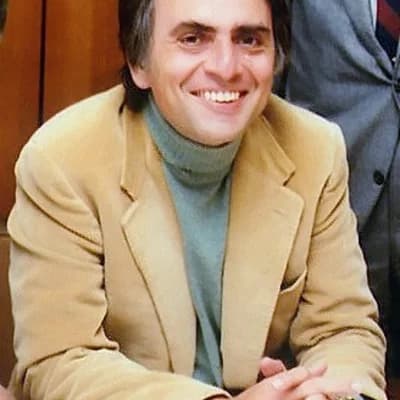
Carl Sagan
Carl Edward Sagan
astronomer
Born 9 November 1934 · Brooklyn, New York, United States · 40.68° N, 73.94° WX
Source: Birth time not documented in publicly accessible records
About this chart
No birth time is documented for this person. The chart therefore shows planetary positions in their signs, the slow aspects between them, and the generational context — but not house placements, the Ascendant, or the Midheaven, which require an accurate birth time. The Moon's sign carries a ±6° margin: if it falls near a sign boundary, the sign could vary. Positions for all other planets are reliable.
Do you have a verified source for this birth time? Share it →
The sky at birth
No birth time is documented for Carl Sagan. The Ascendant, Midheaven, and house positions cannot be determined. The planetary positions below are calculated for noon local time and are accurate to within a fraction of a degree for the slow-moving planets. The Moon's position carries a margin of approximately ±7°.
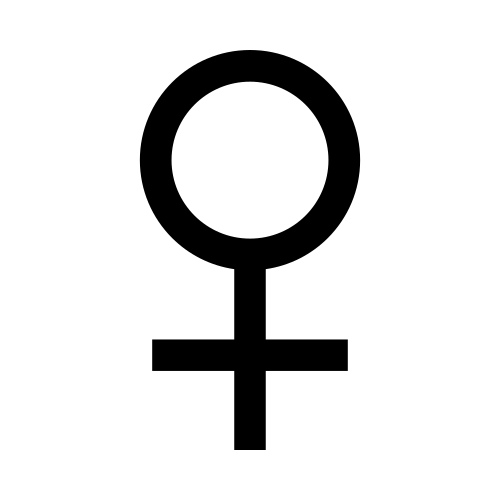
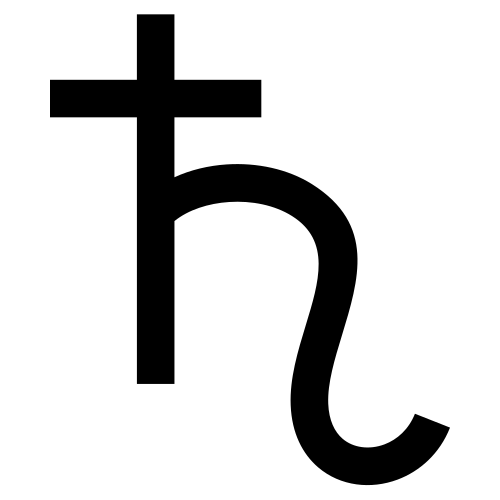
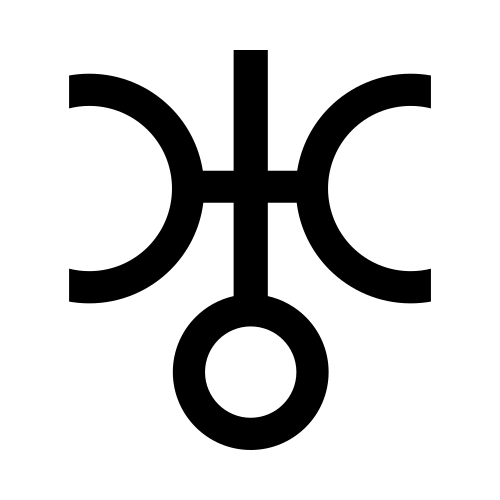
The Sun is at 16°36' Scorpio. The Moon is at 18°52' Sagittarius (noon position, ±7° margin). Mercury is at 3°33' Scorpio R. Venus is at 14°17' Scorpio. Mars is at 13°01' Virgo. Jupiter is at 6°25' Scorpio. Saturn is at 21°39' Aquarius. Uranus is at 28°45' Aries R. Neptune is at 14°11' Virgo. Pluto is at 26°02' Cancer R.
Venus at 14°17' Scorpio sextiles Neptune at 14°11' Virgo (0°06') — the tightest major aspect in the chart and one of the most exact Venus-Neptune sextiles in the Astrian collection. Mars at 13°01' Virgo conjoins Neptune (1°10'). The Sun at 16°36' Scorpio conjoins Venus (2°19'). The Sun sextiles Neptune (2°25'). The Sun sextiles Mars (3°35'). Mercury at 3°33' Scorpio retrograde conjoins Jupiter at 6°25' Scorpio (2°52'). Mercury opposes Uranus at 28°45' Aries retrograde (4°48'). Uranus squares Pluto at 26°02' Cancer retrograde (2°43'). The Sun squares Saturn at 21°39' Aquarius (5°03').
The engine also identifies the following tight minor aspects involving asteroids and calculated points: jupiter opposition pallas (0.02° sep); chiron quincunx juno (0.21° sep).
The tightest major aspects between planets: Venus sextile Neptune (0°06'), Mars conjunction Neptune (1°10'), Sun conjunction Venus (2°19'), Sun sextile Neptune (2°25'), Uranus square Pluto (2°43'), Mercury conjunction Jupiter (2°52'), Sun sextile Mars (3°35'), Mercury opposition Uranus (4°48').
The chart was calculated by Astrian's engine using NASA JPL DE441 ephemerides, sub-arcsecond precision. Timezone: Eastern Standard Time (America/New_York, UTC −5).
| Planet | Sign | Position |
|---|---|---|
| Sun | Scorpio | 16°36' |
| Moon | Sagittarius | 18°52'±6° |
| Mercury | Scorpio | 03°33'retrograde |
| Venus | Scorpio | 14°17' |
| Mars | Virgo | 13°01' |
| Jupiter | Scorpio | 06°25' |
| Saturn | Aquarius | 21°39' |
| Uranus | Aries | 28°45'retrograde |
| Neptune | Virgo | 14°11' |
| Pluto | Cancer | 26°02'retrograde |
| Chiron | Gemini | 08°23'retrograde |
 Sun
Sun Moon
Moon Mercury
 Venus
Venus Mars
Mars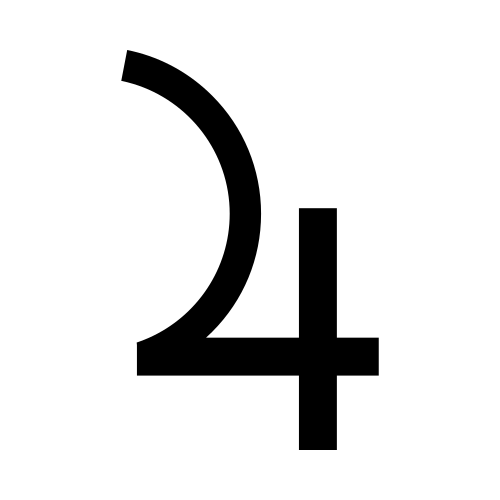 Jupiter
 Saturn
 Uranus
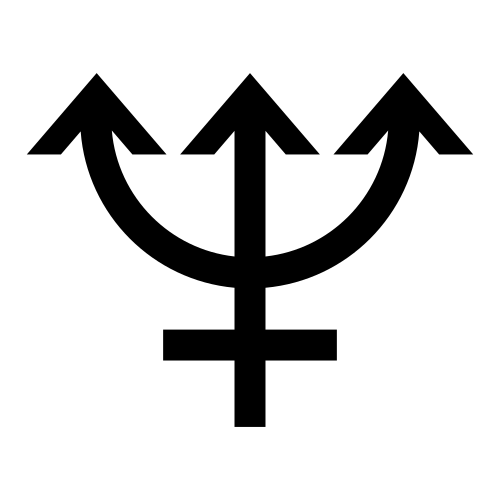 Neptune
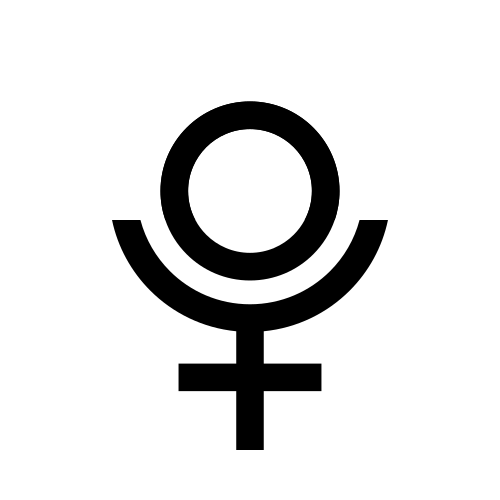 Pluto
Pluto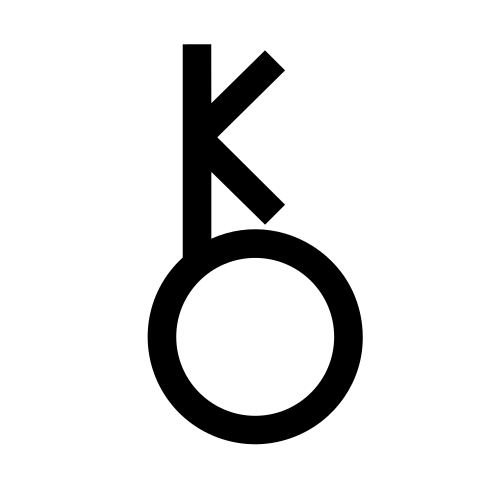 Chiron
Birth time unknown — house positions and Ascendant/MC are not available.
Astronomical context
Those born between approximately 1914 and 1939 carried Pluto in Cancer. This generation lived through two world wars and the Great Depression — a sustained period of upheaval that transformed the meaning of home, national identity, and collective security. They came of age during the Second World War or its immediate aftermath, and they built the institutions of the postwar order: the United Nations, NATO, the welfare state, the space programme.
In astrological tradition, Pluto in Cancer is associated with collective transformation of the domains that sign governs: home, family, emotional security, the nation, and the structures of belonging through which individuals root themselves in the world. Cancer is the sign of the hearth, the mother, the homeland. Pluto's transit through Cancer is read, symbolically, as a period when the institutions of domestic security were subjected to destruction and reconstruction on a civilisational scale. The generation that carries this placement grew up watching borders dissolve and reform, families scatter and reconvene, and the idea of safety itself become something that had to be rebuilt from the ruins. The symbolic reading is correlative, not causal.
Others in the Astrian collection born under this configuration include Martin Luther King (1929) and Nelson Mandela (1918). Carl Sagan, born in 1934, belongs to the final years of this generational wave.
Other profiles from this Pluto in Cancer generation
Symbolic reading
The following describes what classical astrological tradition associates with these configurations. Astrian does not apply these descriptions to the person's biography.
The Sun at 16°36' Scorpio is the most prominent structural feature of this chart. Without a documented birth time, there is no Ascendant or Midheaven — the reading is confined to planetary positions by sign and the aspects between planets.
The Moon at 18°52' Sagittarius represents the noon position; the actual placement falls within approximately 7° on either side. If born early in the day, the Moon could be in the low teens of Sagittarius; if born late, in the mid-twenties. The Moon's sign placement in Sagittarius is secure for the entire day.
Mercury at 3°33' Scorpio retrograde, Venus at 14°17' Scorpio, and Mars at 13°01' Virgo complete the personal planet picture.
### The Scorpio concentration
Four bodies occupy Scorpio: Mercury at 3°33' retrograde, Jupiter at 6°25', Venus at 14°17', and the Sun at 16°36'. This concentration across 13° of a single sign is a structural feature independent of the birth time. Unlike a Scorpio stellium composed entirely of personal planets, this one includes Jupiter — the planet of expansion, meaning, and the impulse to reach beyond the immediate — fused with the communicative faculty (Mercury), the aesthetic sense (Venus), and the identity itself (Sun).
In the vocabulary of the tradition, Scorpio governs depth, intensity, the encounter with what is hidden, the psychology of power, and the capacity for transformation through confrontation rather than evasion. It is the sign of the investigator — the impulse directed not toward surface presentation but toward what lies beneath. A concentration of four bodies in Scorpio directs the identity, the perception, the sense of beauty, and the impulse toward meaning through this single register: everything passes through the demand to go deeper.
Mercury retrograde in Scorpio adds a quality of inward-turning investigation — the mind that revisits, re-examines, and refuses to accept the first answer. Conjoined with Jupiter (2°52'), the investigative mind is also expansive: it does not merely probe but seeks to connect what it finds to the largest possible frame of reference.
### Venus sextile Neptune: beauty in the invisible
Venus at 14°17' Scorpio sextiles Neptune at 14°11' Virgo, orb 0°06' — the tightest major aspect in the chart, functionally exact, and one of the most precise Venus-Neptune aspects in the Astrian collection. Venus governs aesthetics, the sense of beauty, and the capacity to perceive value. Neptune governs the ideal, the imaginary, and the dissolution of ordinary boundaries. The sextile connects them cooperatively — the sense of beauty is drawn toward what cannot be seen directly, what exceeds the ordinary categories of the visible.
Venus in Scorpio perceives beauty in depth, in hidden structures, in the intensity of encounter. Neptune in Virgo operates through the register of method, precision, and the sacred in the quotidian. The sextile between them reads as an aesthetic faculty attuned to the beauty of invisible structures revealed through careful method — the beauty of data that points toward something larger than itself.
### Mars conjunction Neptune: action through vision
Mars at 13°01' Virgo conjoins Neptune at 14°11' Virgo, orb 1°10'. Mars governs action, physical will, and the application of force. Neptune governs the ideal and the imaginary. The conjunction fuses them — action is not separate from imagination but inseparable from it. In Virgo, this fusion operates through the register of method, precision, and service: the will to act is directed by a vision that demands meticulous execution.
The Sun in Scorpio sextiles both Mars (3°35') and Neptune (2°25'), creating a triangular pattern that connects the identity to this Mars-Neptune conjunction. The identity draws energy from the fusion of action and imagination, and the fusion operates through the Virgo register of craft and precision.
### Mercury conjunction Jupiter: the expansive investigator
Mercury at 3°33' Scorpio retrograde conjoins Jupiter at 6°25' Scorpio, orb 2°52'. Mercury governs communication, perception, and the faculty of analysis. Jupiter governs expansion, meaning, and the impulse to connect the particular to the universal. The conjunction fuses the analytical and the expansive — the mind that investigates also narrates, and the narrative aspires to the largest possible scale.
Mercury retrograde gives this conjunction an inward quality: the communication is not casual or spontaneous but the product of sustained reflection. In Scorpio, the reflection concerns what is hidden, what demands confrontation, what cannot be understood without going beneath the surface.
### Mercury opposition Uranus: the mind that breaks frames
Mercury at 3°33' Scorpio retrograde opposes Uranus at 28°45' Aries retrograde, orb 4°48'. The opposition places the investigative mind on one side and the disruptive, originality-driven intelligence on the other. Mercury-Uranus oppositions in the tradition are read as configurations that produce a mind capable of seeing what others cannot, precisely because it operates outside conventional frames. The two retrogrades intensify the inward quality: the original thinking is not performed for an audience but arises from a genuinely different way of processing information.
The planetary pattern here is read as a symbolic portrait, not a causal explanation. No planet caused, predicted, or determined any event or characteristic.
Astrology is a symbolic language with 2,500 years of literature. The reading above is interpretive, not explanatory.
Astrian does not claim that the natal chart of Carl Sagan caused or determined any of the above. Astrology is a symbolic system with 2,500 years of literature. Its capacity for retrospective description does not imply explanatory capacity.
A parallel life
The following are verified biographical facts. No connection to the natal chart is implied.
Carl Edward Sagan was born on 9 November 1934 in Brooklyn, New York, the son of Samuel Sagan, a garment worker who had emigrated from the Russian Empire, and Rachel Molly Gruber. The family was Jewish, working-class, and deeply marked by the awareness that relatives who had not emigrated had perished in the Holocaust. He later attributed his sense of cosmic perspective partly to growing up in a family acutely conscious of how thin the margin was between existence and annihilation.
He attended the University of Chicago, where he earned his bachelor's degree in physics in 1955, a second bachelor's in general studies in 1956, a master's in physics in 1956, and his doctorate in astronomy and astrophysics in 1960. The doctoral work concerned the atmospheric conditions of Venus — a planet he would return to throughout his career. He joined Harvard in 1962 and was denied tenure in 1968, a decision widely attributed to his growing public visibility, which some colleagues regarded as incompatible with serious research. He moved to Cornell University, where he remained until his death.
His NASA work began in the early 1960s and continued for three decades. He contributed to the Mariner missions to Venus, the Viking landers on Mars, the Voyager programme to the outer planets, and the Galileo mission to Jupiter. He designed the Pioneer plaque (1972) — the first physical message carried by a spacecraft beyond the solar system — and co-created the Voyager Golden Record (1977), a selection of sounds and images intended to represent Earth to any intelligence that might encounter it.
His published work ranged across formats and audiences. The Cosmic Connection (1973) established his voice as a popular science writer. The Dragons of Eden (1977) won the Pulitzer Prize for General Non-Fiction. Broca's Brain (1979) explored the intersection of neuroscience and speculative thought. The television series Cosmos: A Personal Voyage (1980), which he co-wrote and presented, was watched by more than 500 million people in sixty countries and remains one of the most widely seen science programmes in broadcast history. The companion book sold millions of copies in dozens of languages.
The novel Contact (1985), later adapted into a film starring Jodie Foster (1997), explored the implications of receiving a message from an extraterrestrial intelligence — a subject he had pursued seriously throughout his scientific career as an advocate for the Search for Extraterrestrial Intelligence (SETI). He co-founded the Planetary Society with Bruce Murray and Louis Friedman in 1980.
In 1983, he co-authored the "TTAPS" paper (with Richard Turco, Owen Toon, Thomas Ackerman, and James Pollack) that modelled the climatic consequences of nuclear war, introducing the concept of nuclear winter into public discourse. The work made him one of the most prominent scientific voices against the arms race.
Pale Blue Dot (1994) took its title from a photograph of Earth taken by Voyager 1 from beyond the orbit of Neptune — a speck of light in a sunbeam — and used it as the starting point for a meditation on the fragility and significance of the planet. The passage in which he described the photograph became one of the most widely quoted texts in popular science.
He married three times: to the biologist Lynn Margulis (1957–1964), with whom he had two sons; to the artist Linda Salzman (1968–1981), with whom he had one son; and to the writer and producer Ann Druyan (1981–1996), with whom he had two children and who became his closest creative collaborator. He died on 20 December 1996 in Seattle, of pneumonia secondary to myelodysplastic syndrome, at the age of sixty-two.
Biographical sources
- Davidson, Keay. Carl Sagan: A Life. John Wiley & Sons 1999
- Poundstone, William. Carl Sagan: A Life in the Cosmos. Henry Holt 1999
This profile presents the sky at the birth of Carl Sagan and verified facts of their biography. Astrian does not claim that astrology has predictive capacity or that the natal chart determines the trajectory of a life. Astrology is a symbolic system with 2,500 years of literature. Its capacity for retrospective description does not imply explanatory capacity.
Calculate your own birth chart with the same NASA JPL DE441 precision.
Calculate my birth chartLast updated: June 12, 2026
Newsletter
A short reading once a month, in your inbox.
A note on the symbolism of the season, recent editorial pieces, and what to look for in next month's sky. No predictions.
Support this project
Independent, no venture funding, no ads. A contribution keeps Astrian precise and free.
Support on Ko-fi (opens in new tab)