PROFILE · POLITICIANS
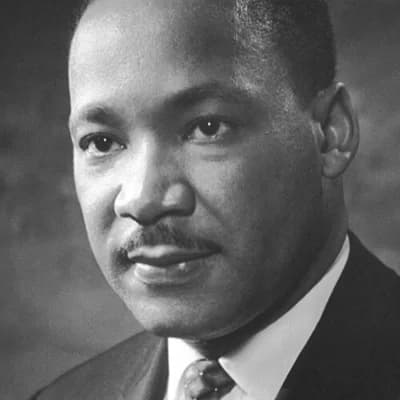
Martin Luther King Jr.
Michael King Jr.
civil rights leader and minister
Born 15 January 1929 · Atlanta, Georgia, United States · 33.75° N, 84.39° WX
Source: Birth time not documented in publicly accessible records
About this chart
No birth time is documented for this person. The chart therefore shows planetary positions in their signs, the slow aspects between them, and the generational context — but not house placements, the Ascendant, or the Midheaven, which require an accurate birth time. The Moon's sign carries a ±6° margin: if it falls near a sign boundary, the sign could vary. Positions for all other planets are reliable.
Do you have a verified source for this birth time? Share it →
The sky at birth
No birth time is documented for Martin Luther King Jr. The Ascendant, Midheaven, and house positions cannot be determined. The planetary positions below are calculated for noon local time and are accurate to within a fraction of a degree for the slow-moving planets. The Moon's position carries a margin of approximately ±7°.
The Sun is at 25°05' Capricorn. The Moon is at 19°02' Pisces (noon position, ±7° margin). Mercury is at 11°41' Aquarius. Venus is at 10°30' Pisces. Mars is at 21°54' Gemini R. Jupiter is at 1°10' Taurus. Saturn is at 25°20' Sagittarius. Uranus is at 3°57' Aries. Neptune is at 0°53' Virgo R. Pluto is at 17°08' Cancer R.
Jupiter at 1°10' Taurus trines Neptune at 0°53' Virgo retrograde (0°17') — the tightest major aspect in the chart, functionally exact. The Moon at 19°02' Pisces trines Pluto at 17°08' Cancer retrograde (1°54'), though this aspect carries the Moon's ±7° uncertainty. The Moon squares Mars at 21°54' Gemini retrograde (2°52'), also within the Moon's uncertainty margin. Mars at 21°54' Gemini retrograde opposes Saturn at 25°20' Sagittarius (3°26').
The engine also identifies the following tight minor aspects involving asteroids and calculated points: ceres trine juno (0.15° sep); jupiter sesquiquadrate lilith (0.16° sep); mars trine pallas (0.23° app); sun semi-sextile saturn (0.26° app).
The tightest major aspects between planets: Jupiter trine Neptune (0°17'), Moon trine Pluto (1°54'), Moon square Mars (2°52'), Mars opposition Saturn (3°26').
The chart was calculated by Astrian's engine using NASA JPL DE441 ephemerides, sub-arcsecond precision. Timezone: America/New_York (Eastern Standard Time, UTC −5).
| Planet | Sign | Position |
|---|---|---|
| Sun | Capricorn | 25°05' |
| Moon | Pisces | 19°02'±6° |
| Mercury | Aquarius | 11°41' |
| Venus | Pisces | 10°30' |
| Mars | Gemini | 21°54'retrograde |
| Jupiter | Taurus | 01°10' |
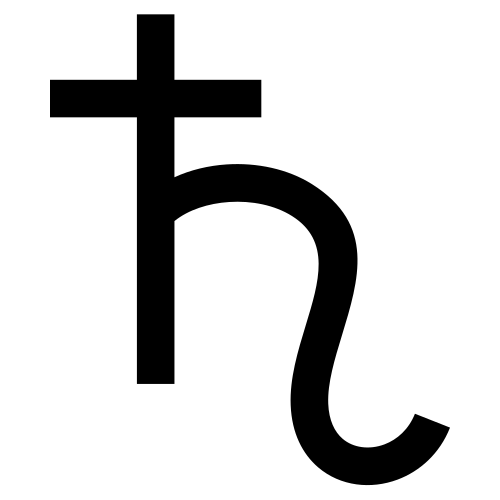
| Saturn | Sagittarius | 25°20' |
| Uranus | Aries | 03°57' |
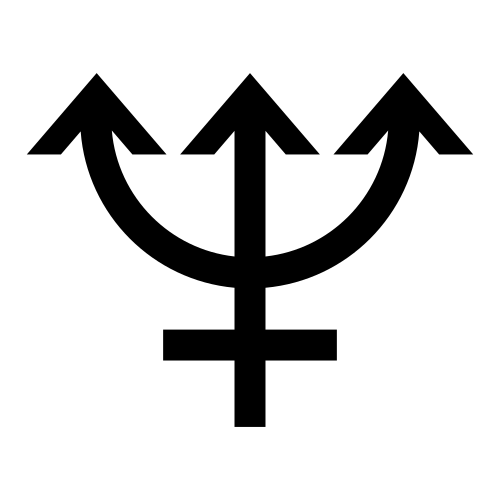
| Neptune | Virgo | 00°53'retrograde |
| Pluto | Cancer | 17°08'retrograde |
| Chiron | Taurus | 05°25' |
 Sun
Sun Moon
Moon Mercury
 Venus
Venus Mars
Mars Jupiter
 Saturn
 Uranus
 Neptune
 Pluto
Pluto Chiron
Birth time unknown — house positions and Ascendant/MC are not available.
Astronomical context
Those born between approximately 1914 and 1939 carried Pluto in Cancer. This generation lived through two world wars, the Great Depression, the collapse and reconstruction of colonial empires, and the founding of the international institutions — the United Nations, the Bretton Woods system, the Universal Declaration of Human Rights — that attempted to impose a new order on the wreckage. The defining experience of this generational cohort was the destruction and rebuilding of the structures of collective security, national identity, and home.
In astrological tradition, Pluto in Cancer is associated with collective transformation of the domains that sign governs: home, family, nation, roots, belonging, and the emotional foundations of collective life. Cancer is the sign of the nurturer, the protector, the one who builds walls around what is loved in order to keep it safe. Pluto's transit through Cancer is read, symbolically, as a period when those walls were breached — when the sanctity of home, nation, and belonging was shattered by forces beyond individual control, and when the generation that carried this placement was compelled to rebuild the foundations of collective security from the ground up. The symbolic reading is correlative, not causal.
Other profiles in the Astrian collection born under this configuration include Nelson Mandela (1918), Carl Sagan (1934), and Richard Feynman (1918). Martin Luther King Jr., born in 1929, belongs to the middle years of this generational wave.
Other profiles from this Pluto in Cancer generation
Symbolic reading
The following describes what classical astrological tradition associates with these configurations. Astrian does not apply these descriptions to the person's biography.
The Sun at 25°05' Capricorn is the most prominent structural feature of this chart. Without a documented birth time, there is no Ascendant or Midheaven — the reading is confined to planetary positions by sign and the aspects between planets.
The Moon at 19°02' Pisces represents the noon position; the actual placement falls within approximately 7° on either side. If born early in the day, the Moon could be near 12° Pisces; if born late, near 26° Pisces. The Moon's sign placement in Pisces is stable for the entire day.
Mercury at 11°41' Aquarius, Venus at 10°30' Pisces, and Mars at 21°54' Gemini retrograde complete the personal planet picture. Venus in Pisces — the sign of its traditional exaltation — occupies a position associated in the tradition with the highest expression of the Venusian faculty: compassion, aesthetic sensitivity, and the love that dissolves boundaries.
### Jupiter trine Neptune: the vision and the faith
The chart's tightest major aspect is Jupiter at 1°10' Taurus trine Neptune at 0°53' Virgo retrograde, orb 0°17' — functionally exact. Jupiter governs expansion, generosity, philosophy, and the instinct toward justice on a large scale. Neptune governs the ideal, the transcendent, the dissolution of boundaries, and the vision that exceeds what is materially present. Their trine connects them in the most cooperative of the major aspects: the flow between them is unobstructed.
Jupiter in Taurus grounds the expansive faculty in the material — what is valued, what is built, what endures. Neptune in Virgo retrograde places the ideal within the domain of service, labour, and the practical work of healing. The trine reads as a configuration where the vision (Neptune) and the faith (Jupiter) operate in seamless cooperation — where the ideal is not abstract but finds expression through material service, and where the capacity for faith is rooted in the earth rather than floating above it. In a chart defined by Capricorn discipline and Pisces compassion, this near-exact trine functions as the primary structural engine: a deep alignment between what is believed and what is done in service of that belief.
### Moon trine Pluto: emotional depth and transformative feeling
The Moon at 19°02' Pisces trines Pluto at 17°08' Cancer retrograde, orb 1°54' — though this aspect carries the Moon's ±7° uncertainty. If the actual birth time places the Moon near its noon position, the emotional faculty (Moon in Pisces — the feelings that absorb everything, that dissolve the boundary between self and other, that feel what others feel) flows cooperatively with Pluto (the force of transformation at the deepest structural level, operating through the domain of home and belonging in Cancer). The trine reads as an emotional life of extraordinary depth and power — a capacity to feel at a level that transforms not just the individual but the collective.
### Mars opposition Saturn: action against structure
Mars at 21°54' Gemini retrograde opposes Saturn at 25°20' Sagittarius, orb 3°26'. Mars governs action, assertion, and the capacity for conflict. Saturn governs discipline, authority, and the established order. The opposition places them in direct confrontation across the axis of communication (Gemini) and philosophy (Sagittarius). Mars retrograde in Gemini acts through language, through the spoken and written word, through communication as a form of action. Saturn in Sagittarius represents the weight of established philosophical and institutional authority.
The opposition reads as a configuration where the will to act is directed against the structures of established authority — and where the instrument of that confrontation is language. The retrograde condition of Mars suggests an action that is not impulsive but turned inward, refined, considered, and deployed with strategic precision. The reading is one of disciplined confrontation with institutional power through the faculty of speech.
### Moon square Mars: the tension between compassion and conflict
The Moon at 19°02' Pisces squares Mars at 21°54' Gemini retrograde, orb 2°52' — within the Moon's ±7° uncertainty. The square creates structural tension between the emotional faculty (Moon in Pisces — compassion, absorption, the dissolution of boundaries) and the capacity for action and conflict (Mars in Gemini — action through language, through the mind, through articulation). The reading is one where the compassion and the combativeness do not flow easily into each other — where the depth of feeling presses against the need to act, and the tension between them generates compressed power.
The planetary pattern here is read as a symbolic portrait, not a causal explanation. No planet caused, predicted, or determined any event or characteristic.
Astrology is a symbolic language with 2,500 years of literature. The reading above is interpretive, not explanatory.
Astrian does not claim that the natal chart of Martin Luther King Jr. caused or determined any of the above. Astrology is a symbolic system with 2,500 years of literature. Its capacity for retrospective description does not imply explanatory capacity.
A parallel life
The following are verified biographical facts. No connection to the natal chart is implied.
Michael King Jr. was born on 15 January 1929 in Atlanta, Georgia, the middle child of Michael King Sr., a Baptist minister at Ebenezer Baptist Church, and Alberta Williams King, a schoolteacher and church organist. His father changed both their names to Martin Luther King in 1934, after a trip to Germany and Palestine, in honour of the Protestant reformer. The family belonged to the Black middle class of Atlanta — educated, churched, and socially prominent within the constraints of Jim Crow segregation.
He was precocious and troubled. He skipped ninth and twelfth grades and entered Morehouse College at fifteen. He was ordained as a Baptist minister at eighteen. He earned a Bachelor of Divinity from Crozer Theological Seminary in 1951 and a PhD in systematic theology from Boston University in 1955. His doctoral dissertation was later found to contain substantial sections of unattributed borrowing — a fact documented by his biographers and by the Martin Luther King Jr. Papers Project at Stanford University.
In Boston he met Coretta Scott, a music student from Alabama. They married in 1953. In 1954, at twenty-five, he became pastor of Dexter Avenue Baptist Church in Montgomery, Alabama.
On 1 December 1955, Rosa Parks was arrested for refusing to give up her seat on a Montgomery city bus. King was elected president of the Montgomery Improvement Association and led the subsequent bus boycott, which lasted 381 days and ended with a federal court ruling that bus segregation was unconstitutional. He was twenty-six. His house was bombed. He was arrested. He did not stop.
Over the next twelve years he led a campaign of nonviolent direct action that dismantled the legal architecture of racial segregation in the American South. The philosophy drew on the same sources as Gandhi's Satyagraha — the Sermon on the Mount, Thoreau's Civil Disobedience, the Gandhian method of truth-force — and on the African American prophetic tradition, the Black church, and the theology of Reinhold Niebuhr. Nonviolence was not passive resistance; it was the deliberate provocation of a confrontation that exposed the violence of the system being resisted, conducted in full view of the press and the television cameras that carried the images to the nation.
The Southern Christian Leadership Conference, which he co-founded in 1957, organised a series of campaigns that became the defining events of the American civil rights movement. The sit-ins. The Freedom Rides. The Birmingham Campaign of 1963, where police under Commissioner Bull Connor used fire hoses and attack dogs against peaceful demonstrators, including children — images that shocked the nation and forced President Kennedy to propose comprehensive civil rights legislation. The March on Washington on 28 August 1963, where King delivered the "I Have a Dream" speech to 250,000 people on the steps of the Lincoln Memorial.
He was awarded the Nobel Peace Prize in 1964, at thirty-five — the youngest man to receive the award at that time. The Civil Rights Act of 1964 and the Voting Rights Act of 1965 were the legislative fruits of the movement he led.
But the victories did not end the struggle. After 1965 he turned his attention to the interconnected problems of poverty, militarism, and racism — what he called the triple evils. He opposed the Vietnam War publicly and forcefully, losing the support of President Johnson and many white liberal allies. He organised the Poor People's Campaign, a planned occupation of Washington, D.C. by poor Americans of all races, designed to force a national reckoning with economic injustice. He became increasingly radical in his analysis, arguing that the problem was not just segregation but the economic structure that perpetuated inequality.
On the evening of 4 April 1968, standing on the balcony of the Lorraine Motel in Memphis, Tennessee — where he had gone to support a sanitation workers' strike — he was shot by James Earl Ray. He died at St. Joseph's Hospital. He was thirty-nine.
Biographical sources
- Branch, Taylor. Parting the Waters: America in the King Years 1954–63. Simon & Schuster 1988
- Branch, Taylor. Pillar of Fire: America in the King Years 1963–65. Simon & Schuster 1998
- Branch, Taylor. At Canaan's Edge: America in the King Years 1965–68. Simon & Schuster 2006
This profile presents the sky at the birth of Martin Luther King Jr. and verified facts of their biography. Astrian does not claim that astrology has predictive capacity or that the natal chart determines the trajectory of a life. Astrology is a symbolic system with 2,500 years of literature. Its capacity for retrospective description does not imply explanatory capacity.
Calculate your own birth chart with the same NASA JPL DE441 precision.
Calculate my birth chartLast updated: June 12, 2026
Newsletter
A short reading once a month, in your inbox.
A note on the symbolism of the season, recent editorial pieces, and what to look for in next month's sky. No predictions.
Support this project
Independent, no venture funding, no ads. A contribution keeps Astrian precise and free.
Support on Ko-fi (opens in new tab)