PROFILE · POLITICIANS
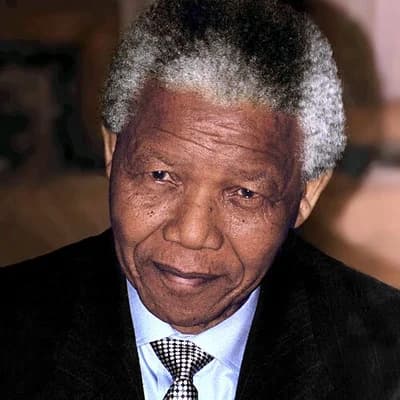
Nelson Mandela
Nelson Rolihlahla Mandela
anti-apartheid activist and statesman
Born 18 July 1918 · Mvezo, Eastern Cape, South Africa · 31.95° S, 28.63° EX
Source: Birth time not documented in publicly accessible records
About this chart
No birth time is documented for this person. The chart therefore shows planetary positions in their signs, the slow aspects between them, and the generational context — but not house placements, the Ascendant, or the Midheaven, which require an accurate birth time. The Moon's sign carries a ±6° margin: if it falls near a sign boundary, the sign could vary. Positions for all other planets are reliable.
Do you have a verified source for this birth time? Share it →
The sky at birth
No birth time is documented for Nelson Mandela. The Ascendant, Midheaven, and house positions cannot be determined. The planetary positions below are calculated for noon local time and are accurate to within a fraction of a degree for the slow-moving planets. The Moon's position carries a margin of approximately ±7°.
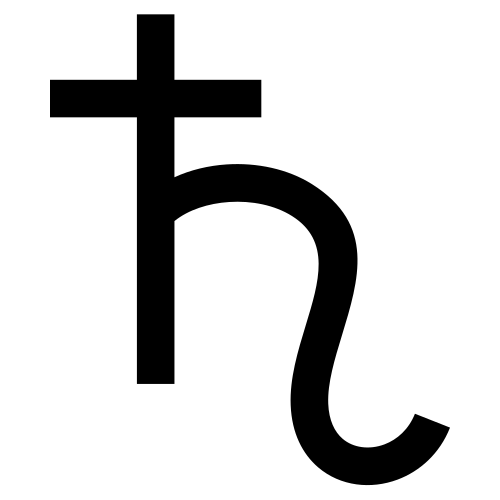
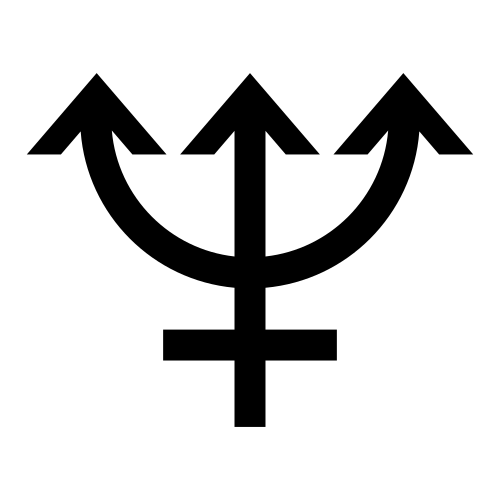
The Sun is at 24°57' Cancer. The Moon is at 18°46' Scorpio (noon position, ±7° margin). Mercury is at 15°56' Leo. Venus is at 22°26' Gemini. Mars is at 12°30' Libra. Jupiter is at 1°08' Cancer. Saturn is at 15°01' Leo. Uranus is at 26°55' Aquarius R. Neptune is at 6°22' Leo. Pluto is at 5°32' Cancer.
Mercury at 15°56' Leo conjoins Saturn at 15°01' Leo (0°55') — the tightest major aspect in the chart. Mars at 12°30' Libra sextiles Saturn (2°31'). The Moon at 18°46' Scorpio squares Mercury (2°50'), though this aspect carries the Moon's ±7° uncertainty. Mercury sextiles Mars (3°26'). The Moon squares Saturn (3°45'), also within the Moon's uncertainty margin. Jupiter at 1°08' Cancer trines Uranus at 26°55' Aquarius retrograde (4°13'). Jupiter conjoins Pluto at 5°32' Cancer (4°24'). Venus at 22°26' Gemini trines Uranus (4°29').
The engine also identifies the following tight minor aspects involving asteroids and calculated points: sun semi-sextile vesta (0.10° app); mercury semi-square jupiter (0.20° app); moon sesquiquadrate chiron (0.36° sep); mars sesquiquadrate uranus (0.58° sep).
The tightest major aspects between planets: Mercury conjunction Saturn (0°55'), Mars sextile Saturn (2°31'), Moon square Mercury (2°50'), Mercury sextile Mars (3°26'), Moon square Saturn (3°45'), Jupiter trine Uranus (4°13'), Jupiter conjunction Pluto (4°24'), Venus trine Uranus (4°29').
The chart was calculated by Astrian's engine using NASA JPL DE441 ephemerides, sub-arcsecond precision. Timezone: Africa/Johannesburg (South Africa Standard Time, UTC +2).
| Planet | Sign | Position |
|---|---|---|
| Sun | Cancer | 24°57' |
| Moon | Scorpio | 18°46'±6° |
| Mercury | Leo | 15°56' |
| Venus | Gemini | 22°26' |
| Mars | Libra | 12°30' |
| Jupiter | Cancer | 01°08' |
| Saturn | Leo | 15°01' |
| Uranus | Aquarius | 26°55'retrograde |
| Neptune | Leo | 06°22' |
| Pluto | Cancer | 05°32' |
| Chiron | Aries | 03°25'retrograde |
 Sun
Sun Moon
Moon Mercury
 Venus
Venus Mars
Mars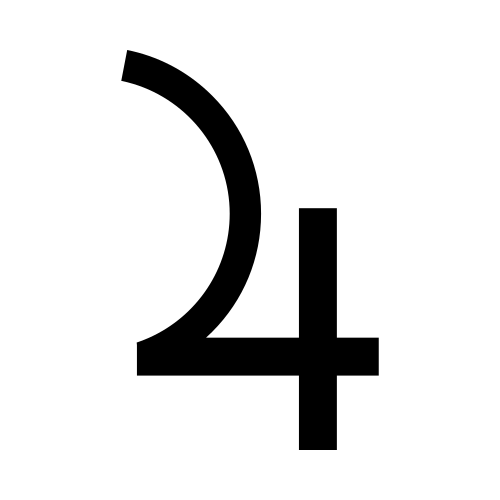 Jupiter
 Saturn
 Uranus
 Neptune
 Pluto
Pluto Chiron
Birth time unknown — house positions and Ascendant/MC are not available.
Astronomical context
Those born between approximately 1914 and 1939 carried Pluto in Cancer. This generation lived through two world wars, the Great Depression, the collapse and reconstruction of colonial empires, and the founding of the international institutions — the United Nations, the Bretton Woods system, the Universal Declaration of Human Rights — that attempted to impose order on the wreckage. The defining experience of this generational cohort was the destruction and rebuilding of the structures of collective security, national identity, and home.
In astrological tradition, Pluto in Cancer is associated with collective transformation of the domains that sign governs: home, family, nation, roots, belonging, and the emotional foundations of collective life. Cancer is the sign of the nurturer, the protector, the one who builds walls around what is loved in order to keep it safe. Pluto's transit through Cancer is read, symbolically, as a period when those walls were breached — when the sanctity of home, nation, and belonging was shattered by forces beyond individual control, and when the generation that carried this placement was compelled to rebuild the foundations of collective security from the ground up. The symbolic reading is correlative, not causal.
Other profiles in the Astrian collection born under this configuration include Martin Luther King (1929), Carl Sagan (1934), and Richard Feynman (1918). Nelson Mandela, born in 1918, belongs to the early years of this generational wave.
Other profiles from this Pluto in Cancer generation
Symbolic reading
The following describes what classical astrological tradition associates with these configurations. Astrian does not apply these descriptions to the person's biography.
The Sun at 24°57' Cancer is the most prominent structural feature of this chart. Without a documented birth time, there is no Ascendant or Midheaven — the reading is confined to planetary positions by sign and the aspects between planets.
The Moon at 18°46' Scorpio represents the noon position; the actual placement falls within approximately 7° on either side. If born early in the day, the Moon could be near 12° Scorpio; if born late, near 25° Scorpio. The Moon's sign placement in Scorpio is stable for the entire day.
Mercury at 15°56' Leo, Venus at 22°26' Gemini, and Mars at 12°30' Libra complete the personal planet picture. Mercury and Saturn both occupy Leo, while Mars in Libra — the sign of its detriment in traditional astrology — occupies a position with distinctive implications for how the will to act finds expression.
### Mercury conjunct Saturn in Leo: the disciplined mind
The chart's tightest major aspect is Mercury at 15°56' Leo conjunct Saturn at 15°01' Leo, orb 0°55'. Mercury governs communication, thought, and the organizing of information. Saturn governs discipline, structure, authority, and the weight of time. Their conjunction in Leo — the sign of the sovereign, the leader, the one who commands attention — fuses the intellectual faculty with Saturnian gravity. The mind works slowly, carefully, with an awareness of consequences. Language is not decorative; it is load-bearing. In the tradition, Mercury-Saturn conjunctions are read as configurations where thought is compressed under pressure until it becomes structural — where what is said carries the weight of what has been endured.
This is the tightest aspect in the chart by a substantial margin, and in a reading without houses or angles, it functions as the chart's primary signature.
### The Leo stellium: authority and its instruments
Mercury, Saturn, and Neptune all occupy Leo. Neptune at 6°22' Leo is too wide to conjoin the Mercury-Saturn pair, but its presence in the same sign adds a further dimension to the Leo emphasis. Three planets in the sign of sovereignty, leadership, and the heart: the chart concentrates a significant portion of its energy in the register of authority, dignity, and the assertion of selfhood in public.
Mars at 12°30' Libra sextiles Saturn at 15°01' Leo (2°31') and sextiles Mercury (3°26'). The sextile is a cooperative aspect. Mars governs action, assertion, and the capacity for conflict. In Libra — the sign of balance, justice, and the negotiation between opposing forces — Mars does not act through direct assault but through strategic positioning, through the balancing of forces, through the kind of action that seeks a just outcome rather than simple dominance. The sextile to Saturn structures this further: the will to act (Mars) finds disciplined form (Saturn) through the faculty of thought and communication (Mercury). Action serves justice; justice is articulated through a disciplined language; and the language carries the authority of endurance.
### Moon in Scorpio: the emotional depth
The Moon at 18°46' Scorpio (noon position, ±7° uncertainty) squares Mercury at 15°56' Leo (2°50') and Saturn at 15°01' Leo (3°45'). The square is a tension aspect. The emotional faculty (Moon in Scorpio — feelings of extraordinary depth, intensity, and tenacity) stands in structural tension with the Mercury-Saturn conjunction in Leo. The feelings do not flow easily into the disciplined language of Mercury-Saturn; they press against it, create friction, demand expression through a register that the controlled Saturnian mind may resist. The reading is one where the emotional life runs deeper than the public language can easily convey — where what is felt exceeds what is said, and the tension between the two becomes a source of compressed power.
If the Moon is near its noon position, this square defines one of the chart's fundamental dynamics: the relationship between an emotional interior of Scorpionic depth and a public language of Leonine authority and Saturnian discipline.
### Jupiter conjunct Pluto in Cancer: transformation of belonging
Jupiter at 1°08' Cancer conjoins Pluto at 5°32' Cancer (4°24'). Jupiter governs expansion, generosity, and the instinct toward justice on a large scale. Pluto governs transformation at the deepest structural level. Their conjunction in Cancer — the sign of home, nation, and belonging — reads as a configuration where the expansion of justice (Jupiter) is fused with the transformation of national identity (Pluto in Cancer). Jupiter trines Uranus at 26°55' Aquarius retrograde (4°13'), connecting this transformative conjunction to Uranus — the planet of liberation, collective change, and the breaking of established patterns. The reading is one where the transformation of national belonging is not merely political but carries a quality of inevitability, as though the structures being dismantled were already obsolete.
The planetary pattern here is read as a symbolic portrait, not a causal explanation. No planet caused, predicted, or determined any event or characteristic.
Astrology is a symbolic language with 2,500 years of literature. The reading above is interpretive, not explanatory.
Astrian does not claim that the natal chart of Nelson Mandela caused or determined any of the above. Astrology is a symbolic system with 2,500 years of literature. Its capacity for retrospective description does not imply explanatory capacity.
A parallel life
The following are verified biographical facts. No connection to the natal chart is implied.
Nelson Rolihlahla Mandela was born on 18 July 1918 in Mvezo, a village on the banks of the Mbashe River in what was then the Transkei, in the Eastern Cape of South Africa. His father, Gadla Henry Mphakanyiswa, was a chief of the Madiba clan of the Thembu people and a councillor to the Thembu regent; his mother, Nosekeni Fanny, was Gadla's third wife. The name Rolihlahla, in Xhosa, is sometimes translated as "pulling the branch of a tree" — colloquially, "troublemaker." The name Nelson was given to him by a teacher on his first day of school, as was common practice in missionary education.
His father died when he was nine. He was taken in by Jongintaba Dalindyebo, the regent of the Thembu nation, and raised at the Great Place at Mqhekezweni alongside the regent's own son, Justice. He was educated at Clarkebury Boarding Institute and Healdtown, a Methodist secondary school, before enrolling at the University of Fort Hare — the only residential centre of higher education for Black Africans in southern Africa at the time. He was expelled after participating in a student protest.
He fled to Johannesburg in 1941, initially to escape an arranged marriage, and found work as a mine security guard and then as an articled clerk at a law firm. He completed his Bachelor of Arts through the University of South Africa by correspondence and enrolled in law at the University of the Witwatersrand. In Johannesburg he met Walter Sisulu, who became his political mentor, and Oliver Tambo, who became his law partner and lifelong ally. Together with others, they founded the ANC Youth League in 1944, determined to transform the African National Congress from a polite petitioning body into a mass movement.
The National Party came to power in 1948 on a platform of apartheid — the systematic classification and separation of South Africans by race, designed to maintain white political and economic dominance. Over the following decade, Mandela led campaigns of civil disobedience, helped organize the Defiance Campaign of 1952, and was repeatedly arrested, banned, and restricted. In 1956 he was charged with treason alongside 155 other activists; the trial dragged on for five years before ending in acquittal.
After the Sharpeville massacre of 21 March 1960 — when police opened fire on unarmed demonstrators, killing 69 — the ANC was banned and Mandela went underground. He co-founded Umkhonto we Sizwe (MK), the armed wing of the ANC, and traveled to Algeria, Ethiopia, and other countries for military training and to raise support. He was arrested in August 1962, convicted of leaving the country illegally and inciting strikes, and sentenced to five years. While serving this sentence, he and other MK leaders were charged in the Rivonia Trial with sabotage and conspiracy to overthrow the government. On 20 April 1964, in a statement from the dock that became one of the most cited speeches of the twentieth century, he said: "I have cherished the ideal of a democratic and free society... It is an ideal for which I am prepared to die." He was sentenced to life imprisonment.
He spent eighteen years on Robben Island, six years at Pollsmoor Prison, and the final fourteen months at Victor Verster Prison. In total: 27 years. The conditions on Robben Island were deliberately harsh — hard labour in a lime quarry, minimal food, one visitor and one letter every six months. His eyesight was permanently damaged by the lime dust. He was offered release multiple times on condition that he renounce violence; he refused each time, insisting that the conditions were for the oppressor to meet, not the prisoner.
While imprisoned, he became the most recognized political prisoner in the world. The international anti-apartheid movement, the divestment campaigns, the cultural boycotts, and the mounting economic pressure on the South African government created the conditions for negotiation. In 1985, President P. W. Botha offered him conditional release; he rejected it through a statement read by his daughter Zindzi at a rally in Soweto. Secret negotiations began in 1986. On 11 February 1990, President F. W. de Klerk ordered his unconditional release.
What followed was a negotiation of extraordinary complexity. The Convention for a Democratic South Africa (CODESA) talks, the multiparty negotiations, the recurring outbreaks of political violence — including the Boipatong massacre and the assassination of Chris Hani — tested the negotiating process to its limits. Mandela's capacity to hold together a coalition that included the ANC, the South African Communist Party, the Congress of South African Trade Unions, and a fractious array of other parties while simultaneously negotiating with the National Party government was the defining political achievement of the transition. He and de Klerk were jointly awarded the Nobel Peace Prize in 1993.
On 27 April 1994, in South Africa's first democratic election, the ANC won 62.6% of the vote. Mandela was inaugurated as president on 10 May. His presidency was defined by the policy of reconciliation — the refusal to pursue retribution against the architects of apartheid, the creation of the Truth and Reconciliation Commission under Archbishop Desmond Tutu, the symbolic gestures (wearing a Springbok jersey at the 1995 Rugby World Cup final, visiting Betsie Verwoerd, the widow of the architect of apartheid) that were calculated to signal that the new South Africa belonged to all its people. He served one term and stepped down in 1999 — a voluntary transfer of power that remains exceptional on the African continent.
He spent his final years in public advocacy, particularly for HIV/AIDS treatment and education — a cause made urgent by the denialist policies of his successor, Thabo Mbeki. His foundation continued its work. He died at his home in Johannesburg on 5 December 2013, at the age of ninety-five.
Biographical sources
- Mandela, Nelson. Long Walk to Freedom. Little, Brown and Company 1994
- Sampson, Anthony. Mandela: The Authorised Biography. HarperCollins 1999
- Meredith, Martin. Mandela: A Biography. PublicAffairs 2010
This profile presents the sky at the birth of Nelson Mandela and verified facts of their biography. Astrian does not claim that astrology has predictive capacity or that the natal chart determines the trajectory of a life. Astrology is a symbolic system with 2,500 years of literature. Its capacity for retrospective description does not imply explanatory capacity.
Calculate your own birth chart with the same NASA JPL DE441 precision.
Calculate my birth chartLast updated: June 12, 2026
Newsletter
A short reading once a month, in your inbox.
A note on the symbolism of the season, recent editorial pieces, and what to look for in next month's sky. No predictions.
Support this project
Independent, no venture funding, no ads. A contribution keeps Astrian precise and free.
Support on Ko-fi (opens in new tab)