PROFILE · SCIENCE & TECHNOLOGY
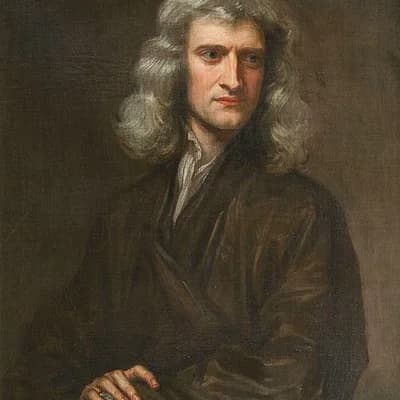
Isaac Newton
Sir Isaac Newton
mathematician and physicist
Born 4 January 1643 · Woolsthorpe-by-Colsterworth, Lincolnshire, United Kingdom · 52.81° N, 0.63° WX
Source: Birth time not documented in publicly accessible records
About this chart
No birth time is documented for this person. The chart therefore shows planetary positions in their signs, the slow aspects between them, and the generational context — but not house placements, the Ascendant, or the Midheaven, which require an accurate birth time. The Moon's sign carries a ±6° margin: if it falls near a sign boundary, the sign could vary. Positions for all other planets are reliable.
Do you have a verified source for this birth time? Share it →
The sky at birth
No birth time is documented for Isaac Newton. The Ascendant, Midheaven, and house positions cannot be determined. The planetary positions below are calculated for noon local time and are accurate to within a fraction of a degree for the slow-moving planets. The Moon's position carries a margin of approximately ±7°.
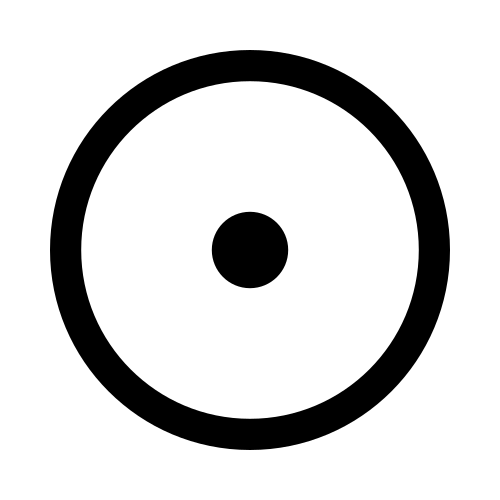
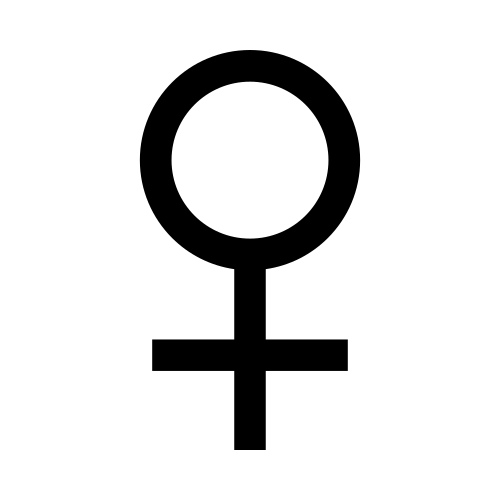
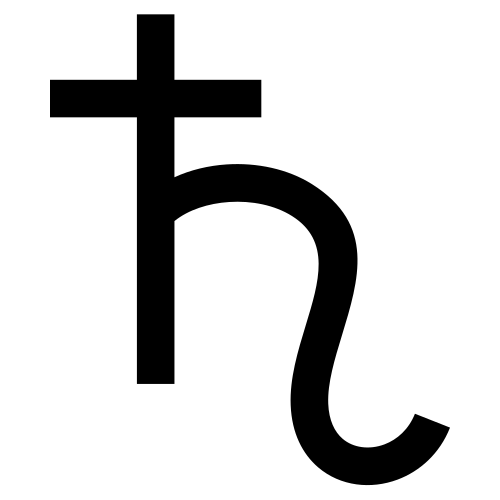
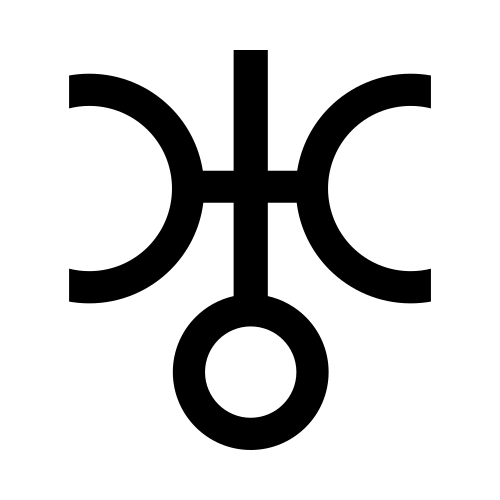
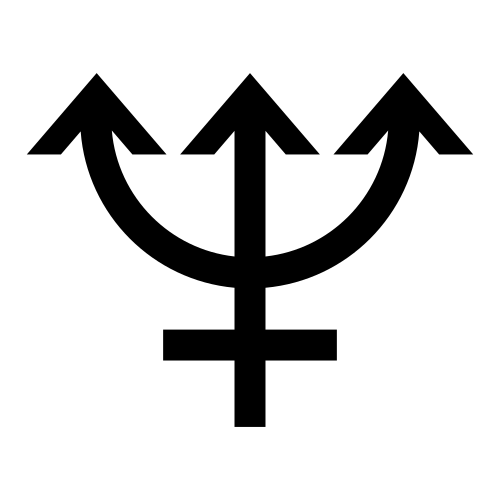
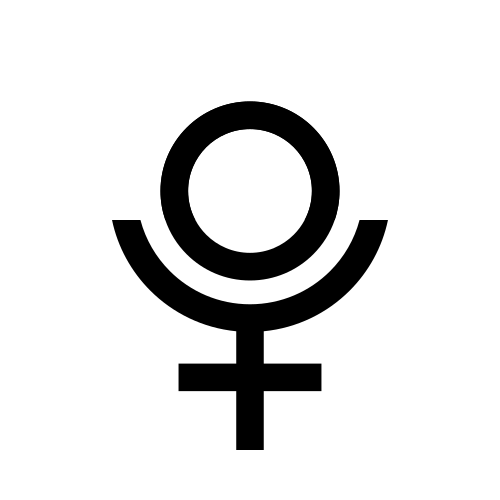
The Sun is at 14°07' Capricorn. The Moon is at 7°43' Cancer (noon position, ±7° margin). Mercury is at 21°26' Sagittarius. Venus is at 27°29' Aquarius. Mars is at 7°39' Taurus. Jupiter is at 14°12' Pisces. Saturn is at 19°55' Pisces. Uranus is at 15°40' Scorpio. Neptune is at 0°58' Sagittarius. Pluto is at 2°35' Gemini R.
The Sun at 14°07' Capricorn sextiles Jupiter at 14°12' Pisces (0°05') — the tightest major aspect between planets in this chart and one of the tightest Sun-Jupiter sextiles in the Astrian collection. The Moon at 7°43' Cancer sextiles Mars at 7°39' Taurus (0°04'), though this aspect carries the Moon's ±7° uncertainty. Jupiter trines Uranus at 15°40' Scorpio (1°28'). The Sun sextiles Uranus (1°33'). Mercury at 21°26' Sagittarius squares Saturn at 19°55' Pisces (1°31'). Neptune at 0°58' Sagittarius opposes Pluto at 2°35' Gemini retrograde (1°37'). Venus at 27°29' Aquarius squares Neptune (3°29').
The engine also identifies the following tight minor aspects: mercury sesquiquadrate mars (1.21° app).
The tightest major aspects between planets: Sun sextile Jupiter (0°05'), Moon sextile Mars (0°04'), Jupiter trine Uranus (1°28'), Mercury square Saturn (1°31'), Sun sextile Uranus (1°33'), Neptune opposition Pluto (1°37'), Venus square Neptune (3°29'), Saturn trine Uranus (4°15').
The chart was calculated by Astrian's engine using NASA JPL DE441 ephemerides, sub-arcsecond precision. Timezone: local mean time for Woolsthorpe (Europe/London, approximately UTC +0:00).
| Planet | Sign | Position |
|---|---|---|
| Sun | Capricorn | 14°07' |
| Moon | Cancer | 07°44'±6° |
| Mercury | Sagittarius | 21°26' |
| Venus | Aquarius | 27°29' |
| Mars | Taurus | 07°39' |
| Jupiter | Pisces | 14°12' |
| Saturn | Pisces | 19°55' |
| Uranus | Scorpio | 15°40' |
| Neptune | Sagittarius | 00°58' |
| Pluto | Gemini | 02°35'retrograde |
 Sun
Sun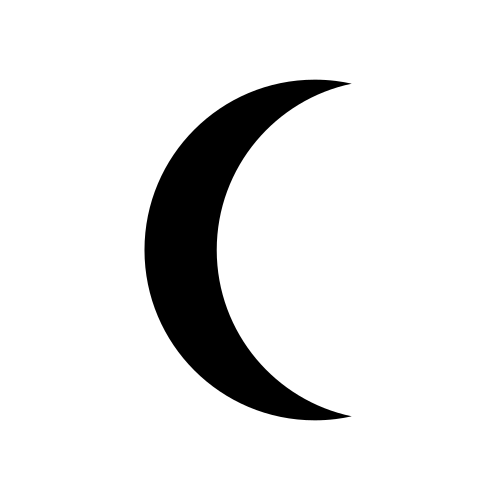 Moon
Moon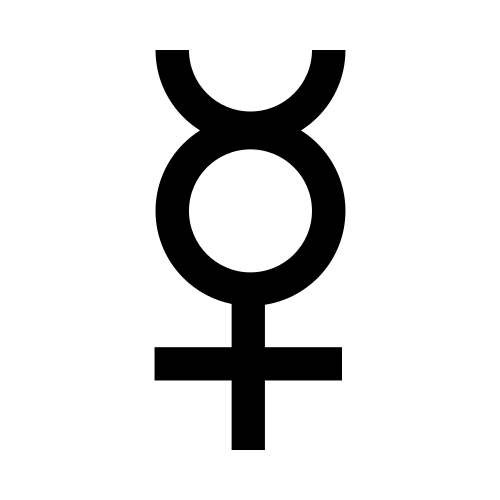 Mercury
 Venus
Venus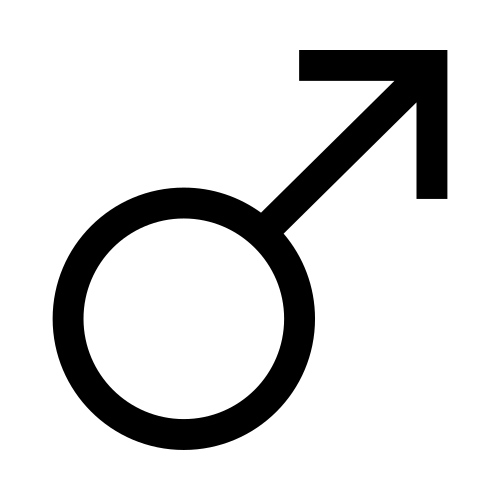 Mars
Mars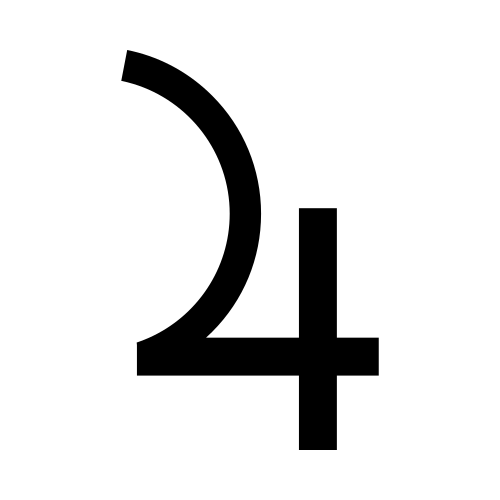 Jupiter
 Saturn
 Uranus
 Neptune
 Pluto
PlutoBirth time unknown — house positions and Ascendant/MC are not available.
Astronomical context
Newton was born with Pluto at 2°35' Gemini retrograde. Pluto's approximately 248-year orbit places it in Gemini at long intervals; this particular transit occurred during the first half of the seventeenth century, a period that encompassed the English Civil War, the Thirty Years' War on the Continent, the Scientific Revolution's earliest phase, and a fundamental restructuring of intellectual authority across Europe.
In astrological tradition, Pluto in Gemini is associated with collective transformation of the domains that sign governs: communication, language, the organisation of information, trade, local movement, and the intellectual frameworks through which the world is named and classified. Gemini is the sign of the messenger, the classifier, the one who moves between worlds and translates what is found there. Pluto's transit through Gemini is read, symbolically, as a period when the structures of how knowledge was communicated, how information was organised, and how the knowable was distinguished from the unknowable were subjected to deep structural pressure. The symbolic reading is correlative, not causal.
No other profiles in the Astrian collection share this specific Pluto-in-Gemini cycle from the seventeenth century.
Other profiles from this Pluto in Gemini generation
Symbolic reading
The following describes what classical astrological tradition associates with these configurations. Astrian does not apply these descriptions to the person's biography.
The Sun at 14°07' Capricorn is the most prominent structural feature of this chart. Without a documented birth time, there is no Ascendant or Midheaven — the reading is confined to planetary positions by sign and the aspects between planets.
The Moon at 7°43' Cancer represents the noon position; the actual placement falls within approximately 7° on either side. If born early in the day, the Moon could be near 1° Cancer; if born late, near 15°. The Moon's sign placement in Cancer is secure for the entire day.
Mercury at 21°26' Sagittarius, Venus at 27°29' Aquarius, and Mars at 7°39' Taurus complete the personal planet picture.
### Sun sextile Jupiter: the self and the whole
The chart's most structurally precise feature is the Sun at 14°07' Capricorn sextiling Jupiter at 14°12' Pisces, orb 0°05' — functionally exact to the arc-minute. The Sun governs identity, the central organising principle of the self. Jupiter governs expansion, the search for meaning, and the capacity to perceive wholes where others perceive fragments. The sextile connects them cooperatively: the identity and the capacity for comprehensive vision work together rather than at cross purposes.
The Sun in Capricorn experiences identity through structure, ambition, and the long view — the self as the instrument of a task that exceeds the individual lifetime. Jupiter in Pisces expands through the register of the universal, the undifferentiated, and the infinite. The sextile reads as a constitution where the structured, ambitious self is cooperatively linked to a faculty that perceives the universal order beneath the particular — the capacity to see the law behind the phenomenon, the principle behind the instance.
The Sun also sextiles Uranus at 15°40' Scorpio (1°33'), extending the cooperative pattern to the planet of originality and sudden insight. Uranus in Scorpio operates through the register of penetrating depth — the drive to see beneath the surface and to restructure what is found there. The Sun's simultaneous sextile to Jupiter and Uranus links the identity to both the philosophical and the revolutionary: the self that perceives the universal order is also the self that ruptures the existing framework to reveal a new one.
Jupiter trines Uranus (1°28'), closing the circuit: expansion and originality flow cooperatively in water signs. The capacity to see the whole (Jupiter in Pisces) and the capacity to see through the existing framework to something previously unthinkable (Uranus in Scorpio) are in trine — a relationship of ease and mutual reinforcement.
### Moon sextile Mars: feeling and method
The Moon at 7°43' Cancer sextiles Mars at 7°39' Taurus, orb 0°04' — functionally exact, though the Moon's ±7° uncertainty applies. If the actual birth time places the Moon near its noon position, this is one of the tightest Moon-Mars sextiles possible. The Moon governs the emotional faculty, the inner life, and the instinctive responses. Mars governs action, the application of force, and the drive to work. The sextile connects them cooperatively: the emotional life and the capacity for sustained work support one another.
The Moon in Cancer feels through the register of security, belonging, and the desire to protect what is valued. Mars in Taurus acts through the register of the methodical, the persistent, and the materially productive. The sextile reads as a constitution where the emotional need for security is met through sustained, methodical labour — and the capacity for work is fuelled by the depth of feeling that drives it.
### Mercury square Saturn: the disciplined mind
Mercury at 21°26' Sagittarius squares Saturn at 19°55' Pisces, orb 1°31'. Mercury governs the organisation of thought, the naming of things, and the communication of ideas. Saturn governs form, limitation, and the demand for rigour. The square places them in friction: the mind that seeks expansive understanding (Sagittarius) is challenged by the demand for formal precision (Saturn in Pisces — the structuring principle operating within the register of the formless and the infinite). The friction generates discipline: the expansive intellectual impulse must pass through the constraint of formal demonstration before it is permitted to stand.
Jupiter and Saturn are both in Pisces, separated by 5°43'. The proximity of the planet of expansion and the planet of contraction in the same sign creates a tension within the philosophical register — the drive to see more and the demand to prove what has been seen coexist in the same domain.
### Venus square Neptune: beauty and the ideal
Venus at 27°29' Aquarius squares Neptune at 0°58' Sagittarius, orb 3°29'. Venus governs aesthetics and the perception of value. Neptune governs the ideal, the imaginal, and the dissolved. The square places the aesthetic faculty in tension with the ideal: what is valued must negotiate with what lies beyond valuation, and the ideal must submit to the judgement of taste. Venus in Aquarius perceives value in the systematic, the collective, and the intellectually elegant. Neptune in Sagittarius idealises the philosophical, the distant, and the quest for ultimate truth. The square reads as a tension between intellectual elegance and the pull toward something that exceeds all frameworks.
The planetary pattern here is read as a symbolic portrait, not a causal explanation. No planet caused, predicted, or determined any event or characteristic.
Astrology is a symbolic language with 2,500 years of literature. The reading above is interpretive, not explanatory.
Astrian does not claim that the natal chart of Isaac Newton caused or determined any of the above. Astrology is a symbolic system with 2,500 years of literature. Its capacity for retrospective description does not imply explanatory capacity.
A parallel life
The following are verified biographical facts. No connection to the natal chart is implied.
Isaac Newton was born prematurely on Christmas Day 1642 (Julian calendar; 4 January 1643 Gregorian) at Woolsthorpe Manor, a small farmstead in Lincolnshire, three months after the death of his father, also named Isaac. His mother, Hannah Ayscough, remarried when he was three and left him in the care of his maternal grandmother. He did not forgive her. The experience of early abandonment — a dead father, a mother who chose a new husband over her son — appears in his later notebooks as a source of enduring rage, and the emotional isolation that characterised his adult life began here.
He attended the King's School in Grantham, where he was noted as a quiet, solitary boy who preferred mechanical models to companionship. In 1661 he entered Trinity College, Cambridge, as a subsizar — a student who earned his keep by performing menial services for wealthier students. He read Aristotle, Descartes, Gassendi, and Kepler; he taught himself mathematics largely from the published work of others, progressing from Euclid through Viète and Wallis to the frontier of the discipline within approximately two years.
The plague closed Cambridge in the summer of 1665. Newton returned to Woolsthorpe and remained there for approximately eighteen months. During this period — known to historians of science as the annus mirabilis, though it extended well beyond a single year — he developed the method of fluxions (the differential and integral calculus), conducted the prism experiments that demonstrated the composite nature of white light, formulated the inverse-square law of gravitational attraction, and began the work on orbital mechanics that would culminate in the Principia. He was twenty-three when this period began. He published none of it.
He returned to Cambridge in 1667, was elected a Fellow of Trinity College, and in 1669, at twenty-six, succeeded Isaac Barrow as Lucasian Professor of Mathematics. His first major publication was a paper on optics, communicated to the Royal Society in 1672, which provoked a dispute with Robert Hooke that lasted decades and established the pattern of Newton's relationship with the scientific community: brilliance followed by withdrawal, then silence, then fury when others claimed priority.
The Philosophiae Naturalis Principia Mathematica was published in 1687, financed by Edmond Halley after the Royal Society declined to fund it. The three books of the Principia — on the laws of motion, on the motion of bodies in resisting media, and on the system of the world — constitute the single most consequential work in the history of the physical sciences. The law of universal gravitation, the three laws of motion, and the mathematical framework that unified terrestrial and celestial mechanics were presented with a formal rigour that set the standard for all subsequent physics.
The Opticks, published in 1704 after Hooke's death, presented his experimental work on light and colour. It was written in English rather than Latin and was more accessible than the Principia; its influence on eighteenth-century natural philosophy was arguably as great.
He was elected President of the Royal Society in 1703 and served until his death. He was appointed Warden of the Royal Mint in 1696 and Master of the Mint in 1699 — positions he took with a seriousness that surprised those who expected a sinecure. He pursued counterfeiters with methodical ruthlessness, personally interrogating suspects and attending executions.
He devoted at least as much time to alchemy and biblical chronology as to the mathematics and physics for which he is remembered. His alchemical manuscripts, totalling approximately one million words, were not published in his lifetime and were largely unknown until the twentieth century. His theological writings, including extensive work on the prophecies of Daniel and Revelation, consumed decades. He was a non-Trinitarian Christian — an Arian — in an age when that belief, had it been publicly known, would have cost him his Cambridge fellowship and possibly his freedom.
He never married. He had few close relationships. The most significant was his friendship with the Swiss mathematician Nicolas Fatio de Duillier in the early 1690s, the collapse of which in 1693 coincided with a severe mental crisis — a period of paranoia, insomnia, and accusatory letters to friends that lasted several months and from which he recovered fully.
He was knighted by Queen Anne in 1705.
He died on 31 March 1727 at Kensington, London, at the age of eighty-four. He was buried in Westminster Abbey.
This profile presents the sky at the birth of Isaac Newton and verified facts of their biography. Astrian does not claim that astrology has predictive capacity or that the natal chart determines the trajectory of a life. Astrology is a symbolic system with 2,500 years of literature. Its capacity for retrospective description does not imply explanatory capacity.
Related profiles
Calculate your own birth chart with the same NASA JPL DE441 precision.
Calculate my birth chartLast updated: June 12, 2026
Newsletter
A short reading once a month, in your inbox.
A note on the symbolism of the season, recent editorial pieces, and what to look for in next month's sky. No predictions.
Support this project
Independent, no venture funding, no ads. A contribution keeps Astrian precise and free.
Support on Ko-fi (opens in new tab)