PROFILE · SCIENCE & TECHNOLOGY
Dmitri Mendeleev
Dmitri Ivanovich Mendeleev
chemist
Born 27 January 1834 · Tobolsk, Russian Empire · 58.20° N, 68.26° EX
Source: Birth time not documented in publicly accessible records
About this chart
No birth time is documented for this person. The chart therefore shows planetary positions in their signs, the slow aspects between them, and the generational context — but not house placements, the Ascendant, or the Midheaven, which require an accurate birth time. The Moon's sign carries a ±6° margin: if it falls near a sign boundary, the sign could vary. Positions for all other planets are reliable.
Do you have a verified source for this birth time? Share it →
The sky at birth
No birth time is documented for Dmitri Mendeleev. The Ascendant, the Midheaven, and the house positions cannot be determined; the reading is confined to planetary sign placements and the aspects between planets. The positions below are calculated for noon local time and are accurate to a fraction of a degree for the slow-moving bodies.
The Moon is near 14°57' Aquarius (noon position, ±7° margin). Sun is at 19°08' Aquarius. Mercury is at 15°11' Aquarius. Venus is at 12°20' Aquarius. Mars is at 20°43' Capricorn. Jupiter is at 29°31' Aries. Saturn is at 10°26' Libra, retrograde. Uranus is at 22°20' Aquarius. Neptune is at 29°49' Capricorn. Pluto is at 11°07' Aries.
5 bodies occupy Aquarius (Sun, Moon, Mercury, Venus and Uranus) — a concentration that stands out as a structural feature of the chart.
The tightest major aspects between planets: Moon conjunct Mercury (0°14'); Jupiter square Neptune (0°17'); Saturn opposite Pluto (0°41'); Venus sextile Pluto (1°13'); Venus trine Saturn (1°55'); Moon conjunct Venus (2°37').
The engine also registers tight minor aspects involving asteroids and calculated points: Sun sesquiquadrate North Node (0°31'); Uranus semi-sextile Lilith (0°47'); Mars sextile Lilith (2°25'); Jupiter sextile North Node (4°06'). These are reported for completeness and carry less weight in traditional reading.
The chart was calculated using NASA JPL DE441 ephemerides, sub-arcsecond precision.
| Planet | Sign | Position |
|---|---|---|
| Sun | Aquarius | 19°08' |
| Moon | Aquarius | 14°57'±6° |
| Mercury | Aquarius | 15°11' |
| Venus | Aquarius | 12°20' |
| Mars | Capricorn | 20°43' |
| Jupiter | Aries | 29°31' |
| Saturn | Libra | 10°26'retrograde |
| Uranus | Aquarius | 22°20' |
| Neptune | Capricorn | 29°49' |
| Pluto | Aries | 11°07' |
 Sun
Sun Moon
Moon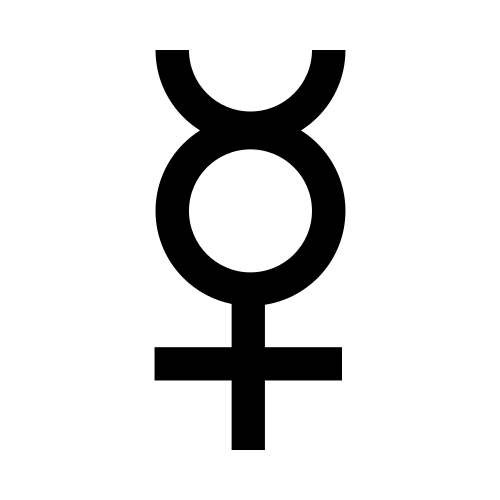 Mercury
 Venus
Venus Mars
Mars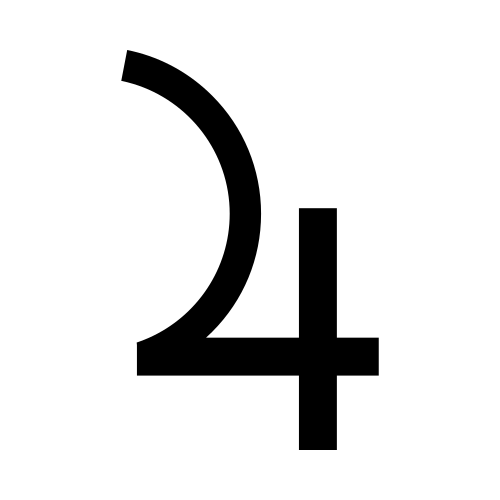 Jupiter
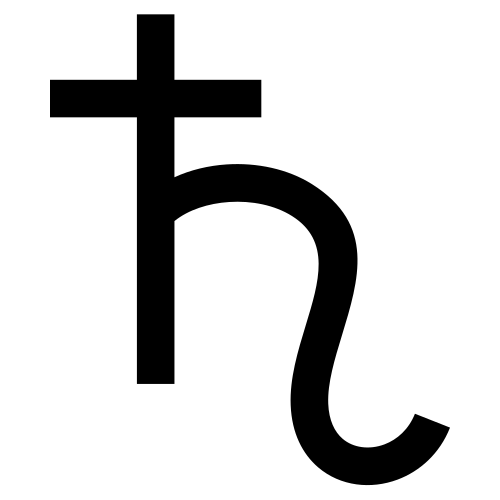 Saturn
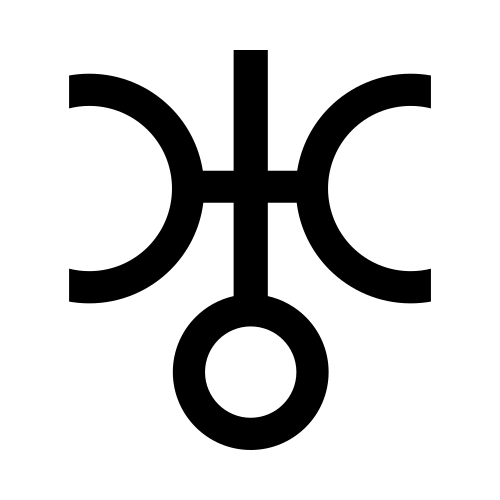 Uranus
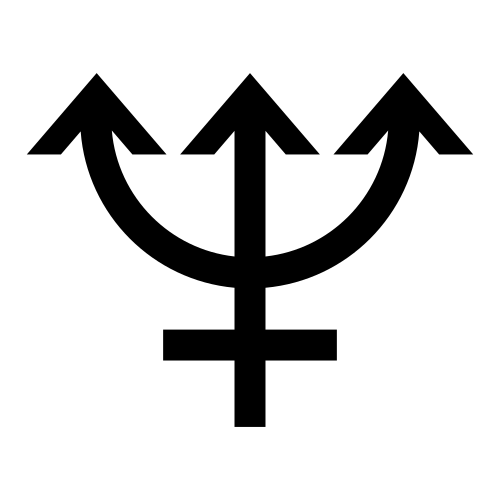 Neptune
 Pluto
PlutoBirth time unknown — house positions and Ascendant/MC are not available.
Astronomical context
Pluto travelled through Aries roughly from 1822 to 1853. In astrological tradition this transit is associated with the transformation of initiative, force, and the will to begin anew — the generation that came of age amid industrial acceleration and new assertions of national energy.
Dmitri Mendeleev (born 1834) belongs to this generational configuration. Astrian groups profiles by such shared signatures rather than by any claim of shared destiny. Related profiles in Astrian: Louis Pasteur · Michael Faraday · James Clerk Maxwell. The symbolic reading is correlative, not causal.
Other profiles from this Pluto in Aries generation
Symbolic reading
The following describes what classical astrological tradition associates with these configurations. Astrian does not apply these descriptions to the person's biography.
The Sun in Aquarius is the most prominent structural feature available without a birth time, centring the chart on independence, abstraction, and the collective. There is no Ascendant or Midheaven to anchor the angles, so the reading rests on sign placements and the aspects between planets rather than on houses.
Among the personal planets, the Moon in Aquarius is associated in tradition with independence, abstraction, and the collective (the Moon's sign is given for the noon chart and may shift with an exact time); Mercury in Aquarius with independence, abstraction, and the collective; Venus in Aquarius with independence, abstraction, and the collective; and Mars in Capricorn with ambition, structure, and the long view. These placements describe registers of feeling, thought, attraction, and action as the tradition catalogues them, independent of the life that follows.
Moon conjunct Mercury (0°14'): tradition reads emotional life and instinct fused with thought and communication.
Jupiter square Neptune (0°17'): tradition reads expansion and meaning in friction with dissolution, imagination, and idealism.
Saturn opposite Pluto (0°41'): tradition reads structure, limitation, and discipline set in polarity with depth, power, and transformation.
Venus sextile Pluto (1°13'): tradition reads values, attraction, and harmony in supportive contact with depth, power, and transformation.
These placements are presented as a symbolic portrait, correlative and never causal — a description within the tradition's vocabulary, not an explanation of the life that follows.
Astrology is a symbolic language with 2,500 years of literature. The reading above is interpretive, not explanatory.
Astrian does not claim that the natal chart of Dmitri Mendeleev caused or determined any of the above. Astrology is a symbolic system with 2,500 years of literature. Its capacity for retrospective description does not imply explanatory capacity.
A parallel life
The following are verified biographical facts. No connection to the natal chart is implied.
Dmitri Ivanovich Mendeleev was born on 8 February 1834 in Tobolsk, in the Siberian region of the Russian Empire. He was the youngest of a large family. After his father lost his sight and died when Mendeleev was still young, his mother worked to support the family and eventually moved to Saint Petersburg so that Dmitri could pursue higher education.
Mendeleev studied at the Main Pedagogical Institute in Saint Petersburg, then at the University of Heidelberg, before returning to Russia to teach at the University of Saint Petersburg. While writing a textbook on chemistry, he found it necessary to develop a systematic method for organising the known elements.
In 1869, Mendeleev presented his periodic table to the Russian Chemical Society, arranging the 63 then-known elements in order of atomic weight and in groups reflecting similar chemical properties. A notable feature of the table was that he left gaps for elements that had not yet been identified, and he provided predictions about the properties of these missing elements. The subsequent discovery of gallium, scandium, and germanium, whose properties closely matched his predictions, was seen as strong confirmation of his system.
Beyond the periodic table, Mendeleev made contributions to other areas, including research on the properties of gases and liquids and studies of the petroleum industry. He also worked in areas of economic and industrial policy in Russia.
Mendeleev was passed over for the Nobel Prize in Chemistry in 1906, with the award going instead to Henri Moissan. The reasons for this decision have been a subject of historical discussion. He died on 2 February 1907 in Saint Petersburg. Element 101, discovered in 1955, was named mendelevium in his honour.
Biographical sources
- Gordin, Michael D. A Well-Ordered Thing: Dmitrii Mendeleev and the Shadow of the Periodic Table. New York: Basic Books, 2004..
- Strathern, Paul. Mendeleev's Dream: The Quest for the Elements. London: Hamish Hamilton, 2000..
- Brook, Daniel. The Invention of the Modern World. New York: Basic Books, 2003..
- Scerri, Eric R. The Periodic Table: Its Story and Its Significance. Oxford: Oxford University Press, 2007..
This profile presents the sky at the birth of Dmitri Mendeleev and verified facts of their biography. Astrian does not claim that astrology has predictive capacity or that the natal chart determines the trajectory of a life. Astrology is a symbolic system with 2,500 years of literature. Its capacity for retrospective description does not imply explanatory capacity.
Related profiles
Calculate your own birth chart with the same NASA JPL DE441 precision.
Calculate my birth chartLast updated: June 14, 2026
Newsletter
A short reading once a month, in your inbox.
A note on the symbolism of the season, recent editorial pieces, and what to look for in next month's sky. No predictions.
Support this project
Independent, no venture funding, no ads. A contribution keeps Astrian precise and free.
Support on Ko-fi (opens in new tab)