PROFILE · SCIENCE & TECHNOLOGY
Friedrich Nietzsche
Friedrich Wilhelm Nietzsche
philosopher
Born 15 October 1844 · 10:00 · 12:33 UTC · Röcken, Prussia · 51.24° N, 12.12° EB
Source: Astro-Databank (Rodden Rating B)
The sky at birth
With a documented birth time, the full chart can be cast. The Ascendant falls at 28°21' Scorpio and the Midheaven at 22°06' Virgo, which fixes the angular framework and allows the planets to be placed in houses.
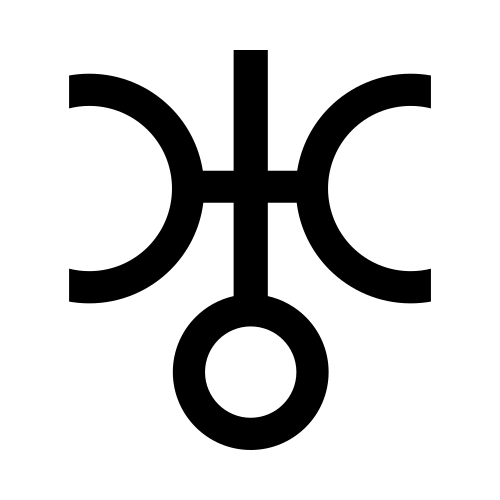
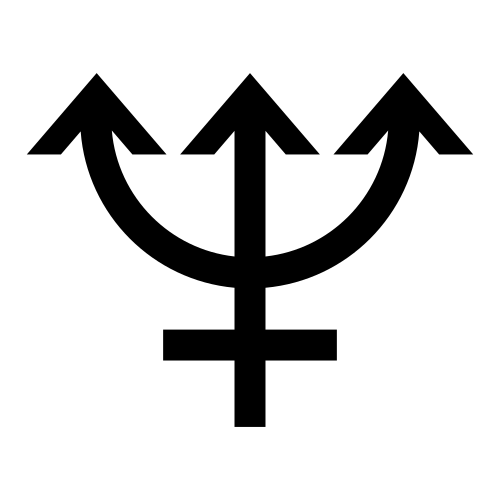
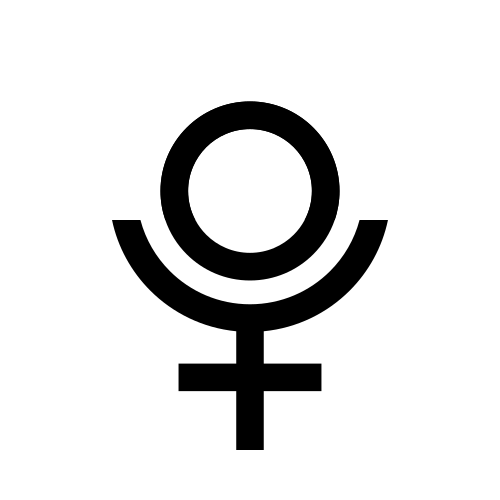
Sun is at 22°07' Libra, house 11. Moon is at 8°59' Sagittarius, house 1. Mercury is at 4°09' Libra, house 10. Venus is at 6°21' Virgo, house 9. Mars is at 27°55' Virgo, house 10. Jupiter is at 26°01' Pisces, house 4, retrograde. Saturn is at 0°46' Aquarius, house 2. Uranus is at 3°33' Aries, house 4, retrograde. Neptune is at 21°01' Aquarius, house 3, retrograde. Pluto is at 22°58' Aries, house 5, retrograde.
The tightest major aspects between planets: Mercury opposite Uranus (0°36'); Sun opposite Pluto (0°52'); Sun trine Neptune (1°06'); Mars opposite Jupiter (1°54'); Neptune sextile Pluto (1°58'); Moon square Venus (2°38').
Neptune sextile Pluto (1°58') is structural but generational — an alignment of slow-moving outer planets shared across many birth years.
The engine also registers tight minor aspects involving asteroids and calculated points: Sun semi-square North Node (0°07'); Pluto semi-square Lilith (0°08'); Venus square North Node (0°38'); Sun sesquiquadrate Lilith (0°44'). These are reported for completeness and carry less weight in traditional reading.
The chart was calculated using NASA JPL DE441 ephemerides, sub-arcsecond precision.
| Planet | Sign | Position | House |
|---|---|---|---|
| Ascendant | Scorpio | 28°21' | — |
| Midheaven | Virgo | 22°06' | — |
| Sun | Libra | 22°07' | H11 |
| Moon | Sagittarius | 08°59' | H1 |
| Mercury | Libra | 04°09' | H10 |
| Venus | Virgo | 06°21' | H9 |
| Mars | Virgo | 27°55' | H10 |
| Jupiter | Pisces | 26°01'retrograde | H4 |
| Saturn | Aquarius | 00°46' | H2 |
| Uranus | Aries | 03°33'retrograde | H4 |
| Neptune | Aquarius | 21°01'retrograde | H3 |
| Pluto | Aries | 22°58'retrograde | H5 |
 Sun
Sun Moon
Moon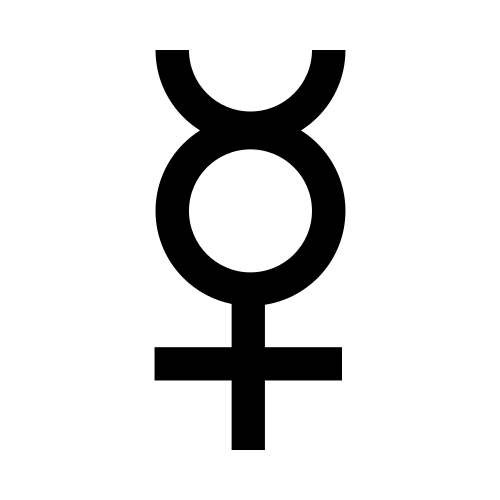 Mercury
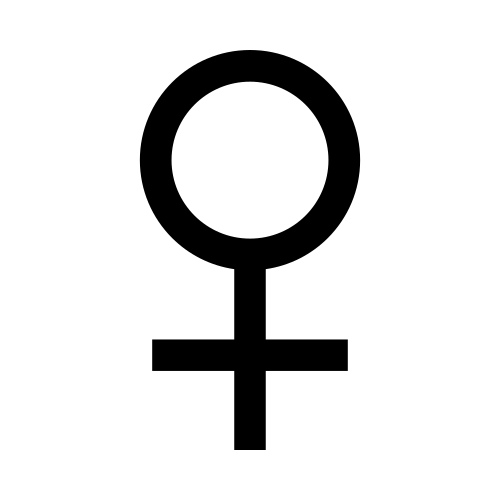 Venus
Venus Mars
Mars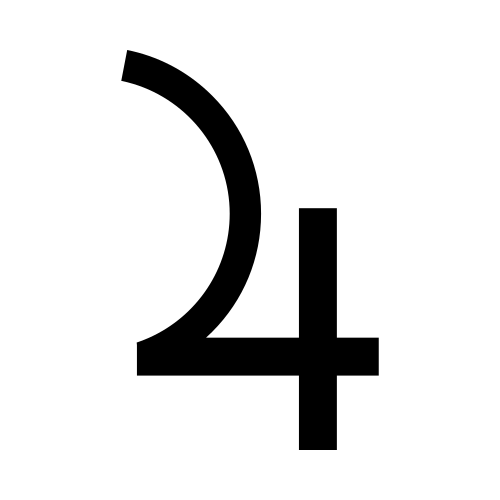 Jupiter
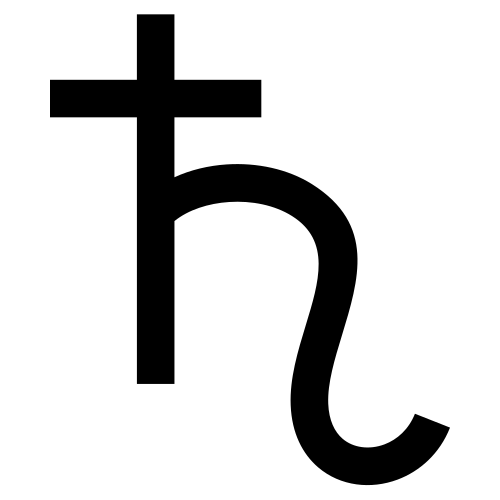 Saturn
 Uranus
 Neptune
 Pluto
PlutoAstronomical context
Pluto travelled through Aries roughly from 1822 to 1853. In astrological tradition this transit is associated with the transformation of initiative, force, and the will to begin anew — the generation that came of age amid industrial acceleration and new assertions of national energy.
Friedrich Nietzsche (born 1844) belongs to this generational configuration. Astrian groups profiles by such shared signatures rather than by any claim of shared destiny. Related profiles in Astrian: Jean-Paul Sartre · Hannah Arendt · Michel Foucault. The symbolic reading is correlative, not causal.
Other profiles from this Pluto in Aries generation
Symbolic reading
The following describes what classical astrological tradition associates with these configurations. Astrian does not apply these descriptions to the person's biography.
The Sun in Libra centres the chart on balance, relationship, and proportion. With the Ascendant in Scorpio, tradition adds intensity, depth, and the will to transform as the threshold through which that energy meets the world; the Sun marks the central drive, the Ascendant the manner of approach.
Among the personal planets, the Moon in Sagittarius is associated in tradition with expansion, conviction, and the horizon; Mercury in Libra with balance, relationship, and proportion; Venus in Virgo with analysis, craft, and the refinement of method; and Mars in Virgo with analysis, craft, and the refinement of method. These placements describe registers of feeling, thought, attraction, and action as the tradition catalogues them, independent of the life that follows.
Mercury opposite Uranus (0°36'): tradition reads thought and communication set in polarity with disruption and innovation.
Sun opposite Pluto (0°52'): tradition reads identity and central purpose set in polarity with depth, power, and transformation.
Sun trine Neptune (1°06'): tradition reads identity and central purpose in easy flow with dissolution, imagination, and idealism.
Mars opposite Jupiter (1°54'): tradition reads drive, assertion, and action set in polarity with expansion and meaning.
These placements are presented as a symbolic portrait, correlative and never causal — a description within the tradition's vocabulary, not an explanation of the life that follows.
Astrology is a symbolic language with 2,500 years of literature. The reading above is interpretive, not explanatory.
Astrian does not claim that the natal chart of Friedrich Nietzsche caused or determined any of the above. Astrology is a symbolic system with 2,500 years of literature. Its capacity for retrospective description does not imply explanatory capacity.
A parallel life
The following are verified biographical facts. No connection to the natal chart is implied.
Friedrich Wilhelm Nietzsche was born on 15 October 1844 in Röcken, a small village in the Prussian province of Saxony. His father, a Lutheran pastor, died in 1849, and Nietzsche was raised in Naumburg by his mother and female relatives. He showed early aptitude in philology and music, and at the age of twenty-four was appointed professor of classical philology at the University of Basel, an unusually young appointment for the position.
His first major publication, The Birth of Tragedy (1872), examined ancient Greek culture and drew on his friendship with the composer Richard Wagner, from whom he later distanced himself. During the 1870s he produced a series of essays collected as Untimely Meditations. In 1879, persistent health problems, including severe headaches and vision difficulties, forced him to resign his professorship. He spent the following decade living modestly in Switzerland, Italy, and France, writing without an academic post.
His subsequent books, written between 1878 and 1888, include Human, All Too Human (1878), The Gay Science (1882), Thus Spoke Zarathustra (published in parts between 1883 and 1885), Beyond Good and Evil (1886), On the Genealogy of Morality (1887), Twilight of the Idols, The Case of Wagner, and The Antichrist (all 1888). These works examined topics including the foundations of moral values, the nature of power, the problem of nihilism, and the history of Western philosophy and religion.
In January 1889, Nietzsche suffered a mental collapse in Turin. He was hospitalized in Basel and later in Jena, and spent the remaining eleven years of his life in a state of mental incapacity, cared for first by his mother and then by his sister Elisabeth Forster-Nietzsche. He died on 25 August 1900 in Weimar.
After his death, Elisabeth Forster-Nietzsche controlled and edited his unpublished notes and correspondence, a circumstance that later scholars identified as distorting the reception of his work. His writings became widely read in the twentieth century across philosophy, literature, and the social sciences.
Biographical sources
- Kaufmann, Walter. Niet.
This profile presents the sky at the birth of Friedrich Nietzsche and verified facts of their biography. Astrian does not claim that astrology has predictive capacity or that the natal chart determines the trajectory of a life. Astrology is a symbolic system with 2,500 years of literature. Its capacity for retrospective description does not imply explanatory capacity.
Related profiles
Calculate your own birth chart with the same NASA JPL DE441 precision.
Calculate my birth chartLast updated: June 14, 2026
Newsletter
A short reading once a month, in your inbox.
A note on the symbolism of the season, recent editorial pieces, and what to look for in next month's sky. No predictions.
Support this project
Independent, no venture funding, no ads. A contribution keeps Astrian precise and free.
Support on Ko-fi (opens in new tab)