PROFILE · SPORTS
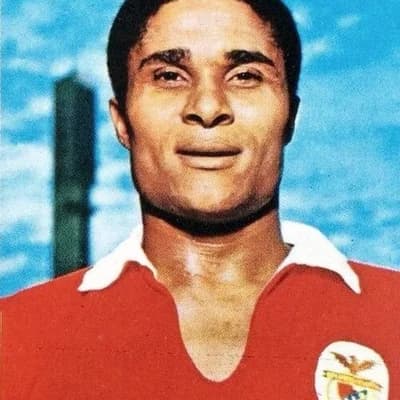
Eusébio
Eusébio da Silva Ferreira
footballer
Born 25 January 1942 · Lourenço Marques, Mozambique · 25.97° S, 32.58° EX
Source: Not documented
About this chart
No birth time is documented for this person. The chart therefore shows planetary positions in their signs, the slow aspects between them, and the generational context — but not house placements, the Ascendant, or the Midheaven, which require an accurate birth time. The Moon's sign carries a ±6° margin: if it falls near a sign boundary, the sign could vary. Positions for all other planets are reliable.
Do you have a verified source for this birth time? Share it →
The sky at birth
Without a documented birth time, house positions, the Ascendant, and the Midheaven are not calculated. Planetary positions in signs are derived from noon on the birth date.
Eusébio da Silva Ferreira was born on 25 January 1942 in Lourenço Marques — the colonial capital of Portuguese East Africa, the city that is now Maputo. The Sun at approximately 4° Aquarius sits in the early degrees of the sign, and it is locked in an opposition to Pluto at approximately 4° Leo at less than one degree of orb — essentially exact. This is the tightest aspect in the chart and its defining signature. In the tradition, Sun opposite Pluto is associated with identity and transformative power in direct confrontation: the person whose sense of self is forged against forces that exceed individual scale, who meets concentrated external pressure and converts it into personal authority.
For a forward who carried the ball out of Lourenço Marques and into the centre of European football — 473 goals in 440 Benfica appearances, eleven league titles, the 1962 European Cup, the 1965 Ballon d'Or — that exact opposition describes the quality of his trajectory: power that emerged not from comfort but from confrontation.
Four planets occupy Taurus: the Moon at approximately 17°, Mars at approximately 6°, Saturn at approximately 21°, and Uranus at approximately 26° retrograde. A stellium of this weight in a single earth sign is associated with physical endurance, material persistence, and sustained effort over time — the qualities of the forward who scored consistently for fifteen years in the same shirt.
Mercury at approximately 23° Aquarius and Venus at approximately 18° Aquarius retrograde place three bodies in the air sign: the Sun, Mercury, and Venus. Jupiter is at approximately 11° Gemini retrograde. Neptune is at approximately 29° Virgo retrograde.
The Sun at 4° Aquarius squares Mars at 6° Taurus. Mars at 6° Taurus squares Pluto at 4° Leo. The three bodies form a T-square in fixed signs — Aquarius, Taurus, Leo — a configuration the tradition reads as sustained tension demanding release through action. The T-square channels enormous dynamic energy into fixed, determined output.
The Moon's position in Taurus is stable for the full range of possible birth times on this date.
No birth time is documented for Eusébio. Planetary sign positions use a noon ephemeris and are approximate. The Moon at noon is at approximately 17° Taurus, ±6°.
| Planet | Sign | Position |
|---|---|---|
| Sun | Aquarius | 04°48' |
| Moon | Taurus | 17°17'±6° |
| Mercury | Aquarius | 23°19' |
| Venus | Aquarius | 18°03'retrograde |
| Mars | Taurus | 06°54' |
| Jupiter | Gemini | 11°35'retrograde |
| Saturn | Taurus | 21°38' |
| Uranus | Taurus | 26°23'retrograde |
| Neptune | Virgo | 29°43'retrograde |
| Pluto | Leo | 04°38'retrograde |
| Chiron | Leo | 11°56'retrograde |
 Sun
Sun Moon
Moon Mercury
 Venus
Venus Mars
Mars Jupiter
 Saturn
 Uranus
 Neptune
 Pluto
Pluto Chiron
Birth time unknown — house positions and Ascendant/MC are not available.
Astronomical context
Eusébio belongs to the Pluto in Leo generation (1939–1957), born in 1942 in Lourenço Marques to a Mozambican mother, Elisa Anissabeni, and a father from Angola, Laurindo António da Silva Ferreira, who worked on the railways and died when Eusébio was young. His childhood was in the Mafalala neighbourhood — the poor, densely populated district on the periphery of the colonial capital where much of the African and mixed-race population lived. He played barefoot football on unpaved streets. Sporting Clube de Lourenço Marques's youth system identified him.
The journey from Mafalala to Estádio da Luz encapsulates the Pluto in Leo generation's capacity for extraordinary individual transformation within and against the structures of the historical moment. Portugal's Estado Novo colonial system both enabled his transfer to Benfica in 1960 — at eighteen, scouted and brought to Lisbon — and defined the political reality in which his career developed. He became a symbol of Portuguese football at the same moment Mozambique's independence movement was gathering force. His story is inseparable from the political economy of Portuguese colonialism.
Other members of this generation include Pelé (1940), Stephen Hawking (1942), Franz Beckenbauer (1945), Johan Cruyff (1947), and George Best (1946).
Other profiles from this Pluto in Leo generation
Symbolic reading
The following describes what classical astrological tradition associates with these configurations. Astrian does not apply these descriptions to the person's biography.
### Sun opposition Pluto: identity and power in direct confrontation
The Sun at 4° Aquarius opposite Pluto at 4° Leo at less than one degree of orb is the chart's signature. In the tradition, this aspect is associated with lives where personal identity is forged through encounters with concentrated power — institutional, political, physical. Eusébio arrived in Lisbon as an eighteen-year-old from a colonial territory and within months was scoring twice in a European Cup final against Real Madrid. The confrontation between individual force and the structures that contain it was not metaphorical.
### T-square: Sun-Mars-Pluto in fixed signs
The Sun in Aquarius squares Mars in Taurus, which squares Pluto in Leo, completing a T-square in fixed signs. Fixed signs hold. The tradition associates this configuration with sustained, relentless drive — the energy that does not dissipate when the obstacle appears but intensifies. For Eusébio, the World Cup 1966 quarterfinal against North Korea — Portugal 3–0 down, Eusébio scoring four goals to win 5–3 — is the biographical expression of that fixed-sign tension demanding and finding release.
### Four planets in Taurus: the earth stellium
Moon, Mars, Saturn, and Uranus in Taurus concentrate the chart's weight in the sign the tradition associates with physical substance, endurance, and the capacity to sustain effort over long periods. Eusébio's playing style — the explosive pace married to physical strength and the stamina to maintain it across ninety minutes and across seasons — carries the signature of a Taurus stellium: body as instrument, reliable and powerful.
### Mercury and Venus in Aquarius: the unconventional mind
Mercury and Venus retrograde join the Sun in Aquarius, placing three planets in the sign associated with unconventional intelligence and individual independence within collective structures. Eusébio's technical quality was of a kind that the established European game had not seen from an African-born player in 1961. The approach was original not because it intended to be but because the source was different.
The readings above are symbolic and archetypal. They do not constitute psychological diagnoses or predictions.
Astrian does not claim that the natal chart of Eusébio caused or determined any of the above. Astrology is a symbolic system with 2,500 years of literature. Its capacity for retrospective description does not imply explanatory capacity.
A parallel life
The following are verified biographical facts. No connection to the natal chart is implied.
Eusébio da Silva Ferreira was born on 25 January 1942 in Lourenço Marques, Portuguese Mozambique. His father, Laurindo António da Silva Ferreira, was a railway worker from Angola who died when Eusébio was young. His mother, Elisa Anissabeni, raised the family in the Mafalala neighbourhood. He grew up in poverty and played barefoot football on unpaved streets.
He developed through Sporting Clube de Lourenço Marques. In 1960, Benfica scouted him and brought him to Lisbon at the age of eighteen. His debut season produced a European Cup victory — 5–3 against Real Madrid in the 1962 final, with Eusébio scoring twice after coming from behind. He won eleven Primeira Liga titles and scored 473 goals in 440 competitive appearances for Benfica — the club's all-time record.
He won the Ballon d'Or in 1965. He won the European Golden Boot in 1968 and 1973. For Portugal, he earned 41 caps and scored 41 goals — a ratio of exactly one goal per match. At the 1966 World Cup in England, he scored nine goals in six matches, including four in the quarterfinal comeback against North Korea from 3–0 down. Portugal finished third. He was the tournament's top scorer. Portugal did not qualify for another major tournament until Euro 1984.
He played briefly in North America between 1975 and 1977 — in Boston, Toronto, and Las Vegas — before a final return to Benfica.
Eusébio died on 5 January 2014 in Lisbon, of cardiac arrest, at the age of seventy-one. Portugal declared three days of national mourning. He was buried in the National Pantheon in Lisbon. A statue stands outside the Estádio da Luz.
Biographical sources
- Eusébio, with Sala.
This profile presents the sky at the birth of Eusébio and verified facts of their biography. Astrian does not claim that astrology has predictive capacity or that the natal chart determines the trajectory of a life. Astrology is a symbolic system with 2,500 years of literature. Its capacity for retrospective description does not imply explanatory capacity.
Related profiles
Calculate your own birth chart with the same NASA JPL DE441 precision.
Calculate my birth chartLast updated: June 12, 2026
Newsletter
A short reading once a month, in your inbox.
A note on the symbolism of the season, recent editorial pieces, and what to look for in next month's sky. No predictions.
Support this project
Independent, no venture funding, no ads. A contribution keeps Astrian precise and free.
Support on Ko-fi (opens in new tab)