PROFILE · SCIENCE & TECHNOLOGY
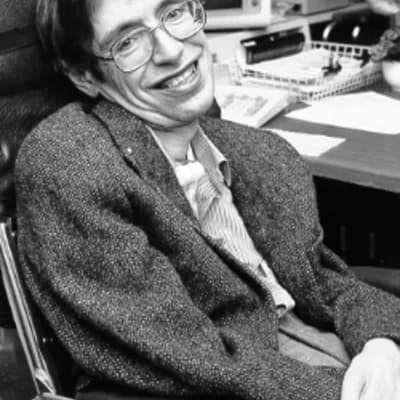
Stephen Hawking
Stephen William Hawking
physicist
Born 8 January 1942 · Oxford, United Kingdom · 51.75° N, 1.26° WX
Source: Birth time not documented in publicly accessible records
About this chart
No birth time is documented for this person. The chart therefore shows planetary positions in their signs, the slow aspects between them, and the generational context — but not house placements, the Ascendant, or the Midheaven, which require an accurate birth time. The Moon's sign carries a ±6° margin: if it falls near a sign boundary, the sign could vary. Positions for all other planets are reliable.
Do you have a verified source for this birth time? Share it →
The sky at birth
No birth time is documented for Stephen Hawking. The Ascendant, Midheaven, and house positions cannot be determined. The planetary positions below are calculated for noon local time and are accurate to within a fraction of a degree for the slow-moving planets. The Moon's position carries a margin of approximately ±7°.
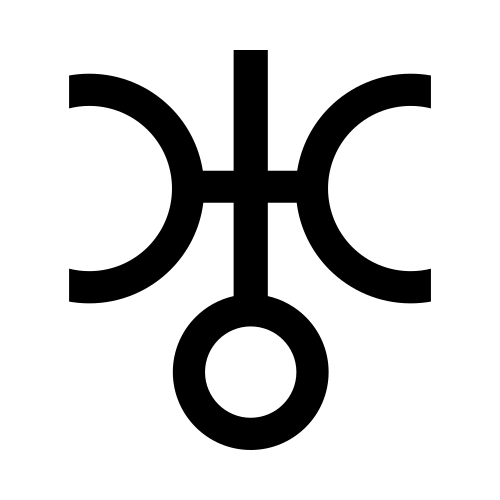
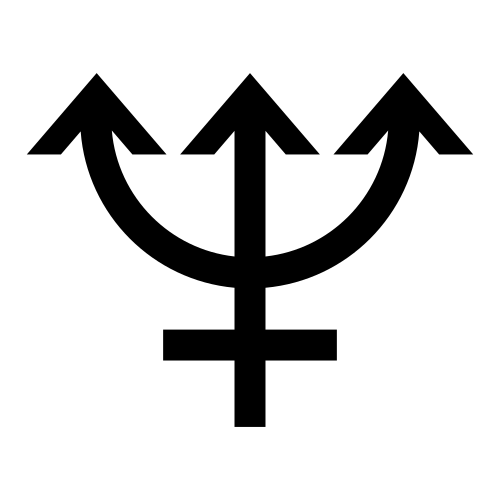
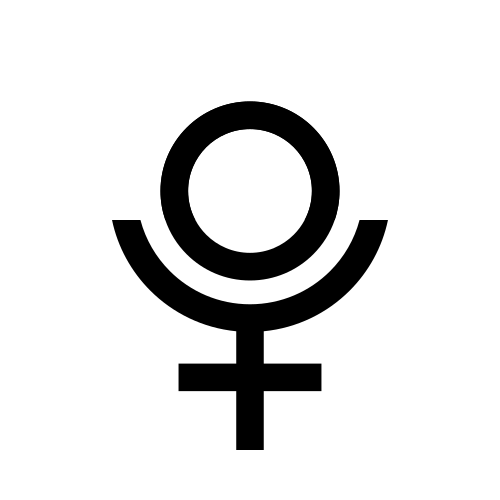
The Sun is at 17°35' Capricorn. The Moon is at 25°40' Virgo (noon position, ±7° margin). Mercury is at 28°07' Capricorn. Venus is at 20°46' Aquarius. Mars is at 28°19' Aries. Jupiter is at 12°40' Gemini R. Saturn is at 21°50' Taurus R. Uranus is at 26°38' Taurus R. Neptune is at 29°51' Virgo R. Pluto is at 5°00' Leo R.
The chart features a Grand Trine in earth signs: Mercury at 28°07' Capricorn, Uranus at 26°38' Taurus, and Neptune at 29°51' Virgo. The orbs are tight — Mercury trine Uranus at 1°29', Mercury trine Neptune at 1°44', Uranus trine Neptune at 3°13'. This three-body alignment in earth, involving the planet of thought, the planet of radical insight, and the planet of the unbounded, is the most prominent geometric structure of the chart. Saturn and Uranus are both in Taurus, within 4°48' of conjunction, further loading the earth emphasis.
The tightest major aspects between planets: Mercury square Mars (0°12'), Venus square Saturn (1°04'), Mercury trine Uranus (1°29'), Mars quincunx Neptune (1°32'), Mercury trine Neptune (1°44'), Uranus trine Neptune (3°13'), Sun trine Saturn (4°15'), Saturn conjunct Uranus (4°48').
The engine also identifies the following tight minor aspects involving asteroids and calculated points: mercury square mars (0.22° app); ceres trine lilith (0.23° app); pallas trine northNode (0.41° app); mercury sesquiquadrate jupiter (0.44° sep).
The chart was calculated by Astrian's engine using NASA JPL DE441 ephemerides, sub-arcsecond precision. Timezone: Greenwich War Time (Europe/London, UTC +1 in January 1942).
| Planet | Sign | Position |
|---|---|---|
| Sun | Capricorn | 17°32' |
| Moon | Virgo | 25°07'±6° |
| Mercury | Capricorn | 28°02' |
| Venus | Aquarius | 20°46' |
| Mars | Aries | 28°18' |
| Jupiter | Gemini | 12°41'retrograde |
| Saturn | Taurus | 21°50'retrograde |
| Uranus | Taurus | 26°38'retrograde |
| Neptune | Virgo | 29°51'retrograde |
| Pluto | Leo | 05°00'retrograde |
| Chiron | Leo | 13°07'retrograde |
 Sun
Sun Moon
Moon Mercury
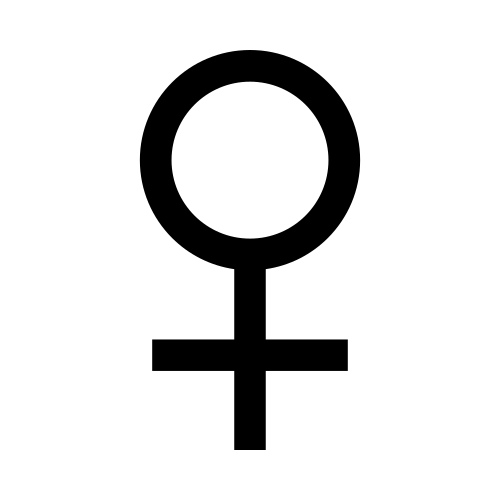 Venus
Venus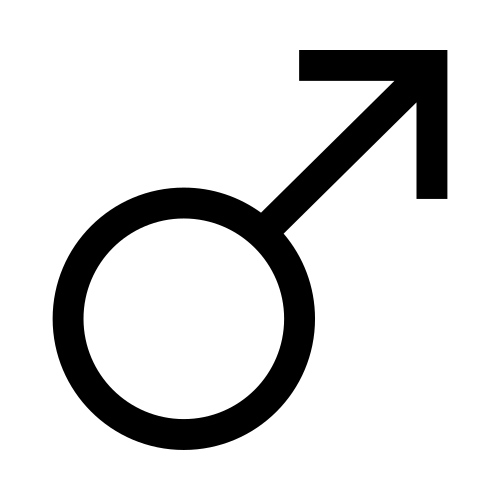 Mars
Mars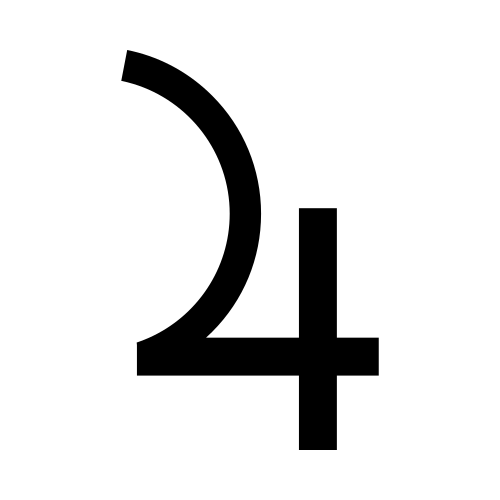 Jupiter
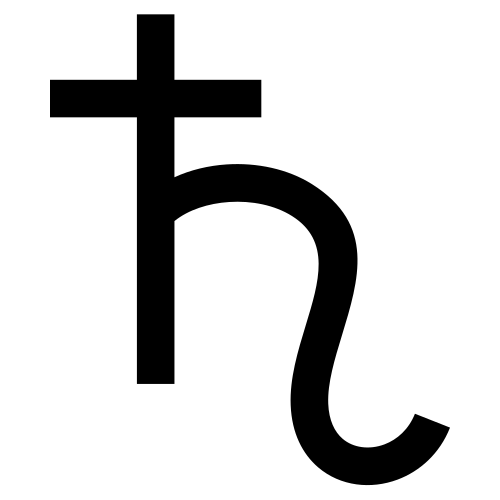 Saturn
 Uranus
 Neptune
 Pluto
Pluto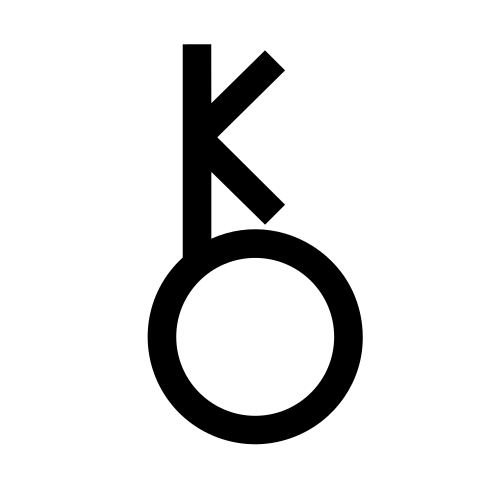 Chiron
Birth time unknown — house positions and Ascendant/MC are not available.
Astronomical context
Those born between approximately 1939 and 1957 carried Pluto in Leo. This generation was born during or immediately after the Second World War and came of age during the postwar reconstruction, the Cold War, and the first space age.
In astrological tradition, Pluto in Leo is associated with collective transformation of the domains that sign governs: self-expression, creative authority, spectacle, and the individual as cultural force. The symbolic reading is correlative, not causal.
Others in the Astrian collection born under this configuration include Steve Jobs (1955), Pele (1940), Franz Beckenbauer (1945), George Best (1946), Johan Cruyff (1947), and Donald Trump (1946). Hawking, born in 1942, belongs to the early-to-middle years of this generational wave.
Other profiles from this Pluto in Leo generation
Symbolic reading
The following describes what classical astrological tradition associates with these configurations. Astrian does not apply these descriptions to the person's biography.
The Sun at 17°35' Capricorn is the most prominent structural feature of this chart. Without a documented birth time, there is no Ascendant or Midheaven — the reading is confined to planetary positions by sign and the aspects between planets.
The Moon at 25°40' Virgo represents the noon position; the actual placement falls within approximately 7° on either side. The Moon's sign placement in Virgo is probable for most of the day.
Mercury at 28°07' Capricorn, Venus at 20°46' Aquarius, and Mars at 28°19' Aries complete the personal planet picture.
### The Grand Earth Trine: Mercury, Uranus, Neptune
The defining geometric structure of this chart is the Grand Trine in earth signs. Mercury at 28°07' Capricorn, Uranus at 26°38' Taurus, and Neptune at 29°51' Virgo form a closed triangle with orbs of 1°29', 1°44', and 3°13'. All three bodies occupy the final degrees of their signs, at the boundary between one symbolic domain and the next.
In the vocabulary of the tradition, Mercury governs thought, analysis, and the naming of things. Uranus, in modern astrology, governs disruption, radical insight, and the overturning of established frameworks. Neptune governs the unbounded, the ideal, and what lies beyond fixed form. A Grand Trine connects three bodies in harmonious alignment — a closed circuit that, in the tradition, is read as a configuration of fluency and mutual reinforcement.
That this trine falls in earth signs — Capricorn, Taurus, Virgo — places it in a register of material structure, endurance, and the tangible. The symbolic territory is unusual: the planet of thought, the planet of revolutionary insight, and the planet of the limitless, all operating in a mode associated with the concrete and the measurable.
The Moon at 25°40' Virgo (noon position) sits near Neptune at 29°51' Virgo, and may participate in the grand trine depending on the actual birth time. If born earlier in the day, the Moon would be closer to Neptune; if later, further away. This is a time-dependent detail that cannot be resolved without a documented birth time.
### Mercury square Mars: the tightest aspect
Mercury at 28°07' Capricorn squares Mars at 28°19' Aries with an orb of just 0°12'. This is the tightest major aspect in the chart. Mercury governs the intellect; Mars governs drive and assertion. Squares create friction — a productive tension that in the tradition is read as an impulse that does not rest, a mode of thought that is combative, incisive, and resistant to passivity.
Both planets occupy cardinal signs (Capricorn and Aries), which in the tradition are associated with initiation and the impulse to begin. The square between them, at its tightest possible orb, describes a configuration where thinking and doing are locked in permanent, active tension.
### Venus square Saturn
Venus at 20°46' Aquarius squares Saturn at 21°50' Taurus retrograde, orb 1°04'. Venus governs aesthetics, relationship, and what one values. Saturn governs limitation, discipline, and the long term. Squares between Venus and Saturn are read in the tradition as configurations where desire encounters structure — where what one values is tested against what endures.
### The Taurus concentration
Saturn at 21°50' Taurus and Uranus at 26°38' Taurus are within 4°48' of conjunction. Both are retrograde. Saturn's register is structure and tradition; Uranus's is disruption and innovation. Their conjunction in Taurus — a sign of material stability and endurance — merges conservation and revolution within the same symbolic domain.
The planetary pattern here is read as a symbolic portrait, not a causal explanation. No planet caused, predicted, or determined any event or characteristic.
Astrology is a symbolic language with 2,500 years of literature. The reading above is interpretive, not explanatory.
Astrian does not claim that the natal chart of Stephen Hawking caused or determined any of the above. Astrology is a symbolic system with 2,500 years of literature. Its capacity for retrospective description does not imply explanatory capacity.
A parallel life
The following are verified biographical facts. No connection to the natal chart is implied.
Stephen William Hawking was born on 8 January 1942 in Oxford — exactly three hundred years after the death of Galileo, a coincidence he noted with pleasure and without superstition. His parents, Frank Hawking, a research biologist, and Isobel Hawking, a philosophy graduate from Oxford, had moved from Highgate, London, to Oxford during the war because the city was, by informal agreement, not a target for German bombing. They returned to London after the war; Stephen grew up in Highgate and later St Albans.
He was not, by his own account, an exceptional student in his early years. He attended St Albans School and entered University College, Oxford, in 1959, at seventeen, to read physics. He later estimated that he spent roughly a thousand hours on his studies during his three years at Oxford, an average of an hour a day. He graduated in 1962 with a first-class degree and moved to Trinity Hall, Cambridge, for his PhD in cosmology, supervised by Dennis Sciama.
In 1963, during his first year at Cambridge, he was diagnosed with amyotrophic lateral sclerosis, a motor neuron disease that progressively destroys the nerve cells controlling voluntary movement. His doctors gave him approximately two years to live. He was twenty-one. The disease progressed, but far more slowly than predicted. He lost the use of his legs in the late 1960s, his hands in the 1970s, and his voice — following a tracheotomy during a bout of pneumonia in 1985 — permanently. From that point forward, he communicated through a speech-generating device controlled first by a hand switch, then by a cheek muscle.
His doctoral thesis, completed in 1966, applied Roger Penrose's singularity theorem — which showed that a star collapsing under gravity would form a singularity — in reverse, to show that a singularity at the beginning of time was a necessary consequence of general relativity. The work established the mathematical structure of the Big Bang as a physical event rather than a mathematical artifact.
In 1974, he demonstrated that black holes are not entirely black: they emit thermal radiation due to quantum effects near the event horizon. This prediction, now called Hawking radiation, brought together general relativity, quantum mechanics, and thermodynamics in a single result, and it remains one of the most significant theoretical achievements in physics since the Second World War. The radiation has not yet been directly observed, but its theoretical implications have shaped the field for half a century.
He was elected a Fellow of the Royal Society in 1974, at thirty-two, and appointed Lucasian Professor of Mathematics at Cambridge in 1979, a chair once held by Isaac Newton. He held the position until 2009.
A Brief History of Time: From the Big Bang to Black Holes, published in 1988, sold more than ten million copies and spent 237 weeks on the Sunday Times bestseller list. It made Hawking the most publicly recognized scientist since Einstein. He became a cultural figure — appearing on The Simpsons, Star Trek: The Next Generation, and The Big Bang Theory — and used his visibility to advocate for disability rights, nuclear disarmament, and the long-term survival of the human species.
He married Jane Wilde in 1965; they had three children: Robert (1967), Lucy (1970), and Timothy (1979). The marriage ended in 1995. He married Elaine Mason, one of his nurses, the same year; they divorced in 2006.
Hawking died at his home in Cambridge on 14 March 2018, the 139th anniversary of Einstein's birth. He was seventy-six. His ashes were interred in Westminster Abbey, between the graves of Newton and Darwin.
Biographical sources
- Hawking, Stephen. My Brief History. Bantam Press 2013
- Ferguson, Kitty. Stephen Hawking: His Life and Work. Bantam Press 2011
- White, Michael, and Gribbin, John. Stephen Hawking: A Life in Science. Viking 1992
- Hawking, Stephen. A Brief History of Time. Bantam Press 1988
This profile presents the sky at the birth of Stephen Hawking and verified facts of their biography. Astrian does not claim that astrology has predictive capacity or that the natal chart determines the trajectory of a life. Astrology is a symbolic system with 2,500 years of literature. Its capacity for retrospective description does not imply explanatory capacity.
Related profiles
Calculate your own birth chart with the same NASA JPL DE441 precision.
Calculate my birth chartLast updated: June 12, 2026
Newsletter
A short reading once a month, in your inbox.
A note on the symbolism of the season, recent editorial pieces, and what to look for in next month's sky. No predictions.
Support this project
Independent, no venture funding, no ads. A contribution keeps Astrian precise and free.
Support on Ko-fi (opens in new tab)