PROFILE · VISUAL ARTS
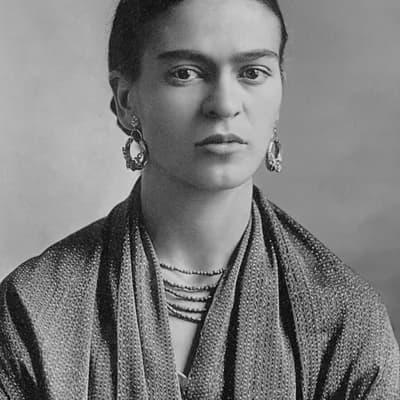
Frida Kahlo
Magdalena Carmen Frida Kahlo y Calderón
painter
Born 6 July 1907 · Coyoacán, Mexico City, Mexico · 19.35° N, 99.16° WX
Source: Birth time not documented in publicly accessible records
About this chart
No birth time is documented for this person. The chart therefore shows planetary positions in their signs, the slow aspects between them, and the generational context — but not house placements, the Ascendant, or the Midheaven, which require an accurate birth time. The Moon's sign carries a ±6° margin: if it falls near a sign boundary, the sign could vary. Positions for all other planets are reliable.
Do you have a verified source for this birth time? Share it →
The sky at birth
No birth time is documented for Frida Kahlo. The Ascendant, Midheaven, and house positions cannot be determined. The planetary positions below are calculated for noon local time and are accurate to within a fraction of a degree for the slow-moving planets. The Moon's position carries a margin of approximately ±7°.
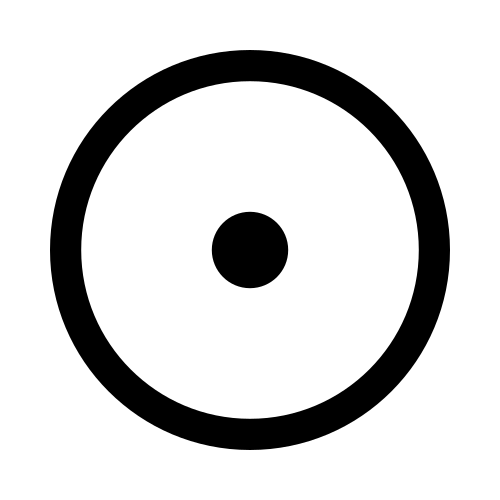
The Sun is at 13°29' Cancer. The Moon is at 1°09' Gemini (noon position, ±7° margin). Mercury is at 6°22' Leo. Venus is at 24°29' Gemini. Mars is at 13°21' Capricorn R. Jupiter is at 20°27' Cancer. Saturn is at 27°26' Pisces. Uranus is at 10°36' Capricorn R. Neptune is at 12°24' Cancer. Pluto is at 23°44' Gemini.
The Sun at 13°29' Cancer opposes Mars at 13°21' Capricorn retrograde (0°08') — functionally exact and the tightest major aspect in the chart. Venus at 24°29' Gemini conjoins Pluto at 23°44' Gemini (0°45'). Mars at 13°21' Capricorn retrograde opposes Neptune at 12°24' Cancer (0°57'). The Sun at 13°29' Cancer conjoins Neptune at 12°24' Cancer (1°05'). Uranus at 10°36' Capricorn retrograde opposes Neptune at 12°24' Cancer (1°48'). Mars conjoins Uranus (2°45'). The Sun opposes Uranus (2°53'). Venus at 24°29' Gemini squares Saturn at 27°26' Pisces (2°57'). Saturn at 27°26' Pisces squares Pluto at 23°44' Gemini (3°42'). The Moon at 1°09' Gemini sextiles Saturn (3°43'), though this aspect carries the Moon's ±7° uncertainty.
The engine also identifies the following tight minor aspects involving asteroids and calculated points: sun opposition mars (0.13° sep); saturn trine ceres (0.13° sep); pallas trine juno (0.16° sep); pluto semi-sextile northNode (0.17° app).
The tightest major aspects between planets: Sun opposition Mars (0°08'), Venus conjunct Pluto (0°45'), Mars opposition Neptune (0°57'), Sun conjunct Neptune (1°05'), Uranus opposition Neptune (1°48'), Mars conjunct Uranus (2°45'), Sun opposition Uranus (2°53'), Venus square Saturn (2°57'), Saturn square Pluto (3°42'), Moon sextile Saturn (3°43').
Note on the Moon's sign: The Moon at 1°09' Gemini at noon is near the Taurus-Gemini boundary. If born early in the day, the Moon could have been in late Taurus. The Moon's sign placement in Gemini is probable but not certain for the entire day.
The chart was calculated by Astrian's engine using NASA JPL DE441 ephemerides, sub-arcsecond precision. Timezone: America/Mexico_City (Central Standard Time, UTC −6).
| Planet | Sign | Position |
|---|---|---|
| Sun | Cancer | 13°30' |
| Moon | Gemini | 01°28'±6° |
| Mercury | Leo | 06°23' |
| Venus | Gemini | 24°31' |
| Mars | Capricorn | 13°21'retrograde |
| Jupiter | Cancer | 20°28' |
| Saturn | Pisces | 27°26' |
| Uranus | Capricorn | 10°36'retrograde |
| Neptune | Cancer | 12°24' |
| Pluto | Gemini | 23°44' |
| Chiron | Aquarius | 17°17'retrograde |
 Sun
Sun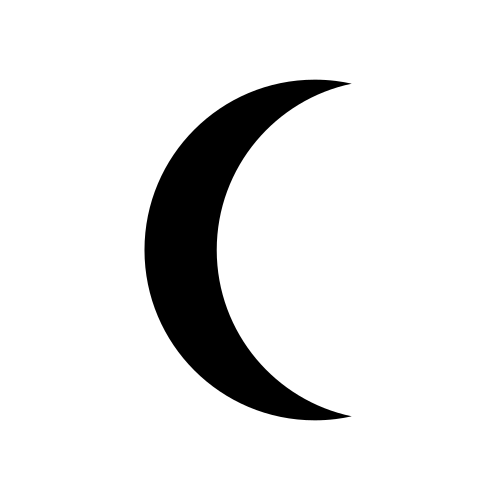 Moon
Moon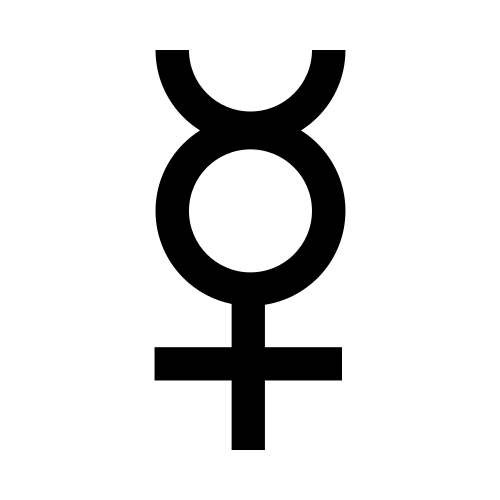 Mercury
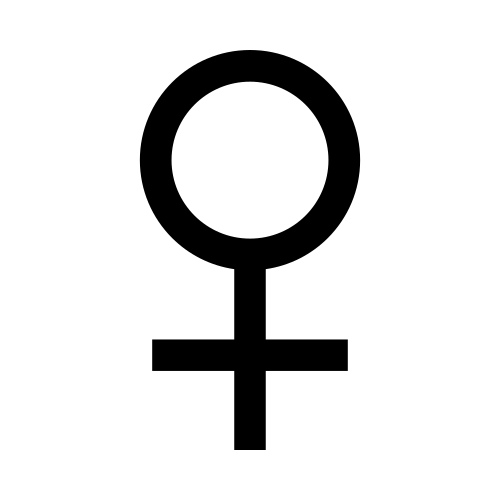 Venus
Venus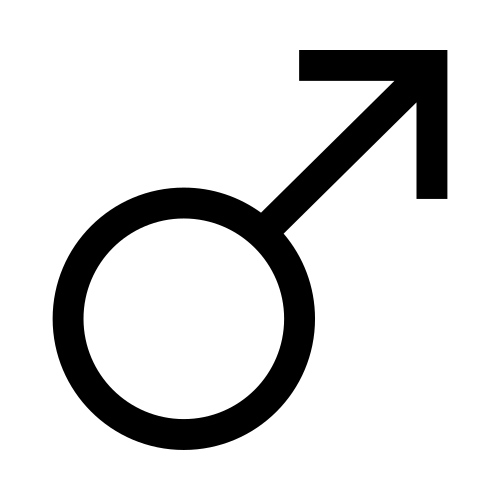 Mars
Mars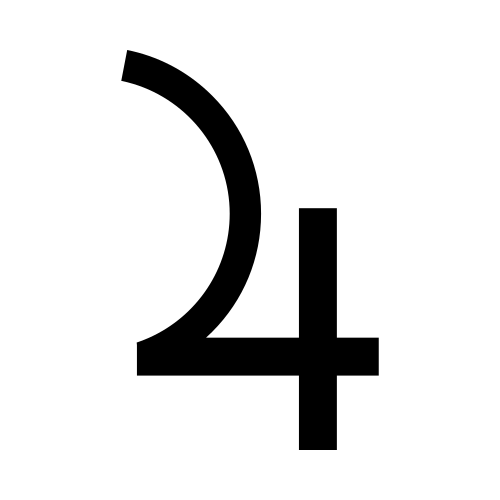 Jupiter
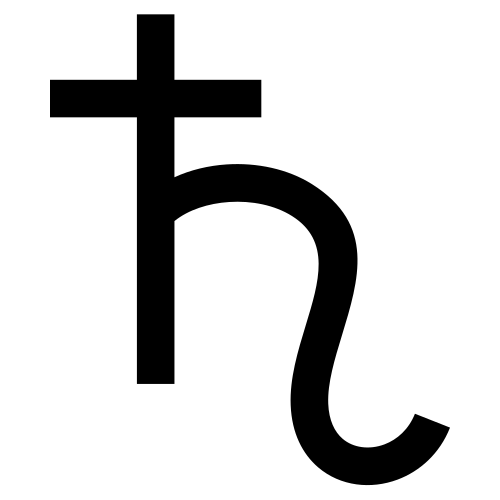 Saturn
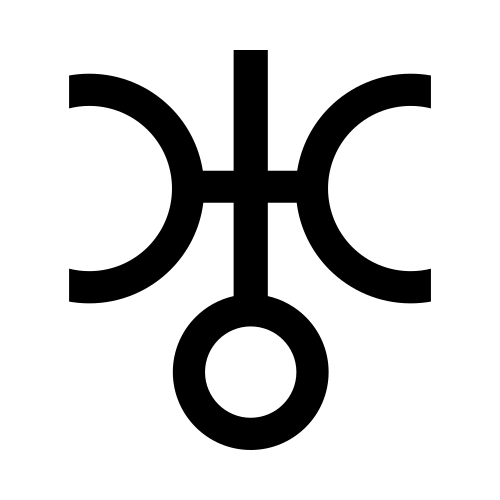 Uranus
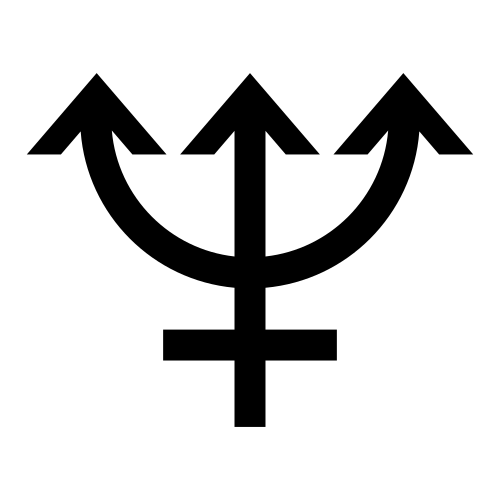 Neptune
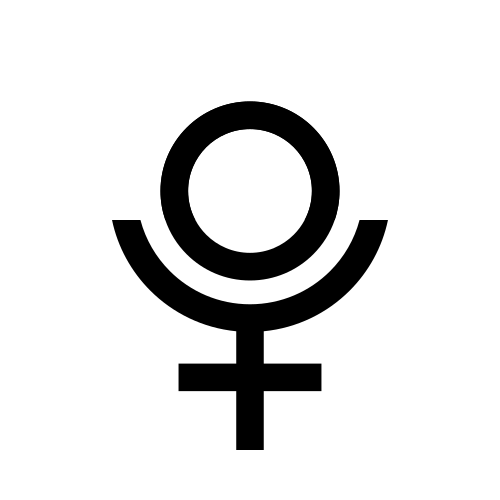 Pluto
Pluto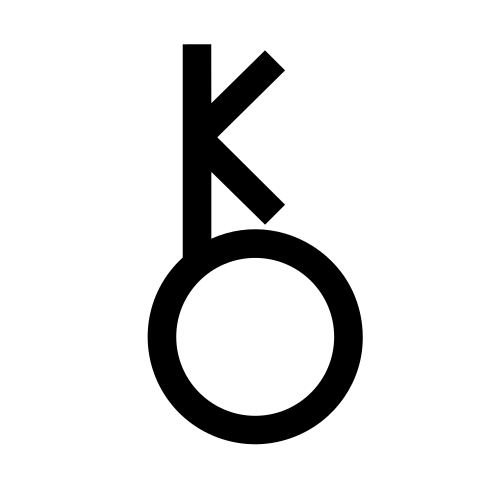 Chiron
Birth time unknown — house positions and Ascendant/MC are not available.
Astronomical context
Those born between approximately 1884 and 1914 carried Pluto in Gemini. This generation lived through the explosion of mass media, the invention of cinema, the development of radio, the First World War, and the early stirrings of the Mexican Revolution that shaped Kahlo's country and her politics. They came of age in a world where information — its production, its control, its weaponization — was being transformed at a pace without precedent.
In astrological tradition, Pluto in Gemini is associated with collective transformation of the domains that sign governs: communication, information, language, trade, and the networks through which ideas circulate. Gemini is the sign of the messenger, the one who names, classifies, and connects. Pluto's transit through Gemini coincided with the emergence of mass literacy, mass journalism, propaganda as state craft, and the first global communications infrastructure — the telegraph, the telephone, the wireless. The symbolic reading is correlative, not causal.
No other profiles currently in the Astrian collection share this generational configuration. Frida Kahlo, born in 1907, belongs to the later years of this generational wave.
Other profiles from this Pluto in Gemini generation
Symbolic reading
The following describes what classical astrological tradition associates with these configurations. Astrian does not apply these descriptions to the person's biography.
The Sun at 13°29' Cancer is the most prominent structural feature of this chart. Without a documented birth time, there is no Ascendant or Midheaven — the reading is confined to planetary positions by sign and the aspects between planets.
The Moon at 1°09' Gemini represents the noon position; the actual placement falls within approximately 7° on either side. If born early in the day, the Moon could have been in late Taurus. Mercury at 6°22' Leo, Venus at 24°29' Gemini, and Mars at 13°21' Capricorn retrograde complete the personal planet picture.
The chart is organized around a striking Cancer-Capricorn axis. The Sun, Jupiter, and Neptune occupy Cancer; Mars and Uranus occupy Capricorn. Three planets in Cancer — the sign of the home, the body, the intimate, the maternal — face two planets in Capricorn — the sign of structure, authority, and the skeleton that holds the body upright. The oppositions across this axis are exceptionally tight.
### Sun opposition Mars: the body and its antagonist
The Sun at 13°29' Cancer opposes Mars at 13°21' Capricorn retrograde, orb 0°08' — the tightest aspect in the chart, functionally exact. The Sun governs identity and the central organizing principle of the personality. Mars governs action, assertion, and the physical body in its capacity for effort and conflict. The opposition places them in direct confrontation: the self faces the force that acts upon and against it.
Sun-Mars oppositions in the tradition are read as configurations where the identity is forged in struggle — where the sense of self is sharpened by what it must fight, resist, or overcome. Mars retrograde intensifies the inward quality: the struggle is not only with the external world but with the body itself, turned back upon its own structure. Cancer (the Sun's position) governs the body as vessel, as home. Capricorn (Mars's position) governs the skeleton, the structural framework. The opposition at 0°08' is as tight as aspects get.
### The Cancer-Capricorn axis: Sun, Neptune, Uranus, Mars
The Sun-Mars opposition is not isolated. Neptune at 12°24' Cancer conjoins the Sun (1°05') and opposes Mars (0°57'). Uranus at 10°36' Capricorn retrograde conjoins Mars (2°45') and opposes Neptune (1°48') and the Sun (2°53'). The result is a four-planet configuration along the Cancer-Capricorn axis: Sun and Neptune together in Cancer, Mars and Uranus together in Capricorn, all within 3° of opposition.
Neptune governs vision, dissolution, and the capacity to transcend the material through imagination. Uranus governs disruption, the radically new, and the shattering of what was thought to be permanent. Together with the Sun and Mars, they create an axis of extreme tension between the body (Cancer) and the forces that break it (Capricorn), between the identity that imagines (Sun-Neptune) and the action that ruptures (Mars-Uranus).
### Venus conjunct Pluto: desire fused with the transformative
Venus at 24°29' Gemini conjoins Pluto at 23°44' Gemini, orb 0°45' — a tight conjunction. Venus governs value, desire, and the aesthetic sense. Pluto governs transformation, concentrated power, and the forces that operate beneath the surface. Their conjunction in Gemini places the faculty of desire and the transformative faculty together in the sign of communication, multiplicity, and the act of naming.
Venus-Pluto conjunctions in the tradition are read as configurations where desire is intense, where the aesthetic sense is drawn to what is hidden, painful, or taboo, and where the creative act carries a charge of transformation. In Gemini, this conjunction operates through language and image — the capacity to name what cannot be spoken, to give visible form to what is concealed.
Both Venus and Pluto square Saturn at 27°26' Pisces (Venus-Saturn 2°57', Saturn-Pluto 3°42'), creating a T-square. Saturn in Pisces introduces the pressure of suffering, of endurance through what cannot be controlled, of structure imposed on dissolution. The T-square connects beauty (Venus), transformation (Pluto), and suffering (Saturn) in a single geometric tension.
The planetary pattern here is read as a symbolic portrait, not a causal explanation. No planet caused, predicted, or determined any event or characteristic.
Astrology is a symbolic language with 2,500 years of literature. The reading above is interpretive, not explanatory.
Astrian does not claim that the natal chart of Frida Kahlo caused or determined any of the above. Astrology is a symbolic system with 2,500 years of literature. Its capacity for retrospective description does not imply explanatory capacity.
A parallel life
The following are verified biographical facts. No connection to the natal chart is implied.
Magdalena Carmen Frida Kahlo y Calderón was born on 6 July 1907 in Coyoacán, then a village on the outskirts of Mexico City, in the house her father Guillermo Kahlo had built three years earlier — the Casa Azul, which would become her studio, her prison, and her museum. Guillermo was a German-Hungarian immigrant who had arrived in Mexico in 1891 and established himself as a photographer. Her mother, Matilde Calderón y González, was of mixed Spanish and indigenous descent.
At six, Kahlo contracted polio. The disease withered her right leg, leaving it permanently thinner than the left — a deformity she would later hide under long skirts and, eventually, make visible in her paintings. She was a combative, intelligent child who enrolled at the Escuela Nacional Preparatoria in 1922, one of thirty-five girls among two thousand students, intending to study medicine.
On 17 September 1925, the bus she was riding collided with a trolley. A steel handrail impaled her through the pelvis. The accident fractured her spinal column in three places, her collarbone, her ribs, her right leg in eleven places, and her right foot. Her pelvis was broken in three places. Her right shoulder was dislocated. She was eighteen years old. The injuries would require more than thirty operations over the next twenty-nine years and left her in chronic pain for the rest of her life.
She began painting during her recovery, working from a specially constructed easel that allowed her to paint lying down. Her mother mounted a mirror above her bed. The self-portrait — the genre that would define her career — began as a practical necessity: she was the subject most consistently available.
In 1929, she married Diego Rivera, twenty years her senior, already the most famous muralist in Mexico. The marriage was a compound of devotion, infidelity, political solidarity, and mutual destruction. Rivera had affairs constantly; Kahlo had affairs with both men and women, including Leon Trotsky, who lived in the Casa Azul under the Riveras' protection from 1937 to 1939. They divorced in 1939 and remarried in 1940.
She produced approximately 200 paintings, of which 143 are catalogued. Fifty-five are self-portraits. The paintings are small — most under two feet in any dimension — and render the body in states of exposure: split open, pierced, bleeding, weeping, bound in surgical corsets, attended by animals and symbols drawn from Mexican folk tradition and pre-Columbian iconography. André Breton called her a surrealist; she rejected the label. "I never painted dreams," she said. "I painted my own reality."
Her political commitments were not ornamental. She was a member of the Mexican Communist Party, hosted Trotsky when Stalin's agents were hunting him, displayed her politics in her clothing (Tehuana dress was a deliberate assertion of indigenous identity), and dedicated paintings to the revolutionary project.
Her health deteriorated through the 1940s. Her right leg was amputated below the knee in 1953. Her last public appearance was at her first solo exhibition in Mexico City, in April 1953, where she arrived by ambulance and was carried to a bed placed in the centre of the gallery.
She died on 13 July 1954, officially of pulmonary embolism. The last words in her diary read: "I joyfully await the exit — and I hope never to return."
Biographical sources
- Herrera, Hayden. Frida: A Biography of Frida Kahlo. Harper & Row 1983
- Zamora, Martha. Frida Kahlo: The Brush of Anguish. Chronicle Books 1990
This profile presents the sky at the birth of Frida Kahlo and verified facts of their biography. Astrian does not claim that astrology has predictive capacity or that the natal chart determines the trajectory of a life. Astrology is a symbolic system with 2,500 years of literature. Its capacity for retrospective description does not imply explanatory capacity.
Related profiles
Calculate your own birth chart with the same NASA JPL DE441 precision.
Calculate my birth chartLast updated: June 12, 2026
Newsletter
A short reading once a month, in your inbox.
A note on the symbolism of the season, recent editorial pieces, and what to look for in next month's sky. No predictions.
Support this project
Independent, no venture funding, no ads. A contribution keeps Astrian precise and free.
Support on Ko-fi (opens in new tab)