PROFILE · SCIENCE & TECHNOLOGY
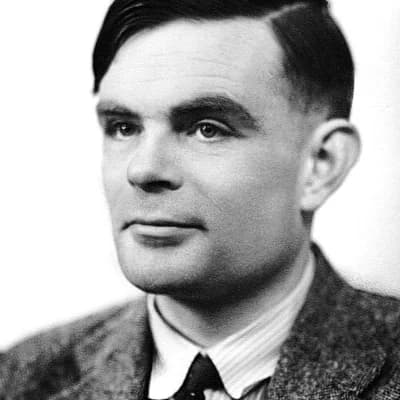
Alan Turing
Alan Mathison Turing
mathematician and computer scientist
Born 23 June 1912 · Maida Vale, London, United Kingdom · 51.53° N, 0.19° WX
Source: Birth time not documented in publicly accessible records
About this chart
No birth time is documented for this person. The chart therefore shows planetary positions in their signs, the slow aspects between them, and the generational context — but not house placements, the Ascendant, or the Midheaven, which require an accurate birth time. The Moon's sign carries a ±6° margin: if it falls near a sign boundary, the sign could vary. Positions for all other planets are reliable.
Do you have a verified source for this birth time? Share it →
The sky at birth
No birth time is documented for Alan Turing. The Ascendant, Midheaven, and house positions cannot be determined. The planetary positions below are calculated for noon local time and are accurate to within a fraction of a degree for the slow-moving planets. The Moon's position carries a margin of approximately ±7°.
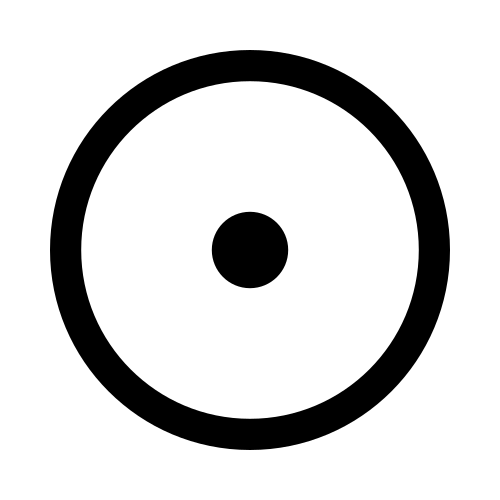
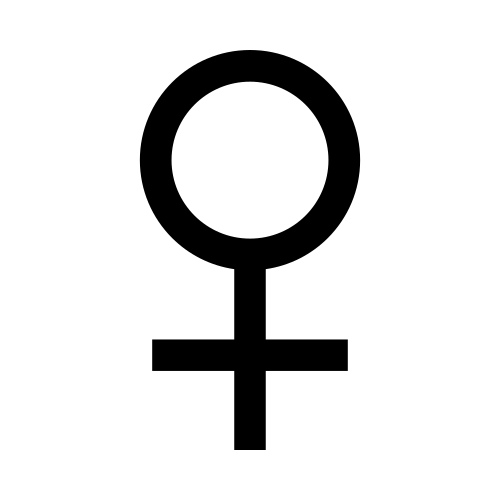
The Sun is at 1°34' Cancer. The Moon is at 21°21' Libra (noon position, ±7° margin). Mercury is at 8°47' Cancer. Venus is at 28°05' Gemini. Mars is at 15°34' Leo. Jupiter is at 7°52' Sagittarius R. Saturn is at 28°28' Taurus. Uranus is at 2°39' Aquarius R. Neptune is at 22°40' Cancer. Pluto is at 28°34' Gemini.
Venus at 28°05' Gemini conjoins Pluto at 28°34' Gemini (0°29') — the tightest major aspect in the chart. The Sun at 1°34' Cancer conjoins Pluto (3°00') and conjoins Venus (3°29'), forming a Sun-Venus-Pluto cluster at the Gemini-Cancer cusp. Saturn at 28°28' Taurus trines Uranus at 2°39' Aquarius retrograde (4°11'). The Moon at 21°21' Libra squares Neptune at 22°40' Cancer (1°19'), though this aspect carries the Moon's ±7° uncertainty. Mercury at 8°47' Cancer opposes Jupiter at 7°52' Sagittarius retrograde (0°55').
The engine also identifies the following tight minor aspects involving asteroids and calculated points: saturn semi-sextile pluto (0.09° app); jupiter sesquiquadrate neptune (0.20° app); venus semi-sextile saturn (0.38° app).
The tightest major aspects between planets: Venus conjunction Pluto (0°29'), Mercury opposition Jupiter (0°55'), Moon square Neptune (1°19'), Sun conjunction Pluto (3°00'), Sun conjunction Venus (3°29'), Saturn trine Uranus (4°11').
The chart was calculated by Astrian's engine using NASA JPL DE441 ephemerides, sub-arcsecond precision. Timezone: Greenwich Mean Time (Europe/London, UTC +0).
| Planet | Sign | Position |
|---|---|---|
| Sun | Cancer | 01°37' |
| Moon | Libra | 21°54'±6° |
| Mercury | Cancer | 08°52' |
| Venus | Gemini | 28°08' |
| Mars | Leo | 15°35' |
| Jupiter | Sagittarius | 07°52'retrograde |
| Saturn | Taurus | 28°29' |
| Uranus | Aquarius | 02°39'retrograde |
| Neptune | Cancer | 22°40' |
| Pluto | Gemini | 28°34' |
| Chiron | Pisces | 11°06'retrograde |
 Sun
Sun Moon
Moon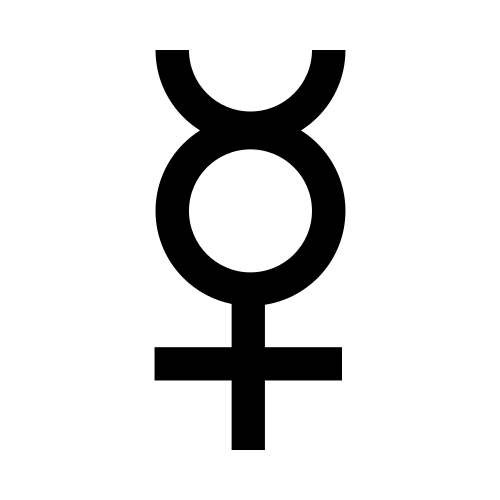 Mercury
 Venus
Venus Mars
Mars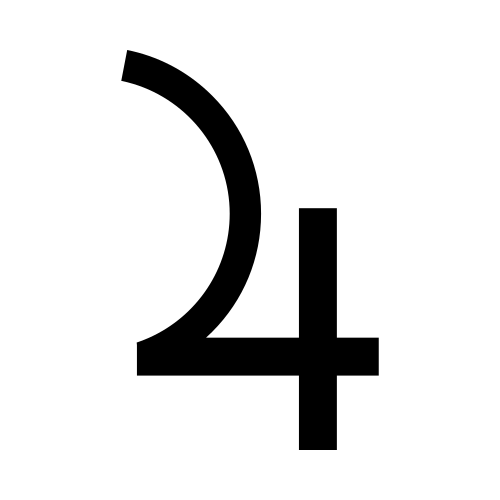 Jupiter
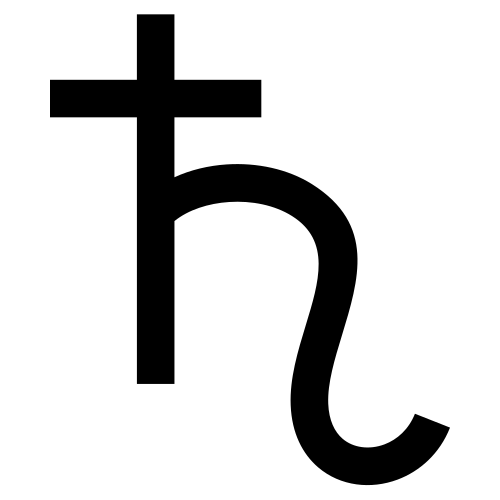 Saturn
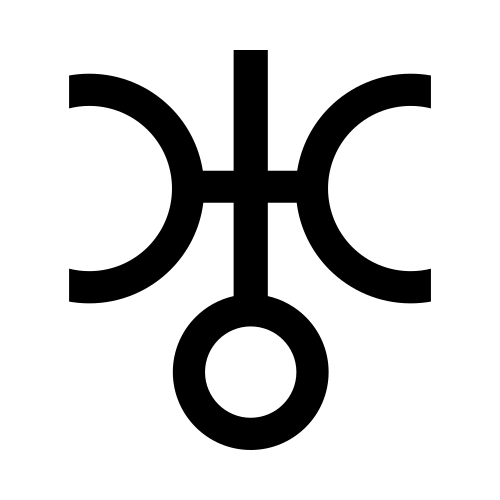 Uranus
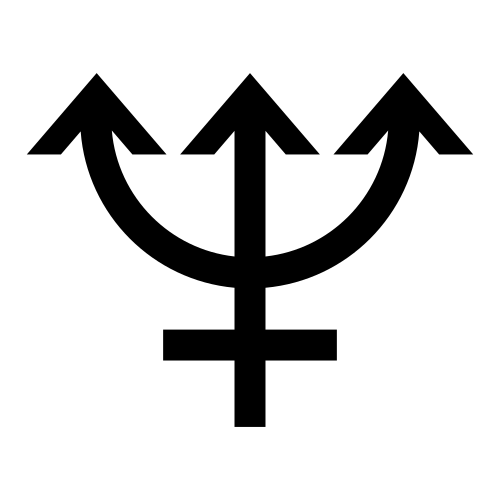 Neptune
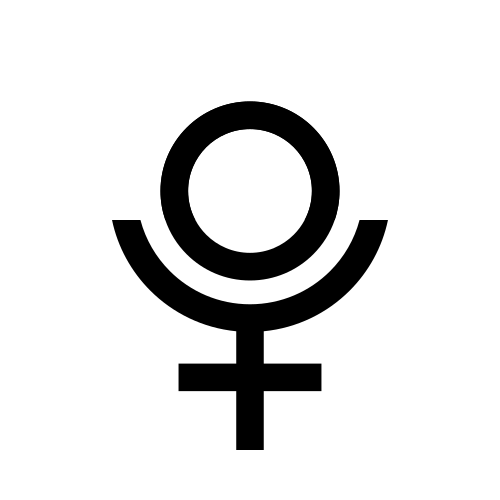 Pluto
Pluto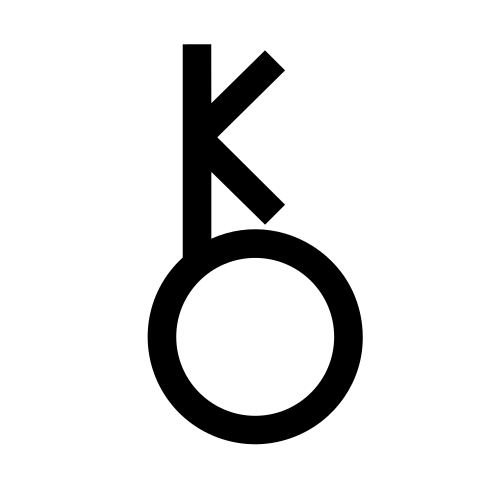 Chiron
Birth time unknown — house positions and Ascendant/MC are not available.
Astronomical context
Those born between approximately 1884 and 1914 carried Pluto in Gemini. This generation grew up during the emergence of mass communication — the telegraph network, the telephone, the radio, the cinema, the rotary press — and the first era of global information exchange. They came of age during or between the two world wars, and many of them built the intellectual and technological infrastructure of the twentieth century.
In astrological tradition, Pluto in Gemini is associated with collective transformation of the domains that sign governs: communication, language, information, the written word, the network, and the structures through which ideas move between minds. Gemini is the sign of the messenger, the connector, the code. Pluto's transit through Gemini is read, symbolically, as a period when the institutions of communication were subjected to deep structural pressure — the old frameworks of how information was gathered, encoded, transmitted, and decoded were torn apart and rebuilt. The generation that carries this placement inherited a world where the very notion of what could be communicated, and how far, was being radically expanded. The symbolic reading is correlative, not causal.
The Astrian collection does not yet include other profiles born under this configuration. Alan Turing, born in 1912, belongs to the final years of this generational wave.
Other profiles from this Pluto in Gemini generation
Symbolic reading
The following describes what classical astrological tradition associates with these configurations. Astrian does not apply these descriptions to the person's biography.
The Sun at 1°34' Cancer is the most prominent structural feature of this chart. Without a documented birth time, there is no Ascendant or Midheaven — the reading is confined to planetary positions by sign and the aspects between planets.
The Moon at 21°21' Libra represents the noon position; the actual placement falls within approximately 7° on either side. If born early in the day, the Moon could be in the mid-teens of Libra; if born late, in the upper twenties. The Moon's sign placement in Libra is secure for the entire day.
Mercury at 8°47' Cancer, Venus at 28°05' Gemini, and Mars at 15°34' Leo complete the personal planet picture.
### Venus conjunction Pluto at the Gemini-Cancer cusp
The chart's most extraordinary feature is the Venus-Pluto conjunction at 0°29' — Venus at 28°05' Gemini conjoined with Pluto at 28°34' Gemini. Venus governs aesthetics, connection, the sense of value, and the capacity to attract and be attracted. Pluto governs transformation, power, and the encounter with what lies beneath the surface. The conjunction fuses them — the sense of beauty and connection is inseparable from the demand to confront what is hidden, and the encounter with depth is itself experienced as a form of beauty.
In Gemini, this conjunction operates through the register of communication, language, and the structures of thought. The Venusian sense of value is directed toward ideas, patterns, and the elegance of logical form. The Plutonian depth transforms the communicative register from the inside: what is communicated is not surface information but structures that reveal the hidden architecture of things.
The Sun at 1°34' Cancer stands just across the sign boundary, conjoining Pluto (3°00') and Venus (3°29'). This three-body cluster — Venus-Pluto in late Gemini, Sun in early Cancer — bridges the cusp between the register of the intellect (Gemini) and the register of feeling, belonging, and the domestic (Cancer). The identity operates at the threshold between these two modes.
### Mercury opposition Jupiter: the mind that sees far
Mercury at 8°47' Cancer opposes Jupiter at 7°52' Sagittarius retrograde, orb 0°55' — a tight opposition that places the analytical faculty on one side and the expansive, meaning-seeking faculty on the other. Mercury governs perception, articulation, and the capacity to process information. Jupiter governs the impulse to connect the particular to the universal, to see the forest rather than the tree.
In opposition, they do not blend but face each other across an axis — the mind must negotiate between the precise and the vast, between the detail and the overarching framework. Mercury in Cancer perceives through feeling and intuition; Jupiter in Sagittarius retrograde expands through internalised philosophical search. The opposition reads as a mind that is simultaneously intimate in its perception and cosmic in its aspirations.
### Saturn trine Uranus: structured innovation
Saturn at 28°28' Taurus trines Uranus at 2°39' Aquarius retrograde, orb 4°11'. Saturn governs structure, discipline, and the patient construction of form. Uranus governs originality, the unexpected, and the capacity to perceive what convention misses. The trine connects them cooperatively — the disciplined faculty works with the inventive one rather than against it. Innovation is not chaotic but structured; the unconventional is expressed through the frameworks of rigorous method.
Saturn in Taurus structures through the concrete, the tangible, and the patient accumulation of material form. Uranus in Aquarius retrograde operates through the register of systems, abstract patterns, and the internalised drive to rethink the architecture of how things work. The trine between them reads as the capacity to produce original work that is also built to last — invention expressed through the discipline of proof and construction.
### Moon square Neptune
The Moon at 21°21' Libra squares Neptune at 22°40' Cancer, orb 1°19' — though this aspect carries the Moon's ±7° uncertainty. If the actual birth time places the Moon near its noon position, this is a tight square: the emotional faculty (Moon) in tension with the register of the ideal, the imaginary, and the dissolution of boundaries (Neptune). Moon-Neptune squares in the tradition are read as configurations where the emotional life is drawn toward what cannot be fully grasped — the feeling that the ordinary world is insufficient, that something just beyond reach demands attention.
The planetary pattern here is read as a symbolic portrait, not a causal explanation. No planet caused, predicted, or determined any event or characteristic.
Astrology is a symbolic language with 2,500 years of literature. The reading above is interpretive, not explanatory.
Astrian does not claim that the natal chart of Alan Turing caused or determined any of the above. Astrology is a symbolic system with 2,500 years of literature. Its capacity for retrospective description does not imply explanatory capacity.
A parallel life
The following are verified biographical facts. No connection to the natal chart is implied.
Alan Mathison Turing was born on 23 June 1912 in Maida Vale, London, the second son of Julius Mathison Turing, a member of the Indian Civil Service, and Ethel Sara Stoney. His parents spent most of his childhood in India, and he and his older brother John were raised largely by foster families in England — a childhood of emotional distance and institutional rigidity that shaped a temperament already inclined toward isolation.
He attended Sherborne School, where he showed an exceptional mathematical gift that his teachers regarded with ambivalence. At King's College, Cambridge (1931–1934), he studied mathematics and was elected a Fellow at twenty-two. His intellectual life at Cambridge was marked by both extraordinary accomplishment and the beginning of a more open engagement with his homosexuality, which was illegal under English law.
In 1936, at the age of twenty-three, he published "On Computable Numbers, with an Application to the Entscheidungsproblem" — a paper that defined the concept of the universal computing machine (now called the Turing machine), demonstrated the limits of what could be computed, and laid the theoretical foundation for the entire field of computer science. The paper was written before any electronic computer existed.
He completed his doctorate at Princeton in 1938, studying under Alonzo Church, and returned to England on the eve of war. From September 1939, he worked at the Government Code and Cypher School at Bletchley Park, where he led the effort to break the German naval Enigma cipher. He designed the Bombe, an electromechanical device that automated the search for Enigma settings, and his work in Hut 8 was credited as a decisive contribution to the Allied victory in the Battle of the Atlantic. Historians have estimated that the intelligence produced by the Enigma decryption shortened the war by at least two years and saved millions of lives.
After the war, he joined the National Physical Laboratory (1945–1948), where he designed the Automatic Computing Engine (ACE), one of the first detailed plans for a stored-programme electronic computer. He then moved to the University of Manchester, where he worked on the Manchester Mark 1 and its successors.
In 1950, he published "Computing Machinery and Intelligence," the paper that proposed what became known as the Turing test — a criterion for machine intelligence based on the capacity of a computer to produce responses indistinguishable from those of a human being. The paper remains the most cited work in the philosophy of artificial intelligence.
His final research, cut short by his death, concerned morphogenesis — the mathematical basis of biological pattern formation. His 1952 paper "The Chemical Basis of Morphogenesis" proposed reaction-diffusion mechanisms to explain how patterns such as spots and stripes arise in nature. The work was decades ahead of its time and is now considered foundational to mathematical biology.
In January 1952, he was arrested after a relationship with a young man named Arnold Murray. He was charged with "gross indecency" under the same statute that had been used to prosecute Oscar Wilde. Rather than face imprisonment, he accepted chemical castration — a course of injections of diethylstilbestrol, a synthetic oestrogen, that lasted a year and caused physical changes including the development of breast tissue.
He was found dead on 7 June 1954, in his home in Wilmslow, Cheshire. A half-eaten apple lay beside his bed. The inquest recorded a verdict of suicide by cyanide poisoning. He was forty-one years old.
He received a posthumous royal pardon from Queen Elizabeth II in 2013. The "Turing Law," enacted in 2017, provided a statutory pardon for the estimated 49,000 men convicted of historical homosexuality offences in England and Wales. His face appeared on the Bank of England fifty-pound note from 2021.
This profile presents the sky at the birth of Alan Turing and verified facts of their biography. Astrian does not claim that astrology has predictive capacity or that the natal chart determines the trajectory of a life. Astrology is a symbolic system with 2,500 years of literature. Its capacity for retrospective description does not imply explanatory capacity.
Related profiles
Calculate your own birth chart with the same NASA JPL DE441 precision.
Calculate my birth chartLast updated: May 21, 2026
Newsletter
A short reading once a month, in your inbox.
A note on the symbolism of the season, recent editorial pieces, and what to look for in next month's sky. No predictions.
Support this project
Independent, no venture funding, no ads. A contribution keeps Astrian precise and free.
Support on Ko-fi (opens in new tab)