PROFILE · VISUAL ARTS
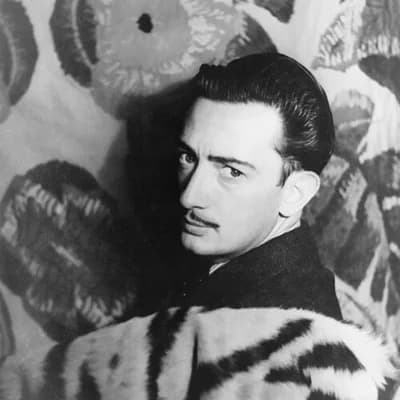
Salvador Dalí
Salvador Domingo Felipe Jacinto Dalí i Domènech
painter
Born 11 May 1904 · Figueres, Catalonia, Spain · 42.27° N, 2.96° EX
Source: Birth time not documented in publicly accessible records
About this chart
No birth time is documented for this person. The chart therefore shows planetary positions in their signs, the slow aspects between them, and the generational context — but not house placements, the Ascendant, or the Midheaven, which require an accurate birth time. The Moon's sign carries a ±6° margin: if it falls near a sign boundary, the sign could vary. Positions for all other planets are reliable.
Do you have a verified source for this birth time? Share it →
The sky at birth
No birth time is documented for Salvador Dalí. The Ascendant, Midheaven, and house positions cannot be determined. The planetary positions below are calculated for noon local time and are accurate to within a fraction of a degree for the slow-moving planets. The Moon's position carries a margin of approximately ±7°.
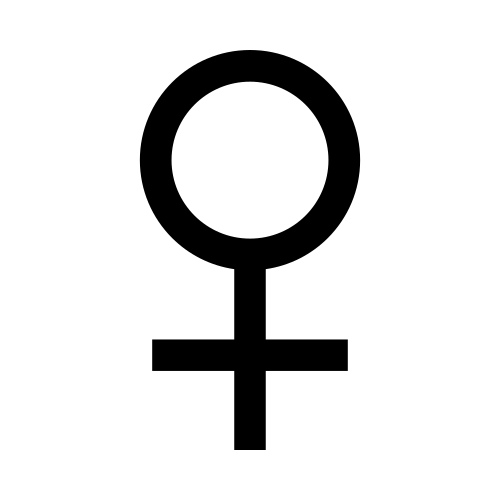
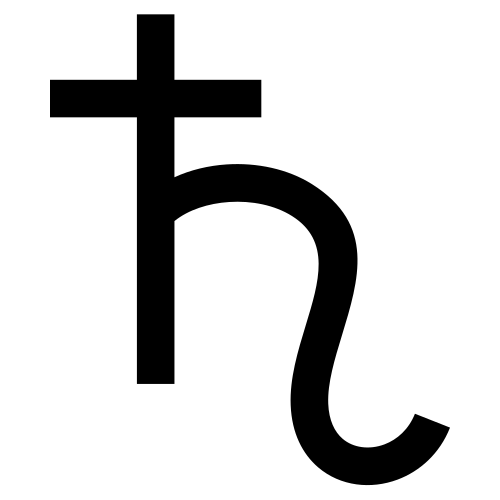
The Sun is at 20°18' Taurus. The Moon is at 3°36' Aries (noon position, ±7° margin). Mercury is at 23°25' Taurus R. Venus is at 4°42' Taurus. Mars is at 25°14' Taurus. Jupiter is at 16°53' Aries. Saturn is at 20°39' Aquarius. Uranus is at 29°23' Sagittarius R. Neptune is at 4°01' Cancer. Pluto is at 19°28' Gemini.
The Sun at 20°18' Taurus squares Saturn at 20°39' Aquarius (0°21') — functionally exact and the tightest major aspect in the chart. The Moon at 3°36' Aries squares Neptune at 4°01' Cancer (0°25'), though this aspect carries the Moon's ±7° uncertainty. Venus at 4°42' Taurus sextiles Neptune at 4°01' Cancer (0°41'). Saturn at 20°39' Aquarius trines Pluto at 19°28' Gemini (1°11'). Mercury at 23°25' Taurus retrograde conjoins Mars at 25°14' Taurus (1°49'). Jupiter at 16°53' Aries sextiles Pluto at 19°28' Gemini (2°35'). Mercury squares Saturn (2°46'). The Sun conjoins Mercury (3°07'). Jupiter sextiles Saturn (3°46'). The Moon squares Uranus at 29°23' Sagittarius retrograde (4°13'), under the Moon's uncertainty. Mars squares Saturn (4°35'). Uranus opposes Neptune (4°38'). The Sun conjoins Mars (4°56').
The engine also identifies the following tight minor aspects involving asteroids and calculated points: sun quincunx ceres (0.02° sep); jupiter semi-square lilith (0.21° sep); venus semi-square pluto (0.22° sep); mars trine northNode (0.37° sep).
The tightest major aspects between planets: Sun square Saturn (0°21'), Moon square Neptune (0°25'), Venus sextile Neptune (0°41'), Saturn trine Pluto (1°11'), Mercury conjunct Mars (1°49'), Jupiter sextile Pluto (2°35'), Mercury square Saturn (2°46'), Sun conjunct Mercury (3°07'), Jupiter sextile Saturn (3°46'), Moon square Uranus (4°13'), Mars square Saturn (4°35'), Uranus opposition Neptune (4°38'), Sun conjunct Mars (4°56').
Note on the Moon's sign: The Moon at 3°36' Aries at noon is near the Pisces-Aries boundary. If born early in the day, the Moon could have been in late Pisces. The Moon's sign placement in Aries is probable but not certain for the entire day.
The chart was calculated by Astrian's engine using NASA JPL DE441 ephemerides, sub-arcsecond precision. Timezone: Europe/Madrid (Western European Time, UTC +0).
| Planet | Sign | Position |
|---|---|---|
| Sun | Taurus | 20°20' |
| Moon | Aries | 04°06'±6° |
| Mercury | Taurus | 23°24'retrograde |
| Venus | Taurus | 04°45' |
| Mars | Taurus | 25°16' |
| Jupiter | Aries | 16°54' |
| Saturn | Aquarius | 20°39' |
| Uranus | Sagittarius | 29°23'retrograde |
| Neptune | Cancer | 04°01' |
| Pluto | Gemini | 19°28' |
| Chiron | Aquarius | 00°06'retrograde |
 Sun
Sun Moon
Moon Mercury
 Venus
Venus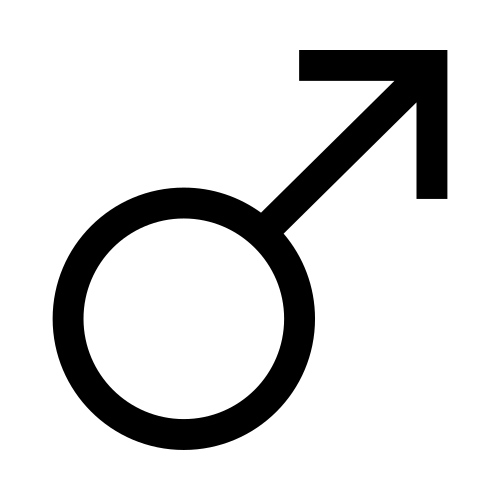 Mars
Mars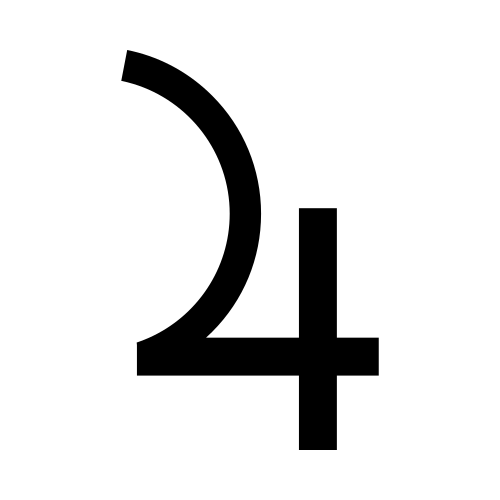 Jupiter
 Saturn
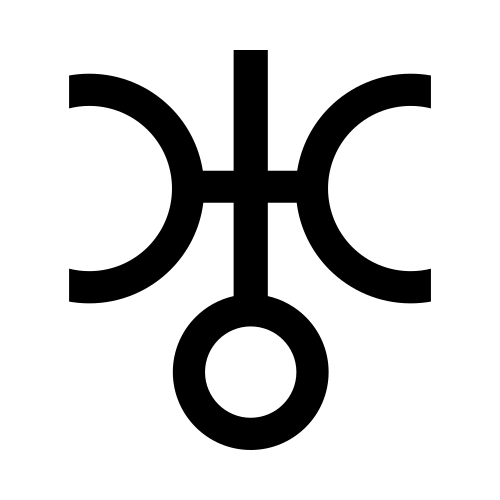 Uranus
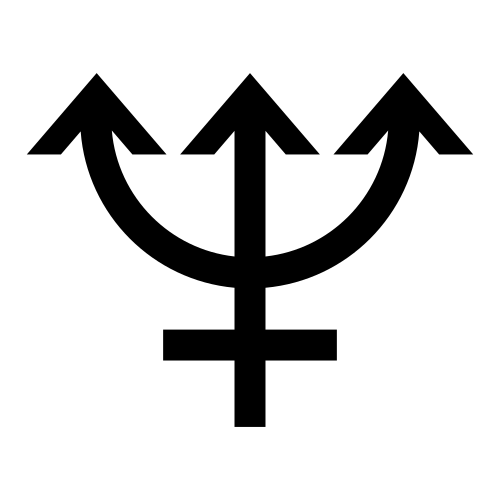 Neptune
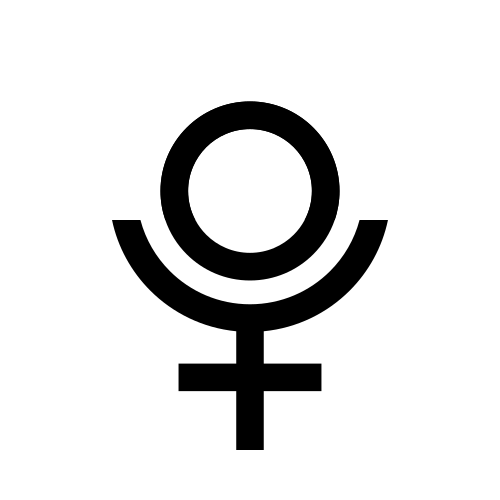 Pluto
Pluto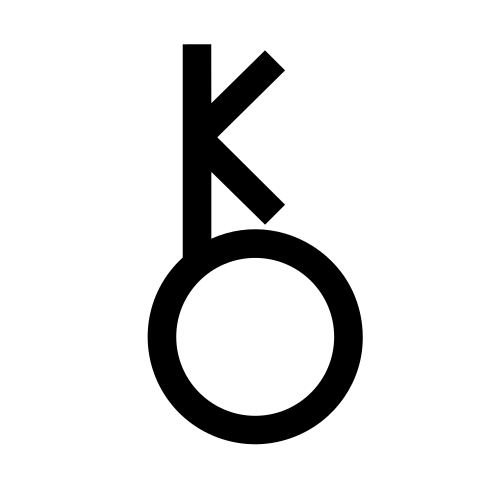 Chiron
Birth time unknown — house positions and Ascendant/MC are not available.
Astronomical context
Those born between approximately 1884 and 1914 carried Pluto in Gemini. This generation lived through the explosion of mass media, the invention of cinema, the development of radio, the rise of propaganda as state craft, and the First World War that shattered the nineteenth century's confidence in progress. They came of age in a world where information itself had become a weapon and a medium of transformation.
In astrological tradition, Pluto in Gemini is associated with collective transformation of the domains that sign governs: communication, information, language, trade, and the networks through which ideas circulate. Gemini is the sign of the messenger, the one who names, classifies, and connects. Pluto's transit through Gemini coincided with the rise of mass literacy, mass journalism, and the first global communications infrastructure. The symbolic reading is correlative, not causal.
Other profiles in the Astrian collection born under this configuration include Frida Kahlo (1907). Salvador Dalí, born in 1904, belongs to the middle years of this generational wave.
Other profiles from this Pluto in Gemini generation
Symbolic reading
The following describes what classical astrological tradition associates with these configurations. Astrian does not apply these descriptions to the person's biography.
The Sun at 20°18' Taurus is the most prominent structural feature of this chart. Without a documented birth time, there is no Ascendant or Midheaven — the reading is confined to planetary positions by sign and the aspects between planets.
The Moon at 3°36' Aries represents the noon position; the actual placement falls within approximately 7° on either side. If born early in the day, the Moon could have been in late Pisces. Mercury at 23°25' Taurus retrograde, Venus at 4°42' Taurus, and Mars at 25°14' Taurus complete the personal planet picture.
The chart's most striking structural feature is the massive Taurus concentration: four personal planets — Sun, Mercury retrograde, Venus, and Mars — all occupy Taurus, the sign of material form, sensory experience, and the insistence on what can be touched and possessed. This is a chart saturated with the tangible, the physical, the stubbornly present. And at its centre stands a functionally exact square to Saturn.
### Sun square Saturn: identity against structure
The Sun at 20°18' Taurus squares Saturn at 20°39' Aquarius, orb 0°21' — the tightest aspect in the chart, functionally exact. The Sun governs identity and the central organizing principle of the personality. Saturn governs structure, authority, discipline, and the framework of limits within which things endure or break. The square places them in tension: the identity is pressured by structure, and the structure is challenged by the identity.
The Sun in Taurus — rooted in the material, the sensory, the beautiful — squares Saturn in Aquarius — cold, systematic, concerned with the collective and the abstract. The friction is between what can be touched and what can only be thought, between the individual's insistence on his own sensory reality and the social framework's insistence on its rules. Mercury (3°07' from the Sun) and Mars (4°56' from the Sun) also square Saturn (2°46' and 4°35' respectively), extending the tension to the communicative and active faculties. Nearly every personal planet in Taurus is in structural tension with Saturn in Aquarius.
### Venus sextile Neptune: beauty and the imagined
Venus at 4°42' Taurus sextiles Neptune at 4°01' Cancer, orb 0°41' — a tight, cooperative aspect. Venus governs value, desire, and the aesthetic sense. In Taurus, Venus operates in the sign of its traditional rulership — the aesthetic faculty at its most rooted in the sensory, the physical, the beautiful-as-experienced. Neptune governs vision, imagination, dissolution of form, and the capacity to perceive what is not materially present. The sextile connects them productively: the sensory aesthetic has access to the imaginary without losing its grip on the physical.
### Moon square Neptune: emotion and dissolution
The Moon at 3°36' Aries squares Neptune at 4°01' Cancer, orb 0°25' — functionally exact, though it carries the Moon's ±7° uncertainty. If the birth time places the Moon near its noon position, the emotional faculty (Moon in Aries — impulsive, direct, self-asserting) is in structural tension with the visionary-dissolving faculty (Neptune in Cancer — imagination operating through the register of home, feeling, and the intimate). Moon-Neptune squares in the tradition are read as configurations of emotional sensitivity that borders on the overwhelming — where the feelings are vast, permeable, and not easily contained.
### Saturn trine Pluto: deep structure
Saturn at 20°39' Aquarius trines Pluto at 19°28' Gemini, orb 1°11'. The structuring faculty connects cooperatively with the transformative depth. Saturn in Aquarius builds systems; Pluto in Gemini transforms through communication and naming. The trine suggests a capacity for systematic transformation — the ability to take what is hidden or subconscious and give it structural, communicable form. Jupiter sextiles both Saturn (3°46') and Pluto (2°35'), connecting the expansive faculty to this structural-transformative axis.
The planetary pattern here is read as a symbolic portrait, not a causal explanation. No planet caused, predicted, or determined any event or characteristic.
Astrology is a symbolic language with 2,500 years of literature. The reading above is interpretive, not explanatory.
Astrian does not claim that the natal chart of Salvador Dalí caused or determined any of the above. Astrology is a symbolic system with 2,500 years of literature. Its capacity for retrospective description does not imply explanatory capacity.
A parallel life
The following are verified biographical facts. No connection to the natal chart is implied.
Salvador Domingo Felipe Jacinto Dalí i Domènech was born on 11 May 1904 in Figueres, a small town in Catalonia near the French border. His father, Salvador Dalí i Cusí, was a notary — an authoritative, prosperous figure in the provincial legal class. His mother, Felipa Domènech Ferrés, was devoutly Catholic and indulgent toward her son. Nine months before his birth, an older brother — also named Salvador — had died at the age of twenty-one months. Dalí grew up in the shadow of a dead child whose name he carried, whose photographs hung in the family home, and whose grave he was taken to visit as a boy.
He showed early talent for drawing and was encouraged by the Impressionist painter Ramon Pichot, a family friend. At seventeen, he enrolled at the Real Academia de Bellas Artes de San Fernando in Madrid, where he befriended Federico García Lorca and Luis Buñuel. He was suspended in 1923 for inciting student disorder and permanently expelled in 1926 for declaring no member of the faculty competent to examine him.
In 1929, he travelled to Paris and joined the Surrealist movement. That same year, he collaborated with Buñuel on Un Chien Andalou — a short film whose opening sequence, the slicing of a woman's eye with a razor, became one of the most notorious images in cinema. He developed what he called the "paranoiac-critical method": the deliberate cultivation of hallucinatory states in which one image could be read as another, where perception itself became unstable and the boundary between the real and the imagined dissolved.
The Persistence of Memory (1931) — the small canvas of melting watches in a barren landscape — became one of the most reproduced images in the history of art. The painting measures only 24 by 33 centimetres. Dalí said the soft watches were inspired by Camembert cheese melting in the sun.
In 1929, he met Gala Éluard, born Elena Ivanovna Diakonova, a Russian émigré ten years his senior who was then the wife of the poet Paul Éluard. She became his wife (they married civilly in 1934 and in a Catholic ceremony in 1958), his model, his business manager, and the organizing principle of his public and private life. Their relationship was codependent, financially strategic, and enduring.
André Breton expelled Dalí from the Surrealist group in 1934, objecting to his refusal to condemn fascism and to his increasingly commercial instincts. Dalí responded: "I am Surrealism." He and Gala spent the Second World War in the United States, where he embraced commercial work — magazine covers for Vogue, advertisements for Chupa Chups, window displays for Bonwit Teller, a dream sequence for Hitchcock's Spellbound (1945). His former colleagues never forgave him. Breton coined the anagram "Avida Dollars."
He returned to Catalonia in 1948 and settled in Port Lligat, near Cadaqués. His late work turned toward nuclear mysticism and religious themes: Christ of Saint John of the Cross (1951), Corpus Hypercubus (1954), The Sacrament of the Last Supper (1955). He designed the Dalí Theatre-Museum in Figueres, which opened in 1974 and remains one of the most visited museums in Spain.
Gala died in 1982. Dalí withdrew into depression. In 1984, he was severely burned in a fire at the Castle of Púbol that Gala had occupied. He spent his final years in the Torre Galatea, the tower adjacent to his museum, largely unable to paint. He died on 23 January 1989 of heart failure, at the age of eighty-four, and was buried in the crypt of his museum in Figueres.
Biographical sources
- Gibson, Ian. The Shameful Life of Salvador Dalí. Norton 1997
- Dalí, Salvador. The Secret Life of Salvador Dalí. Dial Press 1942
This profile presents the sky at the birth of Salvador Dalí and verified facts of their biography. Astrian does not claim that astrology has predictive capacity or that the natal chart determines the trajectory of a life. Astrology is a symbolic system with 2,500 years of literature. Its capacity for retrospective description does not imply explanatory capacity.
Related profiles
Calculate your own birth chart with the same NASA JPL DE441 precision.
Calculate my birth chartLast updated: May 21, 2026
Newsletter
A short reading once a month, in your inbox.
A note on the symbolism of the season, recent editorial pieces, and what to look for in next month's sky. No predictions.
Support this project
Independent, no venture funding, no ads. A contribution keeps Astrian precise and free.
Support on Ko-fi (opens in new tab)