PROFILE · SCIENCE & TECHNOLOGY
James Watson
James Dewey Watson
molecular biologist
Born 6 April 1928 · Chicago, Illinois, United States · 41.88° N, 87.63° WX
Source: Birth time not documented in publicly accessible records
About this chart
No birth time is documented for this person. The chart therefore shows planetary positions in their signs, the slow aspects between them, and the generational context — but not house placements, the Ascendant, or the Midheaven, which require an accurate birth time. The Moon's sign carries a ±6° margin: if it falls near a sign boundary, the sign could vary. Positions for all other planets are reliable.
Do you have a verified source for this birth time? Share it →
The sky at birth
No birth time is documented for James Watson. The Ascendant, the Midheaven, and the house positions cannot be determined; the reading is confined to planetary sign placements and the aspects between planets. The positions below are calculated for noon local time and are accurate to a fraction of a degree for the slow-moving bodies. One caveat: the Moon lies near a sign boundary, so without an exact time it cannot be fixed to a single sign — it sits close to 4°14' Scorpio within a daily margin of about ±7°.
The Moon is near 4°14' Scorpio (noon position, ±7° margin). Sun is at 16°41' Aries. Mercury is at 23°14' Pisces. Venus is at 24°05' Pisces. Mars is at 29°20' Aquarius. Jupiter is at 16°34' Aries. Saturn is at 19°03' Sagittarius, retrograde. Uranus is at 4°07' Aries. Neptune is at 26°38' Leo, retrograde. Pluto is at 14°59' Cancer.
3 bodies occupy Aries (Sun, Jupiter and Uranus) — a concentration that stands out as a structural feature of the chart.
The tightest major aspects between planets: Sun conjunct Jupiter (0°06'); Mercury conjunct Venus (0°50'); Jupiter square Pluto (1°35'); Sun square Pluto (1°41'); Sun trine Saturn (2°23'); Jupiter trine Saturn (2°29').
The engine also registers tight minor aspects involving asteroids and calculated points: Venus semi-square Pallas (0°01'); Jupiter sesquiquadrate Juno (0°06'); Sun sesquiquadrate Juno (0°13'); Moon opposite Chiron (0°14'). These are reported for completeness and carry less weight in traditional reading.
The chart was calculated using NASA JPL DE441 ephemerides, sub-arcsecond precision.
| Planet | Sign | Position |
|---|---|---|
| Sun | Aries | 16°41' |
| Moon | Scorpio | 04°14'±6° |
| Mercury | Pisces | 23°14' |
| Venus | Pisces | 24°05' |
| Mars | Aquarius | 29°20' |
| Jupiter | Aries | 16°34' |
| Saturn | Sagittarius | 19°03'retrograde |
| Uranus | Aries | 04°07' |
| Neptune | Leo | 26°38'retrograde |
| Pluto | Cancer | 14°59' |
| Chiron | Taurus | 04°28' |
 Sun
Sun Moon
Moon Mercury
 Venus
Venus Mars
Mars Jupiter
 Saturn
 Uranus
 Neptune
 Pluto
Pluto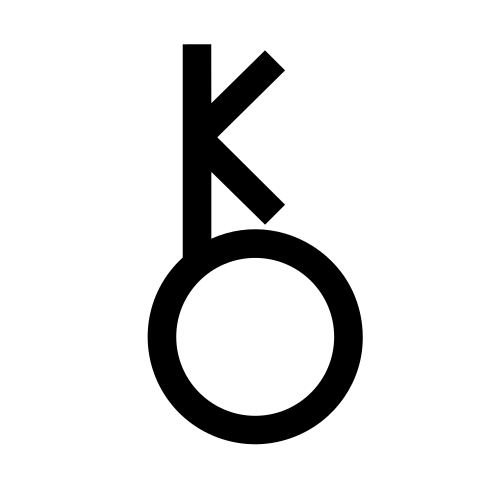 Chiron
Birth time unknown — house positions and Ascendant/MC are not available.
Astronomical context
Pluto crossed Cancer from 1914 to 1939. In astrological tradition this transit is linked to the transformation of home, family, nation, and the sense of belonging — the generation whose lives were marked by the World Wars and a profound redefinition of the nation and the home.
James Watson (born 1928) belongs to this generational configuration. Astrian groups profiles by such shared signatures rather than by any claim of shared destiny. Related profiles in Astrian: Francis Crick · Rosalind Franklin · Linus Pauling. The symbolic reading is correlative, not causal.
Other profiles from this Pluto in Cancer generation
Symbolic reading
The following describes what classical astrological tradition associates with these configurations. Astrian does not apply these descriptions to the person's biography.
The Sun in Aries is the most prominent structural feature available without a birth time, centring the chart on initiative, directness, and the will to begin. There is no Ascendant or Midheaven to anchor the angles, so the reading rests on sign placements and the aspects between planets rather than on houses.
Among the personal planets, the Moon in Scorpio is associated in tradition with intensity, depth, and the will to transform (the Moon's sign is given for the noon chart and may shift with an exact time); Mercury in Pisces with imagination, dissolution, and empathy; Venus in Pisces with imagination, dissolution, and empathy; and Mars in Aquarius with independence, abstraction, and the collective. These placements describe registers of feeling, thought, attraction, and action as the tradition catalogues them, independent of the life that follows.
Sun conjunct Jupiter (0°06'): tradition reads identity and central purpose fused with expansion and meaning.
Mercury conjunct Venus (0°50'): tradition reads thought and communication fused with values, attraction, and harmony.
Jupiter square Pluto (1°35'): tradition reads expansion and meaning in friction with depth, power, and transformation.
Sun square Pluto (1°41'): tradition reads identity and central purpose in friction with depth, power, and transformation.
These placements are presented as a symbolic portrait, correlative and never causal — a description within the tradition's vocabulary, not an explanation of the life that follows.
Astrology is a symbolic language with 2,500 years of literature. The reading above is interpretive, not explanatory.
Astrian does not claim that the natal chart of James Watson caused or determined any of the above. Astrology is a symbolic system with 2,500 years of literature. Its capacity for retrospective description does not imply explanatory capacity.
A parallel life
The following are verified biographical facts. No connection to the natal chart is implied.
James Dewey Watson was born on April 6, 1928, in Chicago, Illinois. He was intellectually precocious, entering the University of Chicago at the age of 15 through a special programme. He graduated in 1947 and completed his doctorate in zoology at Indiana University in 1950 under the supervision of Salvador Luria, studying the genetics of bacteriophages.
After a postdoctoral period in Copenhagen, Watson arrived at the Cavendish Laboratory at Cambridge University in 1951, where he met Francis Crick. The two began collaborating on the problem of the structure of deoxyribonucleic acid. At this time, X-ray crystallography work on DNA was being conducted by Rosalind Franklin and Raymond Gosling at King's College London, and separately by Maurice Wilkins, also at King's College.
In 1953 Watson and Crick proposed the double-helix model of DNA, in which two strands wound around each other are held together by base pairs, with adenine pairing with thymine and guanine pairing with cytosine. This structure immediately suggested a mechanism for genetic copying. Their model was published in Nature in April 1953. The paper relied on and was informed by X-ray diffraction data produced by Franklin and Gosling, as well as crystallographic parameters shared by Wilkins; the nature and extent of access to Franklin's unpublished data has been a subject of historical discussion.
Watson, Crick, and Wilkins shared the Nobel Prize in Physiology or Medicine in 1962. Franklin had died in 1958 and was not eligible, as the Nobel Prize is not awarded posthumously.
Watson became director of the Cold Spring Harbor Laboratory in New York in 1968, later serving as its president and chancellor. He was a prominent advocate for the Human Genome Project and served as its first director at the National Institutes of Health from 1988 to 1992. He wrote "The Double Helix" in 1968, a personal account of the discovery.
In his later years Watson made a number of controversial public statements on topics including race and genetics, which drew widespread criticism from the scientific community and led to the revocation of his honorary titles at Cold Spring Harbor Laboratory in 2019.
James Watson died on November 6, 2025, in Huntington, New York, at the age of 97.
Biographical sources
- James D. Watson, The Double Helix (Atheneum, 1968).
- Nobel Pri.
This profile presents the sky at the birth of James Watson and verified facts of their biography. Astrian does not claim that astrology has predictive capacity or that the natal chart determines the trajectory of a life. Astrology is a symbolic system with 2,500 years of literature. Its capacity for retrospective description does not imply explanatory capacity.
Calculate your own birth chart with the same NASA JPL DE441 precision.
Calculate my birth chartLast updated: June 14, 2026
Newsletter
A short reading once a month, in your inbox.
A note on the symbolism of the season, recent editorial pieces, and what to look for in next month's sky. No predictions.
Support this project
Independent, no venture funding, no ads. A contribution keeps Astrian precise and free.
Support on Ko-fi (opens in new tab)